NASA · United States
Apollo program
- 12
- Missions
- 11
- Crewed missions
- February 26, 1966
- First launch
- December 7, 1972
- Last launch

-1600.webp)

_en_el_instante_del_despegue-1600.webp)

_202_-_RECOVERY_(S66-49413)-1600.webp)



-34_-_APOLLO-SATURN_(A-S)_MISSION_202_-_PRELAUNCH_ALERT_-_KSC_(S66-50969)-1600.webp)

-1600.webp)


-1600.webp)

_-_KSC-1600.webp)




-1600.webp)




-1600.webp)


-1600.webp)
_%E2%80%94_lanzamiento_desde_el_Complejo_37_(S68-19456)-1600.webp)




.jpg)
-1600.webp)


_(cropped).jpg)
-1600.webp)



-1600.webp)




-1600.webp)




.jpg)






-202_MISSION_-_KSC_(S66-50201)-800.webp)




-1600.webp)


-017-1600.webp)

_501_ROLL-OUT_-_CAPE-1600.webp)


-1600.webp)
The Apollo program was NASA's effort to land human beings on the surface of the Moon and return them safely to Earth, and it remains the largest civil engineering undertaking the United States has attempted in peacetime. It began in the late 1950s as a follow-on study to Mercury: a three-seat spacecraft able to fly long missions in high Earth orbit and perhaps to loop around the Moon. Its nature changed on 25 May 1961, when President John F. Kennedy asked Congress to commit the nation to landing a man on the Moon and returning him safely before the decade was out. That sentence turned an exploration project into a political deadline, and the deadline shaped nearly every technical decision that followed. Meeting it meant inventing a spacecraft, a rocket, an industry and a way of working, all at once. The program rested on three new pieces of hardware and on the 1962 decision, taken after a bitter internal argument, to fly by lunar orbit rendezvous: a giant launch vehicle of the Saturn family, a command and service module that carried the crew to the Moon and home again, and a two-stage lunar module that descended to the surface and rejoined the mother ship in orbit. Whole centres were built around that scheme — the assembly and launch complex on Merritt Island, the laboratories at Huntsville, the manned spacecraft centre in Houston — together with a contractor network that at its peak employed some 400,000 people and drew on more than 20,000 industrial firms and universities. The road was not smooth. The cabin fire that killed the Apollo 1 crew during a ground test in January 1967 halted crewed flights for close to two years and forced a redesign of the spacecraft and of the procedures around it. When the program flew again it did so at an extraordinary pace: in little more than a year it strung together the first crewed flight of the command module, the first human voyage to lunar orbit, the lunar module's shakedown in Earth orbit, the full dress rehearsal around the Moon and, in July 1969, the first landing. Between 1969 and 1972, six crews touched down at six different sites and twelve people walked on the Moon. The end came earlier than planned. Budget cuts cancelled the last scheduled missions and Apollo 17, in December 1972, closed crewed lunar exploration; the surplus hardware was reused for the Skylab station and for the joint docking with a Soviet Soyuz in 1975. The scientific harvest was immense: 382 kilograms of lunar rock and soil in some 2,200 individual samples, geophysical stations left running on the surface, and laser reflectors still measuring the Earth-Moon distance half a century later. Its cost, about 25.4 billion dollars in 1973 terms, and its technical legacy — guidance computers, complex program management, mission control — explain why Apollo is still the yardstick against which later human exploration programs are measured.
Objectives
The program's stated goal was to land human beings on the Moon and return them safely to Earth within the 1960s, as the presidential commitment of May 1961 put it. That sentence, however, does not exhaust what Apollo set out to do: NASA broke it down into a set of complementary aims that governed mission design and the allocation of the budget. The first was to demonstrate that American technology and organisation could sustain an operation of that scale, against the background of open competition with the Soviet Union for pre-eminence in space. The second was to carry out a program of scientific exploration of the Moon: to map its terrains, collect samples representative of different geological units, and leave instruments behind that would keep measuring after the crews had gone. The third was to develop the human capability to live and work in the lunar environment, from suits and surface vehicles to the procedures of a working day in reduced gravity and vacuum. To those were added intermediate objectives that ordered the sequence of flights: qualifying the Saturn V launch vehicle and the Apollo spacecraft on uncrewed missions before risking crews; mastering rendezvous and docking in Earth and lunar orbit, without which the chosen flight mode was impracticable; proving the lunar module first in low orbit and then around the Moon; and building on the ground the assembly, transport and launch infrastructure able to prepare vehicles of that size at a rate of several missions a year. Every flight in the program received a specific assignment within that ladder, so that no mission needlessly repeated what its predecessor had already shown.
Missions of Apollo program
| Mission number | Missions | Launch date | Launch vehicle | Crew size | Duration | Outcome |
|---|---|---|---|---|---|---|
| 1 | AS-201 | Feb 26, 1966, 4:12 PM | Saturn IB (SA-201) | — | 37 min | Success |
| 2 | AS-203 | Jul 5, 1966, 2:53 PM | Saturn IB (SA-203) | — | — | Success |
| 3 | AS-202 | Aug 25, 1966, 5:15 PM | Saturn IB (SA-202) | — | 1 hr 33 min | Success |
| 5 | Apollo 4 | Nov 9, 1967, 12:00 PM | Saturn V (SA-501) | — | 8 hr 37 min | Success |
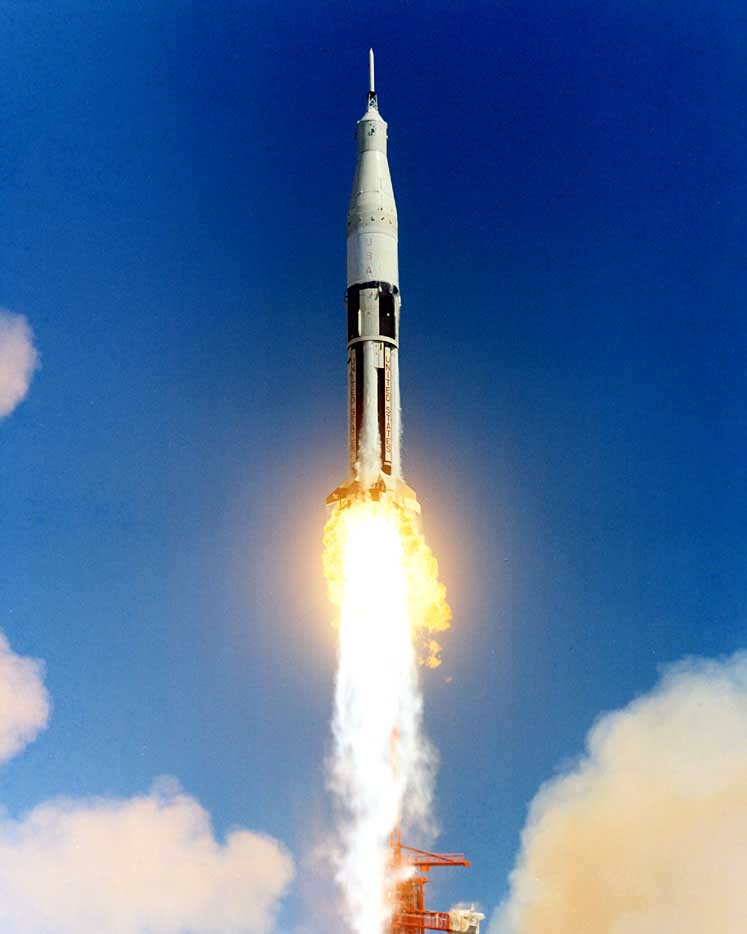
| 6 | Apollo 5 | Jan 22, 1968, 10:48 PM | Saturn IB (SA-204) | — | 7 hr 50 min | Success |
| 7 | Apollo 6 | Apr 4, 1968, 12:00 PM | Saturn V (SA-502) | — | 9 hr 57 min | Partial success |
| 8 | Apollo 7 | Oct 11, 1968, 3:02 PM | Saturn IB (SA-205) | 3 | 10 days 20 hr | Success |
| 9 | Apollo 8 | Dec 21, 1968, 12:51 PM | Saturn V (SA-503) | 3 | 6 days 3 hr | Success |
| 10 | Apollo 9 | Mar 3, 1969, 4:00 PM | Saturn V (SA-504) | 3 | 10 days 1 hr | Success |
| 12 | Apollo 11 | Jul 16, 1969, 1:32 PM | Saturn V (SA-506) | 3 | 8 days 3 hr | Success |
| 14 | Apollo 13 | Apr 11, 1970, 7:13 PM | Saturn V (SA-508) | 3 | 5 days 22 hr | Partial success |
| 4 | Apollo 1 | — | Saturn IB (SA-204) | 3 | — | Failure |
History
Before the commitment: a follow-on project
Apollo did not begin as a lunar program. When NASA started studying it in the late 1950s, the agency was simply asking what should come after Mercury: a roomier, more capable three-seat spacecraft intended for long missions in Earth orbit, for an eventual circumlunar flight and, on a more distant horizon, for a landing with no date attached. Feasibility studies were spread among several companies while the agency's own groups worked on cabin configurations, life-support systems and re-entry profiles at lunar-return speed, the thermal problem that separates an orbital flight from a short interplanetary voyage.
That preparatory work proved decisive. When the program changed scale, the agency was not starting from nothing: spacecraft requirements existed, so did an idea of the heat shield that would be needed, and a family of launch vehicles was already under development led by Wernher von Braun's team, transferred to the Marshall Space Flight Center in Huntsville. The political acceleration therefore found an embryonic architecture to build on rather than a blank sheet.
The 1961 commitment and the race against the calendar
The setting was competition with the Soviet Union. The launch of the first artificial satellite in 1957 and, above all, the first Soviet human orbital flight in April 1961 installed in Washington the perception of a strategic lag. On 25 May 1961, in a message to Congress, President Kennedy proposed that the nation commit itself to achieving, before the decade was out, the goal of landing a man on the Moon and returning him safely to Earth.
The sentence had immediate technical consequences. Fixing a date made time the program's scarcest resource: it forced decisions on incomplete information, development in parallel of work that would normally have been done in sequence, and payment for redundancy wherever waiting would have been cheaper. It also transformed NASA itself. The budget grew quickly, centres were created or enlarged, entire workforces were hired, and project management methods imported from the military and from industry — milestone planning, configuration control, interface tracking — were applied for the first time to a civil program of that complexity.
Choosing the flight mode
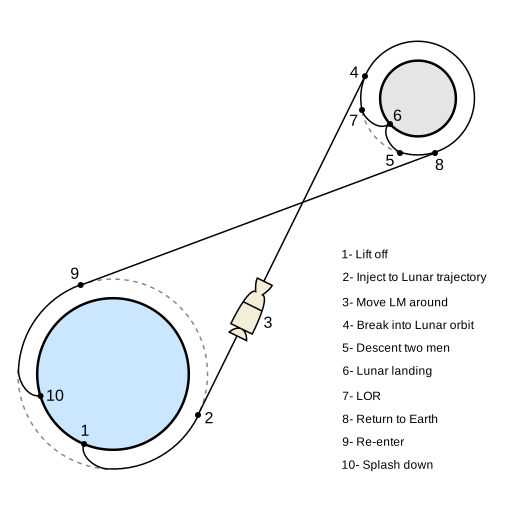
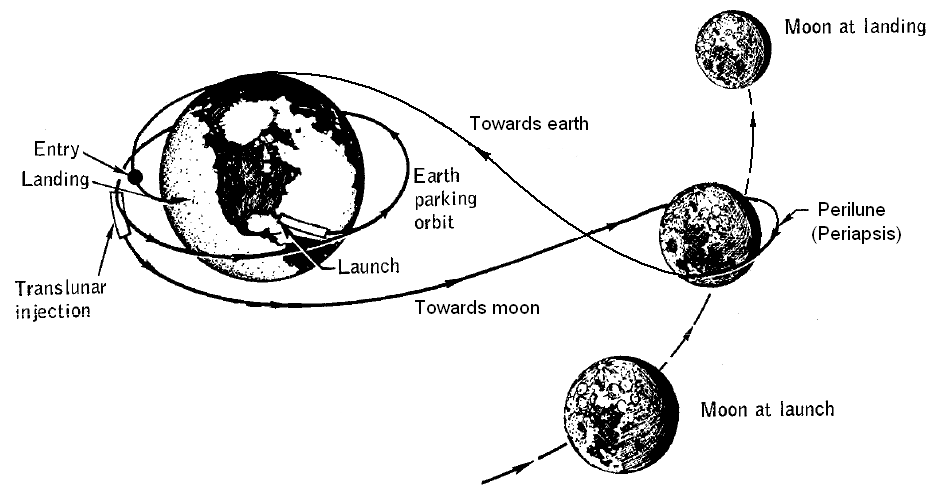
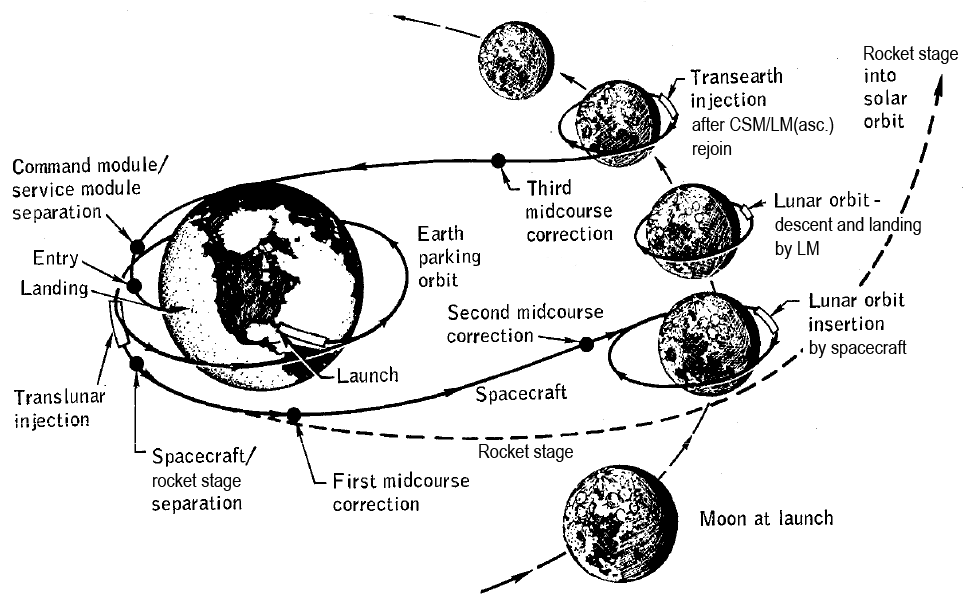
The question that ordered everything else was not which rocket to build but how to get there. Three modes were studied. Direct ascent sent a single spacecraft to the Moon on an enormous booster whose timely availability no project could guarantee. Earth orbit rendezvous split the load between two or more launches assembled around the Earth before departure. Lunar orbit rendezvous, argued persistently by John Houbolt of the Langley research centre, proposed leaving the main spacecraft in lunar orbit and descending with a small specialised vehicle that could also abandon its descent stage on the surface.
The third option was the lightest and allowed each vehicle to be optimised for its task, but it demanded a manoeuvre nobody had yet rehearsed: meeting and docking in lunar orbit, hundreds of thousands of kilometres from home, with no refuge if anything went wrong. The internal debate was hard and set centres against one another. In 1962 the agency settled on lunar orbit rendezvous, and with that choice the size of the launch vehicle, the existence of a separate lunar module and much of the content of later test flights were fixed — those flights had to make orbital rendezvous a routine capability before it could be attempted at the Moon.
Three new machines
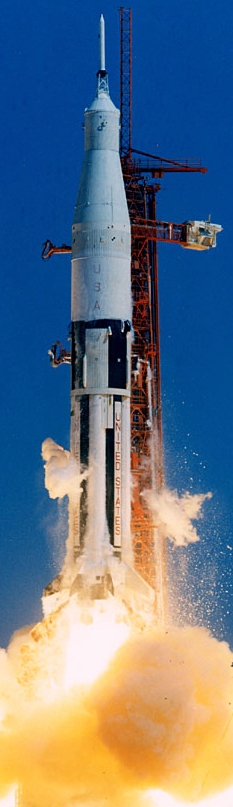
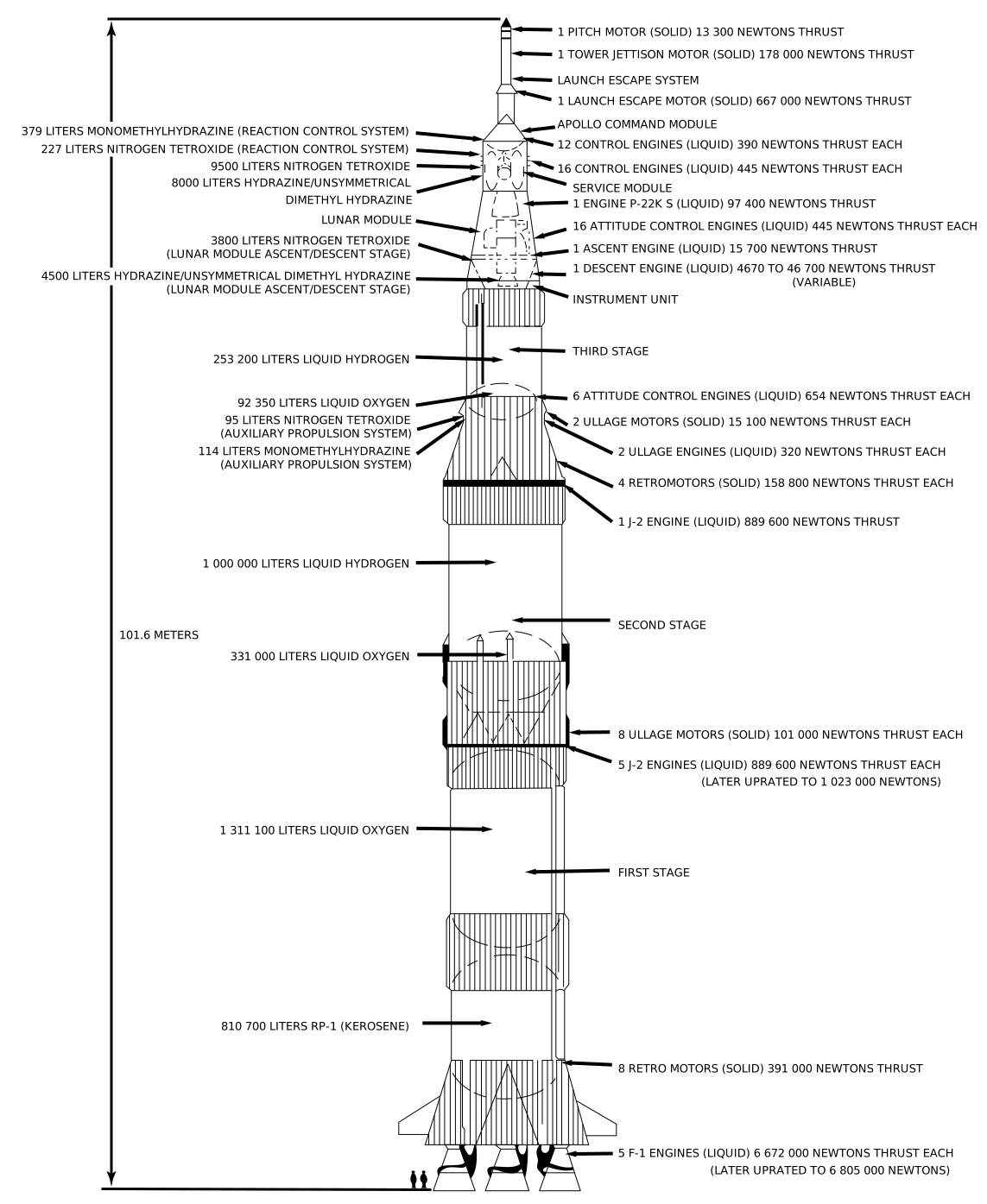
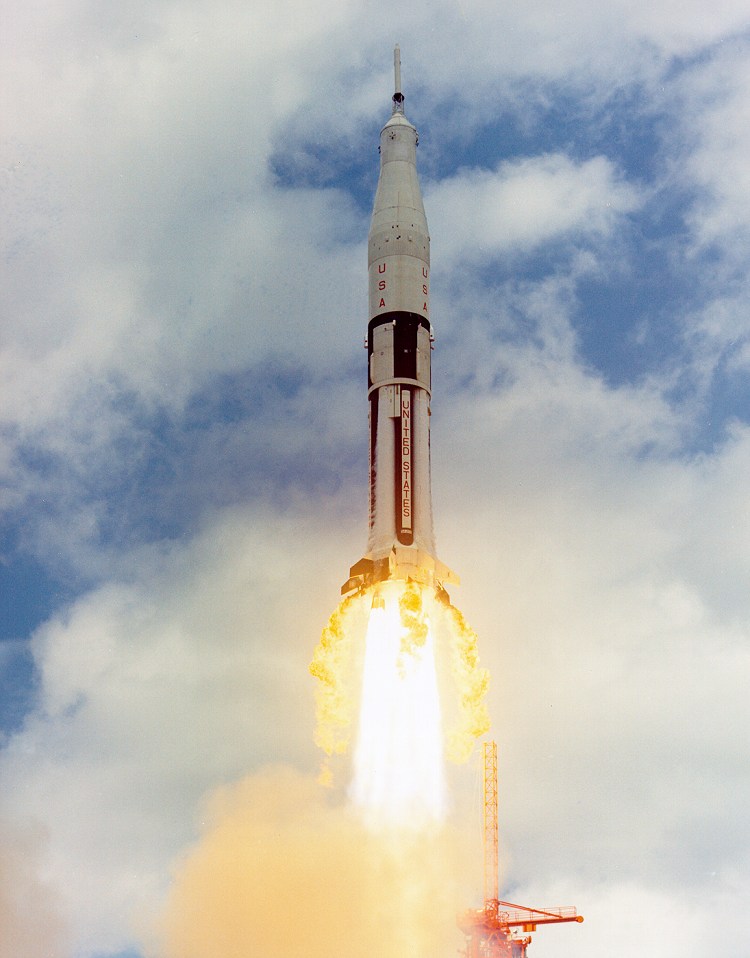
The result was a three-part system. The three-stage Saturn V was designed to place on a translunar trajectory a payload no other machine of the era could move; Boeing built its first stage, North American Aviation the second and Douglas the third, with the instrument unit — the ring carrying guidance and vehicle control — supplied by IBM, all under Marshall's technical coordination. For missions that did not need to leave Earth orbit, the smaller Saturn IB was used, reusing the big vehicle's upper stage.
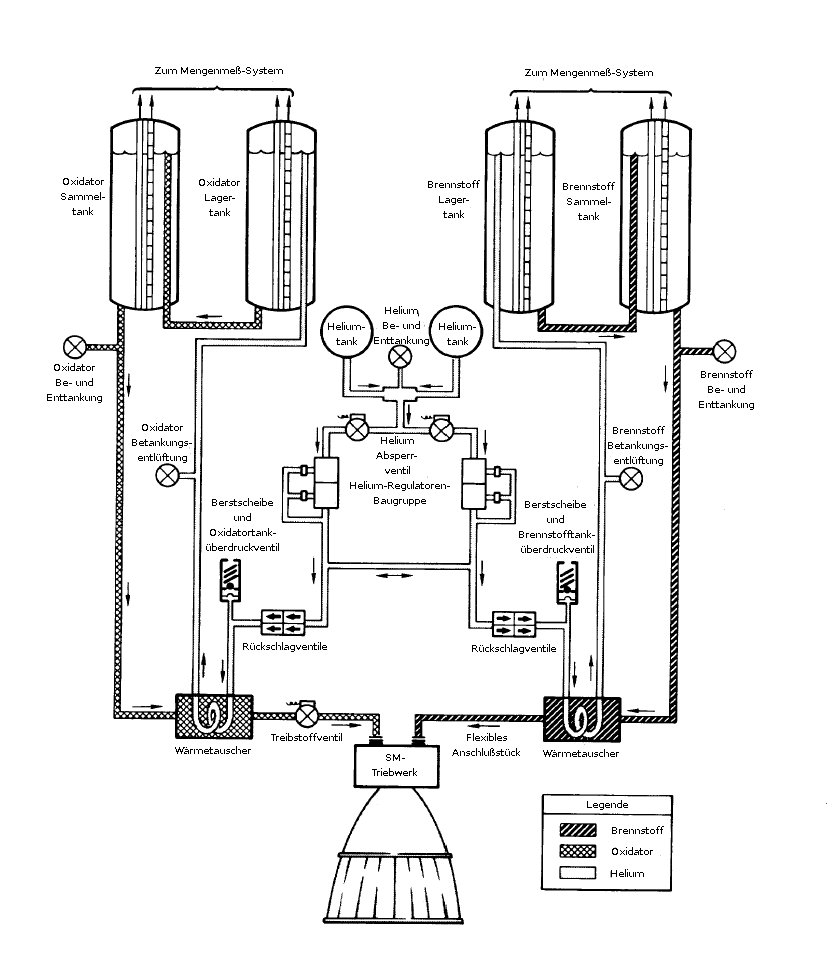
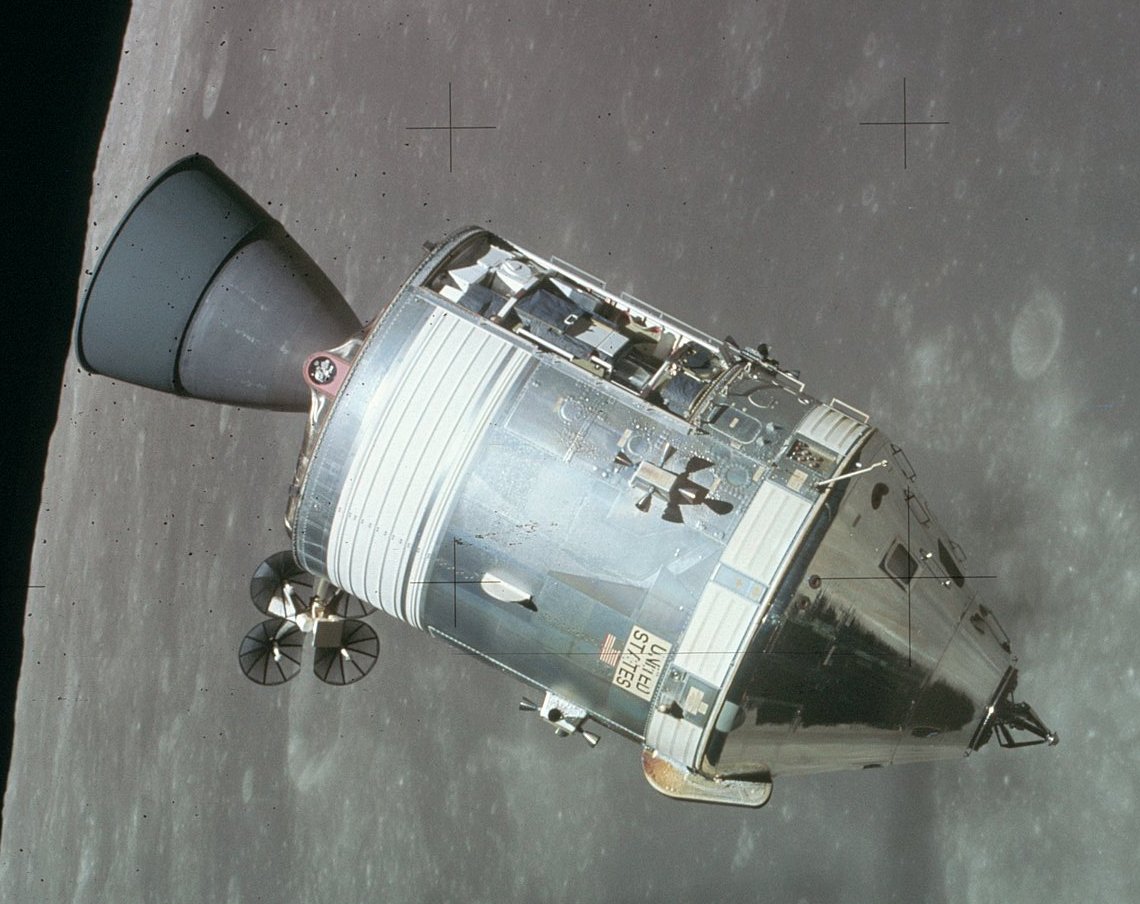
The command and service module, from North American Aviation, was the crew's ship: a pressurised conical capsule with a heat shield able to survive re-entry at lunar-return speed, mated to a cylindrical service module carrying the main engine, fuel cells, tanks and antennas. The lunar module, from Grumman, was the first crewed spacecraft conceived to fly only in vacuum: two independent stages, a descent stage with a throttleable engine and landing gear, and an ascent stage that lifted off from it to rejoin the command module. Lightened to the limit, its structure would not have survived Earth's atmosphere.
A fourth, less visible and no less critical element joined them: the guidance computer developed by the Massachusetts Institute of Technology's instrumentation laboratory, with its inertial unit and navigation software. Modest in computing power by any later standard, its priority scheduling and restart architecture saved critical situations in flight, and it was one of the great drivers of the integrated-circuit microelectronics of the period.
An industry and a port for the Moon
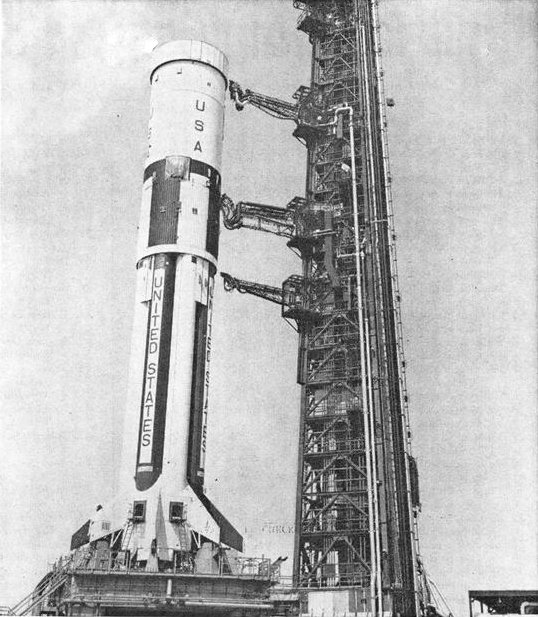
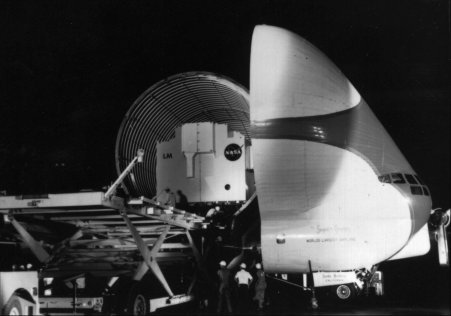
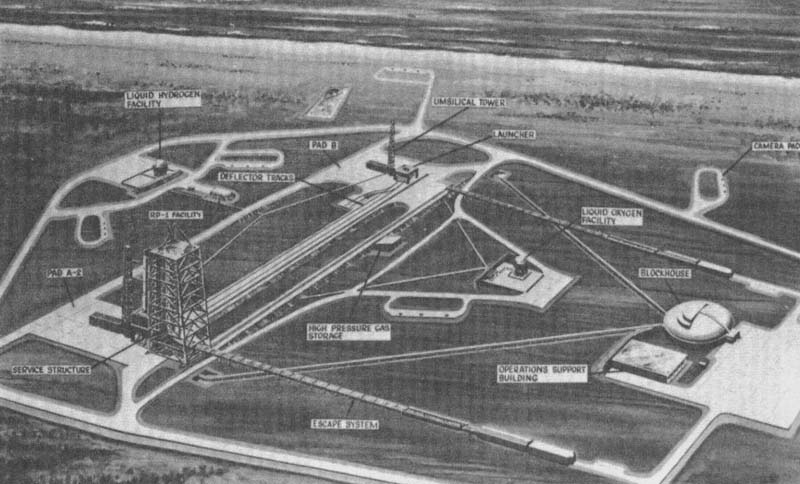
Building the machines was only half the problem; the other half was assembling, moving and launching them. The Saturn vehicles were too large to be prepared on the pad, so NASA raised on Merritt Island, next to Cape Canaveral, a complex designed to stack the complete rocket under cover and then carry it, upright, to the launch point. The vertical assembly building, the mobile launch platforms, the umbilical tower and the crawler-transporters that travelled the roadway to the pads of Launch Complex 39 formed a handling system as singular as the rocket itself, and its story fills an entire volume of the program's official histories.
The industrial effort was proportionate. At its peak the program employed some 400,000 people and required the support of more than 20,000 industrial firms and universities across the country, with a supply chain running from major assemblers down to workshops making a single part. That dispersion forced the invention of quality assurance, component traceability and change control procedures that later became standard systems engineering practice. The program's total cost was put at about 25.4 billion dollars in 1973 terms, equivalent to hundreds of billions today under more recent cost analyses.
The Apollo 1 fire
On 27 January 1967, during a ground test with the vehicle unfuelled, fire broke out in the cabin of the first command module intended to fly with a crew. A pure oxygen atmosphere above ambient pressure, together with wiring and combustible materials inside, turned a spark into a fire that could not be contained, and the hatch — opening inwards and needing several minutes to clear — made escape impossible. The three astronauts assigned to the mission died.
The subsequent investigation was unsparing towards the program and its prime contractor, and its findings remade the spacecraft: a quick-opening outward hatch, removal of flammable materials from the cabin, protected wiring, a change to the atmosphere used on the ground, and a general review of test procedures. Crewed flights stopped for close to two years. Paradoxically, that pause allowed the command module and the lunar module to be refined to a maturity the original schedule would never have allowed, and in the program's memory the accident stands as the moment when haste ceased to be the only criterion.
From qualification to landing
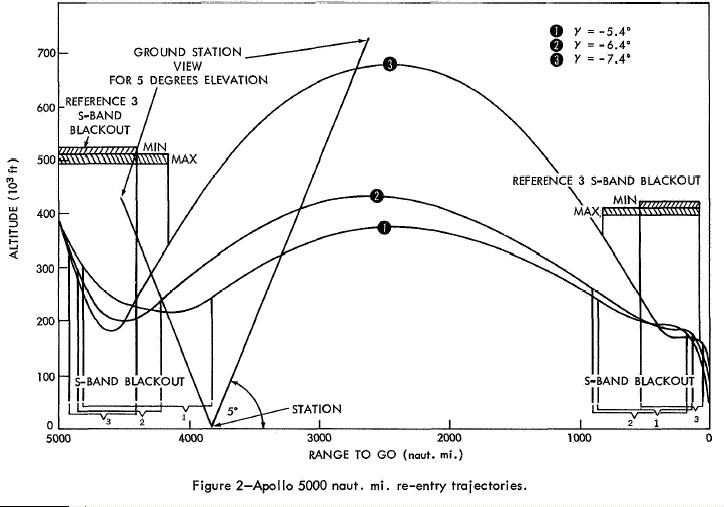
While crewed flight was halted, the uncrewed missions went ahead. The first Saturn V launch, in November 1967, flew the complete vehicle with all stages live on its first attempt and subjected the command module to a re-entry at lunar-return speed; shortly afterwards another flight tested the lunar module in Earth orbit, and a third, marred by severe vibration and upper-stage engine failures, forced detailed redesign before crews could be cleared to fly.
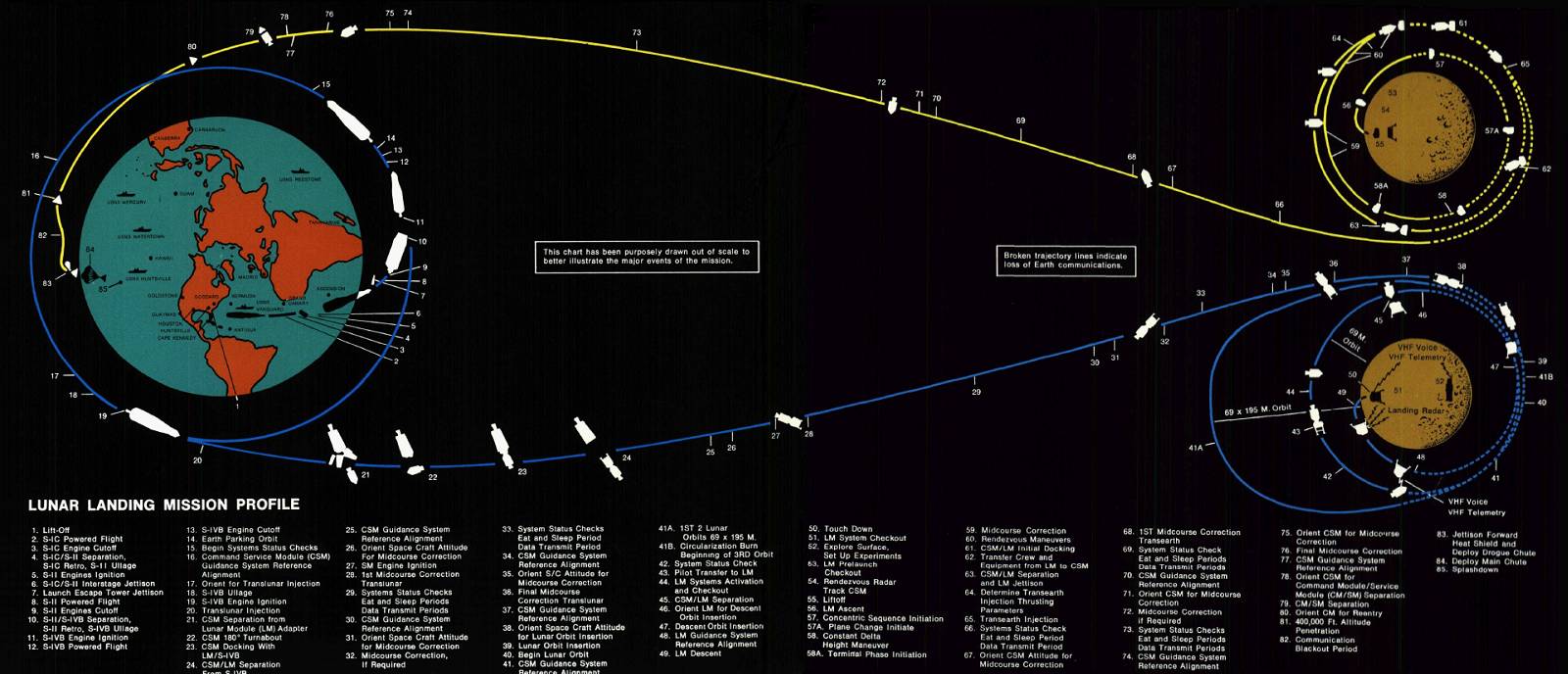
The recovery was headlong. In October 1968 the first crewed flight of the redesigned command module spent eleven days in Earth orbit wringing out the spacecraft; in December, with the lunar module still not ready, NASA took the bold decision to send a crew to lunar orbit aboard the command module alone, a flight that confirmed translunar navigation and the return from lunar orbit. In the spring of 1969 the lunar module was flown with a crew in Earth orbit, with full separation, rendezvous and docking, and the entire profile was then repeated in lunar orbit, descending to within a few kilometres of the surface without touching down. In July 1969 the fifth mission of that sequence landed: humanity set foot on another celestial body for the first time.
Six landings and an emergency
Between 1969 and 1972 the program completed six successful descents at six different regions, and twelve people walked on the Moon. The progression was deliberate. The first landings sought above all to prove the capability and an acceptable landing accuracy, with short stays and limited excursions outside. The next ones extended surface time and scientific payload, and the last three, the so-called J missions, carried a lunar module with greater descent capacity, an electric surface vehicle that multiplied the exploration radius, and a set of instruments and cameras in the service module for mapping from orbit.
In April 1970 the program faced its gravest in-flight emergency: the explosion of a service module oxygen tank on the way to the Moon left the spacecraft without enough power or life support and forced the landing to be abandoned. The crew used the lunar module as a lifeboat, swung around the Moon on a free-return trajectory and came home. The accident demonstrated the strength of mission control, forced another round of service module redesign and delayed the following flights by several months.
Lunar science
The scientific dimension grew as the program gained operational confidence. Each crew deployed on the surface a set of instruments powered by a radioisotope generator — seismometers, magnetometers, solar wind detectors, heat flow probes — that kept transmitting for years after the astronauts had left. Several missions also left corner reflectors that allow the Earth-Moon distance to be measured by laser, an experiment still yielding data half a century later.
The sample harvest was the most durable legacy. In all, the program brought back 382 kilograms of lunar rock and soil in some 2,200 individual specimens taken at six sites of very different geology, from lava plains to highland formations and deposits of volcanic origin. Their analysis rewrote what was known about the age of the lunar surface, the early bombardment of the inner solar system and the origin of the Moon itself, and a fraction of the material was deliberately kept unopened so that later generations could study it with instruments that did not yet exist. Crew training came to include field geology, and the last mission took a professional geologist to the Moon.
An early end and the afterlife of the hardware
The program stopped before the hardware already built had been used up. Once the political goal was judged accomplished, budget priority shifted to other projects and the last scheduled missions were cancelled; the final landing was that of December 1972. Complete Saturn vehicles were left unflown and are displayed today as museum pieces, along with surface equipment already manufactured.
That surplus found two uses. The first was the Skylab space station, placed in orbit in 1973 on an adapted Saturn stage and visited by crews arriving in Apollo spacecraft launched by Saturn IB. The second, in 1975, was the orbital docking of an Apollo command module with a Soviet Soyuz through a purpose-built adapter module, the first joint flight of the two programs that had competed for fifteen years. With that mission the lunar program's hardware was finally retired, and the United States did not launch astronauts again until the Space Shuttle entered service.
What Apollo left behind
The program's balance sheet is usually counted in six landings, but its influence was wider. Technically, it pushed integrated-circuit electronics, cryogenic metallurgy, fuel cells, ablative materials and real-time embedded software far faster than they would have advanced on their own. Organisationally, it left a school of complex project management — formal reviews, configuration control, failure analysis, the dual chain of decision between control centre and vehicle — that became the pattern for later large aerospace programs.
Scientifically, it founded comparative planetary geology as a discipline with real field material, and the stations left on the surface provided the first seismology of another world. Culturally, the images taken by the crews — the Earth rising over the lunar horizon, the whole planet seen from a distance — changed how society looked at itself and fed the nascent environmental movement. Politically it left an uncomfortable lesson: a program conceived as a demonstration of national capability meets its goal and, once met, loses the argument that sustained it. Later lunar exploration programs have had to justify themselves on different grounds — sustained presence, science, resources, international cooperation — precisely because Apollo used up the first one.
The program as a benchmark
Half a century on, Apollo still works as a measuring stick. The figures of its effort — the peak of some 400,000 people, the more than 20,000 firms and universities involved, the 25.4 billion 1973 dollars it cost — are quoted whenever anyone argues about whether a country can afford a human exploration program. Its architectural decisions, particularly lunar orbit rendezvous and the split between transit ship and descent vehicle, reappear almost unchanged in twenty-first-century plans to return to the Moon. And its failures, the ground fire and the oxygen tank explosion, remain required case studies in how schedule pressure turns into risk accepted without ever having been assessed.
Images
Elsewhere
- Smithsonian National Air and Space MuseumApollo program image gallery ↗
- Smithsonian National Air and Space MuseumPhoto Archives — Apollo program holdings ↗
- Library of CongressNASA Johnson Space Center, Apollo Mission Control Center (HABS documentation) ↗
- Library of CongressApollo Mission Control Center — HABS photo gallery ↗
- Project Apollo ArchiveProject Apollo Archive — program photo galleries ↗
- March to the Moon (Apollo Digital Image Archive)Apollo program photo galleries — March to the Moon ↗
- National ArchivesSpace program photographic holdings research guide ↗
- Getty ImagesApollo program stock photo collection ↗
- Getty ImagesApollo Mission Control stock photo collection ↗
- Smithsonian Institution ArchivesApollo Photography Exhibit ↗