Apollo program · NASA · Crewed
Apollo 13
- Apr 11, 1970, 7:13 PM
- Launch date
- 3
- Crew size
- 5 days 22 hr
- Duration
- Partial success
- Outcome
-1600.webp)


-1600.webp)


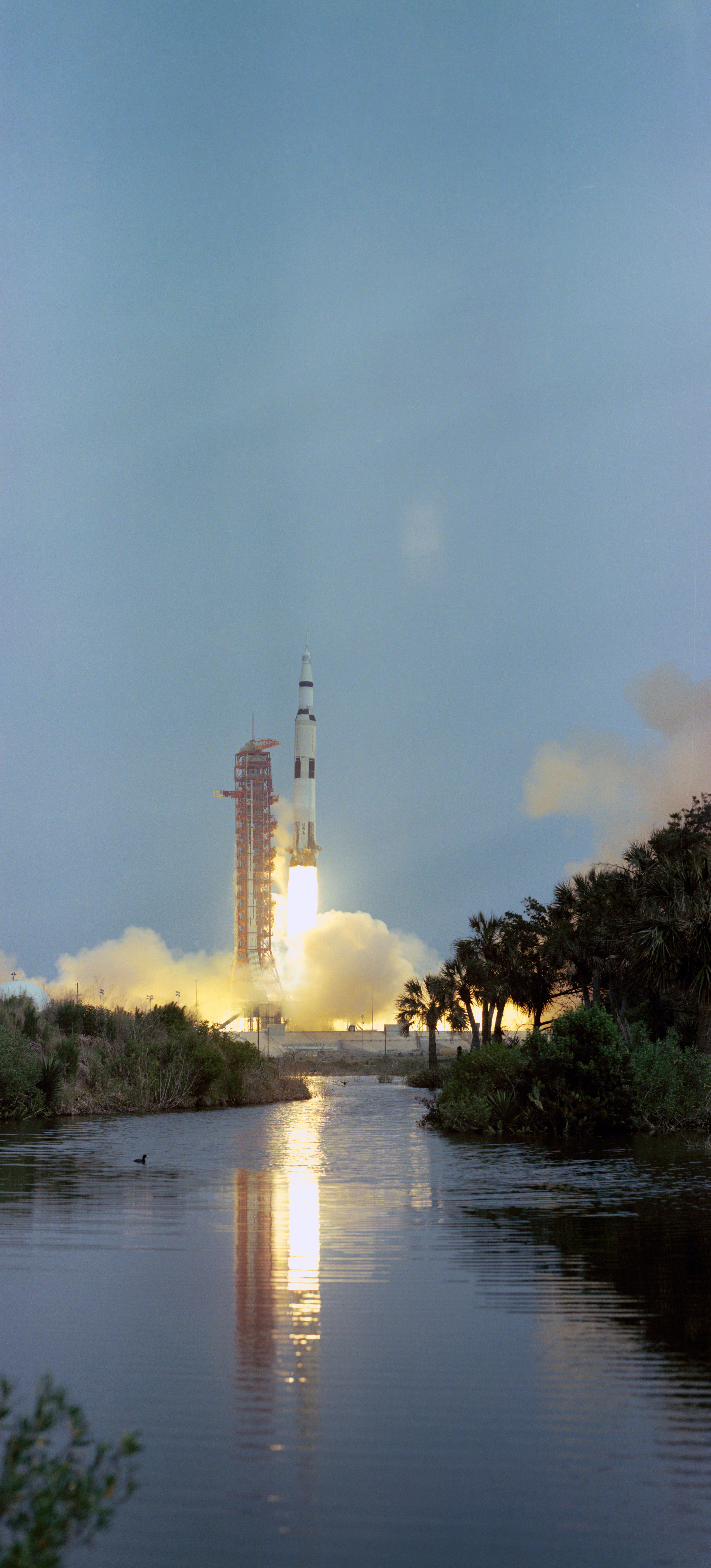
Apollo 13 was the seventh crewed flight of the Apollo programme and was meant to be the third Moon landing. It lifted off from the Kennedy Space Center on 11 April 1970 aboard Saturn V AS-508, with James A. Lovell in command, John L. "Jack" Swigert as command module pilot and Fred W. Haise as lunar module pilot; Swigert had replaced Ken Mattingly two days before launch after the crew was exposed to rubella. The destination was the Fra Mauro formation, chosen because it was thought to preserve material excavated by the impact that formed the Imbrium basin. At 55:54:53 mission elapsed time, two days after launch, oxygen tank 2 in the service module caught fire and ruptured. The explosion blew off an entire external panel, damaged the high-gain antenna and vented the contents of both oxygen tanks to space, stripping the spacecraft of electricity, water and life support. The landing was cancelled within minutes and the mission became a survival problem: bringing three men home from a trajectory aimed at the Moon, with the command module shut down to preserve its batteries. The answer was to use the lunar module Aquarius as a lifeboat. Its descent engine restored the free-return trajectory and, two hours after pericynthion, performed the "PC+2" burn that shortened the trip home and moved splashdown to the Pacific. Along the way the crew had to improvise an adapter — "the mailbox" — so that command module lithium hydroxide cartridges could scrub the carbon dioxide of three men through the lunar module's system, ration water to 200 millilitres per person per day and endure a cabin at 3 °C. Odyssey splashed down safely in the South Pacific on 17 April, after 5 days, 22 hours, 54 minutes and 41 seconds of flight. The review board chaired by Edgar Cortright found the cause far from space: the tank's thermostats, designed for the command module's 28 volts, had failed under the 65 volts applied during a ground heating operation in the Countdown Demonstration Test, damaging the Teflon insulation of the internal wiring. The tank, its thermostats and the oxygen valves were redesigned for Apollo 14 and later missions. Apollo 13 is remembered as the programme's best-handled operational failure: it met none of its principal scientific objectives, but it brought its crew back and reshaped the emergency procedures of crewed spaceflight.
Payload
Apollo 13's science payload was that of an H-class lunar exploration mission. The lunar module's bay carried an Apollo Lunar Surface Experiments Package (ALSEP) that Lovell and Haise were to deploy on the first extravehicular activity: a seismometer (the Passive Seismic Experiment) similar to Apollo 12's, a Heat Flow Experiment requiring two holes drilled 3.0 metres deep, a Charged Particle Lunar Environment Experiment (CPLEE) to measure protons and electrons of solar origin, a Lunar Atmosphere Detector and a Dust Detector. The Heat Flow Experiment and CPLEE were flying for the first time. Power came from a SNAP-27 radioisotope thermoelectric generator, first flown on Apollo 12, whose plutonium oxide capsule travelled inside a cask built with graphite and beryllium heat shields and titanium and Inconel structural parts, designed to survive reentry without scattering plutonium if a mission were aborted. The spacecraft also carried the geological sampling equipment planned for Fra Mauro and its own photographic objectives, including the Gegenschein from lunar orbit. Two further items served scientific or operational ends: the S-IVB third stage, deliberately aimed at the Moon so that its impact would calibrate the seismometer left by Apollo 12, and extra propellant carried as a test for the future J missions, which would need more for their heavier payloads. The lunar module rode inside the SLA-16 adapter during the first hours of flight. When the landing was cancelled, the ALSEP and the rest of the surface payload were lost with Aquarius, which reentered and broke up; the plutonium cask came down, as planned for that contingency, over the Tonga Trench.
| Crew | Role | Agency | Extravehicular activity |
|---|---|---|---|
| James Arthur Lovell Jr. | Commander | NASA · United States | — |
| John Leonard "Jack" Swigert Jr. | Command module pilot | NASA · United States | — |
| Fred Wallace Haise Jr. | Lunar module pilot | NASA · United States | — |
History
A crew reshuffled on the eve of launch
The crew that flew Apollo 13 was not the one the standard rotation had produced. James A. Lovell, a veteran of Gemini 7, Gemini 12 and Apollo 8, commanded a crew completed by Fred W. Haise as lunar module pilot and Thomas K. "Ken" Mattingly as command module pilot. The three had backed up Apollo 11 and were originally slated for Apollo 14 until Deke Slayton, NASA's Director of Flight Crew Operations, swapped their turn with Alan Shepard's crew.
Seven days before launch, backup crew member Charles Duke caught rubella from his son's friend. Of the five men exposed, only Mattingly lacked immunity from prior exposure. The usual rule would have grounded the entire prime crew and flown the backups, but Duke's own illness ruled that out, so two days before launch Mattingly was replaced by the backup command module pilot, John L. "Jack" Swigert. Mattingly never developed rubella, later flew on Apollo 16, and played a decisive part in the rescue from the ground.
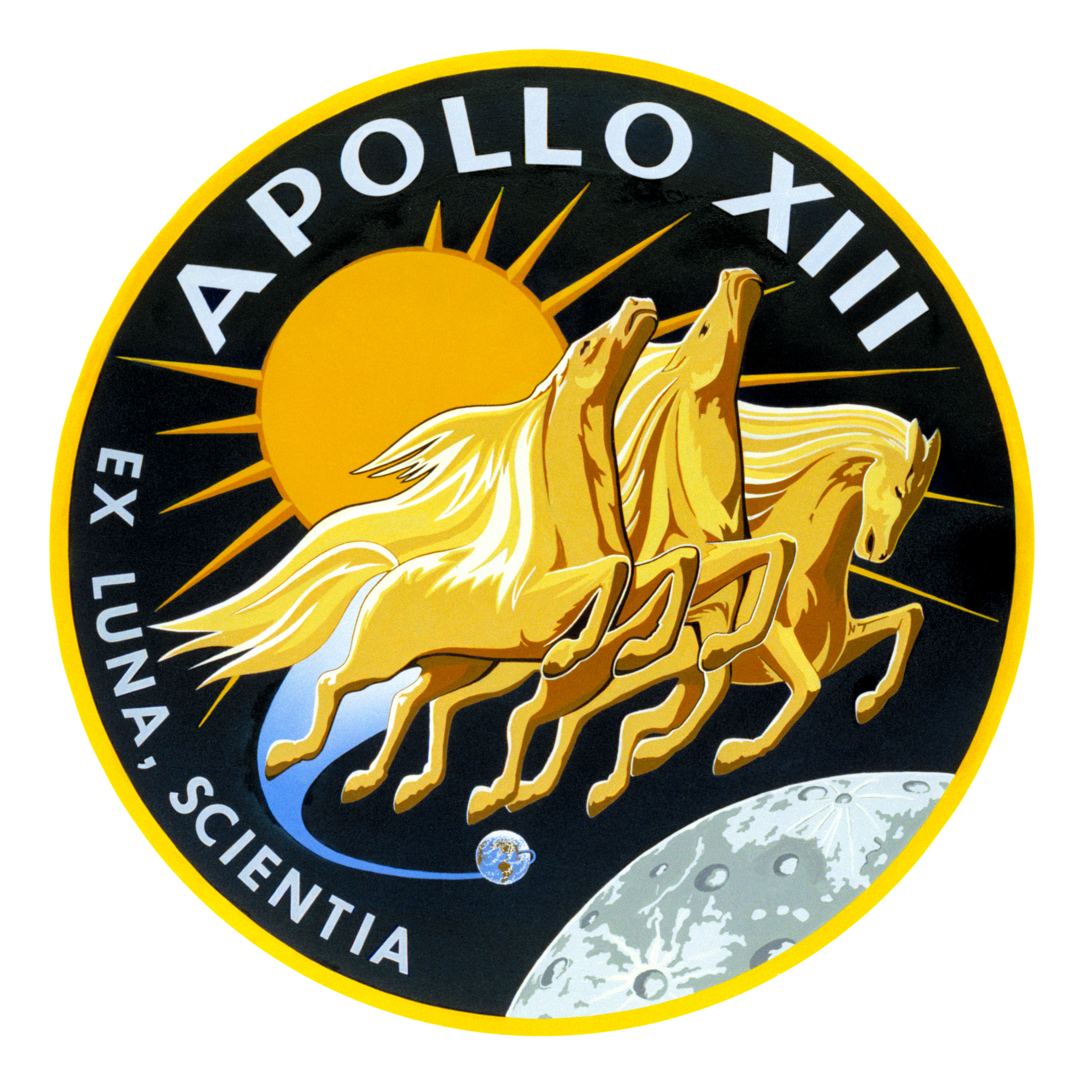
The mission insignia needed no change: Apollo 13's is one of only two Apollo emblems — the other being Apollo 11's — that do not carry the crew's names. The Robbins medallions flown aboard did have to be melted down and reminted after the flight to show the correct crew and the absence of a landing date. Lovell chose the call signs: Aquarius for the lunar module, after the water bearer, and Odyssey for the command module, for its Homeric echo, for the film 2001: A Space Odyssey and for the word's own meaning, a long voyage with many changes of fortune. The spacecraft comprised command and service module CSM-109, Odyssey, and lunar module LM-7, Aquarius.
The science that was planned: the Fra Mauro formation
The designated landing site lay near the crater Fra Mauro. The Fra Mauro formation was believed to hold material thrown out by the impact that excavated the Imbrium basin early in lunar history, so sampling it meant dating one of the Moon's defining events. The primary objectives were stated as performing selenological inspection, survey and sampling of materials in a preselected region of the Fra Mauro formation, deploying and activating an Apollo Lunar Surface Experiments Package (ALSEP), and obtaining photographs of candidate exploration sites, with further photographic tasks including the Gegenschein from lunar orbit and the Moon itself on the way home.
The plan devoted the first of two four-hour extravehicular activities to setting up the ALSEP and the second to investigating Cone crater near the landing site. The prime crew put in more than 1,000 hours of mission-specific training — over five hours for every hour of the ten-day planned mission — with geology taught by Caltech's Lee Silver and orbital observation and photography trained by Farouk El-Baz.
Launch on 11 April 1970 and the centre engine shutdown
Saturn V AS-508 lifted off from the Kennedy Space Center at the planned time, 2:13:00 pm EST (19:13:00 UTC) on 11 April 1970. The vehicle carried extra propellant as a test, since the future J missions would need more for their heavier payloads; that made it the heaviest NASA had flown and visibly the slowest to clear the tower. Apollo 13 also introduced sprayed-on insulation for the S-II second stage's cryogenic tanks, replacing the affixed panels of earlier flights.

The first anomaly arrived minutes into the flight. The S-II's centre (inboard) engine shut down about two minutes early, the result of severe pogo oscillations amplified by turbopump cavitation. Pogo had appeared on the Gemini programme's Titans and on earlier Apollo flights, and a fix was ready, but schedule pressure kept it out of the Apollo 13 vehicle. The guidance system, designed since Apollo 10 to shut an engine down in response to chamber pressure excursions, did what it was built to do; a post-flight investigation found the engine could have withstood only one further cycle before catastrophic failure. The four outboard engines and the S-IVB third stage burned longer to compensate, and the stack reached a parking orbit very close to the planned 190-kilometre circular one, with translunar injection following about two hours later.
Outbound: a hybrid trajectory and a broadcast nobody carried
After translunar injection, Swigert performed separation and transposition and docked Odyssey to Aquarius, and the spacecraft pulled away from the third stage. Controllers then sent the S-IVB to impact the Moon within range of the seismometer left by Apollo 12, which it did at 77:56:40 into the mission.
At 30:40:50 into the flight, with the television camera running, the crew made the burn that placed Apollo 13 on a hybrid trajectory. The reasoning was operational: a free-return trajectory can only reach sites near the lunar equator, whereas a hybrid trajectory, which can be entered at any point after translunar injection, opened up higher latitudes such as Fra Mauro. The price was understood and accepted — leaving free return meant that, without further burns, the spacecraft would miss the Earth on the way back rather than intercept it.
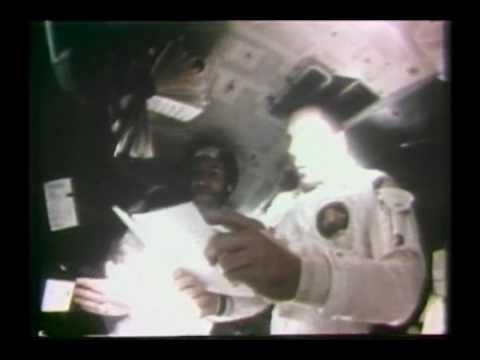
The third day brought a television broadcast scheduled for 55:00:00 mission elapsed time, with Lovell as emcee showing the interiors of Odyssey and Aquarius. No American network carried it live; public interest in flying to the Moon had faded. Haise was finishing the shutdown of the lunar module after testing its systems and Lovell was stowing the camera when the flight stopped resembling the plan.
55:54:53 — "Okay, Houston, we've had a problem here"
A pressure sensor in one of the service module's oxygen tanks had been reading suspiciously, so Sy Liebergot, the EECOM responsible for the CSM's electrical system, asked for the tanks' stirring fans to be run. It was routine, normally done once a day: a stir destratified the contents and restored trustworthy pressure readings. Flight Director Gene Kranz had Liebergot wait a few minutes for the crew to settle after the telecast; CAPCOM Jack Lousma passed on the request, and Swigert threw the fan switches and turned them off again a few seconds later.

The accident happened at 55:54:53 mission elapsed time (03:08 UTC on 14 April; 10:08 pm EST on 13 April). Twenty-six seconds later Swigert reported, "Okay, Houston, we've had a problem here," and at 55:55:42 Lovell echoed him: "Houston, we've had a problem. We've had a Main B Bus undervolt." The line popular culture remembers — "Houston, we have a problem" — is an invention of the 1995 film, which changed the tense of the original and erased the fact that Swigert, not Lovell, spoke first.
What the telemetry was about to show was worse than an undervolt. Liebergot, focused on tank 1 and trusting that its reading would guide him on tank 2, was slow to register the alarming signs from tank 2, as were the controllers in his back room. The fuel cells needed oxygen to run; once tank 1 ran dry, the surviving cell would shut down and the CSM's only significant power and oxygen would be the command module's batteries and its oxygen surge tank, both reserved for the final hours of the mission. Kranz ordered the surge tank isolated to save its contents, knowing that this condemned the last fuel cell to die within about two hours.
What actually failed: a 28-volt thermostat and a heater on the ground
The cause lay not in the flight but in the industrial history of oxygen tank 2. It was built by the Beech Aircraft Company of Boulder, Colorado, as subcontractor to North American Rockwell of Downey, California, prime contractor for the command and service module. The tank was first installed in an oxygen shelf fitted to Apollo 10's service module, SM-106, from which it had to be removed to fix a possible electromagnetic interference problem. During that removal the shelf was accidentally dropped at least 5 centimetres, because a retaining bolt had not been taken out. After retesting that did not include filling the tank with liquid oxygen, in November 1968 the shelf was reinstalled in SM-109 — Apollo 13's — which was shipped to the Kennedy Space Center in June 1969.

The latent damage was triggered during the Countdown Demonstration Test, which began on 16 March 1970 with SM-109 already near the top of the Saturn V. The cryogenic tanks were filled, but tank 2 could not be emptied through the normal drain line, and the problem was written up. Its internal heaters, powered from the ground supply, were used to boil the oxygen off instead. That was the trap: the tank's two thermostatic switches had been designed for the command module's 28-volt DC power and could fail when subjected to the 65 volts used in ground testing at KSC. The thermostats were meant to keep the heaters from raising the temperature above 27 °C, and they failed under the 65-volt supply. The heater tube may have reached 540 °C, hot enough to damage the Teflon insulation on the internal wiring, and nobody noticed because the temperature gauge was not designed to read above 29 °C. The extended heating had been approved by Lovell and Mattingly of the prime crew as well as by NASA managers and engineers.
In flight, the outcome followed mechanically from that damage. The stir shorted the damaged wiring inside tank 2 and ignited it; pressure rose until the tank dome failed, filling the service module's Sector 4 — the fuel cell bay — with rapidly expanding gaseous oxygen and combustion products. The pressure rise popped the rivets holding the aluminium panel over Sector 4 and blew it into space, exposing the sector to vacuum and snuffing out the fire. The detached panel struck the high-gain antenna, disabling the narrow-beam mode and interrupting communications with Earth for 1.8 seconds while the system switched automatically to wide beam. The sudden failure of tank 2 also compromised tank 1, whose contents leaked away over the following 130 minutes — possibly through a damaged line or valve — until the service module's oxygen supply was entirely gone. The module's sectors were not airtight from one another: had there been time for the whole service module to reach Sector 4's pressure, the force on the heat shield would have separated the two modules.
Aquarius as a lifeboat
With the fuel cells doomed and the landing ruled out — mission rules forbade entering lunar orbit unless all fuel cells were working — one reserve remained alive: the lunar module. Aquarius carried charged batteries and full oxygen tanks for the lunar surface, so Kranz directed that it be powered up and used as a lifeboat, a scenario that had been anticipated but considered unlikely. The procedures existed because lunar module controllers had written them after an Apollo 10 training simulation in which the LM was needed for survival and could not be powered up in time.
The handover had to be done by hand and against the clock. As the command module was shut down, Lovell copied its guidance platform's orientation data and worked out by hand how to transfer it to the lunar module's computer, which had been off; at his request Mission Control checked his arithmetic. Odyssey was left dormant, its consumables saved for the only thing that still mattered: reentry.
Back to free return, and the PC+2 burn
A direct abort using the service module's main engine, the Service Propulsion System, to turn back before reaching the Moon was ruled out early: the accident might have damaged the SPS, and the fuel cells would have had to last at least another hour to power it. Kranz chose the long way round, swinging past the Moon before heading home. But Apollo 13 was on the hybrid trajectory aimed at Fra Mauro and had to be returned to a free return: at 61:29:43.49 mission elapsed time, a 34.23-second burn of the lunar module's descent engine did it.
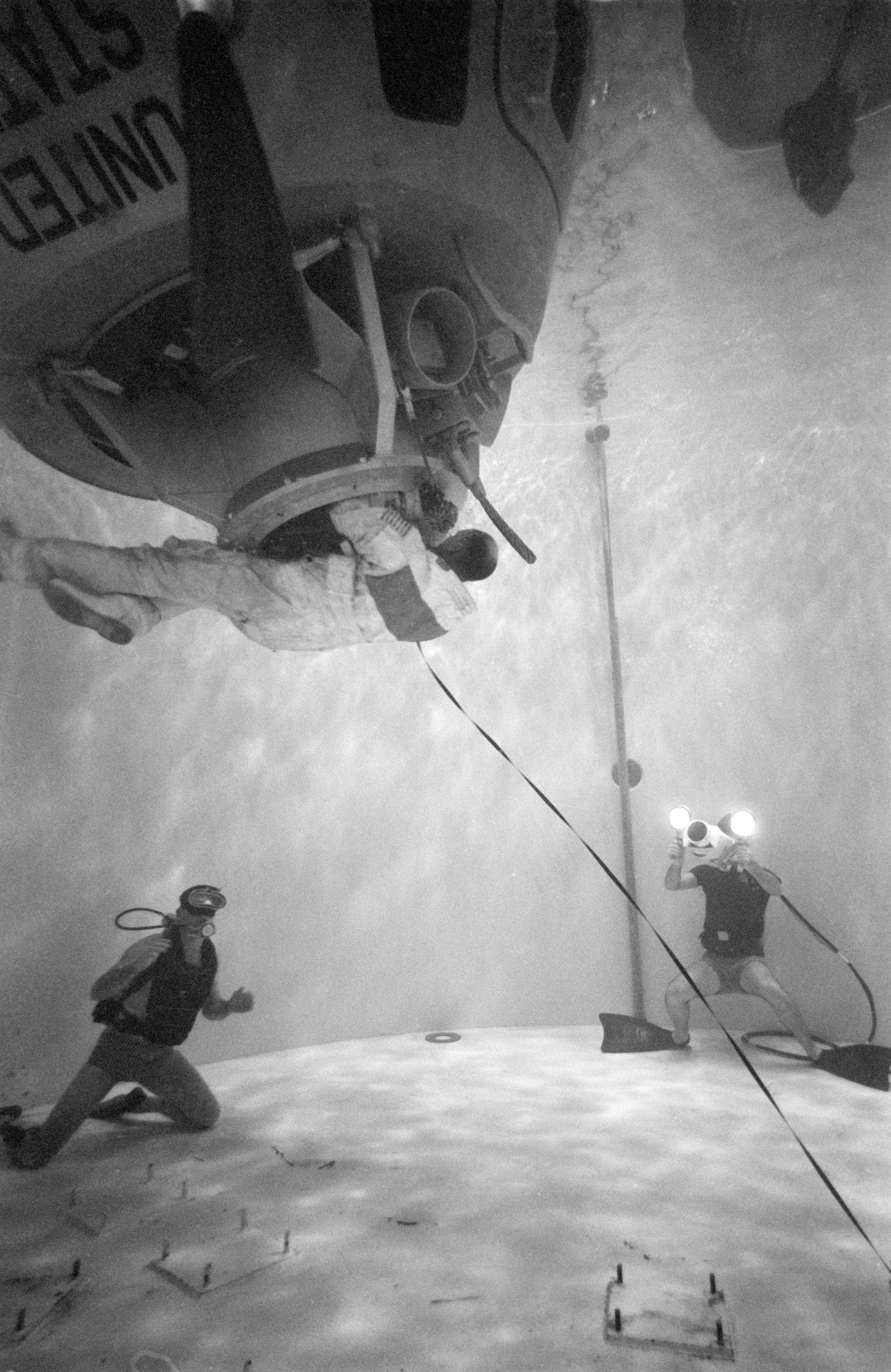
That path brought the spacecraft home in about four days, with splashdown in the Indian Ocean, where NASA had few recovery forces. Jerry Bostick and the other Flight Dynamics Officers wanted both to shorten the trip and to move splashdown to the Pacific, where the main recovery forces were. The answer was a second descent-engine burn two hours after pericynthion, the closest approach to the Moon: the "PC+2" burn. At pericynthion on 14 April the crew was 400,171 kilometres from Earth, the greatest distance humans have been from home until Artemis II's lunar flyby in 2026; the record stood because the Moon was near its farthest point and the free-return path carried the capsule farther from the Moon than on any other Apollo flight. The burn could not be verified the usual way — checking the alignment Lovell had transferred against a navigation star — because glinting debris travelling with the spacecraft made star sightings impractical. While preparing for it, the crew learned that the S-IVB had hit the Moon as planned, prompting Lovell's dry remark that at least something on the flight had worked. Once PC+2 was over, almost everything aboard was shut down to stretch the consumables.
Carbon dioxide and the "mailbox"
Aquarius had oxygen enough, but that did not solve the opposite problem: removing the carbon dioxide exhaled by three men in a cabin built for two men for two days. Carbon dioxide was absorbed by canisters of lithium hydroxide pellets, and the command module's cartridges did not fit the lunar module's system. Ground and crew improvised an adapter from what was aboard, a device NASA engineers called "the mailbox". CAPCOM Joseph Kerwin read the build procedure up to the crew over the course of an hour; Swigert and Haise assembled it, and carbon dioxide levels began dropping immediately. Lovell later called the improvisation a fine example of cooperation between ground and space.
Cold, thirst and minimum power
The CSM drew its electricity from fuel cells that produced water as a by-product; the lunar module ran on silver-zinc batteries, which did not. Power and water — needed for equipment cooling as well as for drinking — became the critical resources. LM power consumption was cut to the lowest level possible. Swigert managed to fill some drinking bags from the command module's water tap, but even assuming rationed personal consumption, Haise initially calculated that they would run out of cooling water about five hours before reentry; the risk was accepted because Apollo 11's lunar module, once jettisoned in lunar orbit, had kept running for seven to eight hours with its water cut off.
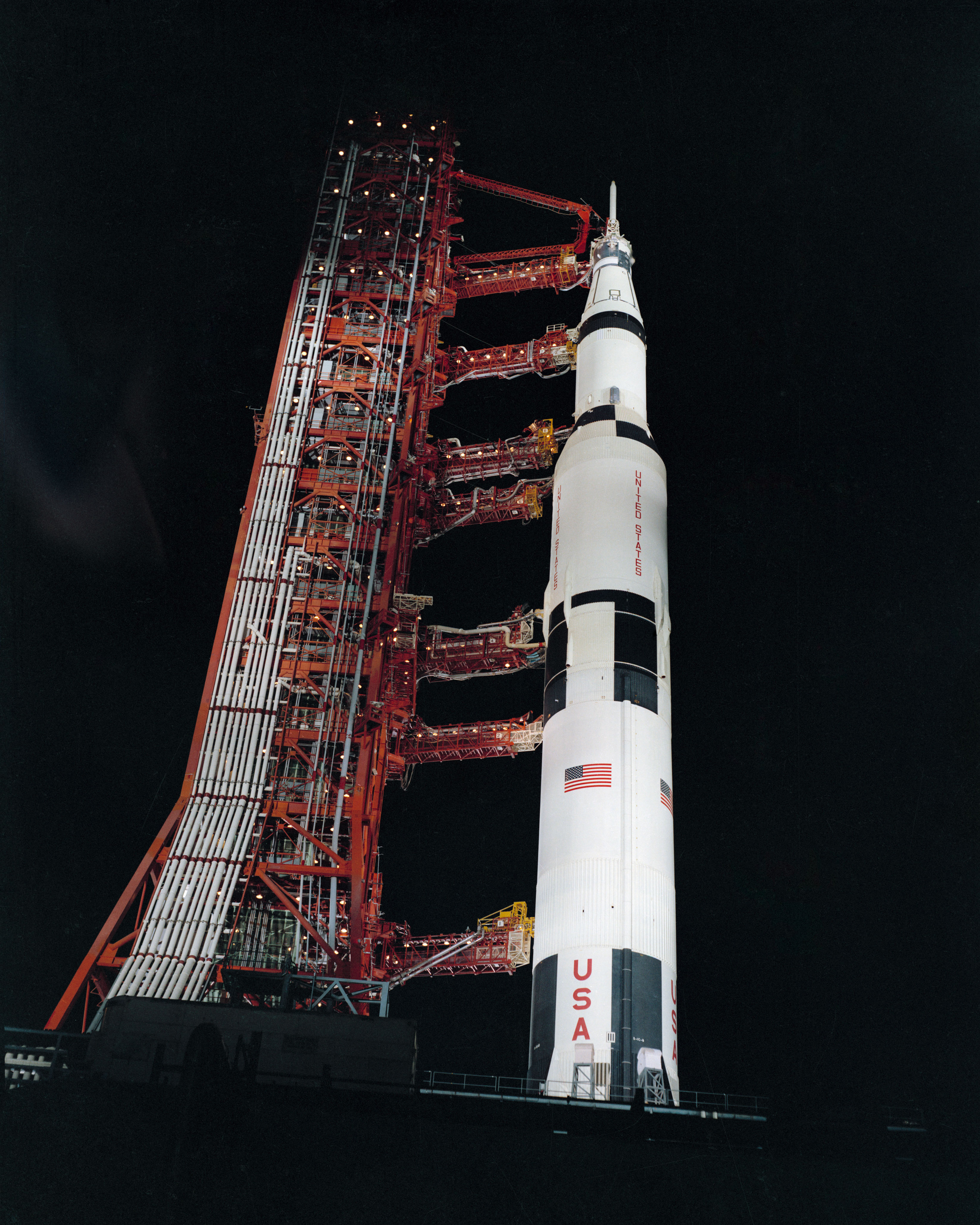
The ration was set at 200 millilitres of water per person per day. The three astronauts lost 14 kilograms between them and Haise developed a urinary tract infection. Inside the darkened spacecraft the temperature fell as low as 3 °C and water condensed on the walls; any condensation behind equipment panels caused no trouble, largely thanks to the electrical insulation improvements made after the Apollo 1 fire. At 133 hours into the flight, recognising that cold and lack of rest would hamper the command module's startup, Mission Control cleared Lovell to power the lunar module up fully to raise the cabin temperature, which meant restarting its guidance computer as well.
Reentry and the long radio silence
Powering a command module up from full shutdown had never been intended in flight, still less under Apollo 13's power and time constraints. Flight controller John Aaron devised the procedure with Mattingly and several engineers and designers, and the crew carried it out without apparent difficulty; Kranz later put their survival down in part to their experience as test pilots in life-or-death situations. Having the LM computer running again let Lovell take a navigational sighting and calibrate the inertial measurement unit; with the lunar module aware of its position and attitude, the command module's computer was then calibrated by reversing the normal procedure, which cut steps from the startup and improved the accuracy of the PGNCS-guided reentry.
The final midcourse correction also addressed the Atomic Energy Commission's concern that the cask holding the plutonium oxide for the SNAP-27 generator should come down somewhere safe. Separating the lunar module raised an engineering question of its own: Grumman, its manufacturer, put a University of Toronto team led by Bernard Etkin on the problem of how much air pressure to leave in the docking tunnel, rather than venting it entirely, to push the modules apart. Since the LM's guidance system had been shut down after PC+2, the crew was told to steer by the day-night terminator on the Earth, a technique used on Earth-orbit missions but never on a return from the Moon.
Ionisation around the command module during reentry normally causes a communications blackout of about four minutes. Apollo 13's ran longer than usual, and that wait was the rescue's last public act. Odyssey regained radio contact and splashed down safely in the South Pacific at 21°38′24″S 165°21′42″W, southeast of American Samoa and 6.5 kilometres from the recovery ship USS Iwo Jima, after 5 days, 22 hours, 54 minutes and 41 seconds of flight. An estimated 40 million Americans watched the splashdown live on all three networks, with another 30 million catching some part of the telecast. The lunar module reentered and broke up, its remains falling into deep water: the impact point was over the Tonga Trench, one of the Pacific's deepest places, and the plutonium cask sank 10 kilometres to the bottom.
The Cortright board and its design consequences
As soon as the crew was back, NASA Administrator Paine and Deputy Administrator George Low appointed a review board. Edgar Cortright chaired it, with Neil Armstrong and six others among its members, and its final report reached Paine on 15 June. The board concluded that Swigert's activation of the tank 2 fan at Mission Control's request caused an electric arc that set the tank on fire, and it faulted the preflight testing of the tank and the presence of Teflon inside it. The report questioned the use of Teflon and of other materials shown to burn in supercritical oxygen, aluminium among them, within the tank. To support the reconstruction the board tested a tank rigged with hot-wire ignitors, which produced a rapid temperature rise and a failure whose telemetry resembled that of Apollo 13's tank 2, and tested panels similar to the missing Sector 4 panel, which separated in the test rig as they had in flight.
The design consequences reached Apollo 14 and the flights after it. The oxygen tank was redesigned and the thermostats were upgraded to handle the proper voltage. The stirring fans, whose motors were unsealed, were removed altogether, at the cost of an oxygen quantity gauge that was no longer accurate. And the fuel cell oxygen supply valves were redesigned so that Teflon-coated wiring was isolated from the oxygen.
What was measured anyway, and the legacy
Although there was no landing, several experiments were completed. The S-IVB impact on the Moon — planned from Apollo 13 onwards to produce shocks larger than the micrometeorite strikes the instruments had been recording, and so to probe the crust — occurred at 77:56:40 into the mission and released enough energy that the gain on Apollo 12's seismometer, 117 kilometres from the impact point, had to be turned down. An experiment added after lightning struck Apollo 12 measured atmospheric electrical phenomena during ascent and returned data indicating a heightened risk in marginal weather.
Apollo 13 revived worldwide interest in the programme: headlines everywhere, networks breaking into their schedules, crowds around television sets; Pope Paul VI led ten thousand people in prayer for the crew, and ten times that number prayed at a religious festival in India. President Richard Nixon awarded the crew the Presidential Medal of Freedom and stopped in Houston to give the same honour to the Mission Operations Team, on Paine's recommendation. Apollo 13's scientific destination was reached by Apollo 14: on 5 February 1971 its lunar module Antares landed near Fra Mauro with Alan Shepard and Edgar Mitchell aboard. The command module Odyssey, restored by Max Ary, is on display at the Cosmosphere in Hutchinson, Kansas. The mission's lasting verdict is the one the historian W. D. Compton set down: only a heroic effort of real-time improvisation by the mission operations teams saved the crew.
Images
Elsewhere
- Smithsonian National Air and Space MuseumCommand Module, Apollo 13 ↗
- Smithsonian National Air and Space MuseumLithium Hydroxide Canister, Mock-up, Apollo 13 Emergency ↗
- Smithsonian National Air and Space MuseumApollo 13 from Pad B ↗
- Smithsonian National Air and Space MuseumApollo 13 Astronauts on the U.S.S. Iwo Jima ↗
- Encyclopaedia BritannicaApollo 13 — Mission, History & Facts ↗
- Space.comAstronaut John Swigert with the improvised "Mailbox" CO2 scrubber ↗
- Space.comApollo 13 Recovery Area ↗
- Space.comFailure Was Not an Option: Apollo 13 Mission of Survival in Pictures ↗
- Space Center HoustonPhoto Gallery: Apollo 13 ↗
- Naval History and Heritage CommandApollo 13 and NASA ↗
- RICHES (Univ. of Central Florida)Apollo 13 Crew on the USS Iwo Jima After Recovery ↗
- HISTORYHow Apollo 13 Became NASA's 'Successful Failure' ↗









![1023- Apollo 13, a successful failure [Pills of History]](https://i.ytimg.com/vi/5yldJ0MQRWk/hqdefault.jpg)










![Un film, une histoire - Apollo 13: Véritable histoire [France-5] (2015)](https://i.ytimg.com/vi/nhFrq-f8hQM/hqdefault.jpg)


![APOLLO 13 - Splashdown & Recovery - Stabilized Live TV [60fps]](https://i.ytimg.com/vi/OomBxxdmnvI/hqdefault.jpg)