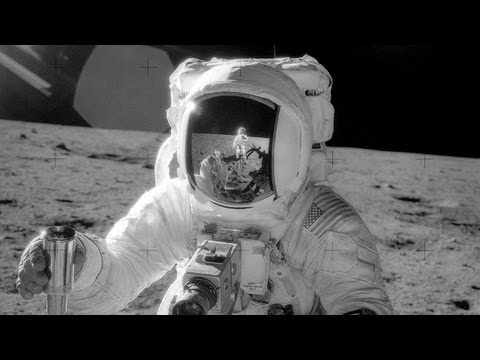
Apollo program · NASA · Crewed
Apollo 12
- Nov 14, 1969, 4:22 PM
- Launch date
- 3
- Crew size
- 10 days 4 hr
- Duration
- Success
- Outcome




Apollo 12 was the sixth crewed flight of NASA's Apollo program and the second to put people on the surface of the Moon. It lifted off from Kennedy Space Center on 14 November 1969 and came home on 24 November with a splashdown in the South Pacific. Its all-Navy crew was commander Charles "Pete" Conrad, lunar module pilot Alan L. Bean and command module pilot Richard F. Gordon, who stayed in lunar orbit aboard Yankee Clipper while his crewmates descended in Intrepid. The mission had been conceived as a backup: had Apollo 11 failed, Apollo 12 would have made the next attempt at the first landing. After the July success NASA pushed the flight back two months and used the extra time to set a bolder goal, a precise touchdown beside the Surveyor 3 probe, which had been sitting in the Ocean of Storms since April 1967. The crew also received far more geology training than their predecessors. The launch, into overcast and rainy skies, nearly ended everything: two lightning strikes hit the Saturn V in the first minute of flight, knocked the fuel cells offline and lit up the caution and warning panel. A call from Houston controller John Aaron, and Bean's quickness in finding an obscure switch, brought the telemetry back and saved the mission. On 19 November Conrad set Intrepid down about 163 metres from Surveyor 3, proving that NASA could send its crews to specific sites of scientific interest. Over two moonwalks the astronauts deployed the first ALSEP, the first nuclear-powered automatic science station left on the Moon, gathered geological samples and removed parts of the old probe for study on Earth, including its television camera. The mission's own colour camera, however, burned out when it was pointed at the Sun. Apollo 12 consolidated pinpoint landing techniques, flew the first hybrid non-free-return trajectory and produced the first artificial moonquake ever recorded, by deliberately crashing the lunar module's ascent stage. Its command module is now at the Virginia Air and Space Center in Hampton, and the camera recovered from Surveyor 3 is displayed at the Smithsonian's National Air and Space Museum in Washington.
Payload
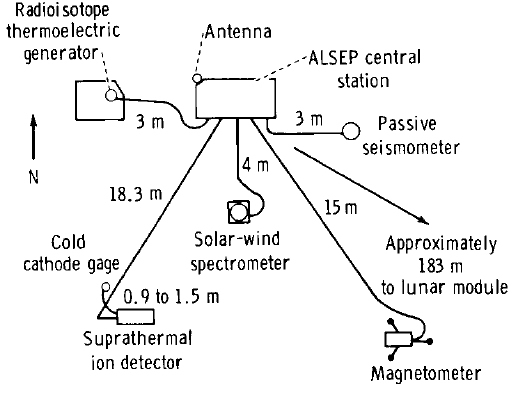
The Apollo 12 spacecraft combined command and service module CSM-108, call sign Yankee Clipper, and lunar module LM-6, named Intrepid, together with the launch escape system and the SLA-15 adapter that housed the lunar module atop the Saturn V. According to NSSDCA, the CSM weighed 28,790 kg at launch, of which 5,609 kg was the command module and 23,181 kg the service module. Compared with Apollo 11, Intrepid had a structural change to carry science packages, two hammocks and a colour television camera for the surface, which failed after being pointed at the Sun. The main science payload was the first ALSEP (Apollo Lunar Surface Experiments Package), built by Bendix: a lunar surface magnetometer, a lunar atmosphere detector, a suprathermal ion detector, a solar wind spectrometer, a dust detector and a passive seismometer, linked to a central station and powered by a SNAP-27 plutonium radioisotope thermoelectric generator, the first use of nuclear power on a crewed NASA spacecraft. The astronauts also deployed the Solar Wind Composition Experiment and brought it back. From orbit, Gordon ran the multispectral photography experiment with four Hasselblad cameras. The return cargo comprised 33.45 kg of lunar samples according to Wikipedia (34.35 kg according to NSSDCA), subsurface core samples and parts of the Surveyor 3 probe: its television camera, its motorised scoop and pieces of cable, aluminium tubing and glass, intended to reveal the effects of long exposure to the lunar environment.
| Crew | Role | Agency | Extravehicular activity |
|---|---|---|---|
| Charles "Pete" Conrad Jr. | Commander | NASA · United States | — |
| Richard Francis "Dick" Gordon Jr. | Command module pilot | NASA · United States | — |
| Alan LaVern Bean | Lunar module pilot | NASA · United States | — |
History
A backup mission that became the second landing
Apollo 12 began life as the fallback for the first lunar landing. While Apollo 11 prepared, Conrad's crew trained for the same landing sites, because if Armstrong and Aldrin did not make it, the next attempt would be theirs. The July 1969 success changed priorities: with the race won, NASA postponed Apollo 12 by two months and eased the schedule of later missions. The extra time went into geology training and into a new goal, pinpoint landing, a skill the program had to master if astronauts were to reach sites chosen for their science rather than only for their safety. Spacecraft and launcher were almost identical to Apollo 11's; the novelties included hammocks so that Conrad and Bean could rest more comfortably inside the lunar module.
Crew and Mission Control
All three crewmen were Navy officers. Commander Charles "Pete" Conrad was 39; he earned an aeronautical engineering degree at Princeton in 1953, became a naval aviator, went through the test pilot school at Patuxent River and was picked in the second astronaut group in 1962. He had flown Gemini 5 in 1965 and commanded Gemini 11 in 1966. Command module pilot Richard "Dick" Gordon, 40, held a chemistry degree from the University of Washington, had been a naval aviator since 1953 and was also a Patuxent River graduate; he joined the third group in 1963 and had flown with Conrad on Gemini 11.

The lunar module pilot seat had originally belonged to Clifton C. Williams Jr., who was killed in October 1967 when his T-38 crashed near Tallahassee. Conrad had earlier asked for Alan L. Bean, a former student of his at test pilot school, but Director of Flight Crew Operations Deke Slayton had refused because Bean was assigned to the Apollo Applications Program. After Williams's death Conrad asked again and Slayton gave way. Bean, 37, an aeronautical engineering graduate of the University of Texas in 1955 selected alongside Gordon in 1963, made his first spaceflight on this mission. The three had served as the backup crew of Apollo 9.
The Apollo 12 backup crew was David R. Scott, Alfred M. Worden and James B. Irwin, who went on to fly Apollo 15. The support crew, a role created for Apollo to keep flight rules, flight plan and checklists current, was Gerald P. Carr, Edward G. Gibson and Paul J. Weitz. Flight directors Gerry Griffin, Pete Frank, Clifford E. Charlesworth and Milton Windler covered one shift each, and the capsule communicators were Scott, Worden, Irwin, Carr, Gibson, Weitz and Don Lind.
Choosing the site: Surveyor crater
The Apollo 11 candidate sites had been picked on strict safety grounds: close to the lunar equator, flat, free of obstacles along the descent path and cleared with Lunar Orbiter photographs. After July, the obvious choice for Apollo 12 was the next site to the west, in Sinus Medii. But NASA planning coordinator Jack Sevier and engineers at the Manned Spacecraft Center in Houston pushed for a landing close enough to the crater where Surveyor 3 had touched down for the astronauts to cut pieces off the probe and bring them home.
Not everyone was convinced. Apollo 11 had landed several miles off target, and some managers feared Apollo 12 would come down too far away to reach the probe, embarrassing the agency. Yet pinpoint landing was essential to the exploration program to come, and on 25 July 1969 Apollo Program Manager Samuel Phillips designated what became known as Surveyor crater, over the unanimous opposition of two site selection boards. To locate the probe precisely, NASA turned to lunar mapper Ewen Whitaker, who had worked with Gerard Kuiper: by comparing Surveyor 3 images with photographs of thousands of craters, he spotted two rocks beside the probe that gave its position away.
Training and preparation
Each crewman logged more than 1,000 hours of mission-specific training, five hours for every hour of planned flight, on top of the 1,500 hours accumulated as Apollo 9 backups. Over 400 hours per man were spent in command module and lunar module simulators, some linked in real time to flight controllers in Houston. Conrad practised landings in the Lunar Landing Training Vehicle even though Armstrong had had to eject from a similar craft in 1968.

Conrad insisted that geology training take place away from the press: he felt ill-treated by reporters since Gemini, and Apollo 11's only field trip had turned into a near-fiasco, with a hovering press helicopter drowning out the astronauts' voices. On the six Apollo 12 field trips, Conrad and Bean worked as if on the Moon, collecting and photographing samples while talking to a CAPCOM and geologists hidden in a nearby tent. When the scientists changed the photo documentation procedure for the fourth or fifth time, Conrad demanded that the changes stop. For the first time specific geology traverses were planned: four routes, one for each possible touchdown point, the seed of traverse planning that on later flights would involve several organisations.
The stages of lunar module LM-6 reached Kennedy on 24 March 1969 and were mated on 28 April; command and service modules 108 arrived on 28 March and were joined on 21 April. The Saturn V, with the spacecraft on top, rolled out to Launch Complex 39A on 8 September, and the training schedule was completed on 1 November, as planned.
Launcher and spacecraft
Saturn V SA-507 was barely changed from Apollo 11's; it carried 17 more instrumentation measurements, for a total of 1,365. At liftoff the whole stack weighed 6,487,742 pounds (2,942,790 kg), of which 110,044 pounds (49,915 kg) was spacecraft. That spacecraft comprised command and service module 108, lunar module LM-6, the launch escape system and adapter SLA-15. The sea-flavoured call signs Yankee Clipper and Intrepid were chosen from thousands of suggestions by employees of North American Aviation and Grumman, the builders of each module; they were proposed by flight test engineer George Glacken and planner Robert Lambert. Changes from Apollo 11 were minor: a hydrogen separator for the drinking water, a strengthened recovery loop, a structural change to the LM so that it could carry science packages, the hammocks and a colour television camera for the surface.
Two lightning strikes at launch
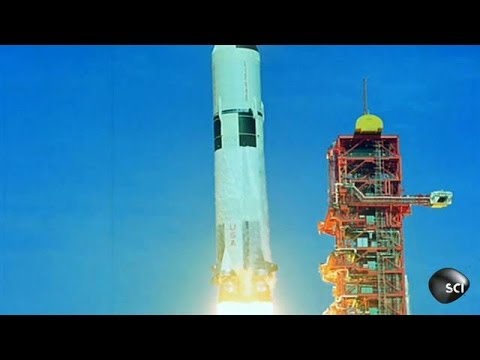
On 14 November 1969, with President Richard Nixon present, the first sitting president to watch a crewed launch, and Vice President Spiro Agnew beside him, Apollo 12 lifted off at 16:22:00 UTC, at the opening of its window. The sky was fully overcast and it was raining; during ascent the vehicle met winds of 151.7 knots (280.9 km/h), the strongest of any Apollo flight. A rule against launching into a cumulonimbus cloud had been waived, and it was later established that the rocket never entered one.

At 36.5 seconds after liftoff a lightning bolt, triggered by the vehicle itself, hit the Saturn V. The discharge knocked all three fuel cells offline, leaving the spacecraft on batteries that could not meet the demand. A second strike at 52 seconds took out the attitude indicator. Telemetry reached Houston garbled and the cabin filled with warning lights, although the Saturn V guidance system, independent from the spacecraft's, kept flying normally.
EECOM John Aaron recognised the pattern from an earlier test in which a power loss had upset the signal conditioning electronics. His call, "SCE to Aux", asked for that equipment to be switched to its auxiliary supply. Neither Flight Director Gerald Griffin, CAPCOM Gerald Carr nor Conrad knew the switch; Bean, the onboard engineer, found it and threw it. Telemetry returned, showed no significant damage, and Bean brought the fuel cells back. Houston also feared that the strikes might have damaged the pyrotechnic bolts of the parachute compartment; the crew were not told, since aborting would have changed nothing. At the end of the flight the parachutes worked normally.
To the Moon on a hybrid trajectory
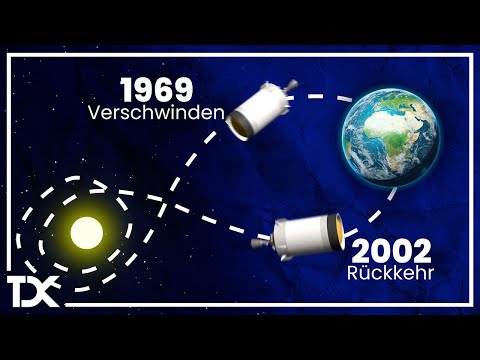
After an unusually careful checkout in parking orbit, the S-IVB third stage fired again for translunar injection, a burn of five minutes and 45 seconds. Gordon performed the transposition and docking with Intrepid, which was televised. The S-IVB was meant to end up in solar orbit, but an error left it in a highly elliptical Earth orbit, 101,350 by 535,522 miles according to NASA; it escaped in 1971 and decades later amateur astronomer Bill Yeung rediscovered it as the object J002E3.

Conrad and Bean entered the lunar module on the first day to check it for lightning damage and found none. The only midcourse correction needed put the craft on a hybrid, non-free-return trajectory: for the first time a crewed mission left the path that would have brought it home without an engine burn. In exchange, the crew could launch in daylight, reach the site with the desired lighting and be tracked by the Goldstone antenna during descent, while the LM descent engine stood by as a backup to the service module engine.
Lunar orbit and the pinpoint landing
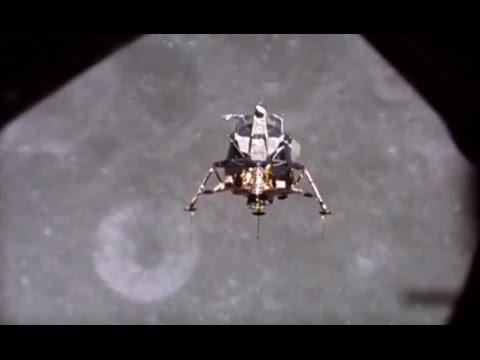
The service module engine braked the spacecraft for 352.25 seconds into a 315.2 by 114.2 km orbit; two revolutions later another burn trimmed it to 122.4 by 101.1 km. Intrepid undocked from Yankee Clipper 107 hours and 54 minutes into the mission. After a 29-second burn to lower its orbit, the 717-second powered descent began. Houston noticed that the trajectory did not match the plan; using a newly developed data processor, controllers voiced up a correction that shortened the range by 4,190 feet.
Conrad had trained to recognise a group of craters nicknamed "the Snowman", with Surveyor crater at its centre, and feared he would see nothing familiar. It was exactly where it should be. He took manual control, aiming for "Pete's Parking Lot", which turned out rougher than expected, manoeuvred and touched down at 06:54:36 UTC on 19 November, 535 feet (163 m) from the probe. The landing point lay at 3.01239° S, 23.42157° W, about 950 miles west of the Apollo 11 site. The descent engine sandblasted Surveyor 3, and later analysis showed it removed more dust from the probe than it deposited.
First moonwalk: flag, camera and ALSEP
Conrad, the shortest man in the early astronaut groups, stepped onto the Moon with a rehearsed quip: "Whoopie! Man, that may have been a small one for Neil, but that's a long one for me." He had bet journalist Oriana Fallaci 500 dollars he would say it, and never collected. Soon afterwards, while carrying the colour television camera, Bean accidentally pointed it at the Sun and burned out its sensor tube, ending surface television almost at once.

After raising the flag, the pair spent most of the excursion deploying the ALSEP at a distance from the LM to shield it from debris thrown up at liftoff. There were snags: the plutonium element of the SNAP-27 generator stuck in its cask and had to be knocked loose with a hammer. Heading back to the LM, their footsteps already registering on the seismometer, they took a core tube and other samples. The first excursion lasted 3 hours, 56 minutes and 3 seconds.
Second moonwalk: visiting Surveyor 3
Conrad had landed between two of the four planned touchdown points, so Houston merged two traverses into one roughly circular route. The first stop was Head crater, where Bean noticed lighter material beneath Conrad's footprints: ejecta from Copernicus crater, 370 km to the north. Samples from Head later allowed geologists to date that impact at roughly 810 million years in the initial analysis. They continued past Bench and Sharp craters and Halo crater, then approached Surveyor crater cautiously, fearing loose footing or a toppling probe; they found firm ground and a stable spacecraft.
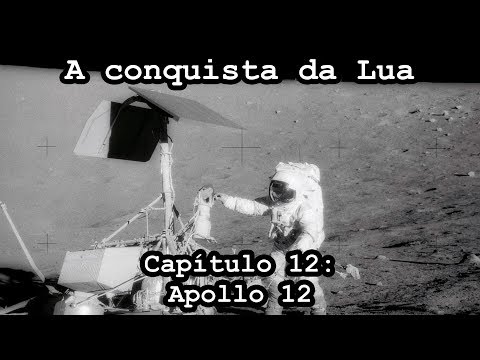
They photographed Surveyor 3 thoroughly and removed its television camera, its motorised scoop and pieces of cable, aluminium tubing and glass. Scientists wanted to learn how long exposure to the lunar environment had affected gears, optics and lubricants, and whether organisms trapped in the cable had survived. Conrad and Bean had secretly packed a self-timer to take a picture of themselves with the probe, but could not find it among their samples. After a stop at Block crater they returned to the LM. The second excursion lasted 3 hours, 49 minutes and 15 seconds; across both, they ranged up to 410 m from the LM and gathered 33.45 kg of samples.
Gordon alone in orbit
While his crewmates were below, Gordon found both Intrepid and Surveyor through the sextant and passed their positions to Houston. He prepared and flew a plane change burn to make up for the Moon's rotation and be well placed for rendezvous, and carried out the multispectral photography experiment, four Hasselblad cameras with different filters aimed through a window, to study the composition of areas that would not soon be visited, among them candidate sites for later missions.
Liftoff, a man-made moonquake and the way home
Intrepid lifted off on 20 November at 14:25:47 UTC, after 31 hours and 31 minutes on the surface according to NASA, and docked with Yankee Clipper about three and a half hours later. Once emptied, the ascent stage was jettisoned and, commanded from Earth, crashed into the Moon. It was the first artificial moonquake ever recorded: the seismometer picked up vibrations for more than an hour, a duration that surprised seismologists. The crew spent another day in orbit photographing candidate landing sites, with a second plane change, and the trans-Earth burn came 172 hours and 27 minutes into the mission. The trip home left time for rest, a televised press conference and photographs of a solar eclipse caused by the Earth, which Bean called the most spectacular sight of the flight.
Splashdown and quarantine
Yankee Clipper splashed down on 24 November 1969 at 20:58:24 UTC in the South Pacific, southeast of Samoa, after 244 hours, 36 minutes and 25 seconds of flight according to NASA. The landing was hard: a camera came loose and struck Bean on the forehead. The carrier USS Hornet recovered the crew, who went into the Mobile Quarantine Facility while the samples and Surveyor parts were flown ahead to the Lunar Receiving Laboratory in Houston. The astronauts reached it on 29 November and left quarantine on 10 December.
The insignia
The patch reflects the crew's naval background: a clipper ship arrives at the Moon, standing for Yankee Clipper, flying the US flag and framed in the Navy's traditional blue and gold. NASA explained that the clipper, which once brought distant shores closer to the United States, symbolised a new era in the use of space. It bears four stars: three for the crew and one for Clifton Williams, added at Bean's suggestion.
Legacy and where the spacecraft are now
Conrad persuaded Bean to join Skylab, where Conrad commanded Skylab 2, the first crewed mission to the station, and Bean commanded Skylab 3. Gordon stayed with Apollo as backup commander of Apollo 15, hoping to walk on the Moon on Apollo 18; that mission was cancelled and he never flew again. The ALSEP worked for years: its magnetometer was switched off on 14 June 1974 and all remaining active experiments were shut down on 30 September 1977, mainly for budget reasons.
The command module was shown at the Paris Air Show, spent time at NASA's Langley Research Center and is displayed at the Virginia Air and Space Center in Hampton; ownership passed to the Smithsonian in July 1971. The service module most likely burned up on re-entry and the S-IVB remains in solar orbit. In 2009 and 2011 the Lunar Reconnaissance Orbiter photographed the landing site, where the descent stage, the ALSEP, Surveyor 3 and the astronauts' tracks remain.
Images
Elsewhere
- NASA ALSJDespegue del Apollo 12, 14 de noviembre de 1969 ↗
- NASA ALSJLanzamiento del Apollo 12 bajo cielo muy nublado ↗
- NASA ALSJDocumentación del rayo que alcanzó el Saturno V del Apollo 12 ↗
- NASA ALSJPete Conrad bajando del módulo lunar Intrepid ↗
- NASA ALSJPete Conrad en la escalerilla del módulo lunar ↗
- NASA ALSJVista de la sonda Surveyor 3 en su cráter ↗
- NASA ALSJAproximación del módulo de mando al amerizaje, 24 de noviembre de 1969 ↗
- ApollospaceRetrato de la tripulación del Apollo 12 ↗
- ApollospaceAstronauta junto al módulo lunar Intrepid ↗
- ApollospaceActividad extravehicular del Apollo 12 ↗
- ApollospacePanorámica de la superficie lunar durante el Apollo 12 ↗
- ApollospaceEquipo científico desplegado en la superficie lunar ↗
Show the 7 more
- NASA Image and Video LibraryVista de la sonda Surveyor 3, con el módulo lunar Intrepid al fondo ↗
- NASA Image and Video LibraryAlan Bean junto al módulo lunar Intrepid ↗
- NASA Image and Video LibraryLos dos artefactos estadounidenses sobre la superficie lunar: Intrepid y Surveyor 3 ↗
- AlamyPete Conrad examinando la sonda Surveyor 3 ↗
- AlamyRetrato icónico de la tripulación del Apollo 12 ↗
- AmericaSpaceReportaje fotográfico sobre el viaje del Apollo 12 a la Luna ↗
- Space.comPiezas del Surveyor 3 recuperadas por el Apollo 12 ↗



![1015- With Apollo 12, a Piece of Italy Goes to the Moon - Towards Space 25 [History Pills]](https://i.ytimg.com/vi/xWh-oeCCJrg/hqdefault.jpg)