Apollo program · NASA · Crewed
Apollo 11
- Jul 16, 1969, 1:32 PM
- Launch date
- 3
- Crew size
- 8 days 3 hr
- Duration
- Success
- Outcome
Apollo 11 in the news
September 12, 2026
The post APOD: 2026 September 12 – Apollo 11: Catching Some Sun appeared first on NASA Science .

August 6, 2026
The Apollo 11 mission made history by taking humans to the Moon using a computer with less capacity than any popular smartphone today.
August 1, 2026
On Aug. 1, 1968, NASA canceled the production of its Saturn V moon rocket, one year before the historic Apollo 11 moon landing, spelling the end of the Apollo program due to budget concerns.


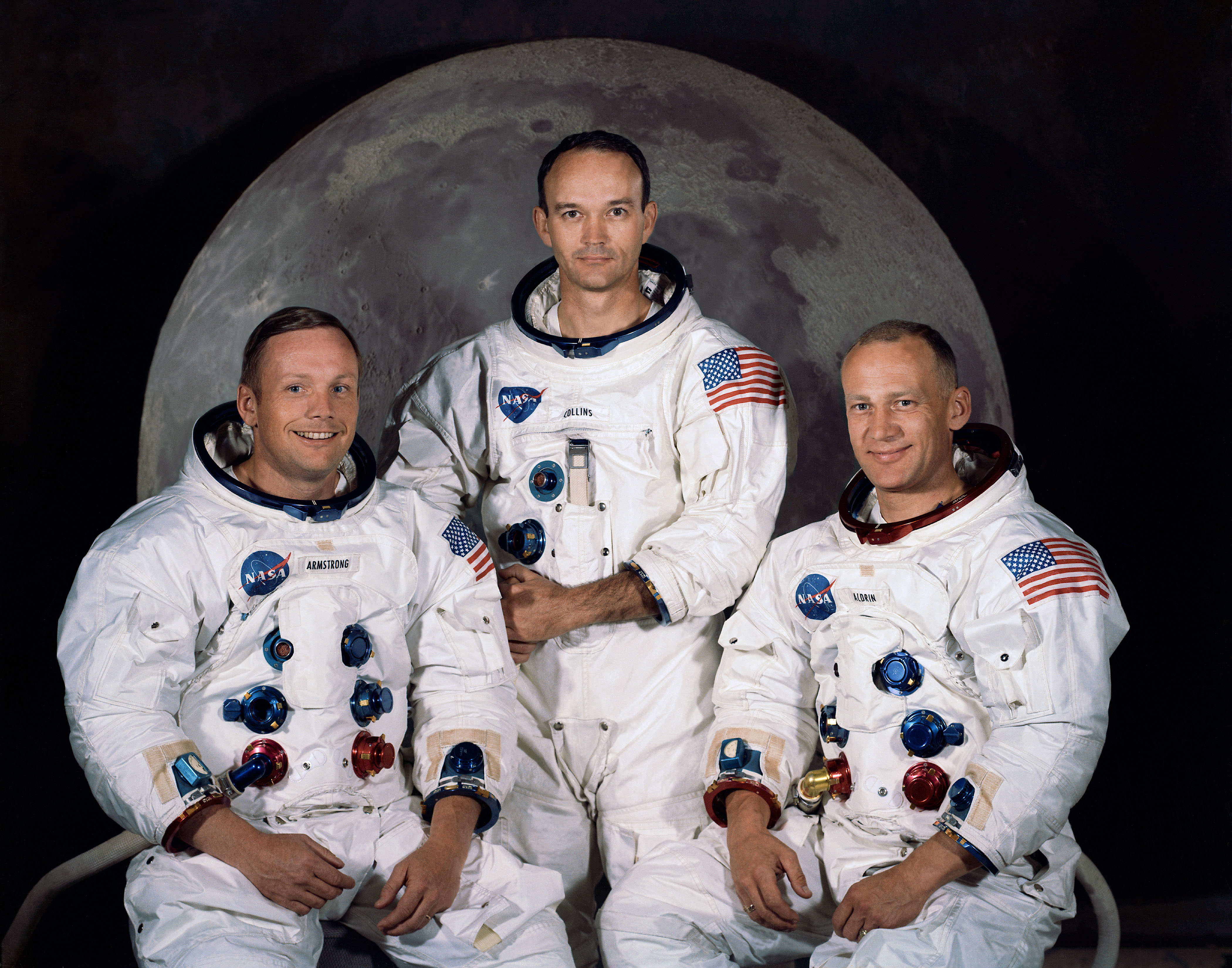
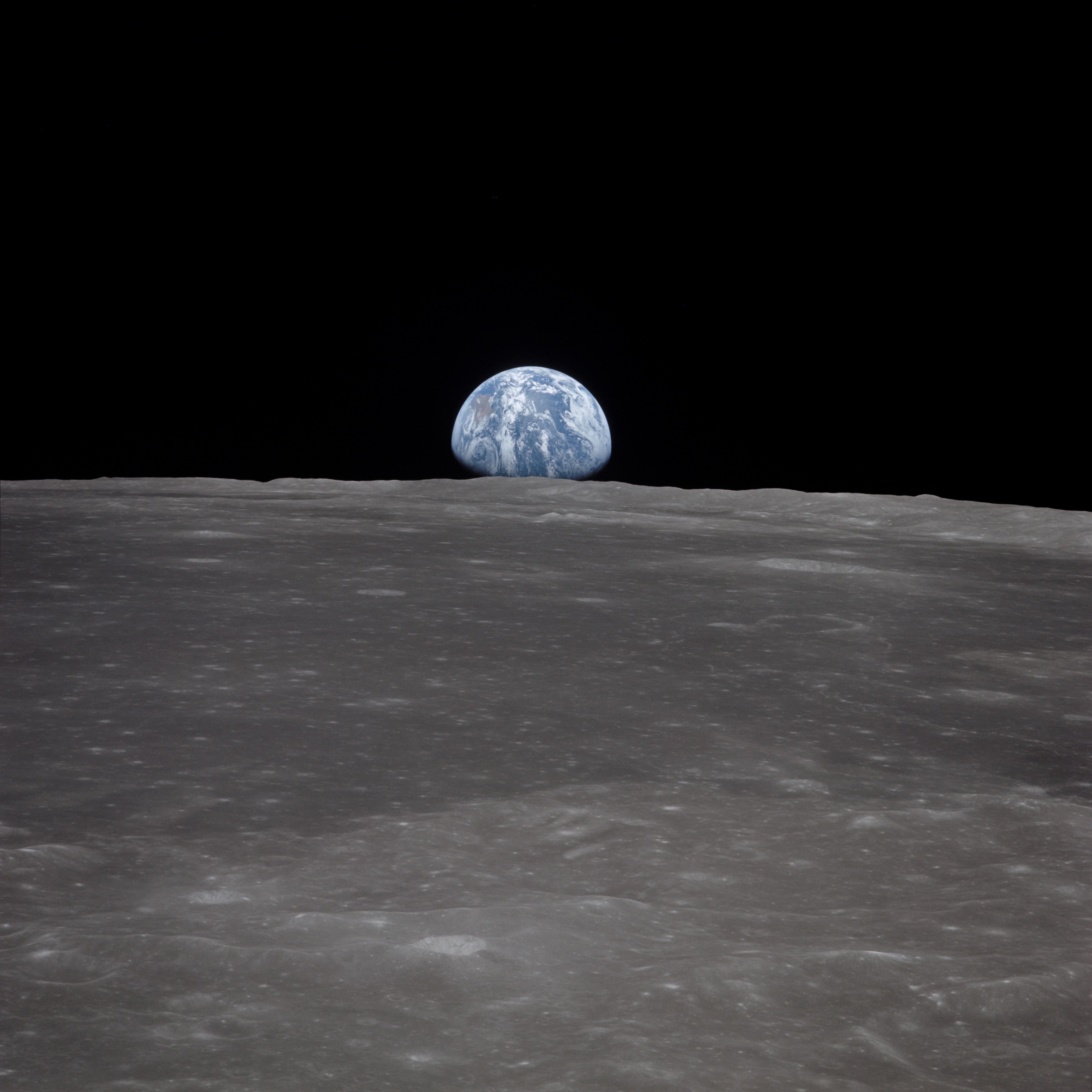
Apollo 11 was the mission that first landed humans on the surface of the Moon and returned them safely to Earth, fulfilling the goal John F. Kennedy had set before Congress in May 1961. Launched from Launch Complex 39A at the Kennedy Space Center on 16 July 1969 by a Saturn V, it carried Neil Armstrong as commander, Michael Collins as command module pilot and Buzz Aldrin as lunar module pilot. The lunar module *Eagle* separated from the command module *Columbia* and landed in the Sea of Tranquillity on 20 July, after a descent marked by the 1202 and 1201 program alarms and by Armstrong's semi-automatic flying to avoid a boulder field. Six and a half hours later Armstrong stepped onto the surface and spoke the most quoted sentence of the space age; Aldrin joined him shortly afterwards. The two spent a little over two hours outside the spacecraft: they planted the United States flag, spoke by radio with President Nixon, deployed the EASEP science package and a solar wind composition experiment, and collected 21.55 kilograms of lunar rock and soil. Collins meanwhile remained alone in lunar orbit aboard *Columbia*. The ascent stage lifted off on 21 July, docked with the command module, and the crew splashed down in the Pacific on 24 July, where the aircraft carrier USS *Hornet* recovered them. All three spent twenty-one days in quarantine as a precaution against possible lunar biological contamination.
Payload
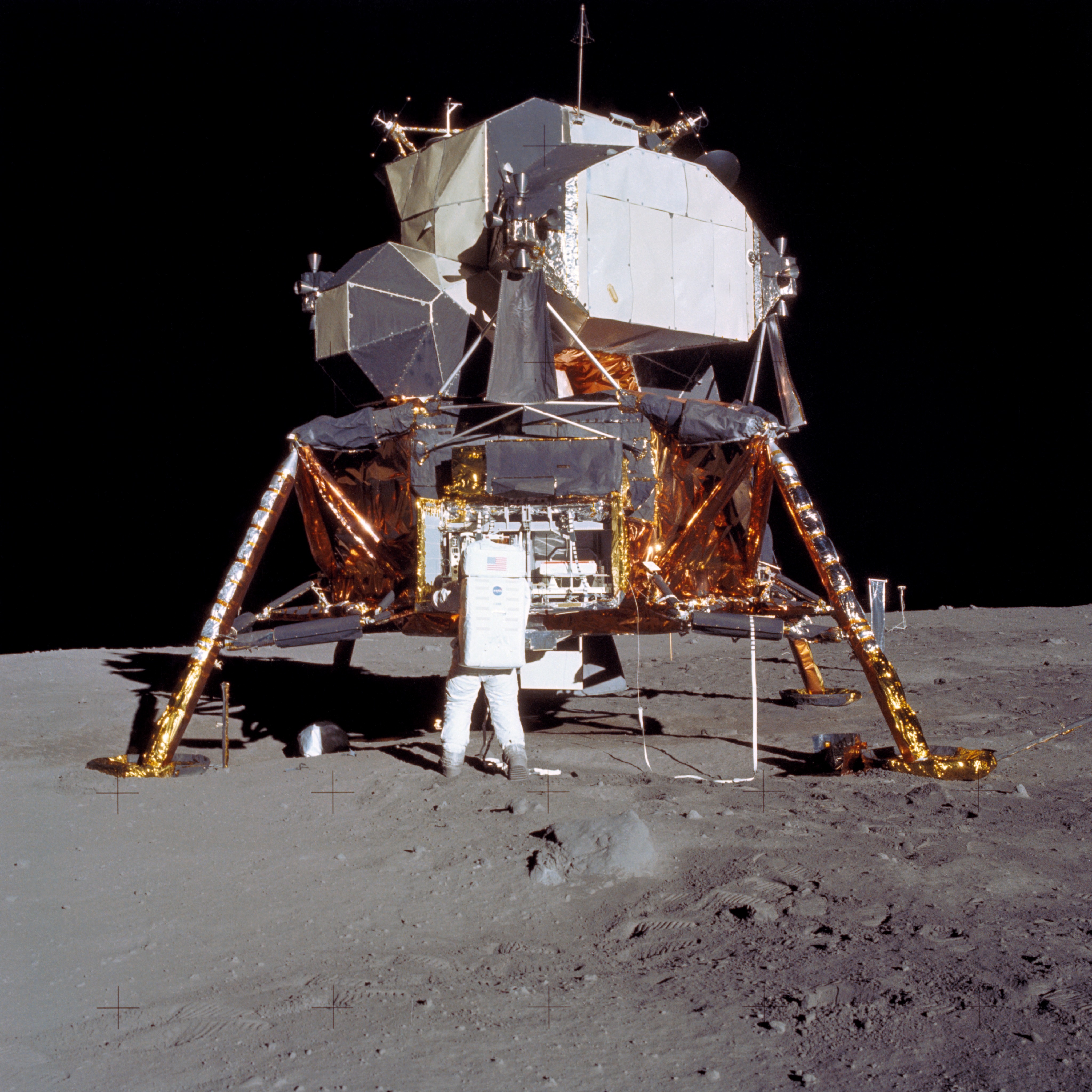
The stack launched by Saturn V AS-506 comprised command and service module CSM-107 *Columbia* and lunar module LM-5 *Eagle*, plus the S-IVB stage that performed trans-lunar injection and was afterwards left in solar orbit. *Eagle* differed from Apollo 10's lunar module in having a VHF antenna to acquire the command module at rendezvous, a lighter ascent engine, more thermal protection on the landing gear and the EASEP science package; on *Columbia* the only substantive change was the removal of insulation from the forward hatch. The science payload deployed on the surface was that EASEP, a reduced version of the ALSEP designed to be set up in a few minutes: a passive seismic experiment to record moonquakes and a laser retroreflector for measuring the Earth-Moon distance. To these was added a solar wind composition experiment, a thin aluminium foil deployed facing the Sun and retrieved after 77 minutes for analysis on Earth. Surface equipment also included the slow-scan television camera, Hasselblad still cameras, the geologist's hammer, core tubes, scoops and tongs on extension handles, and two sample boxes. The symbolic payload comprised a plaque bolted to *Eagle*'s ladder, a silicon disk carrying messages from the leaders of 73 countries, commemorative medals for cosmonauts Komarov and Gagarin, an Apollo 1 mission patch, a golden replica of an olive branch, two United States flags destined for the chambers of Congress, and the crew's personal preference kits of about 0.23 kilograms each. On the return, *Columbia* brought back 21.55 kilograms of lunar rock and soil, exposed film and data tapes.
| Crew | Role | Agency | Extravehicular activity |
|---|---|---|---|
| Neil Alden Armstrong | Commander | NASA · United States | — |
| Michael Collins | Command module pilot | NASA · United States | — |
| Edwin Eugene "Buzz" Aldrin Jr. | Lunar module pilot | NASA · United States | — |
History
A race that began with a speech
The Space Race began on 4 October 1957 with the Soviet launch of Sputnik 1, the first artificial satellite. The shock in the United States led President Dwight D. Eisenhower to create NASA in 1958 and to start Project Mercury, whose goal was to put a man in orbit. The Soviet Union stayed ahead: on 12 April 1961 Yuri Gagarin became the first human in space and the first to orbit the Earth. Almost a month later, on 5 May 1961, Alan Shepard became the first American in space, on a suborbital flight.
On 25 May 1961, before a joint session of Congress, President John F. Kennedy declared that the nation should commit itself, before the decade was out, to landing a man on the Moon and returning him safely to the Earth. He restated the goal at Rice University on 12 September 1962 before an audience of some 40,000 people, with the argument that the United States chose to go to the Moon not because it was easy but because it was hard. Not everyone agreed: the mathematician and philosopher Norbert Wiener dismissed the effort as a "moondoggie", a waste of resources that could serve better ends. Kennedy himself twice explored the alternative of a joint venture: in June 1961 he proposed it to Nikita Khrushchev, and he raised it again before the United Nations General Assembly on 20 September 1963. On both occasions the Soviet side declined.
The mission architecture was settled in July 1962, when NASA administrator James Webb announced the choice of lunar orbit rendezvous. Under it the Saturn V rocket would launch a stack made of three parts: a command module with a cabin for the three astronauts, the only part that would return to Earth; a service module supporting the command module with propulsion, electrical power, oxygen and water; and a two-stage lunar module for the landing and the return to lunar orbit.
The road was not smooth. On 27 January 1967 a fire during a ground test killed the crew of Apollo 1 — Gus Grissom, Ed White and Roger B. Chaffee — and the programme was halted for a redesign of the command module. The crewed flights resumed with Apollo 7 in October 1968, the first crewed flight of the redesigned spacecraft in Earth orbit; Apollo 8 flew to lunar orbit that December; Apollo 9 tested the lunar module in Earth orbit in March 1969; and in May 1969 Apollo 10 carried out a full dress rehearsal, taking its lunar module down to about 15 km above the surface without landing. With that sequence complete, the next flight could attempt the landing itself.
Armstrong, Collins and Aldrin
The core of the crew had flown together before. On 20 November 1967 NASA announced Neil Armstrong as commander, Jim Lovell as command module pilot and Buzz Aldrin as lunar module pilot for the backup crew of Apollo 9. Delays with the lunar module led to the Apollo 8 and Apollo 9 missions swapping places, and their crews with them, so that Armstrong's crew became backup for Apollo 8 and, under the usual rotation of skipping two missions, prime crew for Apollo 11.
Michael Collins, originally command module pilot of Apollo 8, was removed from flight status when a bony growth was found between his fifth and sixth vertebrae, requiring surgery; Lovell took his place on Apollo 8, and once Collins recovered he joined Armstrong's crew. Deke Slayton, director of flight crew operations, later offered Armstrong the chance to replace Aldrin with Lovell; Armstrong declined, on the grounds that Lovell deserved his own command, and the three flew as they were — "amiable strangers", in Collins's description, close professionally rather than personally.
The backup crew was Lovell, Bill Anders and Fred Haise, with Ken Mattingly training in parallel with Anders, who had announced he would leave NASA. The support crew were Mattingly, Ronald Evans and Bill Pogue. The capsule communicators were Charles Duke, Ronald Evans, Bruce McCandless II, James Lovell, William Anders, Ken Mattingly, Fred Haise, Don L. Lind, Owen K. Garriott and Harrison Schmitt.
Which of the two moonwalkers would step out first was settled by the layout of the cabin, in which the hatch opened towards the lunar module pilot's side, and by the crew's own view of the matter; NASA announced the decision on 14 April 1969. In his 2001 autobiography, flight operations director Chris Kraft said management had also concluded that Armstrong, unencumbered by an ego, was the right man for a moment that would be remembered as long as Charles Lindbergh's flight.
Columbia and Eagle
Collins designed the mission insignia: he wanted a symbol for a peaceful landing, and after Lovell suggested a bald eagle he added an olive branch drawn by NASA employee Tom Wilson, at first held in the bird's beak. Robert Gilruth, director of the Manned Spacecraft Center, thought the talons looked too warlike; the olive branch was moved to them. Following the practice of Apollo 9 and Apollo 10, the astronauts' names were left off the patch, so that the emblem would stand for everyone who had worked on the landing. The design was later used on the Eisenhower dollar of 1971 and on the Susan B. Anthony dollar of 1979.
Radio call signs were needed for the two spacecraft. In the spring of 1969 the crew rejected "Snowcone" and "Haystack", suggested by NASA, and settled on *Eagle* for the lunar module, after the bird on the patch, and *Columbia* for the command module — a historical name for the United States, and an echo of the *Columbiad*, the giant cannon that launches a spacecraft in Jules Verne's 1865 novel.
The ascent stage of lunar module LM-5 arrived at the Kennedy Space Center on 8 January 1969, the descent stage four days later, and command and service module CSM-107 on 23 January. Several changes distinguished *Eagle* from Apollo 10's *Snoopy*: a VHF radio antenna to help acquire the command module during rendezvous, a lighter ascent engine, more thermal protection on the landing gear and the addition of the EASEP science package. The command module's only substantive change was the removal of insulation from the forward hatch.
Each astronaut carried a personal preference kit of about 0.23 kg — three stowed in *Columbia* and two in *Eagle*. Armstrong's held a piece of wood from the left propeller of the Wright brothers' 1903 Flyer and a piece of its fabric, along with a diamond astronaut pin given by the widows of the Apollo 1 crew.
The site and the countdown
The site was chosen by NASA's Apollo Site Selection Board, which on 8 February 1968 announced five candidate landing sites after two years of study based on high-resolution photography from the Lunar Orbiter probes and data from Surveyor. Seven criteria governed the choice: the site had to be smooth, with few craters; approachable on the last three kilometres with no high hills, cliffs or deep craters; reachable on a free-return trajectory; with good visibility during the approach, meaning the Sun between 7 and 20 degrees behind the lunar module; and with a general slope of less than two degrees. Because the Sun-angle requirement recurred with the lunar day, each site allowed only one launch day per month. Site 2, in the southern Sea of Tranquillity, was chosen, with sites 3 and 5 as alternatives.
Assembly of the launch vehicle proceeded through the winter: the S-IVB third stage arrived on 18 January 1969, the S-II second stage on 6 February, the S-IC first stage on 20 February, and the instrument unit on 27 February. The stack, weighing 5,443 tonnes, rolled out of the Vehicle Assembly Building at 12:30 on 20 May 1969 for the five-and-a-half-kilometre journey to Launch Complex 39A. A countdown demonstration test ran from 26 June to 2 July, and the final countdown began at 00:00 on 10 July, with checks that used 43 ATOLL computer programs and a loading of liquid hydrogen kept just above absolute zero.
On launch morning Deke Slayton woke the crew at 04:00; they showered, dressed and had the traditional breakfast of steak and eggs with Slayton and the backup command module pilot Bill Anders. They donned their suits and left for the pad at 06:30. Haise entered the command module about three hours and ten minutes before launch to run the checklist; Armstrong took the left-hand couch at 06:54, followed by Collins on the right and Aldrin in the centre. The automatic countdown sequence started at T minus 3 minutes and 20 seconds, with more than 450 people at the consoles of the firing room.
16 July 1969
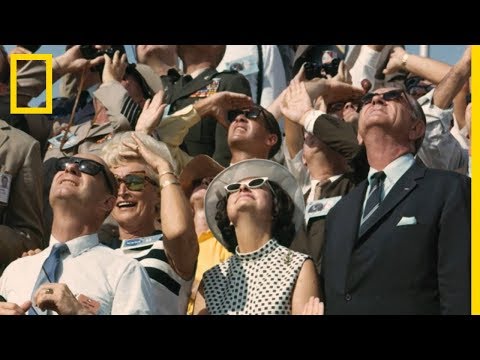
An estimated one million spectators watched the launch from the highways and beaches nearby. The guests included Army Chief of Staff William Westmoreland, four members of the cabinet, nineteen state governors, forty mayors, sixty ambassadors and two hundred congressmen; Vice President Spiro Agnew watched alongside former president Lyndon B. Johnson. Some 3,500 media representatives were present, two thirds of them American and the rest from another 55 countries. The launch was televised live in 33 countries, with an estimated 25 million viewers in the United States alone. Richard Nixon watched from his office in the White House with astronaut Frank Borman.
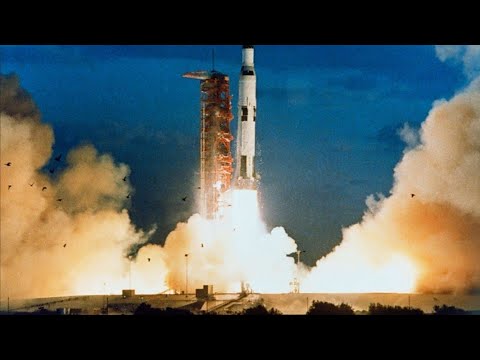
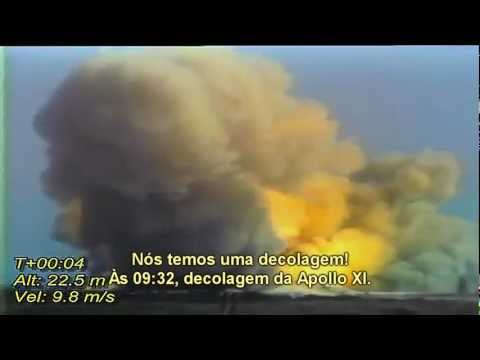
Saturn V AS-506 lifted off on 16 July 1969 at 13:32:00 UTC (09:32:00 EDT). At 13.2 seconds into the flight the vehicle began its roll onto a flight azimuth of 72.058 degrees. The first-stage engines shut down about 2 minutes and 42 seconds after liftoff, followed by S-IC separation and S-II ignition; the second stage shut down and separated at around 9 minutes and 8 seconds, and the S-IVB ignited for the first time seconds later.
Twelve minutes into the flight Apollo 11 was in a nearly circular Earth orbit of roughly 186 by 183 kilometres. After one and a half orbits — about two and a half hours — a second S-IVB burn performed trans-lunar injection: a burn of some 5 minutes and 47 seconds starting at 16:16:16 UTC. Half an hour later, with Collins at the controls from the left-hand seat, came the transposition, docking and extraction manoeuvre: *Columbia* separated from the spent stage, turned around and docked with *Eagle*, still attached to the rocket. With the lunar module extracted, the spacecraft continued towards the Moon while the S-IVB was directed onto a trajectory past it, to avoid any collision with the spacecraft, the Earth or the Moon; the slingshot effect of the lunar pass left it in solar orbit.
On 19 July at 17:21:50 UTC Apollo 11 passed behind the Moon and fired the service propulsion engine to enter lunar orbit. Over the next thirty orbits the crew watched the landing site pass beneath them, in the southern Sea of Tranquillity, about 19 kilometres south-west of the crater Sabine D. The site had been chosen in part because the robotic probes Ranger 8 and Surveyor 5 and the Lunar Orbiters had characterised it as relatively flat and smooth: it lay some 25 kilometres south-east of Surveyor 5's landing point and about 68 kilometres south-west of the Ranger 8 impact site.
The descent and the 1202 alarms
At 12:52:00 UTC on 20 July Aldrin and Armstrong entered *Eagle* and began final preparations. At 17:44:00 *Eagle* separated from *Columbia*. Collins, now alone, inspected the lunar module as it turned slowly before him, checking that it was undamaged and that the landing gear had deployed. Armstrong summed it up: "The Eagle has wings."
As the descent began, both noticed that surface features were passing two or three seconds early: they were running "long" and would land kilometres west of the intended point. *Eagle* was travelling too fast. The cause may have been the mascons, concentrations of mass in the lunar crust that locally distort gravity; flight director Gene Kranz also speculated about excess pressure in the docking tunnel or about the inspection pirouette itself.
Five minutes into the descent burn, at 6,000 feet (1,800 metres) above the surface, the lunar module's guidance computer distracted the crew with the first of several 1201 and 1202 program alarms. In mission control in Houston, computer engineer Jack Garman told guidance officer Steve Bales it was safe to continue, and this was relayed to the crew. The alarms indicated "executive overflows": the computer could not complete all its tasks in real time and had to postpone some. Margaret Hamilton, director of software programming for the Apollo flight computer at the MIT Charles Stark Draper Laboratory, later put it precisely: blaming the computer for the Apollo 11 problems would be like blaming the person who spots a fire and calls the fire department, because the software was programmed to eliminate lower-priority tasks and re-establish the important ones. Far from forcing an abort, the computer prevented one.
During the mission the cause was attributed to the rendezvous radar switch being in the wrong position, so that the computer was processing data from both the rendezvous radar and the landing radar at once. Software engineer Don Eyles concluded in a 2005 paper that the origin was a hardware design flaw already seen in the tests of the first uncrewed lunar module, on Apollo 5: an electrical phasing mismatch between two parts of the rendezvous radar system could make the stationary antenna appear to the computer to dither between two positions, and the resulting spurious cycle-stealing caused the alarms.
The boulder field and the manual landing
When Armstrong looked outside again, he saw that the guidance system was steering the craft towards an area strewn with boulders north and east of a crater 300 feet (91 metres) in diameter, later identified as West crater. He took semi-automatic control. He considered landing short of the boulder field so that geological samples could be taken from it, but his horizontal velocity was too high. Throughout the descent Aldrin called out navigation data while Armstrong flew.
Armstrong found a clear patch and steered towards it; as he came closer, at 250 feet (76 metres), he found that his new landing site had a crater in it. At 107 feet (33 metres), aware that propellant was running down, he decided to land at the first possible spot: he cleared the crater and found another patch of level ground. They were 100 feet (30 metres) above the surface with ninety seconds of propellant remaining. Dust kicked up by the engine began to obscure his sense of the craft's motion, and he fixed on large rocks protruding from the cloud to judge his speed.
A light told Aldrin that at least one of the 67-inch (170-centimetre) probes hanging from the landing legs had touched the ground: "Contact light!" Armstrong was supposed to shut the engine down immediately — engineers feared that the pressure of its own exhaust reflected off the surface might make it explode — but he forgot. Three seconds later *Eagle* settled onto the surface and Armstrong shut down the engine.
"Houston, Tranquility Base here"
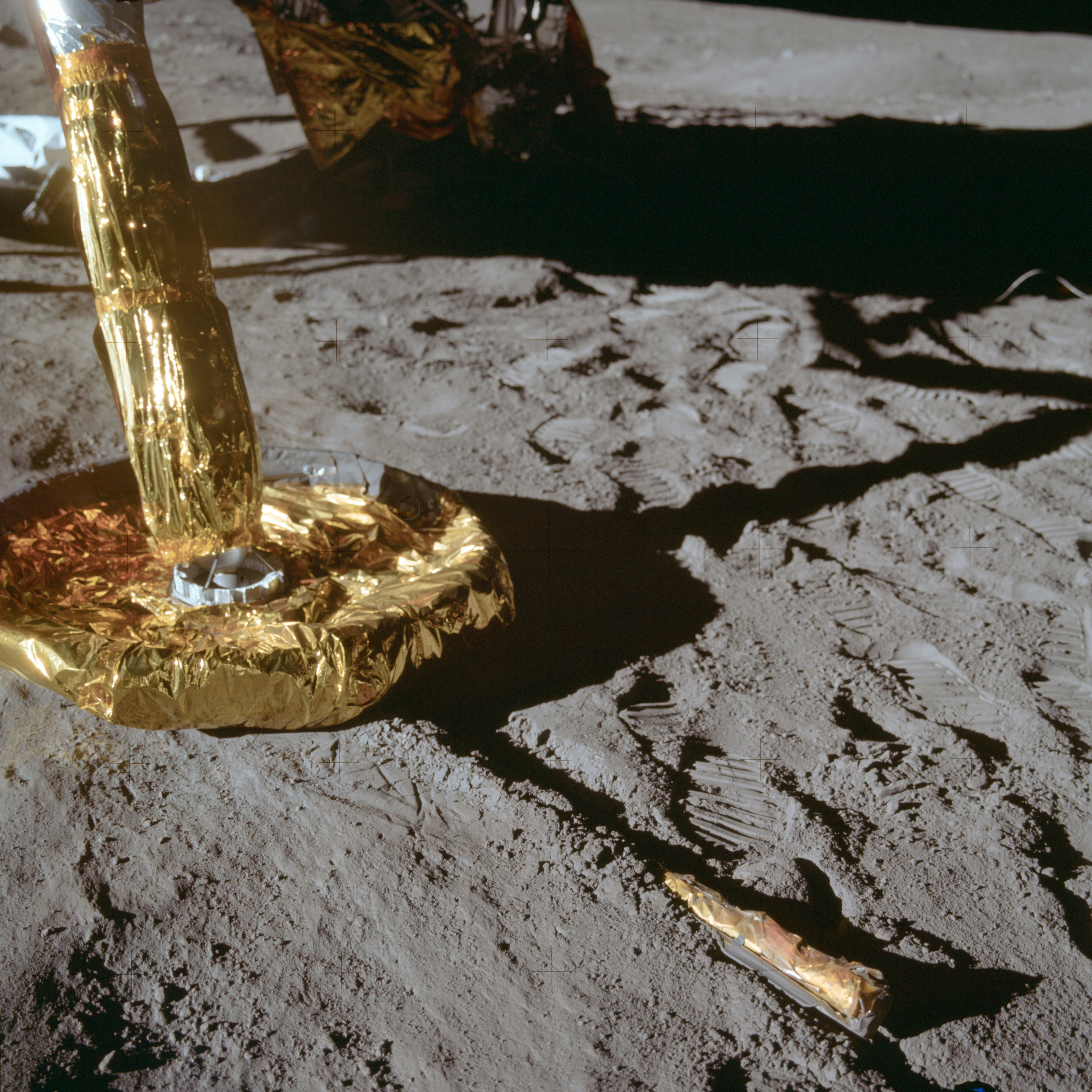
*Eagle* landed at 20:17:40 UTC on Sunday 20 July 1969 with 216 pounds (98 kilograms) of usable fuel remaining. The information available to the crew and the controllers indicated a margin of another 25 seconds of powered flight before aborting without touching down would cease to be safe; later analysis put the real figure closer to 50 seconds. Apollo 11 landed with less fuel than most subsequent missions, and the astronauts received an early low-level warning: it was found afterwards that the propellant had sloshed more than expected and uncovered a sensor. Anti-slosh baffles were added to the tanks on later missions.
After confirming the post-landing checklist, Armstrong answered capsule communicator Charles Duke with the words: "Houston, Tranquility Base here. The Eagle has landed." The unrehearsed change of call sign from *Eagle* to *Tranquility Base* made clear to anyone listening that the landing was complete. Duke expressed mission control's relief: "Roger, Tranquility, we copy you on the ground. You got a bunch of guys about to turn blue. We're breathing again."
Two and a half hours after landing, before beginning preparations to go outside, Aldrin radioed a request that everyone listening pause for a moment to contemplate the events of the past hours and give thanks in their own way. He then took communion privately. NASA was at the time in litigation with the atheist activist Madalyn Murray O'Hair, who demanded that its astronauts refrain from broadcasting religious activities from space, and for that reason Aldrin avoided mentioning it directly. The flight plan called for a five-hour sleep period before the moonwalk, but the crew, convinced they would not sleep, asked to bring the preparations forward.
The first extravehicular activity
Preparations to go outside began at 23:43 UTC and took three and a half hours instead of two: in training everything had been laid out in advance, whereas the real cabin also held checklists, food packages and tools. Six hours and thirty-nine minutes after landing, *Eagle* was depressurised.
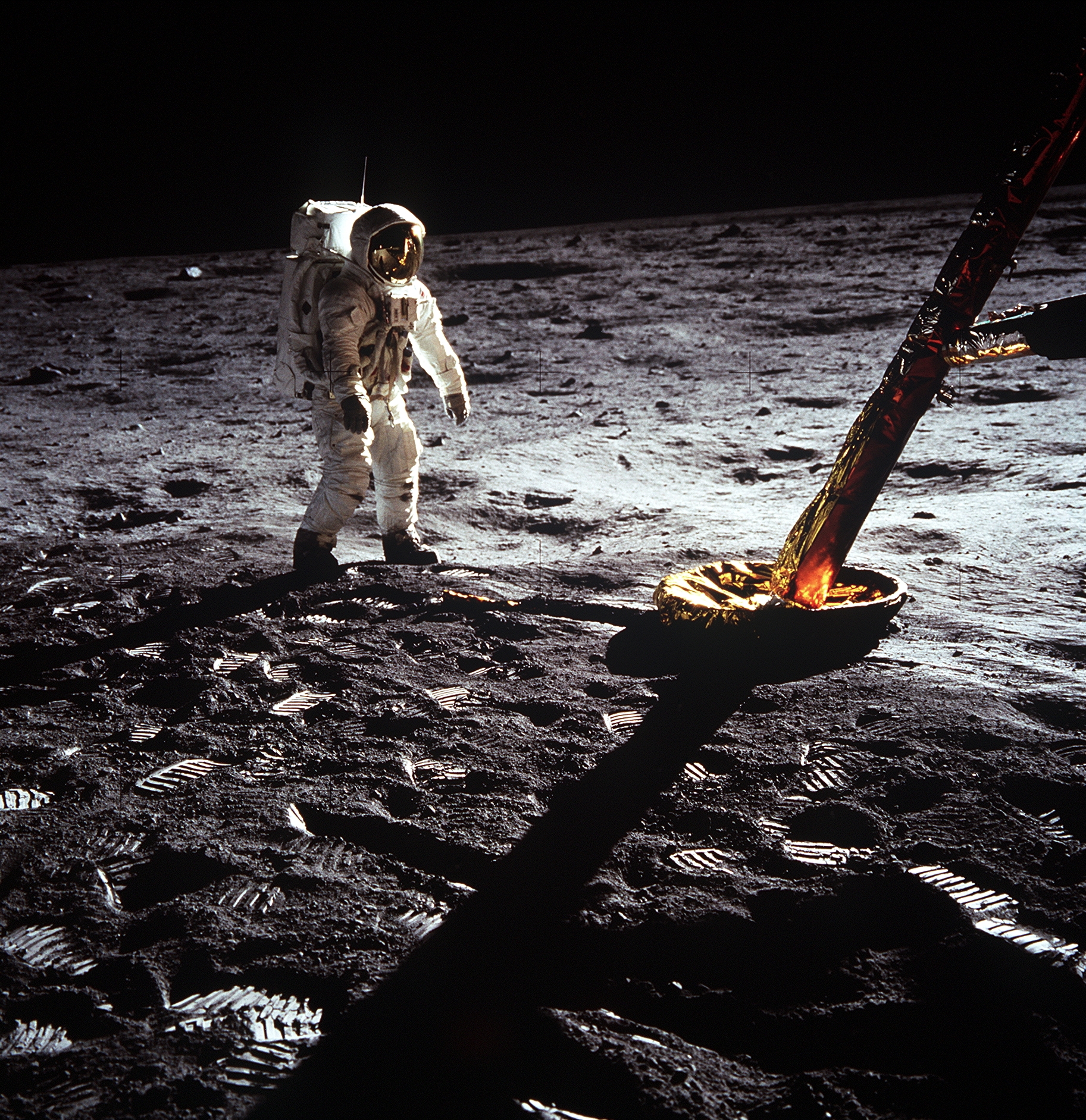
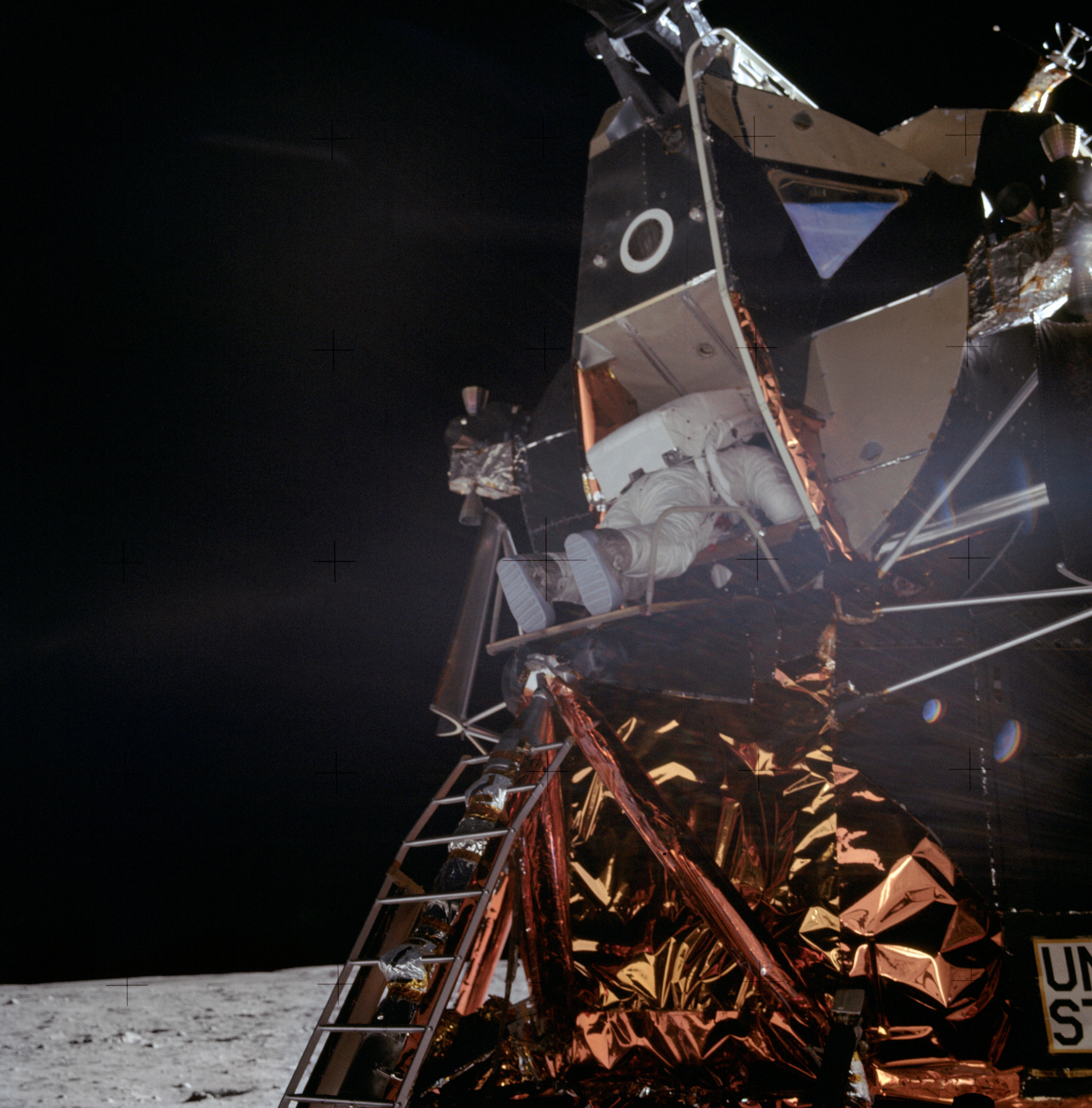
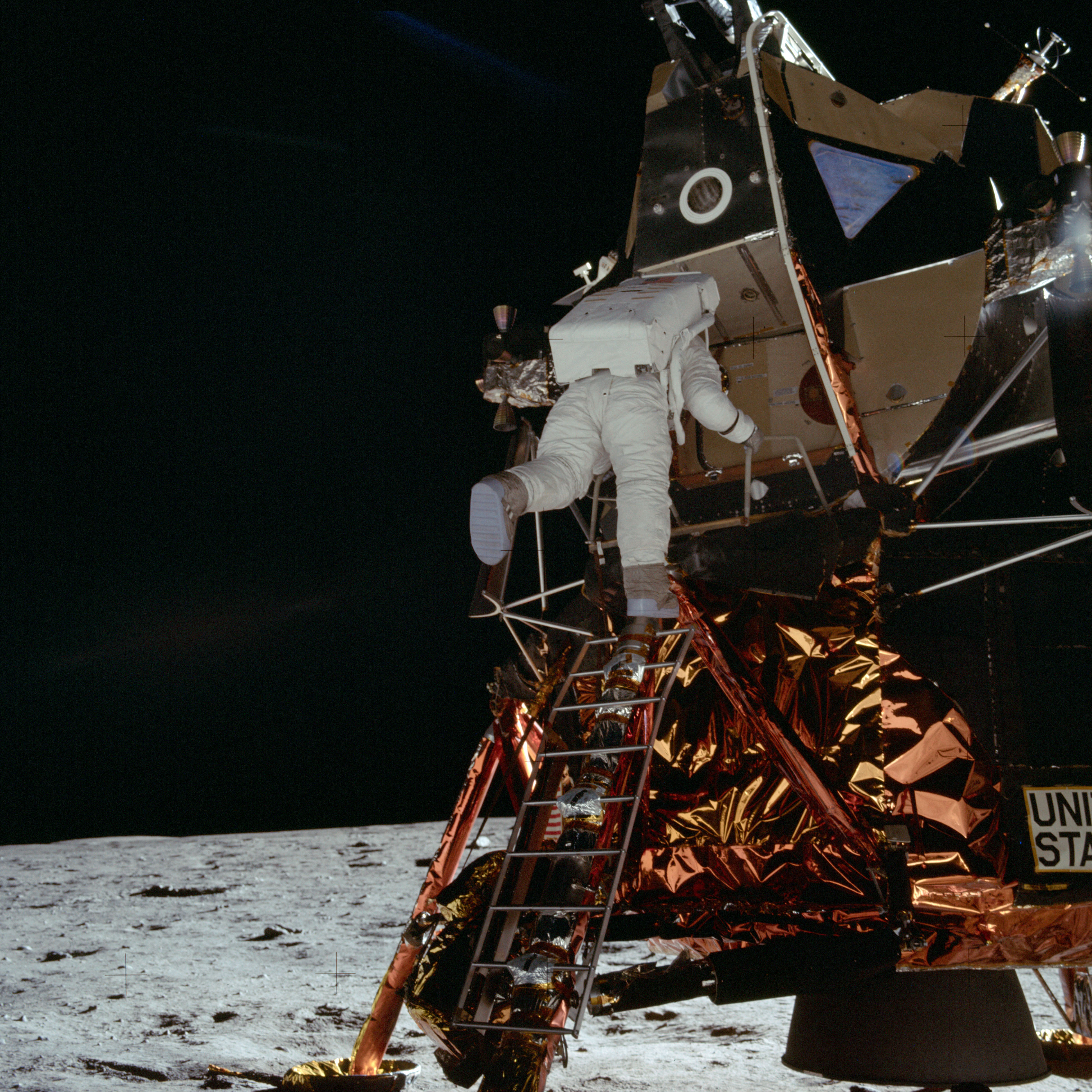
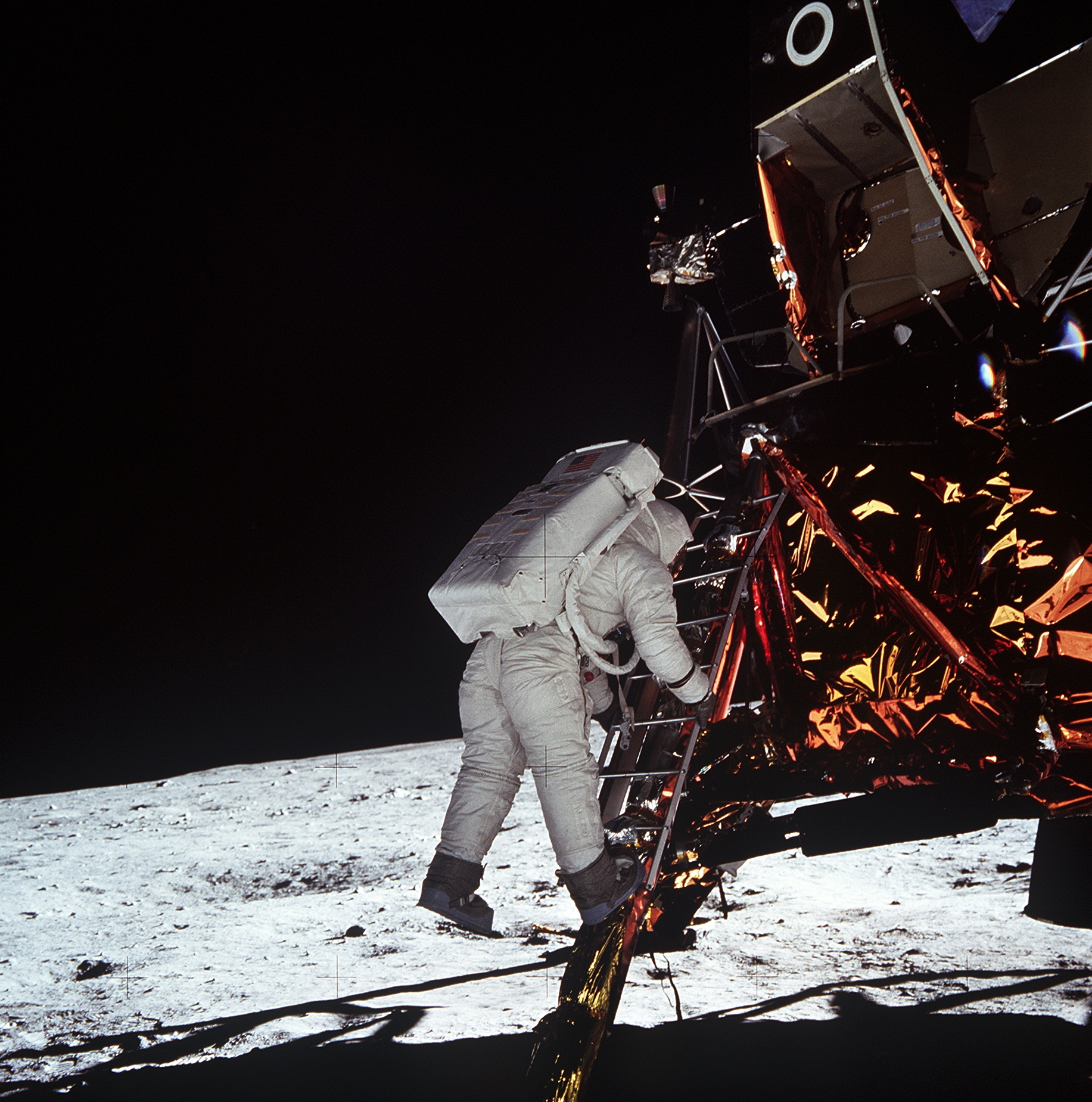
The hatch opened at 02:39:33. Armstrong had some difficulty getting through it with his life-support backpack on; some of the highest heart rates recorded in Apollo astronauts occurred precisely during these exits and entries. At 02:51 he began his descent of the nine-rung ladder, unable to see his own feet because of the remote control unit on his chest. On the way down he pulled a lanyard to deploy the modular equipment stowage assembly (MESA) folded against *Eagle*'s side and to activate the television camera.
Apollo 11 used slow-scan television, incompatible with conventional broadcasting: the picture was shown on a special monitor and an ordinary camera filmed that monitor, with the loss of quality that implied. The signal was received at Goldstone in the United States and with better fidelity at the Honeysuckle Creek station near Canberra; minutes later the feed switched to the more sensitive Parkes radio telescope. Despite the technical and weather difficulties, the black-and-white pictures reached at least 600 million people. Broadcast-format copies survive and are widely available, but the original slow-scan recordings were most probably lost when NASA reused magnetic tapes.
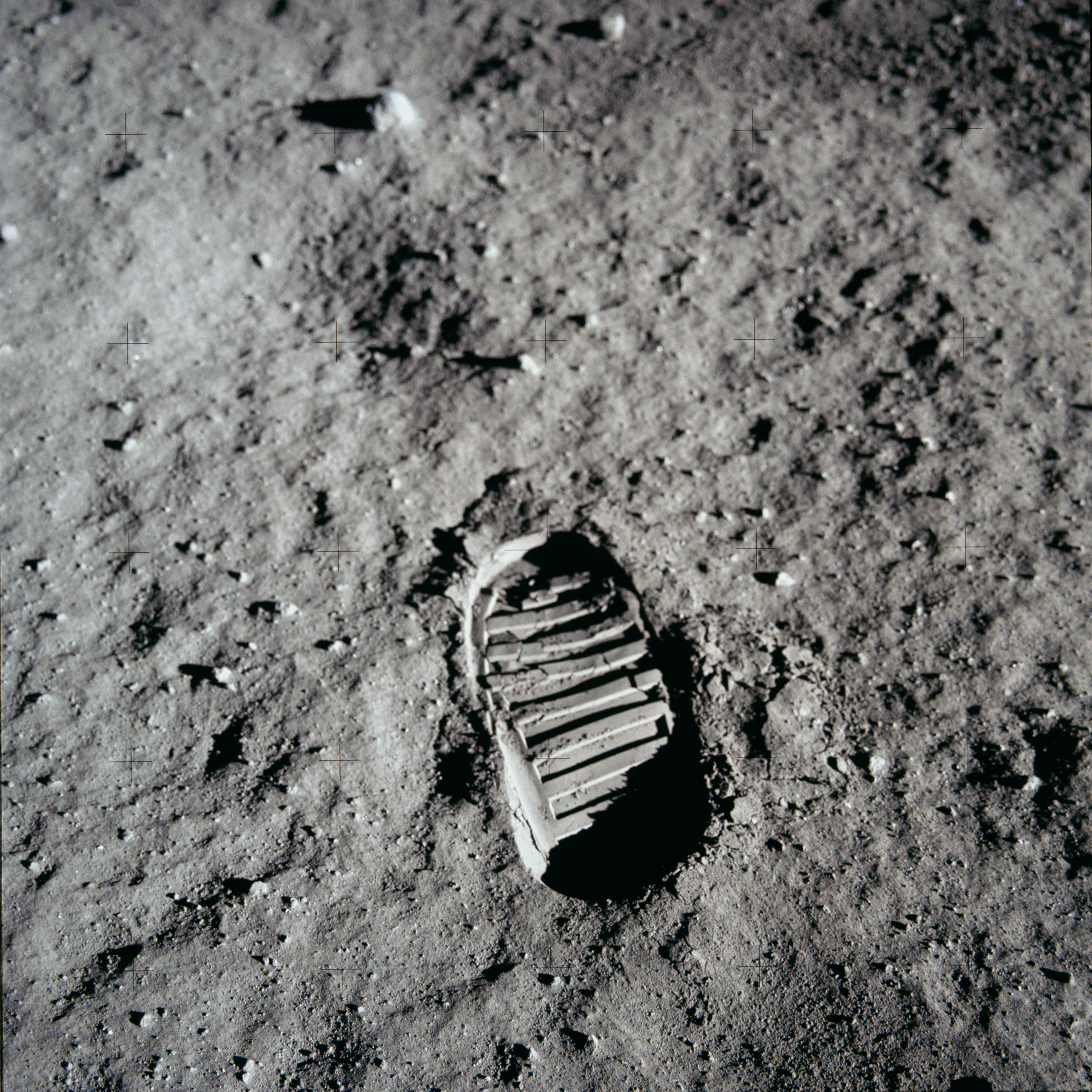
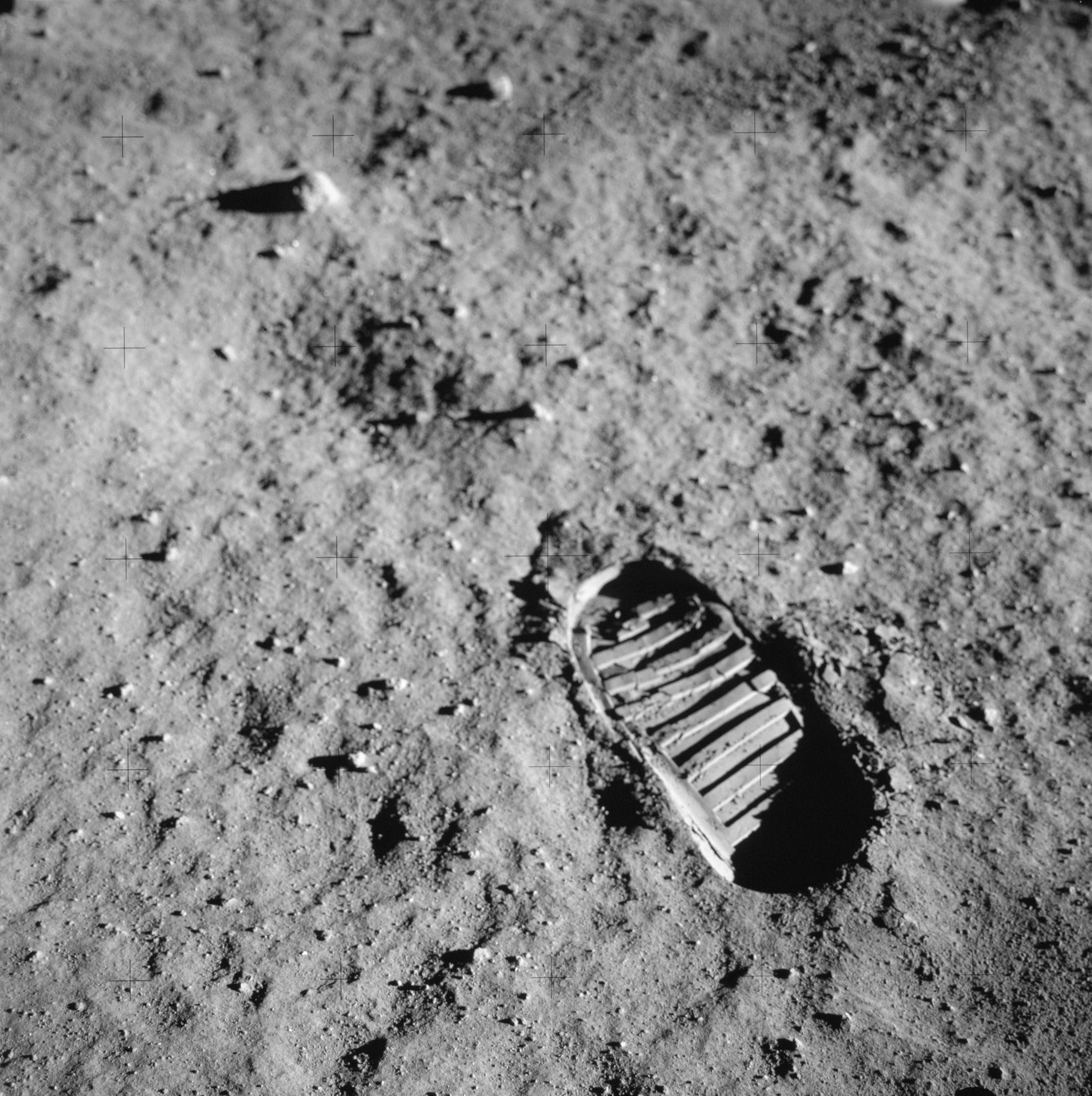
After describing the dust as "very fine grained", "almost like a powder", at 02:56:15 — six and a half hours after landing — Armstrong stepped off *Eagle*'s footpad and declared: "That's one small step for [a] man, one giant leap for mankind." He intended to say "for a man", but the article is not audible in the transmission.
About seven minutes later he collected a contingency soil sample with a bag on a pole and stowed it in a pocket on his right thigh: insurance that some lunar soil would return even if an emergency forced the moonwalk to be cut short. Twelve minutes after that he removed the television camera from the MESA, panned it around and mounted it on a tripod; the cable stayed partly coiled and remained a trip hazard throughout the activity. Still photography was done with a Hasselblad that could be held or mounted on the suit. Aldrin joined him on the surface and described the view in two words: "Magnificent desolation."
Moving in one sixth of Earth's gravity was, Armstrong said, "even perhaps easier than the simulations". Aldrin tried various ways of getting about, including two-footed kangaroo hops; the backpack tended to tip them backwards, but neither had serious balance trouble, and a loping gait became the preferred method. Six or seven steps had to be planned ahead, and the fine soil was slippery. Aldrin noticed that moving from the sunlight into *Eagle*'s shadow made no difference to the temperature inside the suit, though the helmet warmed in sunlight. The MESA, in shadow, did not provide a stable work surface and slowed the tasks somewhat.
The flag, Nixon's call and the plaque
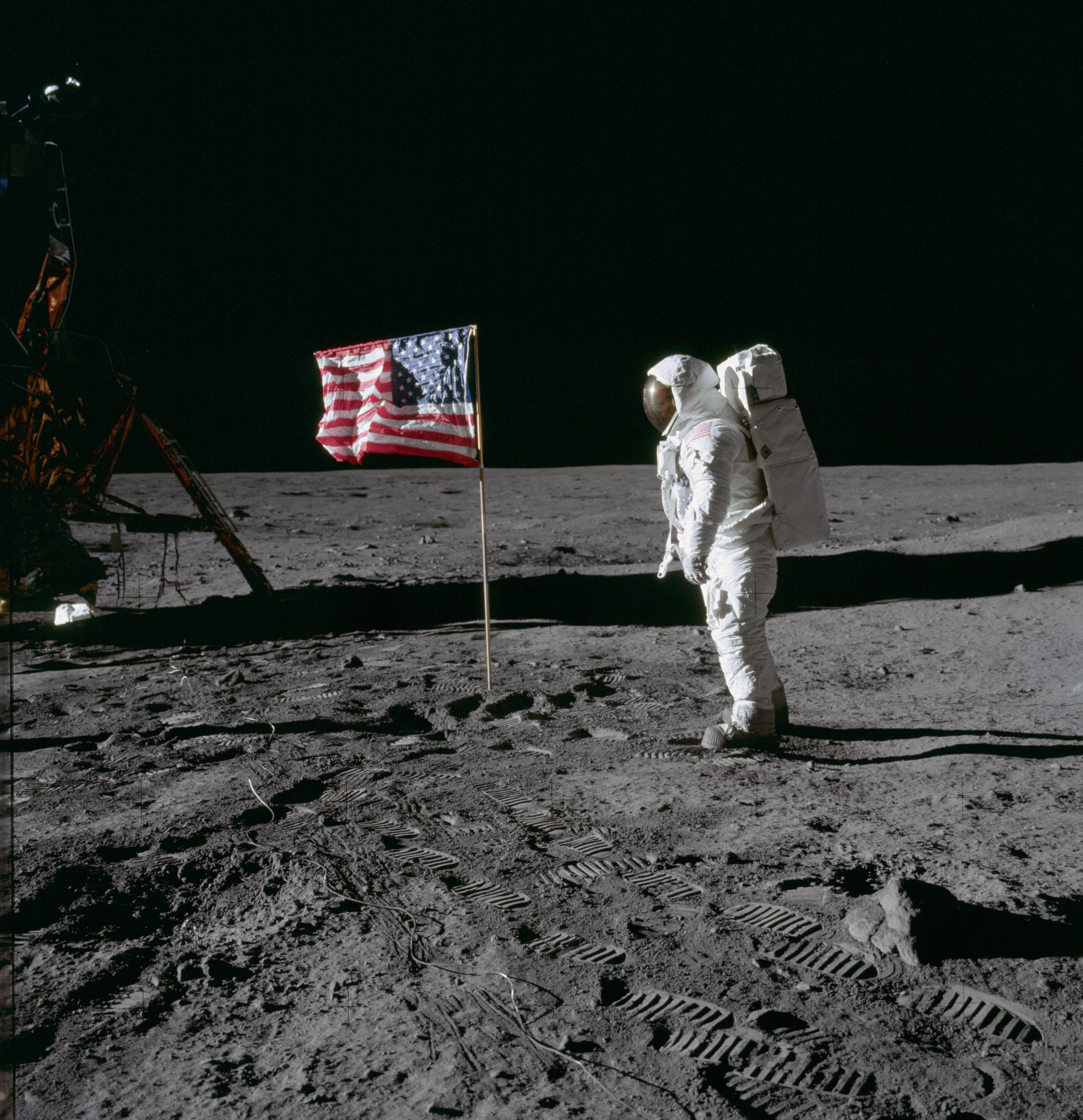
The astronauts planted the lunar flag assembly with the flag of the United States in view of the camera. Aldrin recalled that of all the tasks this was the one he most wanted to go well; but the telescoping pole would only go a couple of inches into the hard ground. Fearing it would topple in front of the television audience, he gave "a crisp West Point salute" anyway.
Before Aldrin could photograph Armstrong with the flag, Richard Nixon spoke to them over a telephone transmission that the president called the most historic call ever made from the White House. Nixon had a long speech prepared; Frank Borman, present as a NASA liaison, persuaded him to keep it short. Nixon said that because of what they had done the heavens had become part of man's world, and that for one priceless moment all the people on Earth were truly one. Armstrong replied that it was an honour to be there representing not only the United States but men of peace of all nations.
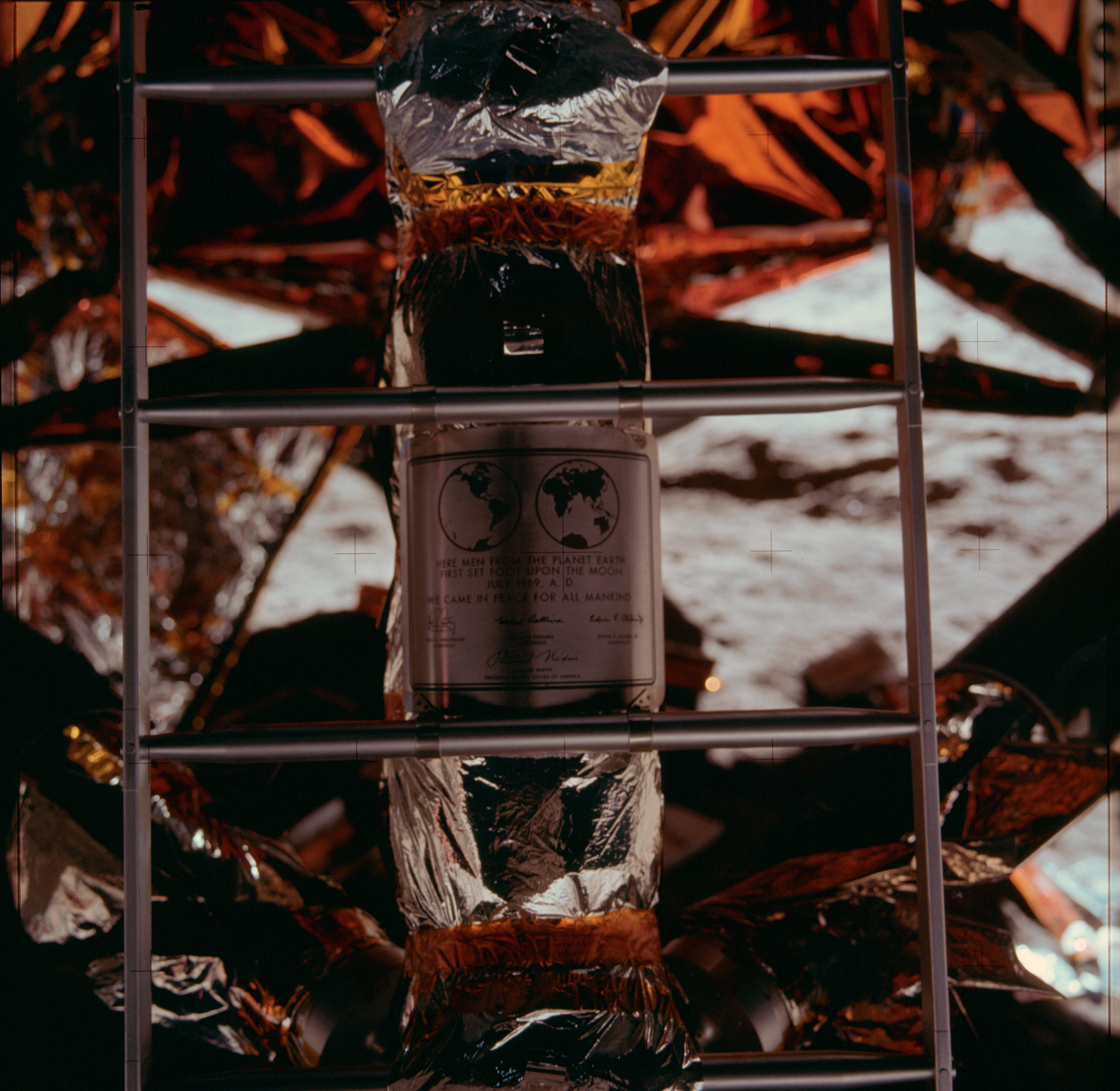
Armstrong also unveiled the plaque mounted on the lunar module's ladder, bearing two drawings of Earth — the western and eastern hemispheres — the signatures of the three astronauts and the president, and an inscription: "Here men from the planet Earth first set foot upon the Moon. July 1969, A.D. We came in peace for all mankind."
EASEP and the science on the surface
Because of the risk of an early abort on the Moon, geologists only persuaded NASA to authorise experiments that could be set up or completed within ten minutes. Apollo 11 therefore left not a full ALSEP, as later missions did, but the simpler EASEP: designed to be deployed with a single handle, with the laser retroreflector ready in under ten minutes. The package comprised a passive seismic experiment, to measure moonquakes, and a retroreflector for the lunar laser ranging experiment. Simple as it was, the seismometer was sensitive enough to detect Armstrong's movements while he slept.
A further experiment measured the heavy elements of the solar wind directly: a thin aluminium foil deployed on the surface facing the Sun, in which solar wind particles were expected to penetrate and become firmly trapped. The foil was retrieved after 77 minutes and returned to Earth inside one of the sample boxes.
Armstrong walked 196 feet (60 metres) from the lunar module to photograph the rim of Little West crater, while Aldrin took two core samples: he used the geologist's hammer to drive the tubes in — the only time the hammer was used on the mission — and could not penetrate more than six inches (15 centimetres). They then collected rocks with scoops and tongs on extension handles. Many of the tasks took longer than planned, so they stopped documenting the sample collection halfway through the 34 minutes allotted, and Aldrin shovelled 6 kilograms of soil into the rock box to pack the samples.
Mission control used a coded phrase to warn Armstrong that his metabolic rate was high and he should slow down; since the rates generally stayed below expectations, the pair were given a fifteen-minute extension. Armstrong explained in a 2010 interview that NASA limited the first moonwalk's duration and scope because there was no empirical proof of how much cooling water the backpacks would consume to remove body heat.
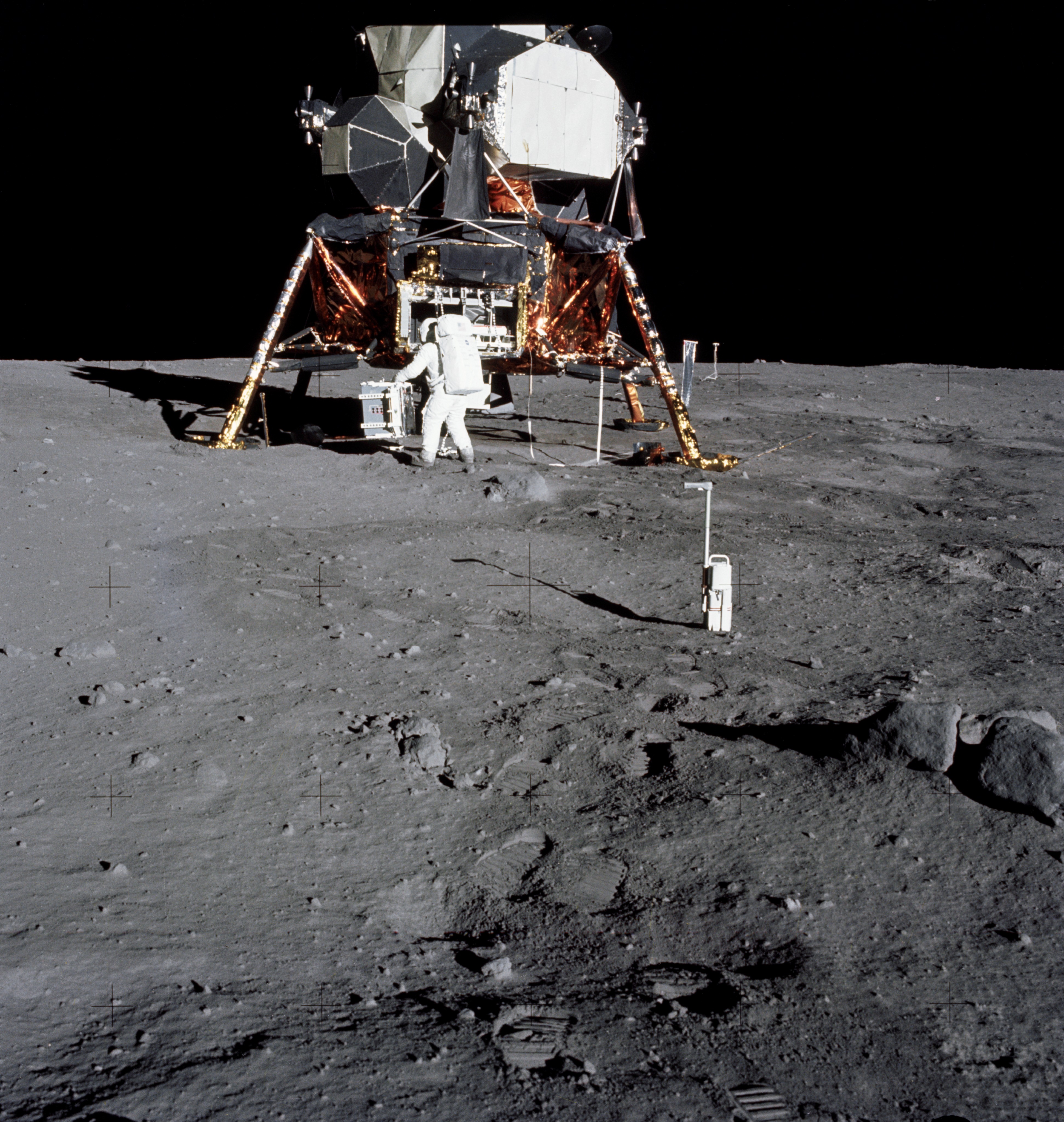
The samples contained two types of rock, basalt and breccia, and yielded three minerals previously unknown: armalcolite — named after Armstrong, Aldrin and Collins — tranquillityite and pyroxferroite. All three have since been found on Earth.
The ascent and the reunion
Aldrin entered first. With some difficulty the two hauled film and two boxes holding 21.55 kilograms of lunar surface material up to the hatch using a flat cable pulley, the lunar equipment conveyor; the system proved so inefficient that later crews preferred to carry the material up by hand. Once inside and connected to the module's life support, they lightened the ascent stage by throwing out the backpacks, lunar overshoes, an empty Hasselblad and other equipment. The hatch closed at 05:11:13 and they settled down to sleep.
Moving about the cabin, Aldrin accidentally damaged the circuit breaker that would arm the main engine for liftoff. There was concern that without it they might be stranded on the Moon; the non-conducting tip of a felt-tip pen proved enough to work the switch.
After more than twenty-one and a half hours on the surface, they left behind — besides the science instruments — an Apollo 1 mission patch in memory of Chaffee, Grissom and White; two commemorative medals for the Soviet cosmonauts Vladimir Komarov and Yuri Gagarin, who died in 1967 and 1968; a bag containing a golden replica of an olive branch, the traditional symbol of peace; and a silicon disk carrying goodwill messages from presidents Eisenhower, Kennedy, Johnson and Nixon and from leaders of 73 countries.
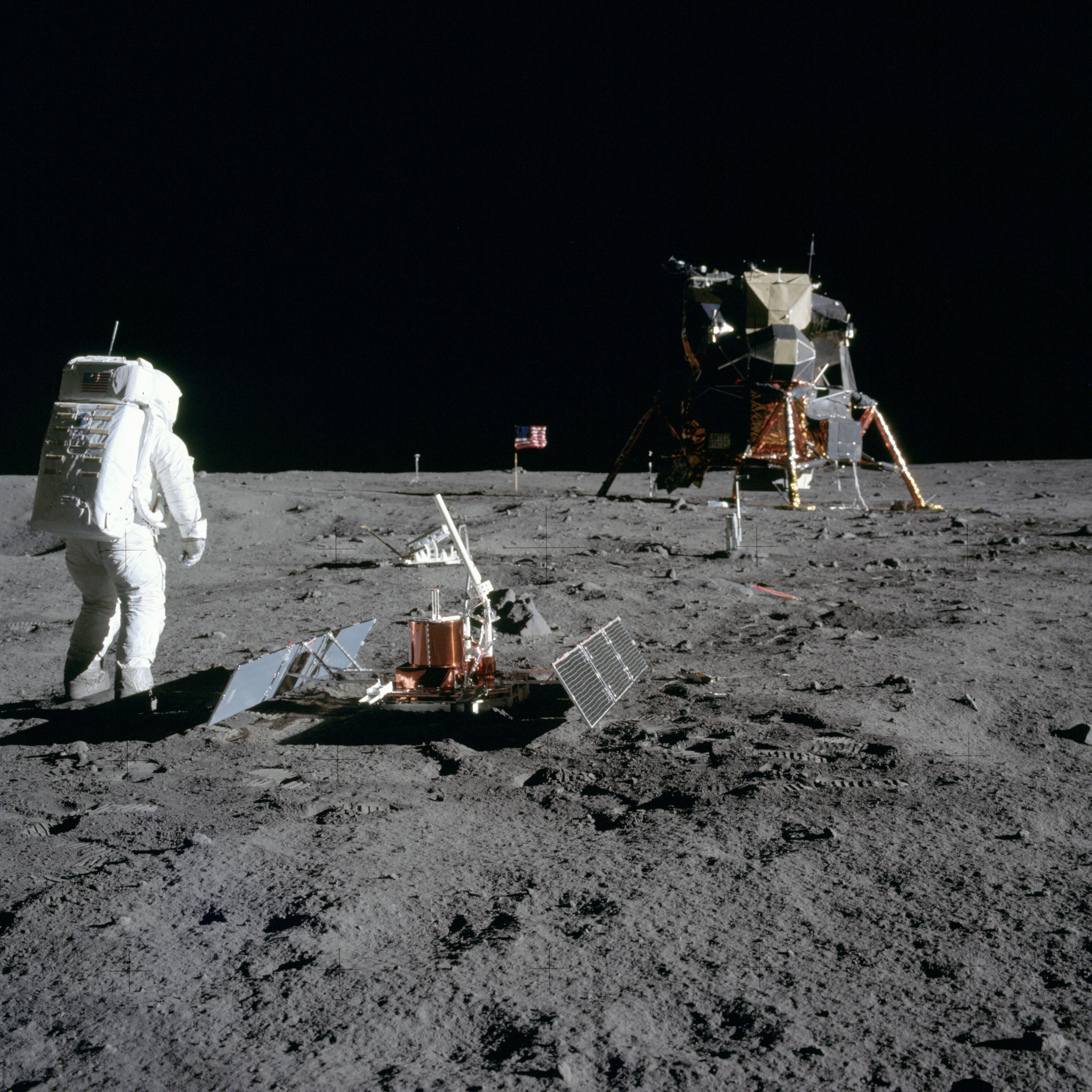
While they slept, a hundred kilometres away the Soviet probe Luna 15 was preparing to descend. Its controllers had unexpectedly brought the manoeuvre forward in an attempt to return samples ahead of Apollo 11; the probe crashed at 15:50 UTC. About two hours later, at 17:54:00 UTC, *Eagle*'s ascent stage lifted off to rejoin Collins. Film shot from the lunar module at liftoff shows the flag — planted about eight metres from the descent stage — whipping violently in the engine exhaust; Aldrin looked up in time to see it fall over. Later missions planted their flags further from the module.
*Eagle* rendezvoused with *Columbia* at 21:24 UTC on 21 July and the two docked at 21:35. The ascent stage was jettisoned into lunar orbit at 23:41.
Collins, alone around the Moon
During his day alone, Collins did not feel lonely. Although it has been written that "not since Adam has any human known such solitude", he regarded himself as a full part of the mission: he wrote in his autobiography that the venture had been structured for three men and that he considered his third as necessary as either of the other two. In the 48 minutes of each orbit when the far side left him without radio contact with Earth, what he felt was not fear or loneliness but "awareness, anticipation, satisfaction, confidence, almost exultation".
One of his first tasks was to locate the lunar module on the ground. Houston told him it believed the landing had occurred about 6.4 kilometres off target, but on every pass he searched in vain. On the third orbit, just before passing to the far side, mission control warned him of a problem with the coolant temperature: if it dropped too far, parts of *Columbia* might freeze. Instead of taking manual control and applying the prescribed malfunction procedure, Collins flicked the system switch from automatic to manual and back again, continued with his routine tasks and watched the temperature; on returning to the near side he was able to report the problem solved.
Return, splashdown and quarantine
On the way home a bearing failed at the Guam tracking station, threatening to leave the final stretch of the return without communications. There was no time for a conventional repair, so the station director, Charles Force, asked his ten-year-old son Greg to work his small hands into the housing and pack it with grease. Armstrong thanked the boy afterwards.
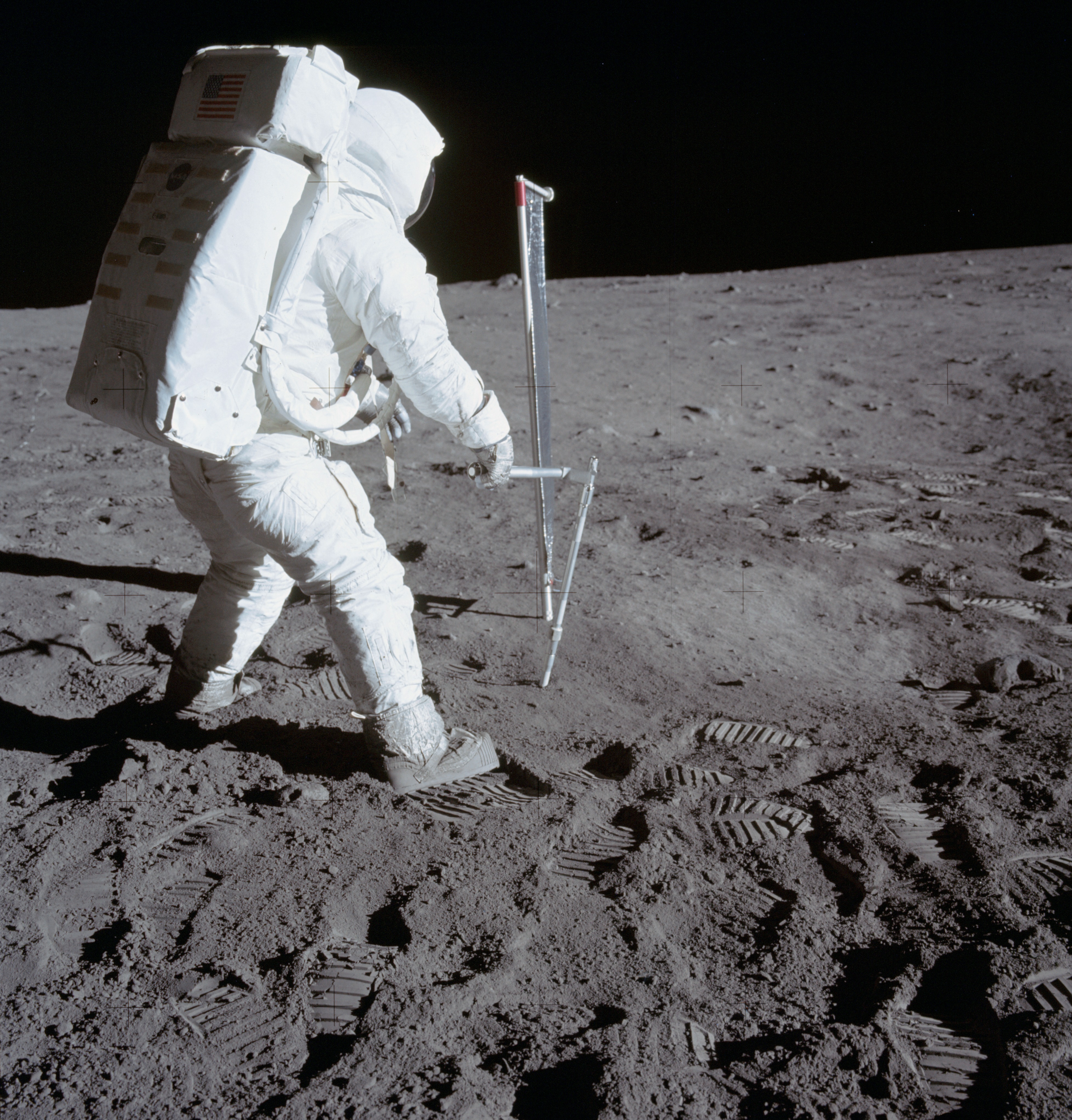
Meanwhile Air Force captain Hank Brandli, who had access to classified spy-satellite imagery, saw that a storm front was heading for the recovery area: the poor visibility and severe upper-level winds would have "torn the parachutes to shreds". He alerted Captain Willard S. Houston Jr. of the Fleet Weather Center at Pearl Harbor, who did hold the necessary clearance, and on the recommendation of both, Rear Admiral Donald C. Davis advised NASA to change the recovery area, each of them risking his career. The new area lay 215 nautical miles (398 kilometres) north-east.
The change altered the flight plan and required a re-entry sequence never used before: in a conventional re-entry the P64 event was followed by P67, while a skip-out re-entry used P65 and P66; here, since the re-entry was lengthened without actually skipping, P65 led directly to P67. The first phase subjected the crew to 6.5 g and the second to 6.0.
The aircraft carrier USS *Hornet*, under Captain Carl J. Seiberlich, had been designated primary recovery ship on 5 June, replacing USS *Princeton*, which had recovered Apollo 10 on 26 May. Arriving at Pearl Harbor on 5 July, she embarked Sikorsky SH-3 Sea King helicopters of squadron HS-4, UDT divers, a 35-strong NASA recovery team and about 120 reporters. She sailed on 12 July for the recovery area in the central Pacific.
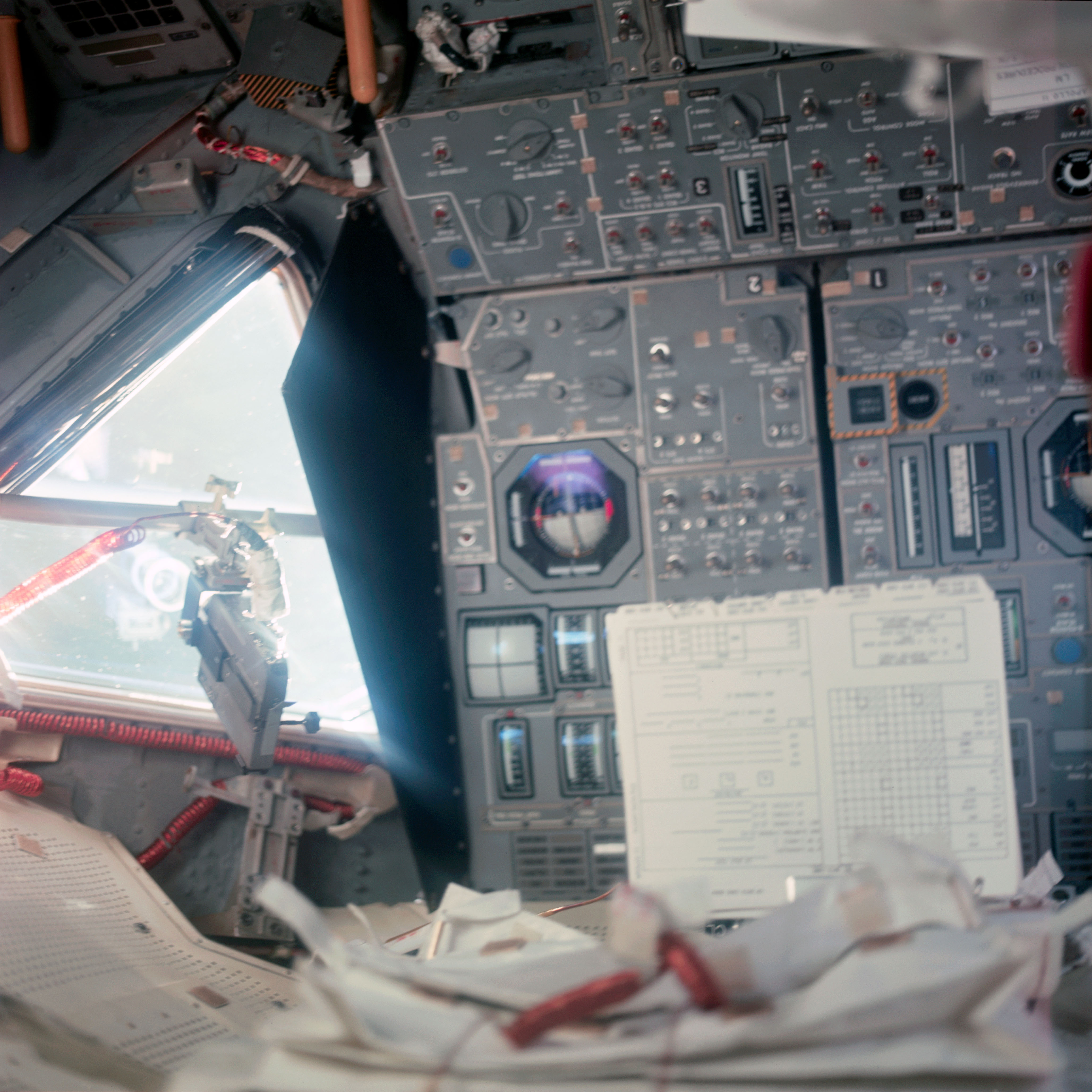
Before dawn on 24 July the *Hornet* launched four Sea Kings and three Grumman E-1 Tracers. At 16:44 UTC *Columbia*'s drogue parachutes deployed, and seven minutes later the capsule struck the water 2,660 kilometres east of Wake Island, 380 south of Johnston Atoll and 24 kilometres from the carrier. *Columbia* came to rest upside down, but flotation bags activated by the astronauts righted it within ten minutes; a diver attached a sea anchor while others fitted flotation collars and rafts.
The divers passed biological isolation garments to the crew and helped them into the raft. The possibility of bringing back pathogens from the Moon was considered remote, but NASA took precautions: the astronauts were rubbed down with a sodium hypochlorite solution and *Columbia* was wiped with povidone-iodine; the raft holding the decontamination material was deliberately sunk. After the helicopter landed on the *Hornet* at 17:53 UTC, the astronauts walked nine metres to the Mobile Quarantine Facility, where they began the terrestrial part of their twenty-one days of isolation. Nixon greeted them there and told them that because of what they had done the world had never been closer together.
*Columbia* was lifted aboard by the ship's crane and mated to the quarantine facility by a flexible tunnel, through which engineer John Hirasaki extracted the samples, film and data tapes. All the recovered material was flown to Ellington Air Force Base in Houston and reached the Lunar Receiving Laboratory in under 48 hours. The *Hornet* returned to Pearl Harbor on 26 July; the quarantine facility was loaded onto a Lockheed C-141 Starlifter and landed in Houston on the 27th, and the astronauts entered the laboratory at 10:00 UTC on the 28th. Under the Extra-Terrestrial Exposure Law, promulgated by NASA on 16 July to codify its protocol, quarantine was maintained until 10 August 1969, when the Interagency Committee on Back Contamination released the crew in Atlanta with a clean bill of health.
Celebrations and the world tour
On 13 August 1969 Armstrong, Aldrin and Collins were honoured with ticker-tape parades in New York and Chicago before an estimated six million people; in New York the route ran from Bowling Green to the United Nations headquarters, and Broadway was renamed "Apollo Way" for the day. That evening, at a state dinner in Los Angeles attended by members of Congress, forty-four governors and ambassadors from 83 nations, Nixon and Agnew presented each astronaut with the Presidential Medal of Freedom. On 16 September they addressed a joint session of Congress and presented two United States flags that had travelled to the lunar surface aboard *Eagle*, one for the House and one for the Senate.
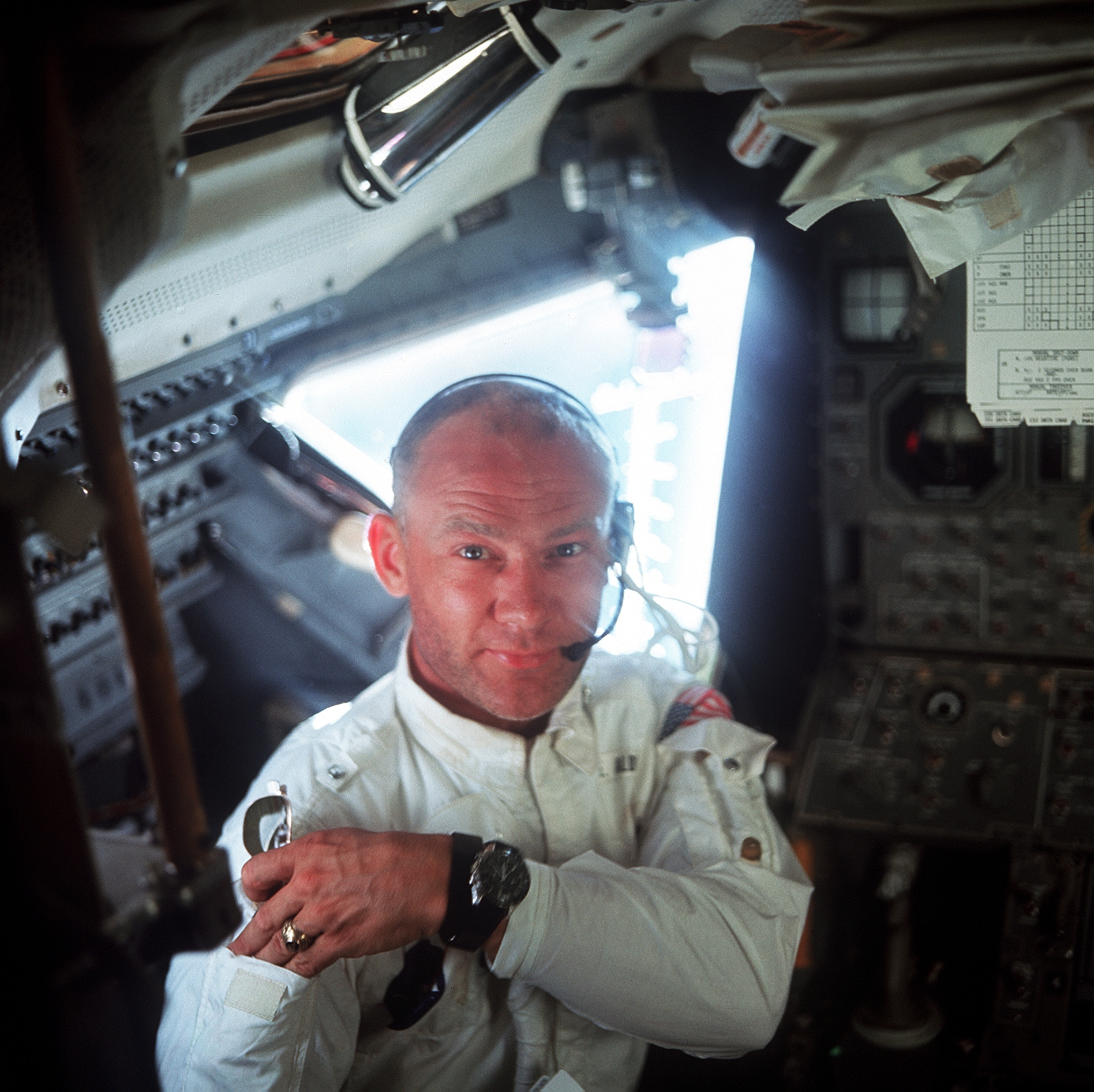
The goodwill world tour, titled "Giant Leap", lasted 38 days: it began on 29 September in Mexico City and ended on 5 November 1969 in Tokyo, with stops in 22 countries — among them Bogotá, Buenos Aires, Rio de Janeiro, Madrid, Paris, Amsterdam, Brussels, London, West Berlin, Rome, Belgrade, Tehran, Bombay, Bangkok, Sydney, Guam and Honolulu. In London Elizabeth II received them at Buckingham Palace; in Belgrade a crowd of four to five hundred thousand accompanied them from the airport to the Tomb of the Unknown Soldier.
Legacy
Walking on the Moon and returning safely fulfilled the goal Kennedy had set eight years earlier: during the landing, in mission control, his speech flashed onto the screens followed by the words "TASK ACCOMPLISHED, July 1969". With Apollo 11, the United States had won the Space Race.
Not everyone celebrated in the same way. The day before the launch, protesters led by Ralph Abernathy demonstrated outside the Kennedy Space Center over the contrast between space spending and poverty; administrator Thomas Paine met him and ended by inviting the protesters to watch the launch as guests. The poet Gil Scott-Heron wrote "Whitey on the Moon" in 1970, reading the mission as emblematic of racial inequality in the United States.
*Columbia* toured the United States, visiting 49 state capitals, Washington D.C. and Anchorage; in 1971 it passed to the Smithsonian and was displayed at the National Air and Space Museum in the Milestones of Flight hall, alongside the Wright Flyer, the Spirit of St. Louis, the Bell X-1, the X-15 and Friendship 7. In 2017 it moved to the restoration hangar at the Steven F. Udvar-Hazy Center to be prepared for the "Destination Moon" tour. *Eagle*'s descent stage remains on the Moon: in 2009 the Lunar Reconnaissance Orbiter photographed the landing sites at resolution sufficient to make out the descent stages, the instruments and the astronauts' foot trails. The ascent stage, which was not tracked after jettison, was assumed to have crashed at an unknown point, although a paper published in 2021 argues that it might still be in orbit.
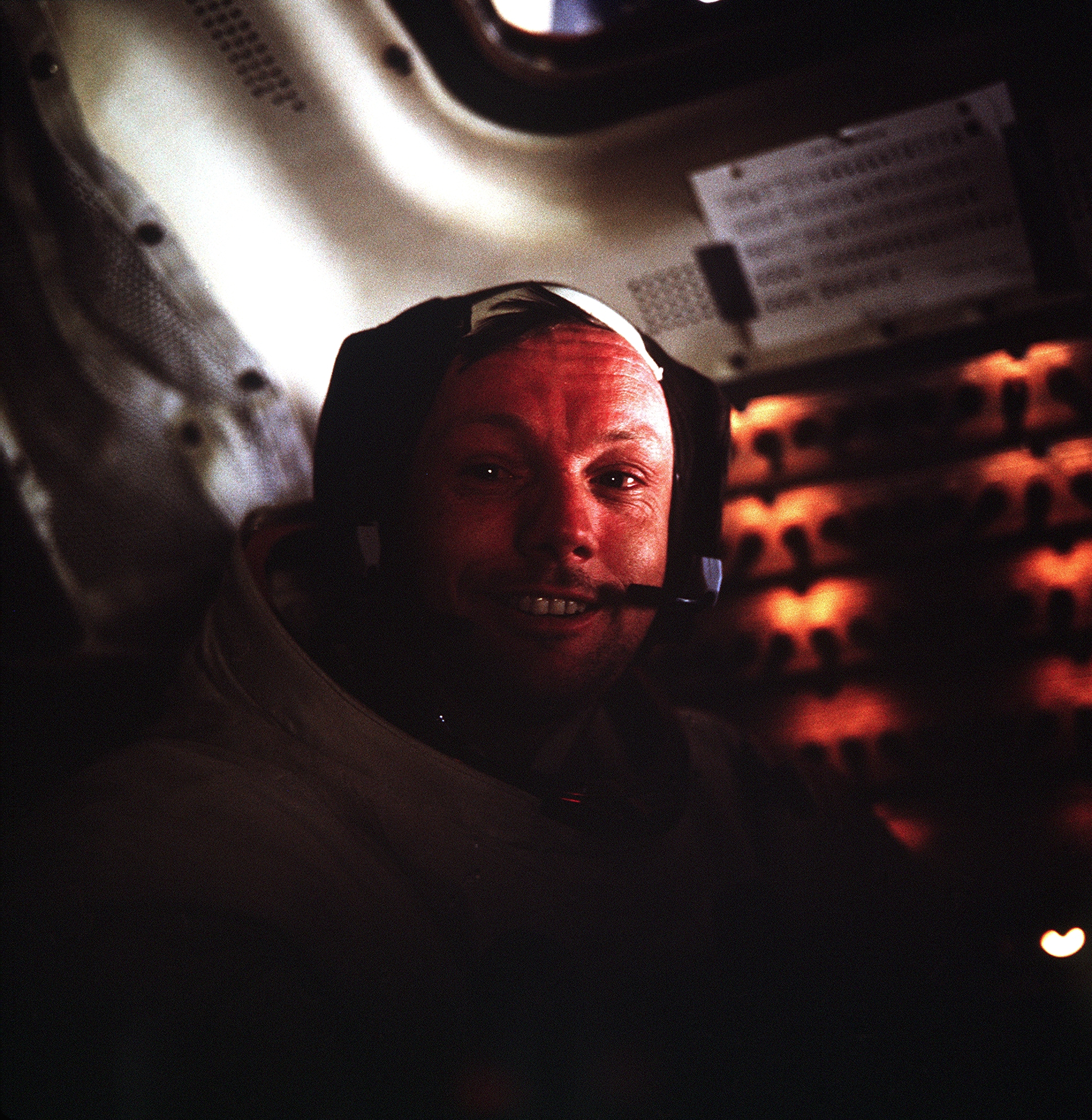
Of the experiments, the passive seismic package stopped receiving commands on 25 August 1969 and lost its downlink on 14 December; the laser retroreflector, by contrast, remains operational as of 2025 and is still measuring the Earth-Moon distance half a century later. The rocks are kept at the Lunar Sample Laboratory Facility at the Johnson Space Center, with a smaller collection at White Sands: over a hundred laboratories worldwide study them, and about five hundred samples are prepared and sent to investigators each year. In November 1969 Nixon asked NASA to prepare some 250 commemorative displays with Apollo 11 lunar dust and flags for 135 nations, the fifty states and the United Nations.
The F-1 engines of the first stage that launched Apollo 11 were located on the Atlantic seabed in 2012 by a team financed by Jeff Bezos, and in July 2013 a conservator found a serial number under the rust that NASA confirmed as Apollo 11's. The S-IVB stage that performed the trans-lunar injection remains in a solar orbit near that of Earth.
Images
Elsewhere
- National Air and Space MuseumBuzz Aldrin on the Moon (visor reflection) ↗
- National Air and Space MuseumApollo 11 collection ↗
- Flickr / Project Apollo ArchiveApollo 11 first photo by Neil Armstrong after setting foot on the Moon ↗
- Flickr / Project Apollo ArchiveApollo 11 first photo on the Moon after landing ↗
- Flickr / Project Apollo ArchiveAS11-40-5868, Apollo 11 Hasselblad image from film magazine 40 ↗
- Encyclopedia BritannicaUS astronaut Edwin Aldrin walking on the Moon, July 20 1969 ↗
- Encyclopedia BritannicaApollo 11 — History, Mission, Landing, Astronauts ↗
- NASA History Office (ALSJ)Apollo 11 Image Library ↗
- National GeographicApollo 11 in Photos: 50 Favorite Images of the Moon Mission ↗
- Space.comApollo 11 Moon Landing Pictures ↗
- Space.comApollo 11 Moon Landing Site Seen in Unprecedented Detail ↗
- WikipediaLunar Panoramic Photography — Apollo 11 ↗
Videos





Show the 36 more







Did you know… about Apollo 11
- How much did the space race cost?
The American side is documented: Project Apollo cost about 25.4 billion dollars as reported to Congress in 1973, roughly 257 billion in 2020 dollars, with…
- How much does the saturn v weigh?
A fully fuelled Saturn V weighed about 2,900 tonnes (some 6.4 million lb) at liftoff for the Apollo lunar missions, with propellant accounting for almost all…