Apollo program · NASA · Crewed
Apollo 10
- May 18, 1969, 4:49 PM
- Launch date
- 3
- Crew size
- 8 days
- Duration
- Success
- Outcome




_rollout_to_Launch_Complex_39B-1600.webp)


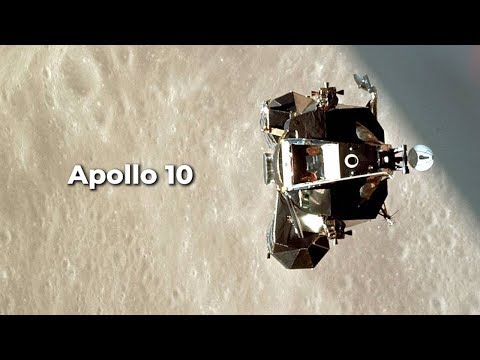
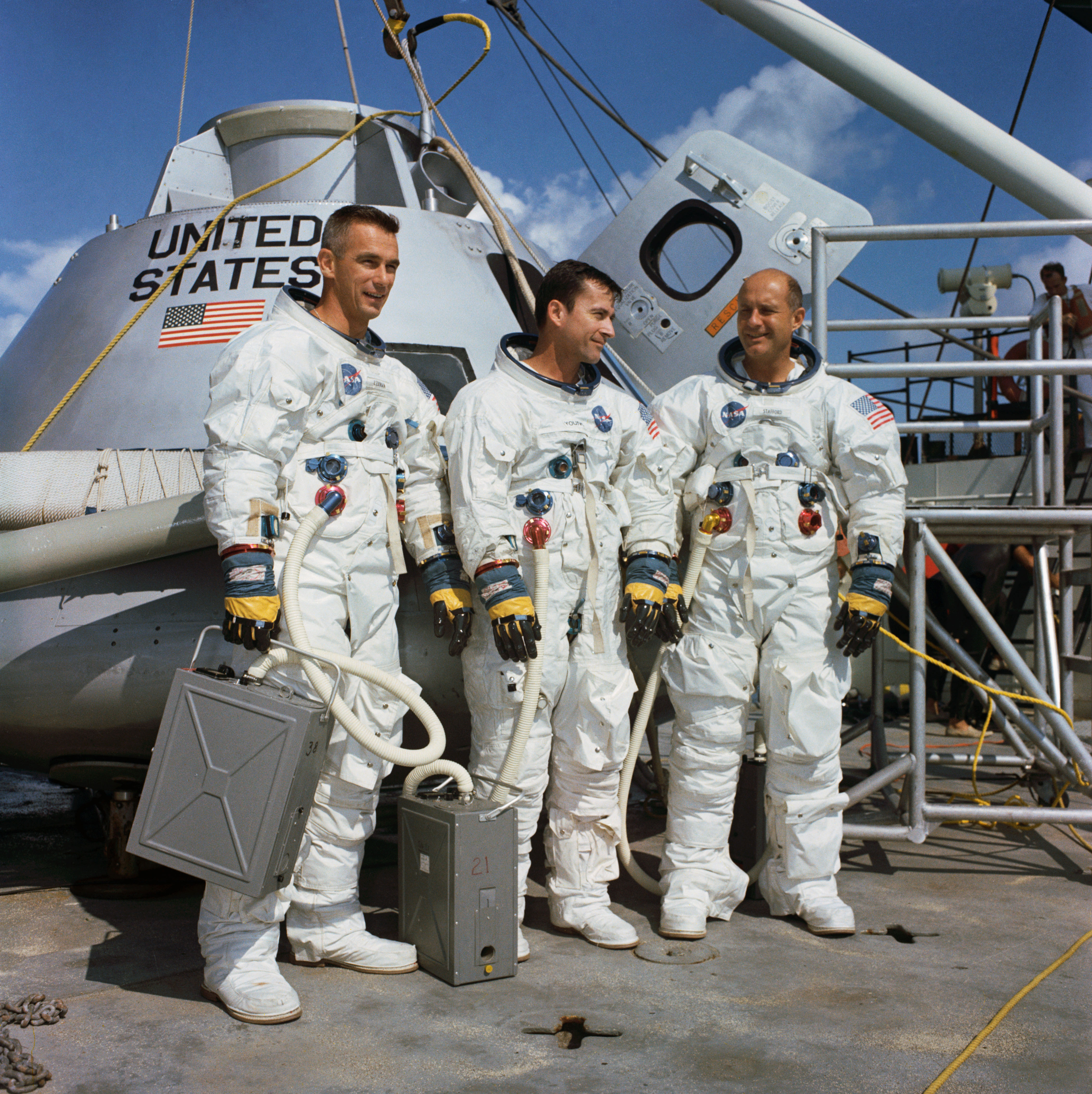
Apollo 10 was the fourth crewed mission of the Apollo programme and the second to orbit the Moon. NASA designed it as the dress rehearsal for the first landing: an "F" mission meant to repeat, step by step, everything Apollo 11 would do two months later, short of the final descent. It lifted off on May 18, 1969 from Launch Complex 39B at Kennedy Space Center on Saturn V AS-505 — the only Apollo launched from that pad — and splashed down in the Pacific on May 26. Its crew, the first American crew made up entirely of spaceflight veterans, was Thomas P. Stafford (commander), John Young (Command Module Pilot) and Gene Cernan (Lunar Module Pilot). The call signs came from *Peanuts*: *Charlie Brown* for the Command Module and *Snoopy* for the Lunar Module, and both characters became the mission's semi-official mascots. In lunar orbit Young stayed alone in *Charlie Brown* while Stafford and Cernan took *Snoopy* down to about 14.4 km above the surface, the altitude at which Apollo 11 would start its powered descent, to test the landing radar and survey the chosen site in the Sea of Tranquility. The Lunar Module carried only enough propellant for the rehearsal and could not have lifted off had it landed. A switch set the wrong way sent the ascent stage into an uncontrolled tumble, which Stafford mastered within seconds before rejoining the Command Module. Apollo 10 circled the Moon 31 times over about 61 hours and 37 minutes, sent the first colour television from inside a spacecraft and, on the way home, set the record for the highest speed reached by a crew relative to the Earth: 39,897 km/h. It met all its primary objectives and cleared the way for Apollo 11. The Command Module is displayed in London, and *Snoopy*'s ascent stage, sent into solar orbit, may be the asteroid 2018 AV2.
Payload
Saturn V AS-505 launched a spacecraft of about 76.99 tonnes, the heaviest yet placed in orbit, made up of Command and Service Module CSM-106 *Charlie Brown* (Command Module 106 and Service Module 106), Lunar Module LM-4 *Snoopy*, the SLA-13A adapter that housed the Lunar Module and joined it to the S-IVB Instrument Unit, and the launch escape system. *Snoopy* was an early Lunar Module too heavy to land: loaded for the mission it weighed 13,941 kg, and its ascent stage carried only rehearsal propellant, against 15,095 kg for the Apollo 11 Lunar Module. The flight carried the first colour television camera installed inside the spacecraft. The descent stage was left in lunar orbit, the ascent stage was sent into heliocentric orbit, and the Command Module is on loan from the Smithsonian to the Science Museum in London.
| Crew | Role | Agency | Extravehicular activity |
|---|---|---|---|
| Thomas Patten Stafford | Commander | NASA · United States | — |
| John Watts Young | Command module pilot | NASA · United States | — |
| Eugene Andrew "Gene" Cernan | Lunar module pilot | NASA · United States | — |
History
An "F" mission instead of a landing
By 1967 NASA had laid out the road to the Moon as a ladder of mission types labelled with letters, the top rung, "G", being the first landing attempt. Uncrewed flights filled the A and B slots; Apollo 7, the first crewed test of the Command and Service Module in Earth orbit, was the C mission, and Apollo 9 flew the D mission by testing the Lunar Module with astronauts aboard around the Earth. Apollo 8, which went into lunar orbit without a Lunar Module, was dubbed "C-prime", and its success persuaded the agency to drop the E mission, meant to exercise the complete spacecraft in high Earth orbit. Apollo 10 was given the letter F: the dress rehearsal, with every piece of hardware and every procedure of a landing except the final descent.
Some within NASA argued for skipping that step too and landing on Apollo 10. Taking two men to within a few kilometres of the surface only to turn them back seemed pointless. The Lunar Module assigned to Apollo 10 was too heavy for a surface mission, but the one built for Apollo 11 could be swapped in if the flight slipped a month from its planned May 1969 date. George Mueller, head of crewed spaceflight and known for pushing the programme hard, favoured the attempt. Christopher C. Kraft, Director of Flight Operations, and others objected: rendezvous in lunar orbit needed new procedures, and too little was known about the Moon's mass concentrations, which could pull a spacecraft off its path. Lieutenant General Sam Phillips, the Apollo Program Manager, heard both sides and ruled that a dress rehearsal was essential.
Stafford, Young and Cernan
NASA named the crew on November 13, 1968. The commander, Thomas P. Stafford, was 38; a 1952 Naval Academy graduate commissioned in the Air Force, he joined the second astronaut group in 1962 and had already flown as pilot of Gemini 6A (1965) and command pilot of Gemini 9A (1966). Command Module Pilot John Young, also 38, was a Navy commander; a 1952 Georgia Tech graduate and a test pilot from 1959, he was selected alongside Stafford, flew Gemini 3 with Gus Grissom in 1965 — becoming the first American outside the Mercury Seven to reach space — and then commanded Gemini 10 (1966) with Michael Collins. Lunar Module Pilot Gene Cernan was a 35-year-old Navy commander, a 1952 Purdue graduate chosen in the third group in 1963, who had flown Gemini 9A with Stafford. With five earlier flights between them, they were the most experienced crew to reach space until the Shuttle era and the first American crew made up entirely of spaceflight veterans.
The backup crew was Gordon Cooper, Donn F. Eisele and Edgar D. Mitchell, who under the usual rotation would have flown Apollo 13. Cooper and Eisele never flew again: Deke Slayton, Director of Flight Crew Operations, felt Cooper did not train hard enough, and Eisele carried the friction with ground controllers on Apollo 7 and a messy divorce. Slayton had only named them because veterans were scarce. Alan Shepard and Stuart Roosa took their places; Mueller turned that crew down for Apollo 13 as needing more training, and it flew Apollo 14 instead, on which Shepard and Mitchell walked on the Moon.
Apollo also introduced a third, support crew, created by Slayton on the advice of James McDivitt so that no meeting at the facilities scattered across the country would lack an astronaut. Usually junior, its members compiled and updated the mission rules, flight plan and checklists; for Apollo 10 they were Joe Engle, James Irwin and Charles Duke. The flight directors were Gerry Griffin, Glynn Lunney, Milt Windler and Pete Frank, and the capsule communicators (CAPCOMs) were Duke, Engle, Jack Lousma and Bruce McCandless II.
Charlie Brown and Snoopy
The call signs came from the *Peanuts* comic strip: the Command Module would be *Charlie Brown* and the Lunar Module *Snoopy*. The astronauts picked them with the blessing of Charles Schulz, who had his doubts because Charlie Brown always failed. Some at NASA found the names undignified, as they had Apollo 9's *Gumdrop* and *Spider*, and public relations chief Julian Scheer pressed for weightier names on the landing flight, which became *Columbia* and *Eagle*. For Apollo 10, though, the characters' popularity turned the choice into a publicity triumph, and both became the mission's semi-official mascots; Schulz also drew mission artwork for NASA.
Snoopy fitted twice over. The Lunar Module was going to "snoop" around the landing site, and the beagle had long been tied to the space programme: outstanding workers received a silver Snoopy pin, and posters of the dog, swapping his flying helmet for a space helmet, hung in NASA facilities. Stafford said the name acknowledged the hundreds of thousands of people who had got them there. In the strip, Snoopy had already reached the Moon the year before.
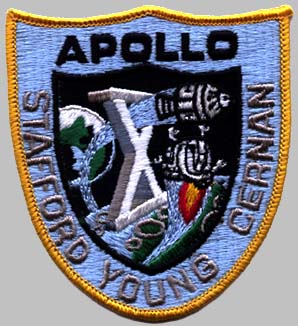
The shield-shaped insignia shows a large three-dimensional Roman numeral X standing on the lunar surface — to show they had left their mark, in Stafford's words — with a Command and Service Module circling the Moon and a Lunar Module ascent stage climbing with its engine firing after its low pass, and the Earth behind. A wide light-blue border carries APOLLO at the top and the crew names below, trimmed in gold. It was designed by Allen Stevens of Rockwell International.
Rehearsal and landing site
The official mission report lists two primary objectives: to demonstrate crew, space vehicle and mission support performance on a crewed lunar mission with both modules, and to evaluate the Lunar Module in the cislunar and lunar environment. The crew was also to photograph Apollo Landing Site 2 (ALS-2) in the Sea of Tranquility, the site chosen for Apollo 11. Apollo 10 was to mirror the first landing as closely as possible — trajectory out and back, timeline, even the Sun angle over ALS-2 — without touching down.
ALS-1, the easternmost candidate, had been photographed extensively by Apollo 8; ALS-2 was preferred as relatively smooth and scientifically interesting. At the suggestion of scientist-astronaut Harrison Schmitt the launch was pushed back to photograph ALS-2 in good light: when the date was announced on January 10, 1969 it moved from a placeholder of May 1 to May 17, and on March 17 it slipped one more day to May 18 for a better view of ALS-3, west of ALS-2. The other departure from the Apollo 11 plan was an extra day in lunar orbit after the two craft rejoined, to test the Lunar Module's systems further and photograph possible future landing sites.
The crew put in five hours of formal training for every hour of the planned eight-day flight, on top of technical briefings and study. They attended tests of the Command and Service Module at North American Rockwell in Downey, California, and of the Lunar Module at Grumman in Bethpage, New York; were briefed on the Apollo Guidance Computer at the MIT Instrumentation Laboratory in Cambridge, Massachusetts; each logged more than 300 hours in the simulators at the Manned Spacecraft Center in Houston and at Kennedy Space Center; and rode the Houston centrifuge to prepare for re-entry loads.
A Lunar Module that could not land
Although Apollo 10 followed a landing script up to powered descent, its Lunar Module could not have landed and returned to orbit. The ascent stage carried only the propellant it would have had left after lifting off the surface and climbing to the altitude where it was to fire, roughly half of what a liftoff and rendezvous required. Loaded for the mission it weighed 13,941 kg, against 15,095 kg for the Apollo 11 Lunar Module. In his 2009 book *Rocket Men*, Craig Nelson quoted Cernan: some people worried that this crew might try to land given the chance, so the ascent stage was short-fuelled and a landing would have left them unable to lift off. Mueller dismissed the speculation, explaining that it was an early, overweight design able to serve only for the rehearsal.
AS-505, CSM-106 and LM-4
The Lunar Module descent stage reached Kennedy Space Center on October 11, 1968, the ascent stage five days later, and the two were mated on November 2. The Service and Command Modules arrived on November 24 and were joined two days later. Saturn V components came in over November and December 1968, and the full rocket stood in the Vehicle Assembly Building (VAB) on December 30. After altitude-chamber testing the spacecraft was stacked on the launcher on February 6, 1969. The vehicle rolled out to Launch Complex 39B on March 11; because it had been assembled in the VAB's High Bay 2, used for the first time, the crawler had to leave through the back of the building and loop around it before joining the main crawlerway. The rollout, on Mobile Launch Platform 3, came eight days after the launch of Apollo 9, which was still in orbit.
The launcher was Saturn V AS-505, the fifth of its kind to fly and the third to carry astronauts into orbit. Compared with Apollo 9's, its first two stages were lighter dry, mainly thanks to a lighter interstage; the S-IVB third stage was slightly heavier, but all three stages could hold more propellant and the S-II second stage gave more thrust. The spacecraft comprised Command Module 106 and Service Module 106 (together CSM-106), Lunar Module 4 (LM-4), the SLA-13A adapter that housed the Lunar Module and joined the spacecraft to the rocket's Instrument Unit, and the launch escape system. At about 76.99 tonnes, Apollo 10 would be the heaviest spacecraft yet placed in orbit.
Launch from Pad 39B
The countdown began at 01:00 UTC on May 17, and the snags that came up were cleared during the built-in holds without delaying the flight. The day before, Cernan was pulled over for speeding on his way back from a last visit to his wife and daughter; carrying no identification and under orders not to say who he was, he feared arrest until pad leader Gunther Wendt, who had recognised him and stopped nearby, explained things to a sceptical officer.
Apollo 10 lifted off on May 18, 1969 at 16:49:00 UTC (12:49 local time), at the opening of a four-and-a-half-hour window timed for the right lighting over ALS-2 at the Lunar Module's closest approach days later. With Pad 39A already being readied for Apollo 11, it was the only Apollo flight to leave from 39B and the only one run from that complex's Firing Room 3. Pogo oscillations made for a rough ride, and about 12 minutes after liftoff the spacecraft was in a low orbit of 185.79 by 184.66 km. After a systems check the crew relit the S-IVB for trans-lunar injection; the stack shook again and Cernan briefly feared an abort, but the burn — 5 minutes 43 seconds long according to the mission report — ended normally.
Young then flew the transposition, docking and extraction manoeuvre, pulling the Command and Service Module away, turning it round, docking its nose to the Lunar Module and drawing the pair clear of the S-IVB. Apollo 10 was the first mission with a colour television camera inside the spacecraft, and Houston watched the manoeuvre live before the public got its first colour views of the Earth. One problem surfaced: the mylar cover of the Command Module hatch had come loose, spreading fibreglass insulation through the tunnel and later into both modules. The S-IVB, commanded from the ground, went into solar orbit with a period of 344.88 days.
Three days out
The outbound coast was quiet. With a light workload the crew studied the flight plan, slept and made five colour television broadcasts; they were told that more than a billion people had watched some of their activities, and in June 1969 they accepted a special Emmy on behalf of the first four Apollo crews for their broadcasts from space. A single course correction was needed, at 26:32:56.8 into the mission, lining the spacecraft up with the trajectory planned for Apollo 11; the third and fourth corrections in the plan proved unnecessary. The one sour note was the food: Stafford apparently put a double dose of chlorine into the drinking water that was also used to rehydrate their meals.
In lunar orbit
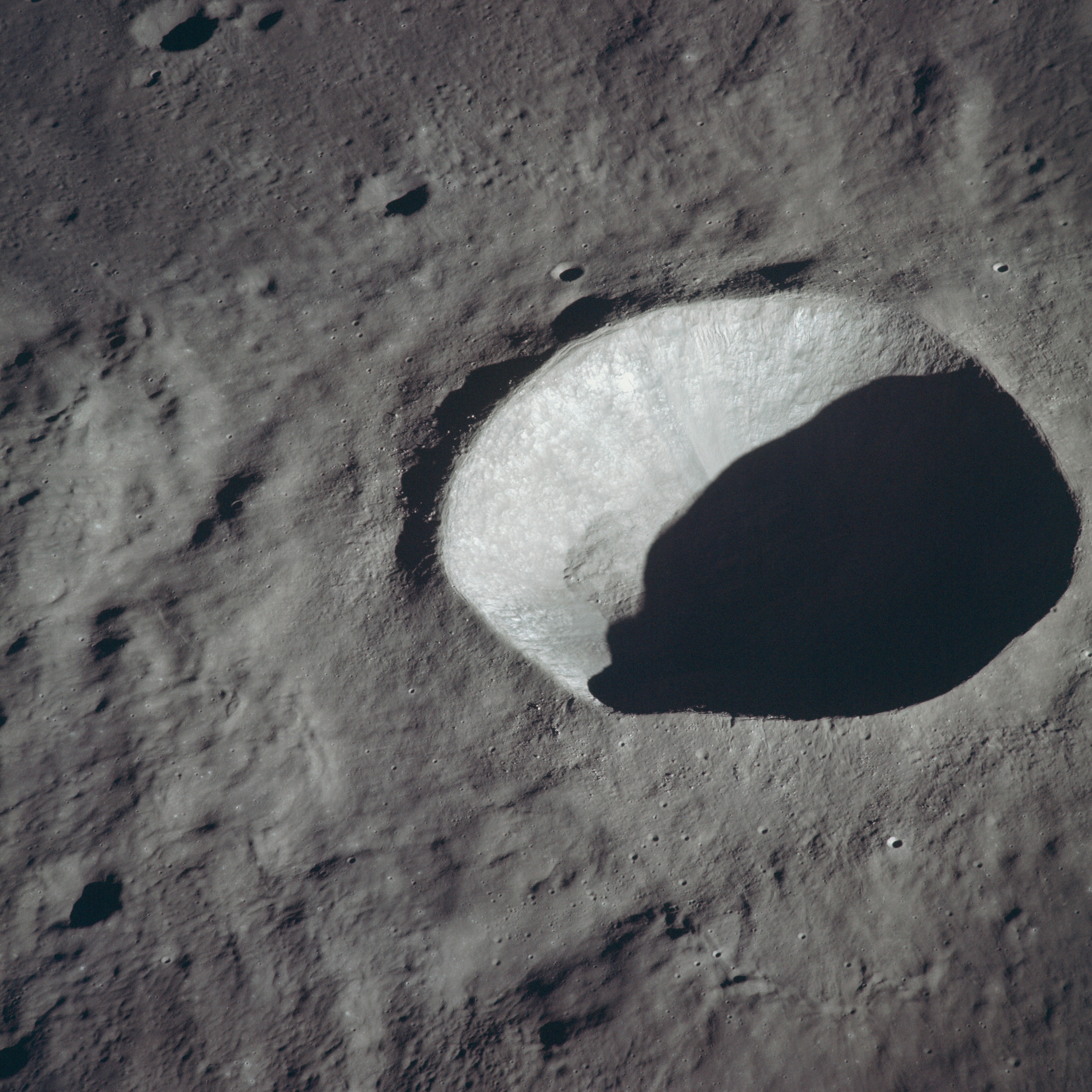
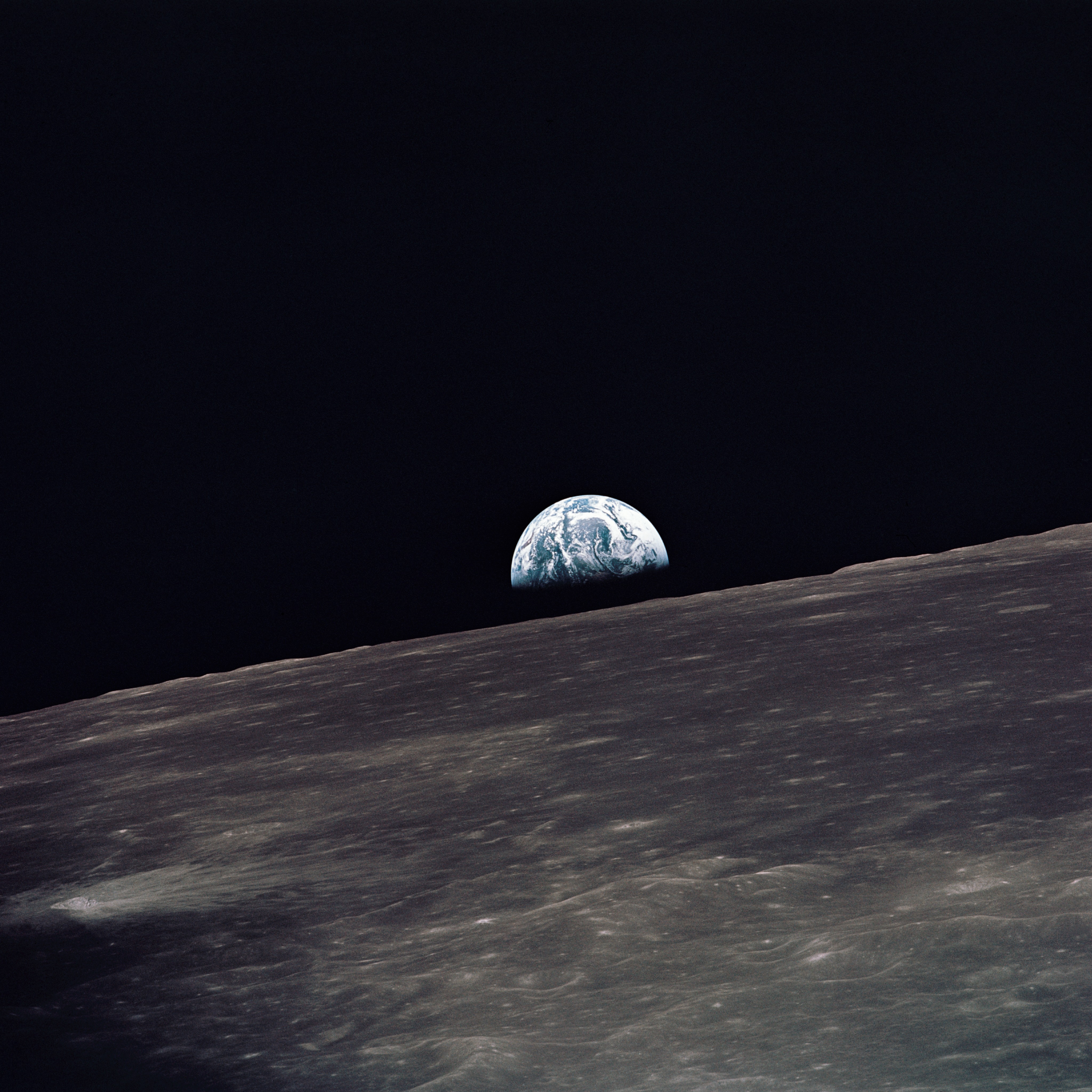
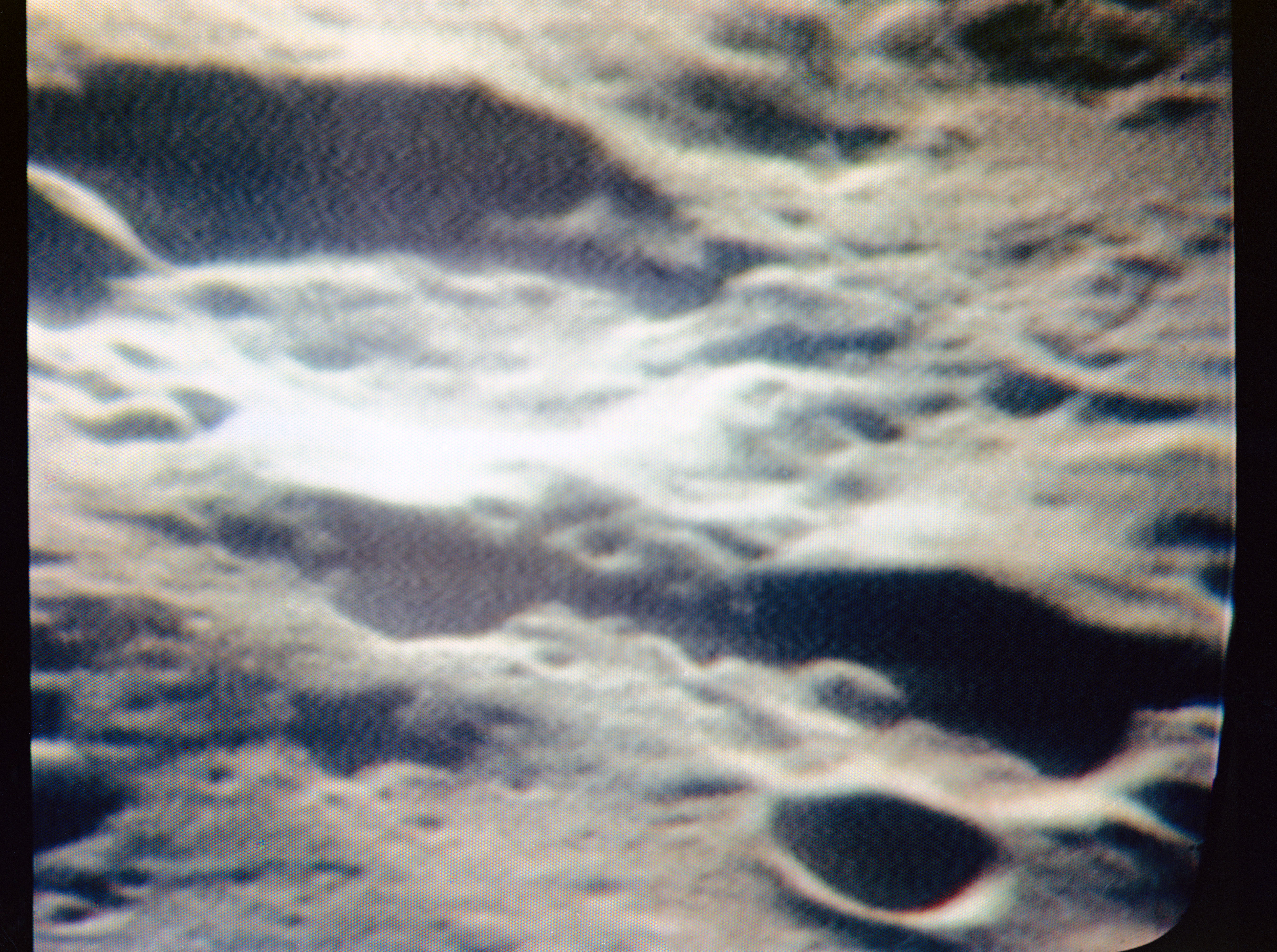
At 75:55:54 into the flight, 176.1 km above the far side, the service module's main engine fired for 356.1 seconds to brake the spacecraft into a 314.8 by 111.5 km lunar orbit. Two revolutions later a 13.9-second burn at 80:25:08.1 circularised it to 113.0 by 109.6 km. The crew spent the first hours tracking landmarks, photographed all three candidate landing sites and craters such as Coriolis, King and Papaleksi on both hemispheres, and put out half an hour of colour television of the surface below.
An hour after the second burn Stafford and Cernan moved into the Lunar Module to check it out and were met by a blizzard of fibreglass particles. They vacuumed up what they could; Stafford had to pick bits out of Cernan's hair and eyebrows, later saying he looked as if he had come out of a chicken coop. The particles itched, got into the air conditioning and had to be scraped off the filter screens for the rest of the flight. Mostly an annoyance, they may also have slightly misaligned the docking ring, which Mission Control judged still within safe limits.
The flight of Snoopy
After a rest in *Charlie Brown*, Stafford and Cernan re-entered *Snoopy* at 95:02 and undocked about three hours later, leaving Young as the first person to fly solo in lunar orbit. The Lunar Module crew deployed the landing gear and checked their systems while Young inspected the craft by eye after backing off about 9 metres on his thrusters; a second separation opened the gap to some 3.7 km. Stafford and Cernan then fired the descent engine for 27.4 seconds at 99:46:01.6 and exercised the landing radar — until then tested only on Earth — as they neared 15,000 metres, the altitude at which Apollo 11 would begin its powered descent. Young tracked the Lunar Module throughout, ready to go to its rescue.
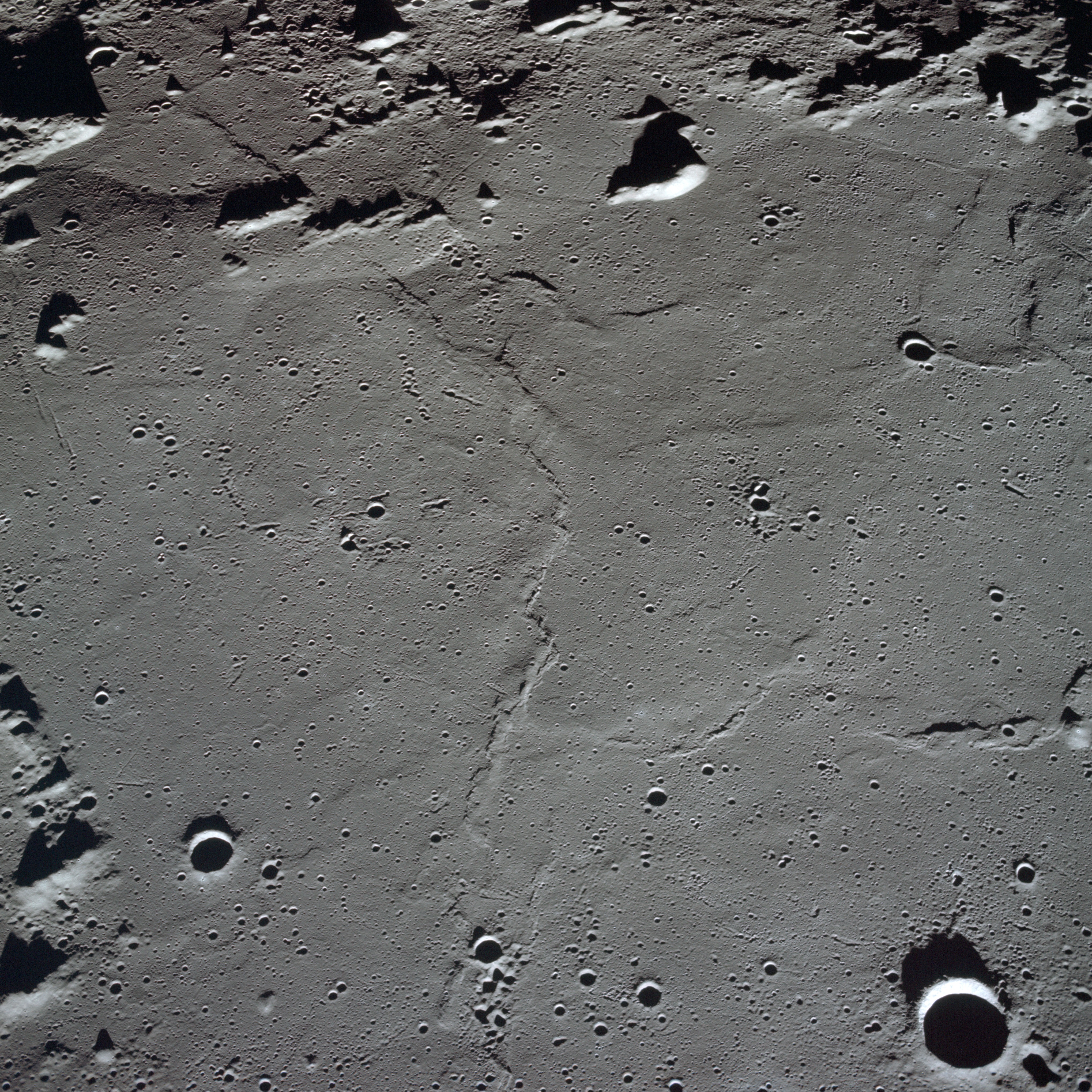
On the first pass, 15 degrees east of ALS-2, they came down to 15.6 km above the surface; a phasing burn of just under 40 seconds at 100:58:25.93 set up a second pass on which they reached 14.4 km, their closest approach. Stafford reported the site smoother than expected, like the desert around Blythe, California, but warned that an Apollo 11 landing off-target could meet rougher ground downrange. On the strength of those observations NASA confirmed ALS-2 as the first landing site.
A tumble out of control
What remained was to separate the ascent stage, drop the descent stage and fire the ascent engine back towards the Command Module. As they prepared, the Lunar Module began to gyrate. Cernan swore into a live microphone, which, with other salty language during the flight, drew complaints on Earth. Stafford jettisoned the descent stage about five seconds into the tumble and fought for control by hand, suspecting a stuck thruster. The cause was a switch setting the abort guidance system's mode: the checklist called for moving it, but both men did, returning it to where it started. Firing in the wrong direction could have cost them the rendezvous or sent them into the Moon. Stafford regained control in about eight seconds and fired the ascent engine at the low point of the orbit, mimicking orbit insertion after a liftoff from the surface; after an hour's coast another burn refined the approach.
*Snoopy* docked with *Charlie Brown* again at 106:22:02, just under eight hours after undocking, the operation televised in colour from the Command Module. With both astronauts back aboard, the ascent stage was sealed, released and burned its remaining propellant on a path past the Moon into heliocentric orbit — the only Apollo Lunar Module to end up there.
The fastest homecoming
With *Snoopy* gone the crew slept and kept photographing the surface; they located 18 landmarks, though fatigue forced two television broadcasts to be cancelled. The main engine relit for about two and a half minutes for trans-Earth injection, achieved at 137:39:13.7. Apollo 10 left the Moon after 31 orbits and about 61 hours and 37 minutes around it.
On the way home the crew made star–Earth horizon sightings for navigation, tested the reflectivity of the high-gain antenna and sent six television transmissions. Cernan later said they were the first to shave successfully in space, with a safety razor and thick gel, items earlier banned as hazards. Only one course correction was needed, of about 6.7 seconds at 188:49:58, a few hours before the Command Module separated from the Service Module.
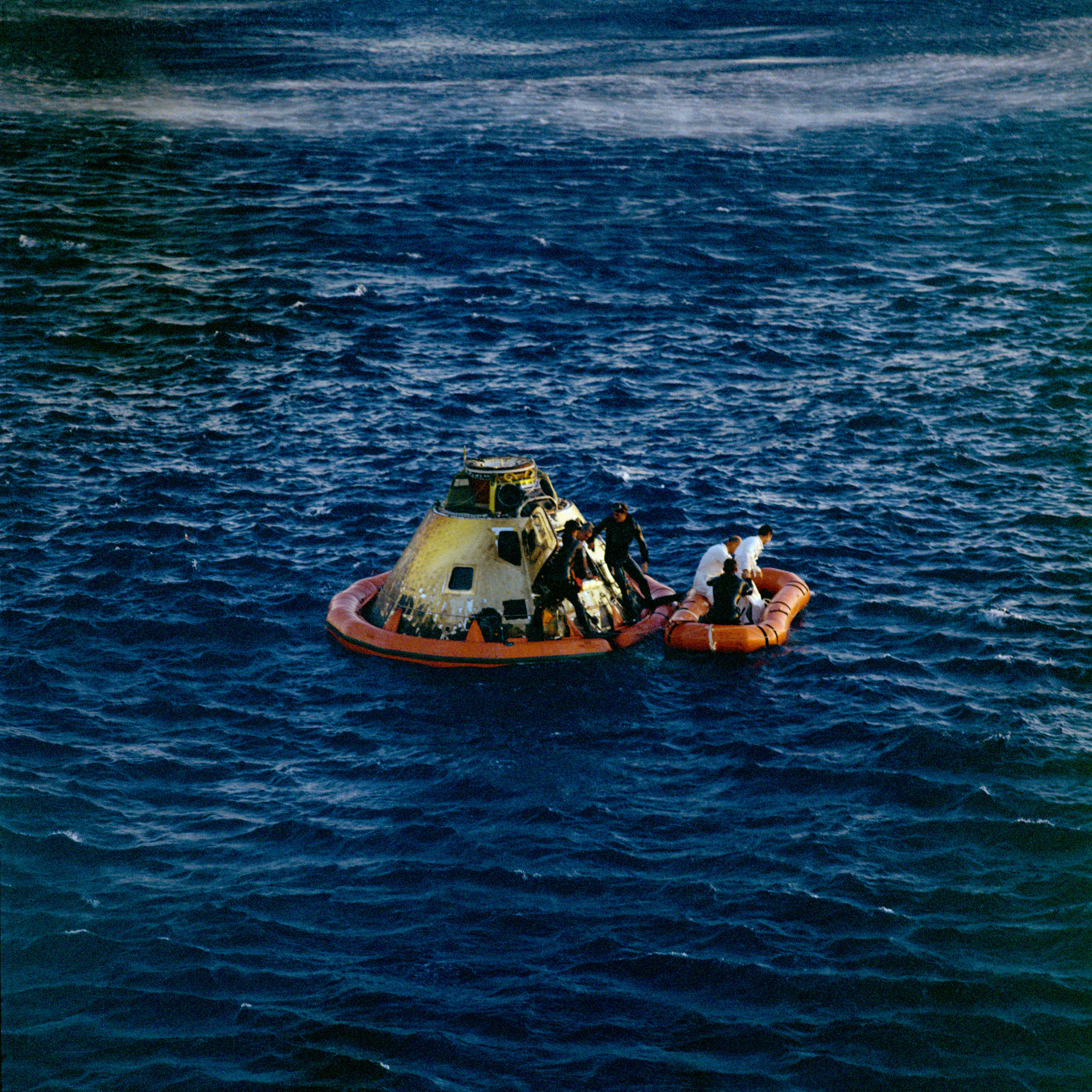
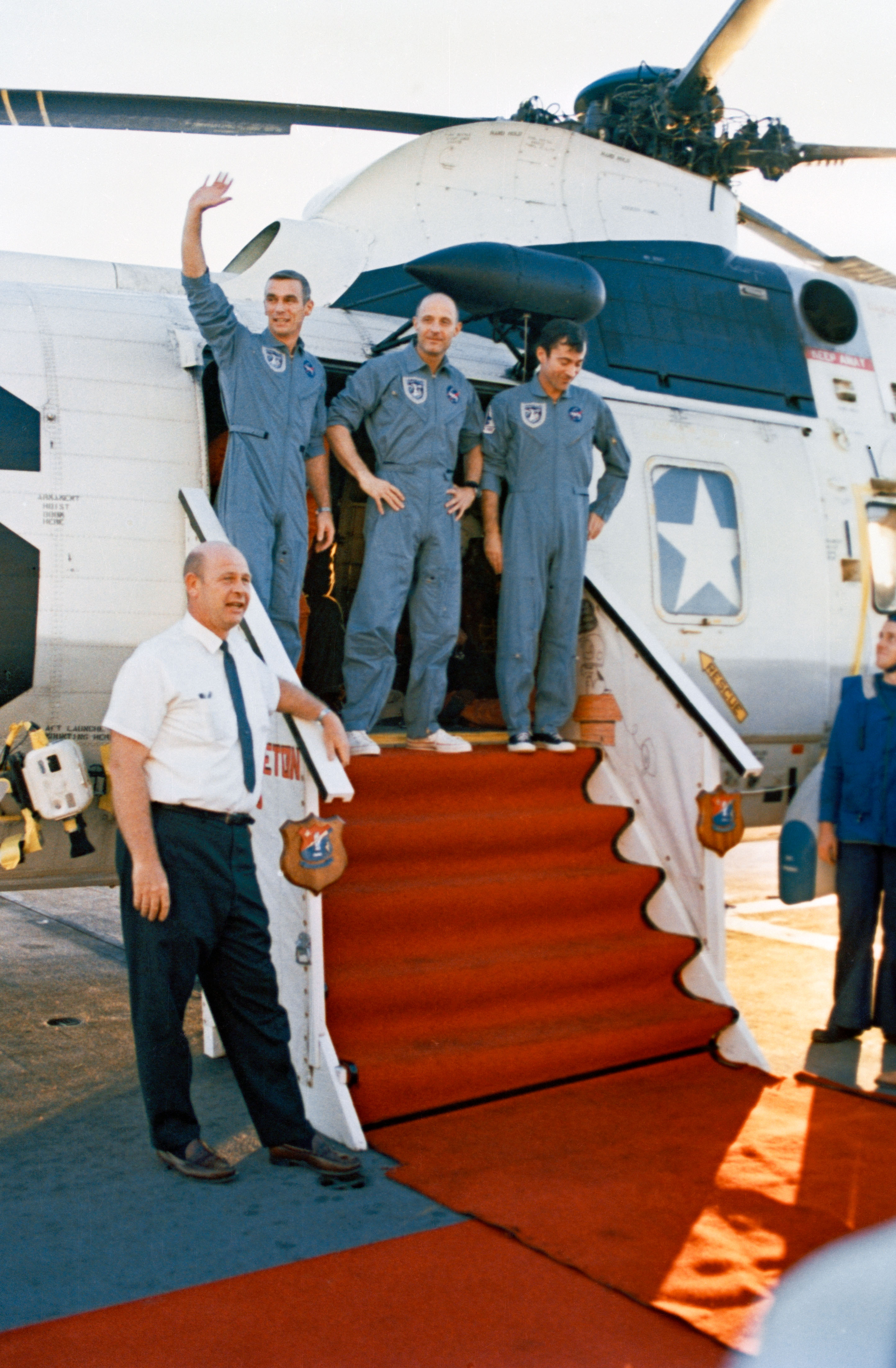
The return trajectory was designed to take 42 hours instead of the usual 56, and on the last day the crew travelled faster than any humans before or since relative to the Earth: 39,897 km/h, or 11.08 km/s (24,791 mph). They also went farther from their Houston homes than anyone before, 408,950 km, although the Apollo 13 crew would get about 200 km farther from the Earth as a whole. The Command Module separated at 191:33:26, entry began at 191:48:54.5 and splashdown came on May 26, 1969 at 16:52:23 UTC, 192:03:23 into the mission, in the Pacific east of American Samoa. The carrier USS *Princeton* recovered them; aboard they took a congratulatory call from President Richard Nixon and, having never touched the lunar surface, were spared the quarantine the landing crews would face. They flew to Pago Pago International Airport in Tafuna for a reception and on by C-141 transport to Ellington Air Force Base near Houston.
What Apollo 10 left behind
The mission report concluded that every primary objective had been met and that no anomaly had arisen that would constrain later flights. The crew showed that Lunar Module checkout, initial descent and rendezvous fitted the allotted times, that the Lunar Module's communications were adequate, that its rendezvous and landing radars worked in lunar orbit and that both craft could be monitored well from the ground. Lunar orbital navigation became more precise and, combined with Apollo 8's data, was judged good enough for the first landing. After about two weeks of analysis a flight readiness team cleared Apollo 11, which launched on July 16, 1969 with Neil Armstrong, Buzz Aldrin and Michael Collins; on July 20 Armstrong and Aldrin landed, and four days later all three were home, meeting John F. Kennedy's challenge.
All three men went on to prominent roles. Stafford replaced Alan Shepard as Chief Astronaut in July 1969 and then served as Slayton's deputy; promoted to brigadier general in 1972, he commanded the American side of the Apollo–Soyuz Test Project, flown in July 1975, led the Air Force Flight Test Center at Edwards and retired in November 1979 as a lieutenant general. Young commanded Apollo 16 in April 1972, was Chief Astronaut from 1974 to 1987, commanded Shuttle missions STS-1 (April 1981) and STS-9 (November 1983) and left the astronaut corps in 2004. Cernan commanded Apollo 17 in December 1972, the programme's last lunar mission, and retired from NASA and the Navy in 1976.
Where Charlie Brown and Snoopy are now
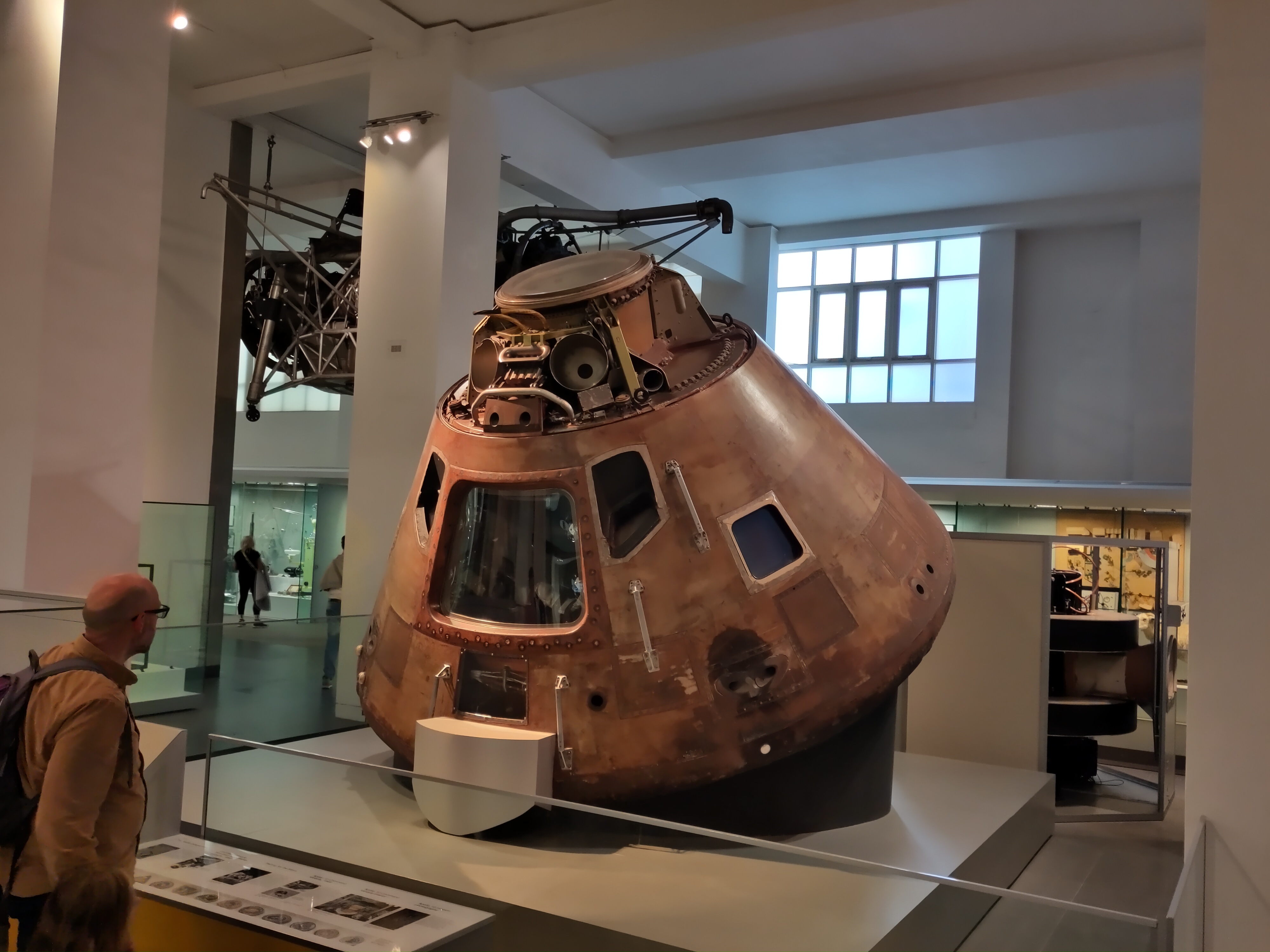
The Smithsonian has been responsible for the Command Module *Charlie Brown* since 1970; after touring several countries it went on loan to the Science Museum in London in 1978. The National Air and Space Museum also holds, among other items, an access hatch associated with the mission. The Service Module was jettisoned before re-entry and broke up over the Pacific, and the S-IVB remains in heliocentric orbit. *Snoopy*'s descent stage was left in low lunar orbit and its whereabouts are unknown, though mascon perturbations probably brought it down onto the Moon.
*Snoopy*'s ascent stage was not tracked after 1969. In 2011 a group of British amateur astronomers began searching for it, and in June 2019 the Royal Astronomical Society announced a possible rediscovery: the small Earth-crossing asteroid 2018 AV2 is thought, with "98%" certainty, to be the spacecraft. If so, it is the only once-crewed spacecraft known to remain in space without a crew.
Images
Elsewhere
- National Air and Space MuseumApollo 10 Crew ↗
- National Air and Space MuseumApollo 10 Launch ↗
- National Air and Space MuseumCommand Module, Apollo 10 ↗
- National Air and Space MuseumApollo 10 Mission Patch ↗
- National Air and Space MuseumView from Titusville, Apollo 10 ↗
- Science Museum GroupApollo 10 Command Module, Call Sign 'Charlie Brown' ↗
- Lunar and Planetary InstituteApollo 10 Mission Lunar Photography Index Maps ↗
- Lunar and Planetary InstituteApollo Image Atlas — frame AS10-32-4822 ↗
- Apollo Flight JournalApollo 10 Flight Journal — Video Library ↗
- Space.comThe Apollo 10 Mission: NASA's Lunar Landing Dress Rehearsal in Photos ↗
- The Planetary SocietyApollo 10 ↗
- collectSPACEInside Apollo 10 at the London Science Museum ↗