Apollo program · NASA · Crewed
Apollo 9
- Mar 3, 1969, 4:00 PM
- Launch date
- 3
- Crew size
- 10 days 1 hr
- Duration
- Success
- Outcome
Apollo 9 was the first mission to fly a lunar module in space with a crew aboard. It lifted off from the Kennedy Space Center on 3 March 1969 atop Saturn V SA-504 — the fourth to fly and the first to carry a lunar module — with James McDivitt as commander, David Scott as command module pilot and Russell "Rusty" Schweickart as lunar module pilot. It was the "D mission" of the ladder of letters with which NASA had ordered the road to the landing: to demonstrate in Earth orbit, without leaving home, every manoeuvre of the lunar voyage except the descent to the surface. For ten days the command and service module CSM-104 "Gumdrop" and the lunar module LM-3 "Spider" rehearsed the entire script. The crew separated the mother ship from the third stage, turned around and docked with the lunar module to pull it out of its adapter: the transposition and docking manoeuvre without which there would be no landing. They then fired the service module engine eight times with the two ships joined, thoroughly tested the lunar module's descent engine — a capability that a year later would save the Apollo 13 crew — and carried out the first internal crew transfer between two spacecraft in history. On the fourth day Schweickart went out through Spider's hatch wearing the self-contained life support backpack intended for the lunar surface while Scott stood up in the command module hatch: it was the flight debut of the extravehicular mobility unit. On the fifth, McDivitt and Schweickart cast off aboard a vehicle that could not bring them back to Earth, drew away to 98 nautical miles and returned to Gumdrop after a complete rendezvous with descent engine burns and the debut of the ascent engine. The final days were given over to checking how the command module held up over the span a lunar mission demanded and to a pioneering experiment in multispectral photography of the Earth, forerunner of the Earth resources satellites. The capsule splashed down in the Atlantic on 13 March after 151 orbits. Without it there would have been no Apollo 11: Apollo 9 was the flight that qualified the lunar module and whose success left NASA two missions short of the Moon.
Payload
Apollo 9's payload was, in itself, the point of the mission: the complete set of spacecraft with which the landing was to be made. Riding on Saturn V SA-504 were the command and service module CSM-104, christened "Gumdrop", the third crewed Block II and the first to carry the probe and drogue assembly that allowed a rigid docking and the passage of the crew from one ship to the other through the inner tunnel; and lunar module LM-3, "Spider", stowed with its legs folded inside the SLA-11A adapter at the end of the S-IVB third stage. Spider was the second flight-worthy lunar module off Grumman's line and the first to fly with people aboard, with both stages complete: the descent stage, with the throttleable engine that was tested both with the ships docked and in free flight, and the ascent stage, whose engine made its debut during the rendezvous and was later fired to oxidiser depletion. Neither LM-2 nor LM-3 could have landed on the Moon: both were too heavy, and Grumman's weight reduction program did not fully bear fruit until the LM-5 of Apollo 11. As crew equipment, the mission carried the complete extravehicular mobility unit into space for the first time — the portable life support system and the oxygen purge system — the assembly with which the Moon would be walked, along with the pressure control valve that allowed an astronaut on an umbilical to stand up through a hatch. The scientific payload was limited to experiment S065, multispectral terrain photography with four identical Hasselblad cameras coupled together and loaded with different film and filter combinations, and to the 16 mm and 70 mm cameras used during the extravehicular activity and the rendezvous.
| Crew | Role | Agency | Extravehicular activity |
|---|---|---|---|
| James Alton McDivitt | Commander | NASA · United States | — |
| David Randolph Scott | Command module pilot | NASA · United States | — |
| Russell Louis "Rusty" Schweickart | Lunar module pilot | NASA · United States | — |
History
The "D mission": how Apollo 9 ended up being called Apollo 9
When Deke Slayton, director of flight crew operations, picked James McDivitt, David Scott and Russell "Rusty" Schweickart in April 1966 as the second Apollo crew, the assignment they were handed was already the one they would carry out three years later: to be the first people to fly a lunar module with a crew aboard. For the moment, though, their job was to back up Gus Grissom, Ed White and Roger Chaffee, assigned to the first crewed flight of the Block I command and service module, designated AS-204. Delays with that Block I pushed the mission into 1967, and the revised plan gave McDivitt's crew the second crewed command module, which was to rendezvous in Earth orbit with a separately launched lunar module. The third crewed flight, commanded by Frank Borman, would be the first to lift off with a crew atop a Saturn V.
The pad fire of 27 January 1967, which killed the three men of the crew that had named their spacecraft Apollo 1, blew that schedule apart and opened a complete review of the program's safety. While it lasted, Apollo 5 flew as the uncrewed trial of the first flight-worthy lunar module, LM-1. The sequence that came out of that review organised the road to the landing — the "G mission" — as a ladder of letters, each rung a prerequisite for the next. Apollo 7 would be the "C mission", the test of the Block II command module without a lunar module. The "D mission" called at last for flying the lunar module with a crew, and that lunar module was running late, at the risk of eating into the deadline John F. Kennedy had set for landing Americans on the Moon and returning them safely before the decade was out. In November 1967 NASA announced that McDivitt's crew would be prime for the D mission: a long campaign of tests of both modules in Earth orbit.
In August 1968, with the lunar module still stuck, program manager George M. Low proposed a move that reordered the program's history: if Apollo 7 went well in October, Apollo 8 would go into lunar orbit without a lunar module. Until then Apollo 8 was the D mission and Apollo 9 the "E mission", a rehearsal in medium Earth orbit. Once the Apollo 8 lunar voyage was approved, the D mission became Apollo 9, and Slayton offered McDivitt the chance to keep Apollo 8 and see the Moon at close range. McDivitt turned it down on his crew's behalf: they had spent years preparing the lunar module and did not want to let go of it. Apollo 7 went well, the crews swapped missions and so did their backups; because the unwritten rule had a backup crew flying as prime three missions later, that trade put Neil Armstrong's team in position to attempt the first landing on Apollo 11 and Pete Conrad's on the second, Apollo 12.
Crew, backups and the control room
McDivitt, an Air Force colonel, had been command pilot of Gemini 4 in 1965 and had held a degree in aeronautical engineering from the University of Michigan since 1959. Scott, also an Air Force colonel, born on 6 June 1932 in San Antonio, Texas, and 36 years old during the flight, had graduated from the Military Academy in 1954 and held a master's in aeronautics and astronautics from MIT earned in 1962; selected as an astronaut in 1963, he had flown on Gemini 8 alongside Armstrong, the mission of the first docking between two spacecraft. Schweickart, a civilian, born on 25 October 1935 in Neptune, New Jersey, and 33 years old during the mission, was the only one without spaceflight experience: an aeronautical engineer since 1956 with an MIT master's in 1963, he had served in the Air Force and the Massachusetts Air National Guard before joining the third astronaut group.
The backup crew was Pete Conrad as commander, Richard F. Gordon as command module pilot and, originally, Clifton C. Williams as lunar module pilot; after Williams died in a T-38 crash in October 1967 his place went to Alan L. Bean. That trio flew as prime crew on Apollo 12 in November 1969. The support crew was made up of Stuart A. Roosa, Jack R. Lousma, Edgar D. Mitchell and Alfred M. Worden — Lousma replacing Fred W. Haise, who had moved to the Apollo 8 backup crew in the cascade of changes triggered by Michael Collins's medical grounding. On the ground, the flight director shifts went to Gene Kranz, Gerry Griffin and Pete Frank, and communications with the spacecraft were handled by Conrad, Gordon, Bean, Worden, Roosa and Ronald Evans.
Training without precedent
The purpose of Apollo 9 was to qualify the lunar module for crewed flight, which in practice meant demonstrating in orbit every manoeuvre of a landing mission except the descent to the surface itself. Historians Colin Burgess and Francis French have described McDivitt's crew as one of the best prepared in the program: they had been together since January 1966 and always on the same assignment. Kranz, who led the first shift, considered them the best prepared crew he had seen and thought Scott an extraordinarily well informed command module pilot. They accumulated 1,800 hours of mission-specific training, roughly seven hours for every hour they would spend in flight, and they began on the very day before the Apollo 1 fire, in the first Block II spacecraft — the one they were originally due to fly.
Training included weightlessness simulations underwater and aboard the parabolic-flight aircraft, with rehearsals of the planned extravehicular activity; trips to Cambridge, Massachusetts, for instruction on the Apollo guidance computer at MIT; and sessions at the Morehead and Griffith planetariums to learn the 37 stars used by the onboard computer. Each man spent more than 300 hours in the command module and lunar module simulators at the Kennedy Space Center and in Houston, part of it with real-time participation by mission control, on top of the time devoted to simulators at other centres. They also took part in the checkout of the command and service module at the North American Rockwell plant in Downey, California, and of the lunar module at Grumman's in Bethpage, New York, and in the testing of both vehicles once at the launch site.
The vehicle: Saturn V AS-504
Apollo 9's Saturn V, designated SA-504, was the fourth to fly, the second to carry astronauts and the first to carry a lunar module. Although its configuration was similar to that of the Apollo 8 rocket, it incorporated several changes. In the first stage, the S-IC, the inner core of the F-1 engine chambers was removed, saving weight and allowing a slight increase in specific impulse; mass was also saved by replacing the liquid oxygen tank skins with lighter ones and by lightening other components. The second stage, the S-II, gained efficiency with uprated J-2 engines and a closed-loop propellant utilisation system in place of the open-loop system of Apollo 8; of the 3,250 pounds (1,470 kg) that stage shed, close to half came from reducing the thickness of the tank sidewalls by 16 percent.
The mission also carried Eastern Test Range designation 9025. The mother ship was CSM-104, the third Block II command and service module to fly with a crew. Apollo 8, without a lunar module, had carried no docking equipment; Apollo 9 was the first crewed flight of the probe-and-drogue assembly along with the rest of the hardware installed near the forward hatch of the command module, which allowed a rigid docking between the two spacecraft and internal crew transfer. Had the missions not been swapped, the Earth-orbital flight would have used CSM-103, which ended up flying on Apollo 8.
Spider: the lunar module that nearly wasn't
The mission was originally to fly with LM-2, but the crew found numerous defects in it, many of them attributable to its being the first flight-worthy lunar module off Grumman's production line. The delay brought by the mission swap made LM-3 available, a machine the astronauts judged far superior. Neither of the two could have gone to the Moon: both were too heavy, and Grumman's weight reduction program did not fully bear fruit until LM-5, the one assigned to Apollo 11. The small cracks that appeared in LM-3's aluminium alloy structure from stresses as ordinary as driving a rivet were a recurring problem: Grumman's engineers kept fixing them until the module had to be mated to the Saturn V in December 1968, housed inside the SLA-11A adapter. LM-2 never flew and is preserved at the National Air and Space Museum.
The lunar module arrived from Grumman in June 1968 and went through an extensive test program, including the altitude chamber that simulated space conditions, while other teams stacked the Saturn V inside the Vehicle Assembly Building. The command and service modules arrived in October, and mating them gave even North American's experienced team at Kennedy more trouble than expected. When the lunar module was finished in the altitude chamber, the CSM took its place, freeing the former to have its rendezvous radar and antennas installed. There were no long delays: on 3 January 1969 the stack left the assembly building for Pad 39A aboard the crawler-transporter, and the flight readiness reviews of the command module, the lunar module and the rocket were held and passed in the following weeks.
Gumdrop, Spider and permission to name the ships
Ever since Grissom christened his Gemini 3 Molly Brown, NASA had forbidden naming spacecraft. Apollo 9 forced the ban to be lifted: with the command module and the lunar module flying separately, two distinct call signs were needed, and the crew had taken to calling them in the simulations "Gumdrop" — after the look of the command module wrapped in the blue plastic in which it had travelled from the factory — and "Spider", after the silhouette of the lunar module with its legs deployed. The public affairs office found them too informal, but the call signs ended up receiving official blessing; from Apollo 11 onward NASA demanded weightier names.
The mission emblem, designed by Allen Stevens of Rockwell International, is a circle containing a Saturn V lettered USA; to its right a command and service module with its nose pointed at the lunar module's "front door" rather than at its upper docking port, with a trail of fire tracing a circle. The three crew members' surnames run along the upper rim and APOLLO IX reads below. The "D" in McDivitt's surname is filled in red: it is the mark of the D mission on the program's ladder of letters.
Suits, backpacks and the debut of the extravehicular mobility unit
Apollo 9 was the first flight of the extravehicular mobility unit backpack, the equipment that would be used to walk on the Moon. Schweickart wore it during his excursion outside. The assembly integrated the portable life support system, which supplied oxygen to the astronaut and water to the liquid cooling garment that prevents overheating during exertion, and the oxygen purge system, the upper block the astronauts called "the ditty bag", which could sustain the wearer for about an hour if the main system failed. A more advanced version of the assembly would be the one to set foot on the Moon on Apollo 11.
Scott, by contrast, wore no backpack during his stand-up excursion through the command module hatch: he remained connected to the spacecraft's systems by an umbilical, with a pressure control valve conceived in 1967 precisely to allow partial exits through the command module or lunar module hatches. Scott himself would use that same device on his stand-up excursion above the lunar surface on Apollo 15 and, afterwards, the command module pilots of the last three Apollo missions on their deep-space excursions.
Apollo astronauts carried portable cassette recorders — forerunners of the personal players that would later become popular — meant for dictating observations during the flight. The Apollo 9 crew was the first authorised to bring a music tape each aboard: McDivitt and Scott went for light and country music, while Schweickart's classical tape was given up for lost until the ninth day of the mission, when Scott handed it to him.
From head colds to lift-off
Launch had been set for 28 February 1969 and the terminal count had even begun: it started at 03:00:00 GMT on 27 February, at T-28 hours. Half an hour into the scheduled three-hour hold at T-16 hours, the count was recycled to T-42 hours so the crew could recover from a mild viral respiratory infection — all three had colds and NASA was unwilling to risk having that spoil the mission. The count resumed at 17:30:00 GMT on 1 March. Keeping the vehicle ready required round-the-clock shifts, and the postponement cost 500,000 dollars.
On launch day a low pressure system southwest of Cape Kennedy, over the Gulf of Mexico, left the sky overcast: stratocumulus with bases at 3,500 feet covered 70 percent of the dome and altostratus based at 9,000 feet covered it completely. The temperature was 67.3 degrees Fahrenheit, relative humidity 61 percent and the wind blew at 13.4 knots from 160 degrees relative to true north. Vice President Spiro Agnew was in the firing room, representing the newly installed Nixon administration.
Ascent
Apollo 9 lifted off from Pad A of Launch Complex 39 at the Kennedy Space Center at 16:00:00 GMT (11:00:00 a.m. Eastern Standard Time) on 3 March 1969, with a launch window that stayed open until 19:15:00 GMT: it left with more than three hours to spare. Between 13.3 and 33.0 seconds into the flight the vehicle rolled from the pad azimuth of 90 degrees to the flight azimuth of 72 degrees. The first stage shut down at 2 minutes 42.76 seconds, followed by separation and second stage ignition; the S-II cut off at 8 minutes 56.22 seconds, and the third stage, the S-IVB, ignited at 9 minutes 0.82 seconds to shut down for the first time at 11 minutes 4.66 seconds.
McDivitt described a smooth ascent, though with some vibration, and all three were surprised to be thrown forward when the first stage stopped pushing, before the second slammed them back into their couches. The first two stages performed slightly below prediction and the third made up the difference: deviations from the planned trajectory came to plus 2.86 feet per second in velocity and minus 0.17 nautical miles in altitude. The S-IC stage fell into the Atlantic at 8 minutes 56.44 seconds, 346.64 nautical miles from the launch point; the S-II struck at 20 minutes 25.35 seconds, 2,413.2 nautical miles out. During the climb the vehicle met a maximum wind of 148.1 knots at 38,480 feet of altitude.
Ten seconds after third stage cutoff, at 000:11:14.65 mission elapsed time, the parking orbit measured 100.74 by 99.68 nautical miles, with an inclination of 32.552 degrees, a period of 88.20 minutes and a velocity of 25,569.78 feet per second. The command and service module received international designation 1969-018A and the third stage 1969-018B; after undocking, the lunar module ascent stage would be 1969-018C and the descent stage 1969-018D.
Transposition, docking and extraction: the manoeuvre the program hinged on
The flight's first serious task came at 2 hours 41 minutes 16 seconds mission elapsed time, with the separation of the command and service module from the third stage. The sequence consisted of pulling away, turning around, pointing the nose — where the docking probe was — at the lunar module riding at the end of the S-IVB, docking with it and extracting it from the adapter. If that manoeuvre was not possible there would be no landing: nothing else mattered. Scott flew it, and docking was completed at 3 hours 1 minute 59.3 seconds, with the probe and drogue assembly working as it should. With the ships joined, the commander and the lunar module pilot pressurised the tunnel connecting them, removed the command module hatch with Scott's help, checked the latches of the docking ring to verify the seal and connected the electrical umbilicals that would power the lunar module while it stayed attached. At 4 hours 8 minutes an ejection mechanism flown for the first time on this mission pushed the docked pair clear of the S-IVB.
After the separation manoeuvre, the third stage reignited at 4 hours 45 minutes 55.54 seconds for 62.06 seconds and ten seconds later entered an intermediate orbit of 1,671.58 by 105.75 nautical miles, with a period of 119.22 minutes, an inclination of 32.302 degrees and an insertion velocity of 27,753.61 feet per second, intended to let the engine cool before a third burn. That third burn, at 6 hours 7 minutes 19.26 seconds, lasted 242.06 seconds and served to demonstrate restart capability after an 80-minute coast and to drive the engine outside its nominal conditions; it also improved ground tracking lighting conditions for the later rendezvous. Ten seconds after cutoff, at a velocity of 31,619.85 feet per second, the stage reached the escape trajectory that sent it into solar orbit. Its behaviour was not as expected: several anomalies, among them loss of pneumatic control of the engine valves, prevented the planned liquid hydrogen dumps, and the tank had to be safed through the non-propulsive liquid oxygen vent system.
Two ships joined: the service propulsion engine under examination
Before that, at 5 hours 59 minutes 1.07 seconds mission elapsed time, the crew had carried out the first of the eight service propulsion system burns, a 5.23-second manoeuvre that raised the docked stack's orbit to 127.6 by 113.4 nautical miles. The point was to demonstrate that a single engine could manoeuvre two docked spacecraft; Scott reported, delighted, that the lunar module was still there.
The second day was given over to systems checks, pitch, roll and yaw manoeuvres and three more service engine burns with the lunar module docked. The second, at 22 hours 12 minutes 4.07 seconds, lasted 110.29 seconds and raised the orbit to 192.5 by 110.76 nautical miles; it included deliberately gimballing the engine to see whether the digital autopilot would damp the induced oscillations, which it did within five seconds. The third, at 25 hours 17 minutes 39.27 seconds, ran 279.88 seconds, lifted the orbit to 274.9 by 112.4 nautical miles and lightened the spacecraft enough for the reaction control system to manage it later and to place it in a better rescue position during the rendezvous. During those two burns the oscillatory response of the docked stack was measured to refine the autopilot. The fourth, at 28 hours 24 minutes 41.37 seconds, was a 27.87-second phasing manoeuvre meant to shift the node eastward and improve the later lighting, braking and docking conditions. The stability of the stack during engine gimballing would have consequences years later: in 1972, by then manager of the Apollo Spacecraft Program, McDivitt drew on that data to authorise Apollo 16 to continue when its service module showed unstable gimballing in lunar orbit.
Third day: inside Spider, and space sickness
The plan for the third day was for the commander and the lunar module pilot to enter Spider, check out its systems and use the descent engine to move the whole stack, thereby demonstrating that this engine could stand in for the service engine — a capability that would save the lives of the Apollo 13 crew. The plan wobbled when Schweickart, suffering from space adaptation syndrome, vomited; McDivitt was queasy too. Both men had been avoiding abrupt movements, but the contortions needed to don their suits for the lunar module inspection were enough to upset them. The episode taught the doctors enough about space sickness to head it off on the landing missions, but at the time Schweickart feared his vomiting might endanger Kennedy's goal.
They found themselves fit to carry on and moved into the lunar module: it was the first crew transfer between two spacecraft in the American space program and the first in history that did not require going outside, as the Soviet cosmonauts had had to do two months earlier between Soyuz 4 and Soyuz 5. The lunar module pilot crossed over at 43 hours 15 minutes mission elapsed time and the commander at 44 hours 5 minutes; the landing gear was deployed at 45 hours, taking in sequence the position it would hold on the Moon. The hatches were closed with the ships still docked to demonstrate that Spider's communications and life support worked in isolation from Gumdrop's.
At 45 hours 40 minutes the commander reported to the ground that his crewmate had been sick twice and that they were running behind the plan. For that reason, and because of the workload the rendezvous preparation demanded, the extravehicular activity was restricted to a single daylight pass and to simply opening the hatches of both spacecraft; it was also decided to keep the lunar module pilot connected to the environmental control system hoses. The first episode had not been reported to the ground because it was so brief, and when the press learned what had happened there were repercussions and a run of unkind articles. At 46 hours 25 minutes a five-minute television transmission was made from inside the lunar module, with the camera pointed at the displays, the rest of the cabin and the crew: the picture was good, the sound was not.
The descent engine was fired at 49 hours 41 minutes 34.46 seconds with the ships still joined, and ran for 371.51 seconds reproducing the throttle profile planned for the lunar landing; attitude control with the digital autopilot and manual throttling to maximum thrust were also demonstrated. The return to the command module began at 50 hours 15 minutes and the lunar module was deactivated at 51 hours. The fifth service propulsion burn, of 43.26 seconds, took place at 54 hours 26 minutes 12.27 seconds to circularise the orbit ahead of the lunar-module-active rendezvous: the result was an orbit of 131.0 by 125.9 nautical miles against the 130.0 circular orbit desired, a difference judged acceptable.
Fourth day: the first outing in the lunar suit
The programme for the fourth day, 6 March, called for Schweickart to leave through the lunar module hatch and make his way along the outside of the stack to the command module hatch, where Scott would be waiting to help him in: the point was to show that an external transfer was possible in an emergency. Schweickart was to wear the life support backpack intended for excursions on the lunar surface, and this was the only extravehicular activity scheduled before the landing, that is, the only chance to test the equipment in space. McDivitt went as far as cancelling it because of his crewmate's condition, but when Schweickart felt better he decided to let him go out and, once outside, move around the exterior of the lunar module holding on to the handrails. The plan was cut from 2 hours 15 minutes to 39 minutes because of the previous day's nausea and because of the amount of work the rendezvous preparation demanded.
The lunar module was depressurised at 72 hours 45 minutes and the forward hatch opened at 72 hours 53 minutes. Schweickart began his egress onto the exterior platform at 72 hours 59 minutes 2 seconds, feet first and face up, and completed it at 73 hours 7 minutes. He wore the extravehicular mobility unit backpack, which gave him communications and oxygen and circulated water through his suit to keep him cool; his only tie to the module was a 25-foot nylon rope that kept him from drifting away. He secured his feet in the "golden slippers", the gold-painted restraints outside the hatch on the "front porch", and stayed there the whole time. During the excursion he used the call sign "Red Rover", a nod to the colour of his hair.
At the same time Scott depressurised the command module and opened the side hatch at 73 hours 2 minutes, depending throughout on the spacecraft's life support. He came partway out to observe, photograph and retrieve thermal samples from the side of the command module; as the samples were not there, at 73 hours 26 minutes he retrieved those on the service module instead. Schweickart removed the lunar module thermal samples at 73 hours 39 minutes and three minutes later began an abbreviated evaluation of translation capability and body attitude control using the transfer handrails; the hand-over-hand trip to the command module, as planned, was never made. The two men photographed each other and Schweickart also recorded, on 16 mm and 70 mm film, his crewmate's activity and the exterior of both spacecraft. He found moving about easier than it had been in the rehearsals, and both he and Scott came away convinced that the external transfer could have been completed had it been necessary; they simply did not consider it necessary.
Schweickart's ingress into the lunar module began at 73 hours 45 minutes and was completed at 73 hours 46 minutes 3 seconds; by 73 hours 53 minutes the forward hatch was closed and locked and the lunar module repressurised. The command module hatch was closed at 73 hours 49 minutes and the cabin was repressurised by 74 hours 2 minutes. At 74 hours 55 minutes a second, ten-minute television transmission was made from inside the lunar module, this time with good voice and picture quality. The commander returned to the command module at 75 hours 15 minutes and the lunar module pilot at 76 hours 55 minutes.
Fifth day: Spider adrift, the ship that could not come home
7 March brought what the mission itself regarded as its central event: the separation and reunion of the lunar module and the command module. Spider had no capability to bring anyone back to Earth; it was the first time human beings flew in a vehicle that could not carry them home. McDivitt and Schweickart entered the lunar module early — the pilot at 88 hours 5 minutes and the commander at 88 hours 55 minutes — with permission to do so without helmets and gloves, which made activation easier.
The command module was manoeuvred to the undocking attitude at 92 hours 22 minutes. The first attempt, at 92 hours 38 minutes, did not release: the capture latches balked and Scott had to press the button again. Undocking actually occurred at 92 hours 39 minutes 36 seconds, and Spider rotated about its axis so that the command module pilot could inspect it visually. After some 45 minutes of formation flying, a small separation manoeuvre with the service module thrusters, at 93 hours 2 minutes 54 seconds, placed the lunar module two nautical miles behind the command module three quarters of an hour later. Spider moved into a slightly higher orbit so that the two ships would drift apart with Gumdrop ahead; the maximum distance between them reached 98 nautical miles, about halfway between the start of the coelliptic sequence and the constant differential height manoeuvre.
Over the following hours McDivitt fired the descent engine at various settings until it had been thoroughly tested. In the first rendezvous phasing manoeuvre, executed at 93 hours 47 minutes 35.4 seconds with the descent engine under the abort guidance system, the engine ran smoothly until the throttle was lowered to 20 percent: it then began to chug noisily. The commander stopped moving the throttle and waited; within seconds the noise ceased. He advanced to 40 percent before shutdown and had no further trouble. After checking systems the crew fired the descent engine again at 10 percent and it ran evenly. The manoeuvre left the lunar module in a near-equiperiod orbit, with apogee and perigee 12.2 nautical miles above and below those of the command module. The second planned manoeuvre was never applied: it was a computation reserved for a contingency requiring an abort. The third was executed at 95 hours 39 minutes 8.06 seconds and left the lunar module in an orbit of 138.9 by 133.9 nautical miles.
Coelliptic sequence initiation came at 96 hours 16 minutes 6.54 seconds, and the descent stage was jettisoned immediately after reaction control thrusting began. The manoeuvre left the lunar module ten nautical miles below and 82 behind the command module, and the ascent stage in an orbit of 116 by 111 nautical miles. With rendezvous radar tracking re-established, the command module could not acquire the ascent stage's tracking light, which had failed. The constant differential height manoeuvre was performed at 96 hours 58 minutes 15 seconds, and was the debut of the ascent engine. The onboard solution for terminal phase initiation was executed at 97 hours 57 minutes 59 seconds, leaving the ascent stage in an orbit of approximately 126 by 113 nautical miles; two small midcourse corrections followed, at ten and at twenty-two minutes.
Terminal braking began at 98 hours 30 minutes 3 seconds. To show that either ship could conduct the rendezvous, the active role fell to Spider: McDivitt brought it in to Gumdrop and then rotated it to show Scott every side so that he could inspect it for damage. Docking, at 99 hours 2 minutes 26 seconds, was flown by McDivitt himself, with difficulty from the glare of the Sun that obliged Scott to talk him in — on later lunar missions that task would always fall to the command module pilot. The ascent stage had been separated from the command module for 6 hours 22 minutes 50 seconds.
The crew returned to the command and service module before 101 hours. The ascent stage was jettisoned at 101 hours 22 minutes 45 seconds and at 101 hours 53 minutes 15.4 seconds its engine fired for 362.4 seconds to oxidiser depletion, simulating the ascent from the lunar surface; the final orbit of that fragment of Spider came to 3,760.9 by 126.6 nautical miles, with an estimated orbital lifetime of five years, although in fact it did not re-enter until 23 October 1981. The only major lunar module system that could not be fully tested was the landing radar: in Earth orbit there was no way to do it.
The last five days: Earth as an object of study
Apollo 9 was to remain in space some ten days to check how the command and service module behaved over the time a full lunar mission demanded. Almost all the important events had been concentrated at the beginning to ensure they would be accomplished if the flight had to be cut short; indeed, the first half of the mission loaded the crew with more work than either Apollo 7 or Apollo 8 had faced, and many of the lunar module tests exceeded the conditions expected in an actual landing. The remaining days went by at a gentler pace.
With the primary objectives in hand, the hatch window was turned to a programme of terrain photography with four identical Hasselblad cameras coupled together and loaded with films sensitive to different parts of the spectrum. The experiment, designated S065, sought to determine how far multiband photography in the visible and near infrared from orbit could be applied to the study of Earth resources, and to obtain simultaneous exposures with four film and filter combinations in order to define future multispectral systems. The images made different surface features stand out — the trail of water pollution leaving a river mouth, or agricultural areas enhanced in the infrared — and the system, still a prototype, opened the way to the Earth Resources Technology Satellite that would be the precursor of the Landsat series, besides feeding into Skylab planning. The results were rated excellent and superior to those of any previous orbital mission, for several reasons: the four days available allowed the crew to wait out cloud cover, the orbital inclination of 33.6 degrees gave vertical and near-vertical access to areas never photographed before, there was ample attitude control propellant to point the spacecraft when convenient, the windows were clean and the science support team in Houston worked continuously. The photographs covered the southern United States, Mexico, Brazil and Africa.
Scott used the sextant to track terrain features and also aimed it at the sky to observe Jupiter, rehearsing the navigation techniques of later missions: it was the first time a planet had been used to align the inertial measurement unit. Daylight star sightings, landmark observations and sextant measurements were also made. On two consecutive revolutions, at 192 hours 43 minutes and at 194 hours 13 minutes, the crew tracked the Pegasus III satellite — launched on 30 July 1965 — at a range of one thousand nautical miles, and over Hawaii they sighted Spider's ascent stage between 222 hours 38 minutes 40 seconds and 222 hours 45 minutes 40 seconds.
The sixth service propulsion burn, of 1.43 seconds, took place at 123 hours 25 minutes 6.97 seconds, one revolution later than planned because the propellant settling thrust with the reaction control system had been improperly programmed; it was an orbit-shaping manoeuvre to lower perigee and improve the ability to deorbit with those same thrusters in a contingency. The seventh, of 24.90 seconds, came at 169 hours 30 minutes and took the orbit to 253.2 by 100.7 nautical miles, establishing the desired conditions for the nominal deorbit point and extending Gumdrop's orbital lifetime: if the main engine failed at the moment of return, the small thrusters would suffice to deorbit and land near the primary recovery area. That burn was deliberately lengthened to test the propellant gauging system, which had behaved anomalously on earlier burns. A good part of the command module testing fell to Scott, which left McDivitt and Schweickart time to look at the Earth and call their crewmate over when something worth seeing came up.
Re-entry, splashdown and return
The eighth and last service propulsion burn, the deorbit burn, was executed after 151 orbits: 11.74 seconds at 240 hours 31 minutes 14.84 seconds, one revolution later than planned because of bad weather in the intended recovery area, some 220 nautical miles east-southeast of Bermuda. The service module was jettisoned at 240 hours 36 minutes 3.8 seconds and, although it could not survive re-entry intact, radar data placed its impact in the Atlantic 175 nautical miles downrange of the command module. The capsule entered the atmosphere — conventionally, 400,000 feet — at 240 hours 44 minutes 10.2 seconds at 25,894 feet per second, following a primary guidance profile.
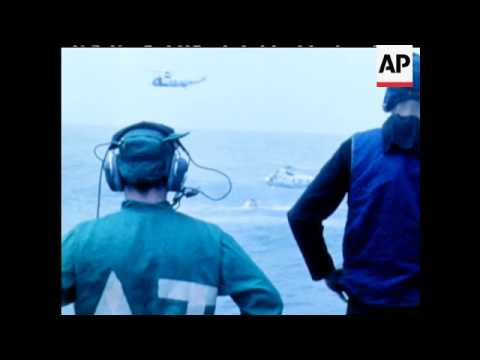
The parachute system set the command module down in the Atlantic at 17:00:54 GMT (12:00:54 p.m. Eastern Standard Time) on 13 March, after a mission of 241 hours and 54 seconds. Splashdown occurred some 160 nautical miles east of the Bahamas, 2.7 nautical miles from the target point and three from the helicopter carrier U.S.S. Guadalcanal; the capsule floated apex up. The crew was aboard the ship 49 minutes later and the command module was recovered 83 minutes after that, with an estimated splashdown weight of 11,094 pounds after travelling roughly 3,664,820 nautical miles. The three astronauts left the Guadalcanal by helicopter at 15:00 GMT on 14 March, reached Eleuthera, in the Bahamas, at 16:30 GMT and flew on to Houston from there. The capsule was offloaded on 16 March at Norfolk Naval Air Station, Virginia, where the safing team began its evaluation and deactivation; once that was finished on 19 March, the spacecraft was flown to Long Beach and trucked to the North American Rockwell facility in Downey, California, arriving on 21 March for postflight analysis. Apollo 9 was the last crewed spaceflight to splash down in the Atlantic for half a century.
The verdict: what Apollo 9 demonstrated
Postflight analysis concluded that the onboard rendezvous equipment and procedures in both spacecraft provided the precision a lunar landing mission would require, and that the command module pilot had completed the computations and preparations for the mirror-image manoeuvres on time. The functional operation of the docking process between the two spacecraft was demonstrated, with the caveat that the alignment aids require proper lighting conditions. The performance of every system in the extravehicular mobility unit was excellent throughout the excursion and, together with satisfactory qualification tests of minor design changes, verified the equipment for use on the lunar surface. The extent of the extravehicular activity established the practicality of contingency external crew transfer, with normal cabin depressurisation and repressurisation demonstrated in both spacecraft. The behaviour of the lunar module systems established its operational capability for a lunar mission, with the exception of the steerable antenna, which was not operated, and the landing radar, impossible to evaluate fully in Earth orbit; none of the anomalies recorded adversely affected the mission. And the manned space flight network showed that it could control two crewed spacecraft from the ground simultaneously.
The four primary objectives were declared achieved: to demonstrate crew, space vehicle and mission support facilities performance during a crewed Saturn V mission with command, service and lunar modules; to demonstrate lunar module and crew performance; to demonstrate nominal and selected backup lunar orbit rendezvous activities — transposition, docking and lunar module withdrawal; intravehicular and extravehicular crew transfer; extravehicular capability; service propulsion and descent propulsion burns; and lunar-module-active rendezvous and docking; and to assess the consumables of all three modules.
Consequences
The institutional verdict was unanimous: program officials described it as about as successful a mission as anyone could wish and beyond even the most optimistic forecasts, and Kranz spoke of sheer elation. Buzz Aldrin, following the mission from mission control in Houston, understood on watching Spider and Gumdrop dock that Apollo 10 would go well and that it would fall to Armstrong and himself to attempt the landing; on 24 March NASA made it official.
After the success, NASA dropped the "E mission" of tests in medium Earth orbit and even considered skipping the "F mission", the dress rehearsal in lunar orbit, to go straight to the landing. It did not: the spacecraft assigned to the first attempt were still being assembled, and there was also the case for one more lunar module test flight after the accumulated difficulties, and the chance to study from lunar orbit the mass concentrations that had perturbed Apollo 8's trajectory. The success of Apollo 9 guaranteed, in short, that the next mission would return to the Moon.
McDivitt, who could probably have commanded a landing, left the astronaut corps after Apollo 9 and went on to manage the Apollo spacecraft program that same year. Scott was named backup commander of Apollo 12 and then commander of Apollo 15, with which he landed on the Moon in 1971. Schweickart volunteered for medical investigation of his own space sickness, but could never shake off the stigma and was never again assigned to a prime crew; he took a leave of absence in 1977 that became permanent. Eugene Cernan, commander of Apollo 17, summed the matter up by saying that Schweickart had paid the price for them all in understanding sickness in space.
Where Apollo 9 is today
The command module Gumdrop (1969-018A) is on display at the San Diego Air & Space Museum; before that it was at the Michigan Space and Science Center in Jackson, Michigan, until it closed in April 2004. The service module, jettisoned shortly before re-entry, disintegrated in the atmosphere. Spider's ascent stage (1969-018C) re-entered on 23 October 1981 and the descent stage (1969-018D) fell into the Indian Ocean off the east coast of Africa in late March 1969. The S-IVB third stage (1969-018B) remains in solar orbit.


![[COMIC] - The first flight of the Lunar Module - Apollo 9](https://i.ytimg.com/vi/uqRXYQbGN5E/hqdefault.jpg)