Apollo program · NASA · Crewed
Apollo 8
- Dec 21, 1968, 12:51 PM
- Launch date
- 3
- Crew size
- 6 days 3 hr
- Duration
- Success
- Outcome
Apollo 8 was the first crewed spacecraft to leave Earth's gravitational influence, reach the Moon and orbit it. Launched on 21 December 1968 from the Kennedy Space Center atop Saturn V AS-503 — the rocket's first crewed flight — it carried Frank Borman, James Lovell and William Anders around the Moon and back until 27 December, when the command module splashed down in the North Pacific. The mission flew without a lunar module: in its place rode a ballasted test article, because it was precisely the delay of that vehicle that gave rise to the flight. The mission was born of a change of plan decided in August 1968. The seven-step plan NASA adopted in September 1967 assigned Apollo 8 the role of the "D" mission, a lunar module test in low Earth orbit. When LM-3 reached the Kennedy Space Center in June 1968 with more than a hundred significant defects, George Low, manager of the Apollo Spacecraft Program Office, proposed exploiting the fact that the next command and service module, CSM-103, would be ready three months earlier: instead of repeating the Earth-orbit flight of Apollo 7, that CSM could be sent all the way to the Moon. On 9 August 1968 the idea was discussed with the programme's leadership, and Apollo 8 became a "C-Prime" lunar-orbit mission. The flight was also the crewed debut of the Saturn V, a rocket whose previous outing — the uncrewed Apollo 6 of April 1968 — had suffered severe pogo oscillation, the failure of two second-stage engines and a third stage that refused to reignite in orbit. Teams at the Marshall Space Flight Center redesigned fuel lines and igniter lines and fitted a helium damping system; without those fixes no NASA administrator could have justified putting three men on AS-503. After trans-lunar injection Apollo 8 reached a maximum distance from Earth of 377,349 kilometres, entered the Moon's sphere of influence and completed ten lunar orbits, twenty hours during which it photographed candidate landing sites — among them the one Apollo 11 would use in Mare Tranquillitatis — and described over the radio a landscape no human being had seen from close range. Two of the most enduring cultural images of the twentieth century came out of those orbits: the colour photograph of the Earth rising above the lunar limb that Anders took on the fourth orbit, known as Earthrise, and the Christmas Eve broadcast from the ninth orbit, in which the three crewmen read the opening of the Book of Genesis to an audience estimated at a quarter of humanity. The reading ended up in court through a lawsuit brought by the atheist activist Madalyn Murray O'Hair, and the photograph is counted among the inspirations of the first Earth Day, in 1970.
Payload
Apollo 8 carried no lunar module. The crewed vehicle was the Block II command and service module CSM-103, with a mass of 28,870 kg, and in the place the lunar module would have occupied rode a test article, a 9,000 kg boilerplate reproducing the weight and balance of LM-3, which stayed attached to the S-IVB third stage after separation. The working payload was therefore instrumental and photographic: 70 mm still cameras with which Anders took more than eight hundred images of the lunar surface and of the Earth — Earthrise among them — a 16 mm film camera mounted in a window recording one frame per second, of which some 210 m of film were exposed, and a two-kilogram black-and-white television camera with a vidicon tube and two lenses (a 160° wide-angle and a 9° telephoto) used for the flight's six transmissions. Dosimetry was handled by one personal dosimeter per crewman, transmitting data to the ground, plus three passive film dosimeters for the cumulative dose. To these were added a built-in sextant for star-sighting navigation and the data storage equipment able to record voice and telemetry and dump them at high speed. Among the unofficial baggage travelled a turkey dinner with stuffing and three miniature bottles of brandy that Slayton hid in the food locker, along with small presents from the crew's wives.
| Crew | Role | Agency | Extravehicular activity |
|---|---|---|---|
| Frank Frederick Borman II | Commander | NASA · United States | — |
| James Arthur Lovell Jr. | Command module pilot | NASA · United States | — |
| William Alison Anders | Lunar module pilot | NASA · United States | — |
History
A programme against the clock
On 20 September 1967 NASA adopted a seven-step plan for the Apollo missions, the last step being the lunar landing. Apollo 4 and Apollo 6 were "A" missions, tests of the Saturn V launch vehicle with an uncrewed Block I production command and service module in Earth orbit; Apollo 5 was the "B" mission, the lunar module test in Earth orbit; and Apollo 7, scheduled for October 1968, was the "C" mission, the first crewed CSM flight around the Earth. Everything beyond that depended on the lunar module being ready. Apollo 8 was to be the "D" mission — an LM test in low Earth orbit in December 1968 with James McDivitt, David Scott and Russell Schweickart — while Borman's crew would fly the "E" mission, a more demanding test in an elliptical medium Earth orbit. Then would come the "F" mission, with CSM and LM in lunar orbit, and the "G" mission, the landing.
The plan broke where it was most likely to. Lunar module production fell behind, and when LM-3 arrived at the Kennedy Space Center in June 1968 more than a hundred significant defects were found in it. Bob Gilruth, director of the Manned Spacecraft Center, and others concluded there was no prospect of that vehicle flying in 1968; delivery might even slip to February or March 1969. Following the original plan meant delaying the "D" mission and everything after it, and endangering the commitment to land before the end of the decade.
The mission change of August 1968
The way out was proposed in August 1968 by George Low, manager of the Apollo Spacecraft Program Office. The next command and service module, designated CSM-103, would be ready three months before LM-3; instead of using it to repeat Apollo 7's Earth-orbit flight, it could be sent all the way to the Moon, with the possibility of entering lunar orbit and returning. The mission would also allow the rehearsal of lunar procedures that would otherwise have had to wait for Apollo 10, and it made the medium Earth orbit "E" mission unnecessary. The net effect was that only the "D" mission slipped, and a landing in mid-1969 remained on the timeline.
On 9 August 1968 Low put the idea to Gilruth, Flight Director Chris Kraft and Director of Flight Crew Operations Donald Slayton. The four flew to the Marshall Space Flight Center in Huntsville, where they met KSC Director Kurt Debus, Apollo Program Director Samuel C. Phillips, Rocco Petrone and Wernher von Braun. Jerry Wittenstein presented trajectories for the new mission. Kraft judged the proposal feasible from a flight control standpoint; Debus and Petrone undertook to have the next Saturn V, AS-503, ready by 1 December; von Braun declared himself confident that the pogo oscillation problems of Apollo 6 had been solved. Almost every senior manager backed the change. The one man who needed convincing was Administrator James E. Webb, who authorised it. Apollo 8 officially stopped being a "D" mission and became the "C-Prime" lunar-orbit mission.
The change dragged the crews with it. Slayton asked McDivitt whether he still wanted the flight; McDivitt turned it down, because his crew had spent a great deal of time preparing to test the lunar module and that was what he wanted to do. Slayton therefore swapped the prime and backup crews of the "D" and "E" missions, which also meant swapping spacecraft: Borman's crew took CSM-103 and McDivitt's CSM-104. David Scott was unhappy at giving up CM-103, whose testing he had supervised closely, and Anders was less than enthusiastic about being a lunar module pilot on a flight with no lunar module. In its place Apollo 8 carried an LM test article, a boilerplate that reproduced the weight and balance of LM-3.
Soviet pressure was added to the pressure of the calendar. On 21 September 1968 the Zond 5 mission returned living creatures — tortoises among them — to Earth after a cislunar loop, and there was speculation inside NASA and in the press that the USSR might launch cosmonauts on a similar circumlunar flight before the end of the year. American reconnaissance satellites had also observed a mockup N1 being rolled out to the pad at Baikonur on 25 November 1967.
Preparing AS-503
Apollo 8's Saturn V was designated AS-503, the third vehicle of the Apollo-Saturn programme. When it was erected in the Vehicle Assembly Building on 20 December 1967 it was expected to fly an uncrewed Earth-orbit test with a boilerplate command and service module. The problem was the rocket's recent record: on its April 1968 flight, Apollo 6 had suffered severe pogo oscillation in the first stage, the failure of two second-stage engines and a third stage that would not reignite in orbit. Without assurance that all of this had been fixed, the agency could not justify risking a crew.
Marshall Space Flight Center teams attacked all three fronts. On pogo, a task force of contractors, NASA representatives and centre researchers concluded that the engines vibrated at a frequency close to that of the vehicle structure itself, and that the resulting resonance induced the oscillations; a system using helium gas to absorb part of those vibrations was installed. On the engines, investigators determined that a leaking hydrogen line had ruptured when exposed to vacuum, causing loss of pressure in engine two, and that the automatic shutoff of the liquid hydrogen valve had accidentally shut down engine three's liquid oxygen through a miswired connection, so that the third engine failed within a second of the second. The same problem was found in the third stage, in the igniter line. Igniters and fuel conduits were modified, and in August 1968 the fixes were tested at Marshall itself: an S-IC stage fitted with shock absorbers for pogo, and an S-II retrofitted with modified lines to demonstrate resistance to rupture in vacuum.
With the fixes accepted, the spacecraft was placed on the rocket on 21 September and the stack made the three-mile (4.8 km) journey to the pad on one of the two crawler-transporters on 9 October. Testing continued through December, with readiness tests between the 5th and the 11th, and the final verification of the pogo, fuel line and igniter modifications took place on 18 December, three days before the scheduled launch.
The crew and the emblem
The initial crew assignment for the third crewed Apollo flight was announced on 20 November 1967: Frank Borman as commander, Michael Collins as command module pilot and William Anders as lunar module pilot. Collins was replaced by Jim Lovell in July 1968 after a cervical disc herniation that required surgery. The resulting crew was unique among pre-Shuttle missions in that the commander was not its most experienced member: Lovell had already flown twice, on Gemini VII and Gemini XII. It was also the first case of a commander of an earlier mission flying as a subordinate, and the first time two crewmates from a previous flight were reunited, since Borman and Lovell had shared the Gemini VII capsule.
The backup crew, announced the same day, was Neil Armstrong as commander, Lovell as command module pilot and Buzz Aldrin as lunar module pilot; when Lovell moved to the prime crew, Aldrin became backup CMP and Fred Haise came in as backup LMP. The support crew — a role Apollo added to prime and backup — consisted of Ken Mattingly, Vance Brand and Gerald Carr, responsible for the flight plan, checklists and emergency procedures in the simulators. The mission control shifts were led by Clifford E. Charlesworth, Glynn Lunney and Milton Windler.
The emblem, triangular like the command module's section, shows a red figure 8 looping around the Earth and the Moon, referring both to the mission number and to its circumlunar nature; the names of the three astronauts run along the bottom of the 8. Lovell sketched the initial design in the back seat of a T-38 shortly after learning of the flight's redesignation. The crew wanted to name the spacecraft and NASA would not allow it; had they been able to, they would probably have chosen Columbiad, the giant cannon that launches Jules Verne's projectile in his 1865 novel From the Earth to the Moon — a name that would later echo in Apollo 11's Columbia.
The night before launch, already housed at the Kennedy Space Center, the three received a visit from Charles Lindbergh and his wife, Anne Morrow Lindbergh. Lindbergh told them that before his 1927 flight he had measured the distance from New York to Paris with a piece of string on a globe and worked out the fuel he needed from it; the total he carried was a tenth of what the Saturn V would burn every second. The next day the Lindberghs watched the launch from a nearby dune.
Launch and trans-lunar injection
Apollo 8 lifted off at 12:51:00 UTC (7:51 am EST) on 21 December 1968. The Saturn V's three stages placed it in a parking orbit with an apogee of 185.18 km and a perigee of 184.40 km, inclined 32.51° to the Equator, with a period of 88.19 minutes; propellant venting raised the apogee by 11.9 km over the 2 hours, 44 minutes and 30 seconds spent there. The S-IC first stage fell into the Atlantic and the S-II further east; the third stage, the S-IVB, stayed attached to perform the decisive burn.
For 2 hours and 38 minutes the crew and the Houston controllers checked that the spacecraft was in working order. Correct operation of the S-IVB was critical, because in the last uncrewed test it had refused to reignite. Collins, on duty as CAPCOM, transmitted at 2 hours, 27 minutes and 22 seconds into the flight the words that formally authorised the voyage: "Apollo 8. You are Go for TLI." The engine lit on time and burned for 318 seconds, accelerating the stack — a 28,870 kg command and service module plus the 9,000 kg LM test article — from 7,793 m/s to 10,822 m/s, the highest speed relative to Earth ever reached by human beings. That was slightly below Earth's escape velocity of 11,200 m/s, so the spacecraft entered a very elongated Earth orbit that would take it close enough to be captured by lunar gravity.
Once the CSM had separated from the S-IVB, the crew rotated the spacecraft to photograph the spent stage and practise formation flying with it. In doing so they saw the whole Earth at once, something no one had done before. Borman worried that the S-IVB was staying too close and asked for a separation manoeuvre; after discussion with Mission Control a burn of 2.3 m/s was made, and the time it took put the crew an hour behind their onboard tasks. Five hours after launch, Houston commanded the S-IVB to vent its remaining propellant and change course: the stage, with the test article attached, passed the Moon's orbit and entered a solar orbit with a period of 340.80 days.
The crew were also the first to pass through the Van Allen radiation belts, which extend to some 24,000 km from Earth. A fast transit at high speed was expected to give a dose comparable to a chest X-ray; each crewman wore a personal dosimeter transmitting data to the ground and three passive film dosimeters, and by the end of the mission the average recorded dose was 1.6 mGy.
Three days to the Moon
Lovell's main job as command module pilot was navigation. The calculations were normally done by Mission Control, but someone aboard had to be able to navigate in case communication was lost; Lovell took star sightings with a built-in sextant, measuring the angle between a star and the Earth's or the Moon's horizon. The task was made harder by a cloud of debris around the spacecraft that blurred the stars. Seven hours into the flight the crew was an hour and forty minutes behind the flight plan.
To spread the heat, the spacecraft entered passive thermal control, the so-called barbecue roll: a slow rotation about its long axis, roughly once an hour. Without it, sunlit parts could exceed 200 °C while shadowed parts dropped to −100 °C, risking cracks in the heat shield or burst propellant lines. Since the roll was never perfect, it had to be corrected every half hour.
The first mid-course correction came eleven hours into the flight. Ground testing had shown that the service propulsion system engine had a small chance of exploding in long burns unless its chamber was first "coated" by a short one; this first correction lasted 2.4 seconds and added about 6.2 m/s, less than the planned 7.6 m/s because of a helium bubble in the oxidiser lines, and had to be made up with the reaction control thrusters. The two later planned corrections were cancelled because the trajectory proved perfect.
Shortly after starting his sleep shift, Borman asked permission to take a sleeping pill. He slept badly, woke feeling ill, vomited twice and had a bout of diarrhoea that left the cabin full of small globules the crew cleaned up as best they could. Borman did not want it known; Lovell and Anders insisted on reporting it and used the data storage equipment to record a description and dump it to the ground. The medical conference concluded there was little to worry about: a twenty-four-hour flu or a reaction to the pill. It is now attributed to space adaptation syndrome, which affects about a third of astronauts on their first day in space and had not appeared on Mercury or Gemini because those cabins barely allowed movement.
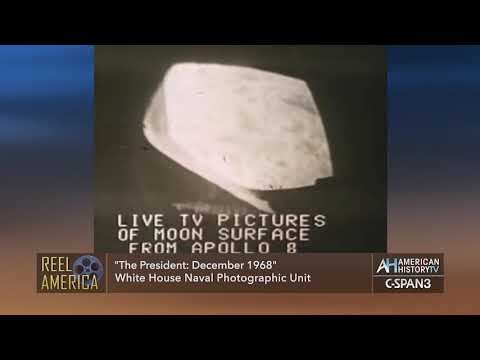
The cruise was otherwise uneventful. At 31 hours came the first television broadcast, with a two-kilogram black-and-white camera using a vidicon tube and two lenses, a 160° wide-angle and a 9° telephoto. Without a monitor aboard, aiming the telephoto was almost impossible and the Earth came out as a bright blob; after seventeen minutes the spacecraft's rotation took the high-gain antenna out of view of the receiving stations and the transmission ended with Lovell wishing his mother a happy birthday. The second broadcast, at 55 hours, went better: the crew improvised filters from the still cameras for the telephoto lens and sent back the first television pictures of the Earth from deep space, over twenty-three minutes.
The sleep shifts were soon abandoned. Three of the five windows fogged with oils outgassed from the silicone sealant, and the attitude required for passive thermal control did not help either: the crew could barely see the Moon during the whole outward cruise. At 55 hours and 40 minutes into the flight, thirteen hours before orbit insertion, Apollo 8 became the first crewed vehicle to enter the gravitational sphere of influence of another celestial body, then 62,377 km from the Moon. The last significant correction, retrograde, slowed the spacecraft by 0.61 m/s at exactly 61 hours, when it was 38,900 km from the Moon, trimming the pass to 115.4 km above the surface.
Ten orbits around the Moon
At 64 hours preparations began for lunar orbit insertion. The manoeuvre had to be carried out on the far side of the Moon, out of radio contact with Earth, and it had to be perfect. After the go/no go poll, at 68 hours the crew was told they were go; Lovell answered "We'll see you on the other side", and for the first time human beings passed behind the Moon and out of contact. Ten minutes before ignition, while checking the position of every switch, they saw the Moon for the first time: Lovell made out the first shafts of sunlight obliquely lighting the surface.
The engine ignited at 69 hours, 8 minutes and 16 seconds into the flight and burned for four minutes and seven seconds. The crew described those four minutes as the longest of their lives: too short a burn would have left them in a highly elliptical orbit or flung them into space, too long a one would have driven them into the Moon. In Houston the wait was silent, in the knowledge that if the spacecraft appeared early the engine had not fired. The signal came at the calculated instant, with the spacecraft in a 311.1 by 111.8 km orbit.
Lovell gave the first description of the lunar surface: an essentially colourless grey, like plaster of Paris or greyish beach sand, with rounded, terraced craters — he singled out Langrenus, with its central cone and six or seven terraces down the wall — and less contrast than expected around the Sea of Fertility. One of the crew's main tasks was reconnaissance of future landing sites, particularly one in Mare Tranquillitatis planned for Apollo 11, and the launch time had been chosen precisely so that the lighting there would be at its best. A film camera set up in one window recorded one frame per second; Anders spent much of the twenty hours photographing. By the end of the mission the crew had taken more than eight hundred 70 mm stills and some 210 m of 16 mm film.
Borman kept asking about the engine data during the hour of each orbit when there was contact with Earth: he wanted certainty that they could come home early if necessary, and asked for a go/no go decision before every pass behind the Moon. On the second orbit the crew set up equipment to broadcast a view of the surface while Anders described the craters, and at the end of that orbit an eleven-second burn circularised the trajectory to 112.7 by 114.7 km. On the third, Borman read a prayer that a fellow parishioner and Mission Control engineer, Rod Rose, had suggested recording for the church service the flight prevented him from attending. Over the ten orbits, which lasted some twenty hours, the effect of the lunar mass concentrations proved greater than predicted and perturbed the orbit to 117.8 by 108.5 km.
Earthrise and the Genesis reading
Coming out from behind the Moon for their fourth pass across the near side, the crew witnessed an Earthrise in person for the first time in history. The first image of the phenomenon had been taken by the Lunar Orbiter 1 probe on 23 August 1966, but no human eye had seen it. Anders saw the planet emerging from behind the lunar horizon, called out to the other two and shot first in black and white; then he asked Lovell for colour film and took the photograph known as Earthrise, later picked by Life magazine as one of its hundred photographs of the century. Because of the Moon's synchronous rotation, Earthrise is not visible from almost anywhere on the lunar surface — from there the Earth stays practically fixed in the sky — but only from orbit, or at places near the limb where libration makes it rise and set.
While Anders went on photographing, Lovell took the controls so that Borman could rest. On waking, the commander noticed that his crewmates were failing to understand questions and asking for repetitions: none of them had slept properly in more than three days. He ordered the rest of the lunar observation programme scrubbed and sent Anders and Lovell to sleep for two orbits while he sat at the helm; Anders agreed only on condition that the camera be left taking automatic photographs. Behind the order lay a calculation too: one television broadcast remained, and Borman wanted the crew alert for it.
As they rounded the Moon for the ninth time, that second transmission from lunar orbit began. Borman introduced the crew and each man gave his impression of the landscape — the commander called it "a vast, lonely, forbidding expanse of nothing" — and then Anders announced that they had a message for everyone on Earth, and the three read in turn from the creation account in the Book of Genesis. Borman closed with a Christmas greeting: "And from the crew of Apollo 8, we close with good night, good luck, a Merry Christmas and God bless all of you—all of you on the good Earth." It is estimated that a quarter of the people alive at the time saw that transmission, live or delayed. The Apollo 8 broadcasts won an Emmy Award.
The return
The only task left was trans-Earth injection, scheduled for two and a half hours after the end of the broadcast. It was the most critical burn of the flight: if the engine failed to light, the crew would be stranded in lunar orbit with no way out, and again it had to be done out of contact with Earth. It happened exactly on time. Telemetry was reacquired as the spacecraft reappeared at 89 hours, 28 minutes and 39 seconds, the calculated moment, and when voice contact returned Lovell announced: "Please be informed, there is a Santa Claus." It was 25 December.
On the way home Lovell used some idle time for navigational sightings and accidentally erased part of the guidance computer's memory, leaving the inertial measurement unit convinced that the spacecraft still held its pre-launch orientation, so that the thrusters fired to "correct" the attitude. It took ten minutes to work out the right numbers, using the thrusters to align the stars Rigel and Sirius, and another fifteen to enter them. Sixteen months later, on Apollo 13, Lovell would have to repeat a similar manual realignment in far worse circumstances.
On Christmas afternoon there was a fifth broadcast, a tour of the spacecraft and of how the crew lived aboard; when it ended they found a present from Slayton in the food locker, a real turkey dinner with stuffing in the same pack issued to troops in Vietnam, and three miniature bottles of brandy that Borman ordered left alone and that remained unopened years later. The sixth and last transmission, at about 124 hours into the mission and lasting four minutes, produced the best images of the Earth of the whole flight.
Before reentry the service module was jettisoned, exposing the heat shield. Six minutes before hitting the upper atmosphere the crew saw the Moon rising above the Earth's horizon, exactly as the trajectory specialists had calculated. Glowing plasma wrapped the capsule, deceleration peaked at 6 g, and the computer flew the descent by changing attitude, so that the spacecraft skipped briefly like a flat stone before falling. The drogue parachute deployed at 30,000 feet (9.1 km) and the three mains at 10,000 feet (3.0 km). Splashdown came at 15:51:42 UTC on 27 December 1968 in the North Pacific, southwest of Hawaii.
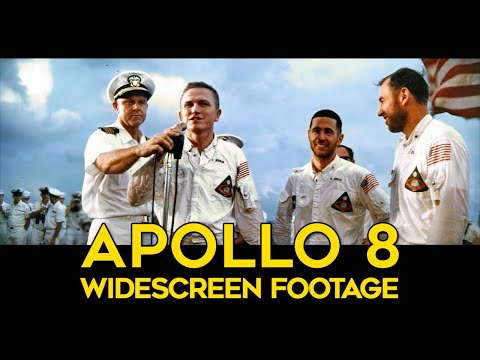
The parachutes dragged the capsule over on contact with the water and left it upside down, in what was called the Stable 2 position, buffeted by a three-metre swell; Borman vomited again while the three flotation bags did their work. About six minutes later the uprighting system returned the spacecraft to its normal attitude. The first US Navy frogman arrived forty-three minutes after splashdown and, forty-five minutes after that, the crew stepped onto the flight deck of the aircraft carrier Yorktown.
Legacy and controversy
Apollo 8 closed a convulsive year. Despite the political assassinations, the unrest in the streets of Europe and America and the Prague Spring, Time magazine chose the crew as its Men of the Year for 1968, as the people who had most influenced events. They had been the first to leave the Earth's gravitational influence and orbit another celestial body, on a mission the crew themselves had rated as having a fifty-fifty chance of complete success. A stranger summed up its effect in a telegram Borman received afterwards: "Thank you Apollo 8. You saved 1968."
The coverage was the largest since the first American orbital flight, John Glenn's in 1962: 1,200 journalists followed the mission and the BBC broadcast it in 54 countries and 15 languages. The Soviet newspaper Pravda carried a statement by Boris Nikolaevich Petrov, chairman of the Interkosmos programme, who called the flight an "outstanding achievement of American space sciences and technology".
The Genesis reading had legal consequences. The atheist activist Madalyn Murray O'Hair sued NASA to have the courts ban public prayer by astronauts, who were government employees. The case was rejected by the Supreme Court, apparently for lack of jurisdiction in outer space, but it left the agency wary of religion for the rest of the programme: Buzz Aldrin took Presbyterian communion on the lunar surface during Apollo 11 without mentioning it publicly for years.
The other legacy was visual. Anders's Earthrise was the first such image taken by a human being behind the camera and is credited as one of the inspirations of the first Earth Day, in 1970; Life chose it as the first of its hundred photographs that changed the world. In 1969 the United States Post Office Department issued a commemorative stamp with a detail of the photograph and the words "In the beginning God ...", the opening of Genesis; that same January, eighteen days after the crew's return, the three men recited the Pledge of Allegiance in the pre-game show of Super Bowl III.
The spacecraft went its own way: in January 1970 it travelled to Osaka to be displayed in the United States pavilion at Expo '70, and it is now kept at the Chicago Museum of Science and Industry together with personal items from the flight donated by Lovell and Borman's space suit. Lovell's suit is displayed at the visitor centre of NASA's Glenn Research Center and Anders's at the Science Museum in London.