Apollo program · NASA · Crewed
Apollo 7
- Oct 11, 1968, 3:02 PM
- Launch date
- 3
- Crew size
- 10 days 20 hr
- Duration
- Success
- Outcome
Apollo 7 was the first crewed flight of the Apollo program and the mission that returned the United States to space after twenty-one months of silence. It lifted off from Launch Complex 34 at Cape Kennedy Air Force Station on 11 October 1968 and splashed down in the Atlantic on 22 October, after a little under eleven days in Earth orbit. Walter M. Schirra flew as commander, Donn F. Eisele as command module pilot and R. Walter Cunningham as lunar module pilot, a title he kept even though the mission carried no lunar module at all. The flight existed for one very specific reason. The Apollo 1 fire, which killed Grissom, White and Chaffee during a launch pad rehearsal on 27 January 1967, had stopped the program dead. Apollo 7 inherited the objectives of that lost mission and met them with a different spacecraft: the Block II command and service module, thoroughly redesigned in the light of the accident investigation. Schirra, Eisele and Cunningham had spent months following their vehicle through the North American Aviation plant at Downey, determined that what had happened would not happen again. In orbit the spacecraft was put through an exhaustive examination. The crew fired the service propulsion engine, ran guidance and navigation manoeuvres, flew a simulated docking approach to the spent S-IVB stage and, the next day, a full rendezvous with that same drifting stage. The big engine, the one that would have to lift lunar crews out of Moon orbit, worked eight times out of eight. The mission also produced the first live television broadcast from an American spacecraft, an exercise engineers had spent years dismissing as dead weight and which ended up earning NASA a special Emmy. The other side of the flight was human. Schirra developed a heavy head cold about fifteen hours into the mission and his two crewmates caught it soon after. In weightlessness mucus does not drain, and the discomfort compounded an overloaded flight plan and a staggered sleep schedule that worked badly. Out of that came sharp exchanges with Mission Control, broadcast almost live, and the commander's refusal to wear helmets during re-entry for fear of ruptured eardrums. Technically the mission was faultless. Apollo program director Samuel Phillips called it a perfect flight in which one hundred and one percent of the objectives were accomplished, and its success was enough for NASA to commit Apollo 8 to lunar orbit barely two months later. The price was paid by the three men who flew it: none of them ever went into space again. Schirra had already announced his retirement before launch; Eisele and Cunningham watched their astronaut careers stop. Forty years later, in 2008, NASA finally awarded them the Distinguished Service Medal they had been denied.
Payload
Apollo 7 carried no lunar module. Its payload was the complete Block II vehicle — command and service module CSM-101, built by North American Rockwell — together with the launch escape system and the spacecraft/lunar module adapter SLA-5. That adapter, which on later missions would house the lunar module, instead carried a structural stiffener and served only as the link between the service module and the S-IVB instrument unit. The escape system was jettisoned after S-IVB ignition, and the adapter was left behind with the spent stage when the spacecraft separated in orbit. Inside the cabin, the item of cargo that had caused the most argument was a portable television camera. It had gone in and out of the design since 1963, because engineers saw it as expendable weight and test-pilot crews regarded it with indifference; only the persistence of the public affairs people and of a few engineers in management kept it alive until Phillips ordered it installed in CSM-101. With it the crew made the first live broadcasts from an American spacecraft. The rest of the load was the equipment of a long-duration engineering flight: eleven days of provisions with more than sixty different items and roughly 2500 calories a day per crew member, sleeping bags stowed under the outer couches, an Exer-Genie exercise device, medical supplies and decongestants, still cameras and the material needed to photograph weather and terrain of scientific interest, an activity that found its way into the flight plan because the mission was open-ended.
| Crew | Role | Agency | Extravehicular activity |
|---|---|---|---|
| Walter Marty "Wally" Schirra Jr. | Commander | NASA · United States | — |
| Donn Fulton Eisele | Command module pilot | NASA · United States | — |
| Ronnie Walter "Walt" Cunningham | Lunar module pilot | NASA · United States | — |
History
A program stopped by fire
On 27 January 1967 Virgil Grissom's crew was rehearsing the countdown for the mission due to fly on 21 February when a fire broke out in the cabin and killed all three men. The Block I command module burned through in seconds in a pressurised pure-oxygen atmosphere, and the hatch, which opened inward, could not be worked in time. Every crewed flight was suspended and the safety of the whole Apollo program was reviewed from the ground up.
The twenty-one months that followed were spent on redesign and uncrewed flights. When NASA next put people on top of a rocket, it did so with a different spacecraft: the Block II, conceived from the start to dock with a lunar module and now also rebuilt around the lessons of the investigation. Apollo 7 was that mission. It inherited Apollo 1's objectives — to test the command and service module in low Earth orbit — and completed them, closing the cycle the tragedy had opened.
Schirra, Eisele and Cunningham
Walter M. Schirra was one of the seven original Mercury astronauts. A Naval Academy graduate of 1945, he had flown Mercury-Atlas 8 in 1962, the fifth crewed flight of Project Mercury and the third to reach orbit, and in 1965 he had been command pilot of Gemini 6A, the first space rendezvous. At the time of Apollo 7 he was a Navy captain of forty-five, which made him the oldest person to have reached space up to that point and, in time, the only astronaut to fly Mercury, Gemini and Apollo.
Donn F. Eisele graduated from the Naval Academy in 1952 with a degree in aeronautics but chose to serve in the Air Force; he was a major, aged thirty-eight. R. Walter Cunningham had joined the US Navy in 1951, began flight training the following year and served with a Marine squadron between 1953 and 1956; on Apollo 7 he was a civilian of thirty-six holding the rank of major in the Marine Corps reserve. He had earned a bachelor's degree in physics from the University of California, Los Angeles, in 1960 and a master's in 1961. Both Eisele and Cunningham were selected in 1963, in the third group of astronauts.
Eisele's route to this crew was a crooked one. He had been slated for the Apollo 1 crew alongside Grissom and Edward White, but a shoulder injury requiring surgery, days before the official announcement of 25 March 1966, gave his seat to Roger Chaffee and moved him to Schirra's team. The three were first named as an Apollo crew on 29 September 1966, for a second Earth-orbital test flight of the command module. Cunningham, a rookie assigned to a prime crew without ever having been a backup, suspected the second flight was redundant if Apollo 1 went well; he learned later that Donald Slayton, director of flight crew operations and himself one of the Mercury Seven, had planned to command it if he regained medical clearance. He did not, and in November 1966 the mission, by then called Apollo 2, was cancelled and Schirra's team became backups to Grissom's. Thomas Stafford, who had been backup commander for that second orbital flight, recalled that the cancellation came after Schirra and his crew presented a list of demands to NASA management — Schirra wanted a lunar module and a command module able to dock with it — and that being reduced to backups left Schirra convinced that Slayton and chief astronaut Alan Shepard had ruined his career.
After the fire, Slayton asked Schirra, Eisele and Cunningham to fly the first mission of the resumption. The backup crew was Stafford's, with John W. Young as command module pilot and Eugene A. Cernan as lunar module pilot: all three would become the prime crew of Apollo 10. The support crew was Ronald E. Evans, John L. Swigert and Edward G. Givens; Givens died in a car accident on 6 June 1967 and was replaced by William R. Pogue. Evans handled hardware testing at the Kennedy Space Center, Swigert served as launch capsule communicator and worked the operational side, and Pogue spent his time modifying procedures. The mission's capsule communicators were Evans, Pogue, Stafford, Swigert, Young and Cernan, and the flight directors were Glynn Lunney, Gene Kranz and Gerry Griffin.
Preparation: watching the spacecraft rather than training on it
By Cunningham's account, Schirra had lost interest in a third spaceflight and was already looking at a career beyond NASA. Flying the first mission after the fire changed that: Wally Schirra was being cast as the man to rescue the crewed space program, and that, Cunningham wrote, was a job worthy of Wally's interest. Eisele put it differently, recalling that coming right on the heels of the fire, they knew the fate of the entire program — and their own skins — rode on the success or failure of Apollo 7.
Initial distrust of the North American Aviation workforce at Downey, California, where the command modules were built, led the crew to follow their spacecraft step by step through assembly and testing. This interfered with training, though early on it hardly mattered: the command module simulators were not yet ready and launch was far away. Once the simulators were available at the Manned Spacecraft Center in Houston and at Kennedy, the schedule became impossible even with help from the backup and support crews, and twelve- and fourteen-hour days became normal. When the command module was finished and shipped to Florida, training moved there, and weekends at home became rare. Astronaut Tom Jones wrote in 2018 that Schirra, holding incontrovertible evidence of the risk his crew ran, now had enormous influence over NASA and North American management and used it: in meeting rooms or on the assembly line, he got his way.
The crew spent five hours in training for every hour they expected to spend aboard if the mission ran its full eleven days, on top of technical briefings, pilot meetings and their own study. They practised evacuating the pad, egressing the spacecraft in the water after splashdown and using firefighting equipment, and they trained on the Apollo guidance computer at the Massachusetts Institute of Technology. Each crew member logged one hundred and sixty hours of command module simulation, some of it with Mission Control in Houston participating live. The plugs-out test — the same test that had killed the Apollo 1 crew — was repeated with the prime crew aboard, this time with the hatch open.
In parallel, equivalent command modules went through a battery of trials. A crew of Joseph Kerwin, Vance Brand and Joe Engle spent eight days inside a module in an altitude chamber in Houston in June 1968 to test the systems. Another, of James Lovell, Stuart Roosa and Charles Duke, spent forty-eight hours at sea inside a module lowered from a Navy ship in the Gulf of Mexico in April 1968, to see how the systems responded to salt water; further tests followed in a tank in Houston the next month. Fires were deliberately set in a test module with various atmospheric mixtures and pressures, and the results led to a launch atmosphere of sixty percent oxygen and forty percent nitrogen, replaced within four hours by low-pressure pure oxygen — a compromise that gave adequate protection against fire. Other test articles were dropped to check the parachutes and to simulate the damage of a hard landing on ground. All the results were satisfactory.
Meanwhile the Soviet Union sent the uncrewed Zond 4 and Zond 5 probes around the Moon, the latter carrying two tortoises, which appeared to herald a crewed circumlunar flight. The American lunar module was running late, and George Low, manager of the spacecraft program, proposed that if Apollo 7 succeeded, Apollo 8 should fly to lunar orbit without a lunar module. With that proposal accepted, the stakes on Apollo 7 rose. Stafford recalled that Schirra felt the entire weight of the program on his mission and became more openly critical and sarcastic as a result.
There was one battle Schirra fought and won outside the schedule: Guenter Wendt. A McDonnell Aircraft engineer, Wendt had led the pad crews of Mercury and Gemini with final responsibility for the state of the spacecraft at launch, and the astronauts respected him. Because Apollo's contractor was North American rather than McDonnell, Wendt had not been in charge of the Apollo 1 pad. Schirra pressed until Slayton persuaded North American management to hire him, and Schirra himself lobbied the launch operations manager to move him off the midnight shift onto the day shift. Wendt led the pad for the rest of the Apollo program. As he left the spacecraft area before liftoff, Cunningham said "I think Guenter's going", and Eisele answered, playing on the name, "Yes, I think Guenter went."
CSM-101: the first Block II to fly
The Apollo 7 spacecraft was command and service module 101, the first Block II article ever flown, built by North American Rockwell. Unlike the Block I of Apollo 1, intended only for early Earth-orbital missions, the Block II could dock with a lunar module, though none was carried on this flight. The stack was completed by the launch escape system and the SLA-5 adapter, which instead of a lunar module held a structural stiffener and joined the service module to the S-IVB instrument unit.
The post-fire redesign was deep: more than 1,800 changes were recommended and 1,300 were incorporated in time for Apollo 7. The most visible was the new aluminium and fibreglass hatch, which opened outward and could be worked in seven seconds from inside by the crew and in ten seconds from outside by the pad crew. Aluminium tubing in the high-pressure oxygen system was replaced with stainless steel, flammable materials were swapped for non-flammable ones — including plastic switches, which became metal — and an emergency oxygen system was added to protect the crew from toxic fumes, along with firefighting equipment.
The industrial history of this particular spacecraft says a great deal about the pace of the program. CSM-101 entered manufacturing early in 1966 and by July had been formed, wired, fitted with subsystems and made ready for testing. The January 1967 fire forced changes above all to wiring, the hatch area and the forward egress tunnel, and it did not return to testing until December. It passed a customer acceptance review in three phases; at the third session, held at Downey on 7 May 1968, no item appeared that might constrain the launch. North American cleared thirteen outstanding deficiencies and shipped the vehicle to Kennedy on 30 May.
Low, whose mind was already on the lunar flight, watched Apollo 7 with particular care precisely because the previous attempt to put a crew in orbit had ended in disaster. After rereading the evaluations of the fourth, fifth and sixth missions, he asked one of his troubleshooters, Simpkinson, for a list of possible oversights, and he set John Hodge's crew safety review board to questioning every judgment decision that had seemed reasonable in isolation, to check that the sum still was. Aaron Cohen concluded that they were sound individually and collectively. At North American, Dale Myers was conducting the same examination of the one hundred and thirty-seven changes stemming from the spacecraft 012 fire. At the flight readiness review on 20 September, Myers declared CSM-101 "a very good spacecraft", and the launch preparation managers at Kennedy agreed.
A minor detail, but telling about the commander: after Grissom named his Gemini 3 capsule "Molly Brown", NASA had forbidden crews to name their spacecraft. Schirra wanted to call his "Phoenix" and was refused. The first command module with a call sign of its own would be Apollo 9's, which needed two distinct radio identities because it carried a lunar module.
Saturn IB SA-205 and Complex 34
Flying in low Earth orbit without a lunar module, Apollo 7 did not need a Saturn V: it was launched by a Saturn IB, vehicle SA-205, the fifth of its series to fly and the first to carry a crew. It differed from its predecessors in having strengthened propellant lines to the augmented spark igniter of the J-2 engines, a modification meant to prevent a repeat of the early shutdown suffered on the uncrewed Apollo 6 flight; post-flight analysis had shown those lines had leaked. The Saturn IB was a two-stage rocket whose second stage, the S-IVB, was similar to the third stage of the Saturn V. After Apollo the same launcher carried crews to Skylab and flew the Apollo-Soyuz Test Project.
Apollo 7 was the only crewed mission of the program to lift off from Launch Complex 34 at Cape Kennedy Air Force Station. Every later Apollo and Skylab flight, Apollo-Soyuz included, left from Launch Complex 39 at the neighbouring Kennedy Space Center. Complex 34 was declared surplus and decommissioned in 1969, which makes Apollo 7 the last crewed mission of the twentieth century launched from the Cape's Air Force station. Like every previous Saturn IB, the vehicle was assembled directly on the pad.
Objectives: an open-ended engineering test
There were three primary objectives, stated without rhetoric: to demonstrate the performance of the command and service module with a crew; to demonstrate the performance of the crew, space vehicle and mission support facilities during a crewed command and service module mission; and to demonstrate the rendezvous capability of the command and service module. The program flight summary records all three as accomplished, along with the long list of detailed test objectives, both for the launch vehicle — orbital safing of the S-IVB, attitude control, qualification of the J-2 igniter line modification — and for the spacecraft: thermal coating degradation on the environmental control system's primary radiator, thermal protection of the Block II forward heat shield, inertial measurement unit alignments with the sextant, velocity manoeuvres under guidance, navigation and control, verification of life support functions, water management, service propulsion system performance in space and operation of the S-band communications system with the manned space flight network.
Samuel Phillips wrote to administrator James Webb that those objectives could be met in three days, but that the mission would be open-ended up to eleven days to gather additional data and evaluate the aspects of a long crewed flight. The eleven-day limit was itself a reduction from the fourteen days planned for Apollo 1. That margin left room to photograph weather and terrain of possible scientific interest. Much of the data-gathering was scheduled early in the flight: if the mission ended prematurely, the data would already be on the ground and problems could be corrected before the next Apollo.
11 October 1968: launch
That morning the wind was from the east. Launching in those conditions violated the safety rules, because if the launch vehicle failed and an abort were needed, the command module might be blown over land rather than water; Apollo 7 was also flying the old Apollo 1-style couches, which offered less protection than later ones. Schirra said afterwards that he believed the launch should have been scrubbed, but management waived the rule and he yielded to the pressure. It was the first disagreement of a series.
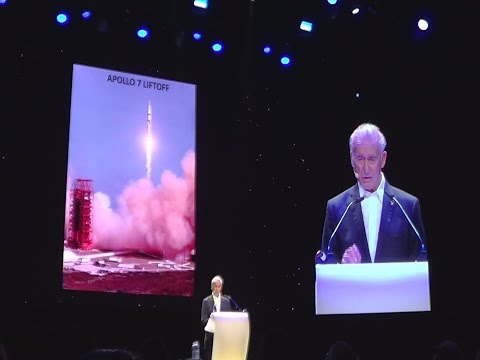
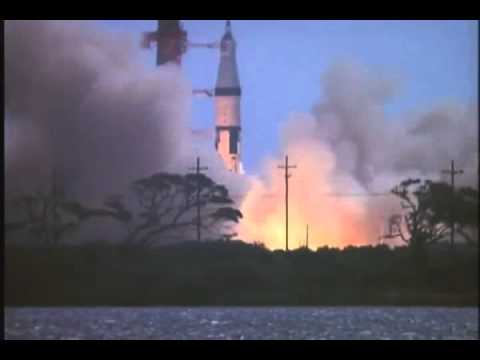
Liftoff came at 11:02:45 in the morning, Eastern Daylight Time — 15:02:45 universal time — on Friday 11 October 1968, from Complex 34, in front of more than six hundred news media representatives. It was the first American crewed spaceflight in twenty-two months. In the cabin, Schirra, Eisele and Cunningham heard the roar of propellants entering the chambers, felt the vehicle sway and sensed the vibration of ignition. The ascent was flawless: the Saturn IB performed well on its first crewed flight, with no significant anomalies, and the astronauts described it as very smooth, with little vibration and moderate acceleration. Ten and a half minutes after liftoff they were in an orbit of 227 by 285 kilometres. In Houston a Mission Control organised in three shifts under flight directors Lunney, Kranz and Griffin took over. The ascent made Schirra, at forty-five, the oldest person to have reached space to that date.
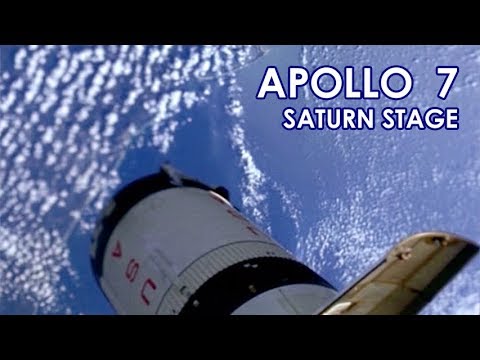
In the first three hours of flight the crew carried out two manoeuvres simulating what a lunar mission would demand. First they manoeuvred the stack with the S-IVB still attached, as would be required for the translunar injection burn. Then, with the spacecraft separated from the stage, Schirra turned around and approached a docking target painted on the S-IVB, reproducing the lunar module capture manoeuvre. Cunningham reported that the hinged adapter panels had not fully opened, something that reminded Stafford, at the capsule communicator console, of the "angry alligator" of his Gemini 9A flight. On a mission carrying a lunar module, half-open panels would have been a collision hazard, so later flights jettisoned them explosively once the spacecraft had separated. After twenty minutes of station keeping, Schirra let the stage drift away to about one hundred and twenty-two kilometres in preparation for the next day's rendezvous.
That first day also brought the first hot meal prepared aboard an American spacecraft. Schirra had insisted on carrying instant coffee over the objections of NASA physicians, who argued it had no nutritional value; five hours after launch he reported that he was drinking, and enjoying, his first plastic bag of coffee.
The rendezvous with the S-IVB
The rendezvous had a very specific purpose: to show that the command and service module could match the orbit of a lunar module and rescue it after an aborted landing or after liftoff from the surface. It was scheduled for the second day, but by the end of the first Schirra had already reported a cold and, despite Slayton coming on the line to press him, refused Mission Control's request to switch on and test the television camera before the rendezvous, citing the cold, the fact that the crew had not eaten, and a heavily loaded schedule.
The manoeuvre was complicated by Apollo 7 having no rendezvous radar, which lunar missions would carry. The service propulsion engine, the same type that would later have to put spacecraft into and out of lunar orbit, had only been fired on a test stand; the crew trusted it but feared it might behave unexpectedly and force an early end to the mission. The burns were computed on the ground, and the final approach required Eisele to use the telescope and sextant to work out the last corrections while Schirra fired the reaction control thrusters. The first firing of the big engine came as a surprise: in contrast to the smoothness of the Saturn, the thrust shook the spacecraft hard, startled Eisele and drew a shout of "Yabba dabba doo!" from Schirra, the catchphrase of Fred Flintstone. Eisele summed it up afterwards by saying they were not quite sure what to expect but got more than they expected, a real boot in the rear that pinned them back in their seats. Schirra brought the spacecraft up to the tumbling S-IVB and completed the rendezvous successfully.
The first live television from an American spacecraft
The camera that nearly stayed on the ground made history on 14 October. The broadcast opened with a card reading "From the Lovely Apollo Room High Atop Everything", a nod to the introductions of dance band announcers on 1930s radio. Cunningham operated the camera and Eisele was master of ceremonies. For seven minutes the crew showed off the spacecraft and offered views of the southern United States; before signing off, Schirra held up another card: "Keep those cards and letters coming in, folks", another old radio line that Dean Martin had put back into circulation.
It was the first live television broadcast from an American spacecraft. Gordon Cooper had transmitted slow-scan images from Faith 7 in 1963, but they were of poor quality and were never broadcast. Jones described it as a public relations masterstroke delivered by apparently amiable astronauts. Daily broadcasts of about ten minutes followed, with more cards and explanations of spaceflight for a lay audience; on their return the crew received a special Emmy for those transmissions. The cards, and the music tapes that lightened the mission, were supplied by Michael Kapp.
On that same 14 October, the onboard radar receiver locked onto a ground transmitter, another demonstration that a command module in lunar orbit would be able to keep contact with a lunar module returning from the surface.
Eleven days of life aboard
With the rendezvous and the critical tests behind them, the rest of the mission consisted of a systematic examination of the spacecraft: propulsion, navigation, environmental control, electrical systems and thermal control. Everything responded. Authors Francis French and Colin Burgess concluded that the redesigned Apollo spacecraft performed better than anyone had dared to hope. By the end of the mission the service propulsion engine had fired eight times without a single failure.
The problems were minor and very domestic. One of the three fuel cells supplying the spacecraft's electricity would develop higher temperatures than desired, but sharing the load between them avoided any loss of power. The environmental circuit fans were so noisy that the crew switched off first one and then the other; the cabin remained comfortable, though the coolant lines sweated and water pooled on the floor, something already expected after the Kerwin team's altitude chamber run. Schirra and his crew vacuumed the excess water overboard through the urine dump hose.
Window visibility ranged from poor to good depending on the moment. Shortly after the escape tower was jettisoned, two windows carried soot deposits and two others condensation. Two days later Cunningham reported that nearly all were in acceptable condition, though moisture was collecting between the inner panes of one; by the seventh day Schirra described much the same. Even so the windows did their job: those used for the rendezvous and station keeping with the S-IVB stayed almost clear. Optical navigation was the genuinely difficult part. Aiming the telescope and sextant at any of the thirty-seven preselected Apollo stars was troublesome shortly after a waste water dump, because several minutes had to pass for the frozen particles to disperse; Eisele reported that unless he could see at least forty or fifty stars at once, he had trouble deciding which part of the sky he was looking at. He also found the Earth horizon awkward for star sightings because of atmospheric diffusion.
Solid waste management worked but was a trial: the bags, containing a germicide to prevent bacteria and gas formation, sealed easily and were stowed in empty food containers, but each use took between forty-five and sixty minutes and left unpleasant odours, so it was put off until a gap in the work appeared. In nearly eleven days there were twelve defecations in all. Urination was far simpler, needing no removal of clothing, with collection devices for both the pressure suits and the flight coveralls and overboard dumping through the hose; the valve had been expected to freeze in vacuum and never did.
For the first time astronauts had a spacecraft with room to move. Where Gemini had talked about extravehicular activity, Apollo introduced intravehicular activity. The crew adapted at once to floating: Schirra remarked that all the fears about the spacecraft picking up crew motion proved unfounded and that one ended up something of a gymnast, and Cunningham added that the effort was almost nil and that no rugged handholds were needed to move about. Exercise mattered: sleeping in the couches curled the body into a foetal position and produced lower back and abdominal aches, so they took hurried turns on a stretching device called the Exer-Genie.
Sleep was the weak point of the planning. The plan required one crew member to be awake at all times, and Eisele was assigned the watch while the other two slept, resting during part of his crewmates' work period. It did not work well: it was hard to work without disturbing him, and Cunningham recalled waking to find Eisele dozing. Schirra complained about the continuous schedule, with sleep periods that could begin at four in the afternoon or four in the morning. Slayton suggested all three sleep at once, but Schirra replied that the machine was flying well and he did not want to change anything. Two sleeping bags were stowed under the outer couches, unpopular because the restraints were in awkward places; Cunningham preferred to sleep in his couch with the shoulder harness and lap belt fastened. From the third day on, the crew had found a routine that let them rest enough.
The food did not help morale either. There were more than sixty items to choose from, at roughly 2500 calories a day, but the bites crumbled and particles floated around the cabin; the crew came to detest the energy sweets and negotiated among themselves over the breakfast items, which were the most acceptable. During and after the flight they insisted that space food fell well short of their eating habits.
The cold and the tug of war with Mission Control
About fifteen hours into the flight Schirra developed a bad head cold, and Cunningham and Eisele caught it soon after. A cold is a nuisance on the ground; in weightlessness it is another matter, because mucus accumulates, fills the nasal passages and does not drain, and the only relief is to blow hard, which punishes the eardrums. All three spent days with blocked ears and noses, taking aspirin and decongestants and discussing the symptoms with the flight surgeons.
Lack of sleep and general discomfort fed the tension that surfaced again and again between the crew and Houston, which Schirra had opened before liftoff with his anger at being cleared to launch in the wind: the mission, he said, had put them against the wall in terms of risk. Jones considered that pre-launch argument the prelude to a whole-flight tug of war over command decisions. The television test was the first public clash. Schirra settled it at the time: "You have added two burns to this flight schedule, and you have added a urine water dump; we have a new vehicle up here, and I can tell you at this point TV will be delayed without any further discussion until after the rendezvous." He later wrote that they would resist anything that interfered with the primary objectives, and that a television show on that Saturday morning clearly interfered. Eisele agreed in his memoir: they were engrossed in preparing a critical exercise and did not want to be distracted by what then seemed trivialities, though "the folks on the ground thought otherwise; there was a big flap over the stubborn, recalcitrant, and unresponsive Apollo 7 crew". French and Burgess wrote that, viewed objectively, on a mission front-loaded with tasks the rendezvous, alignments and engine tests had to come before a television show, and that it is hard to argue with Schirra. Slayton gave way, but the commander's attitude took the controllers by surprise.
On the eighth day, after the ground passed up a new procedure that left the computer locked, Eisele broadcast that they had not gotten the results they were looking for, that they had gotten nothing at all, and that as far as he was concerned somebody down there had screwed up royally when he laid that one on them. Schirra thought later that this was the main occasion on which Eisele irritated Mission Control. There was more the following day: having had to fire the reaction control system repeatedly to hold the spacecraft steady through a test, Schirra said he would like to find out the name of the idiot who thought up the test, because he wanted to talk to him personally when he got back down. Eisele joined in, asking them to find out who dreamed up the P22 horizon test as well, "that is a beauty also".
The most serious disagreement was over the helmets. Schirra repeatedly stated that re-entry should be flown with helmets off: he saw a risk of eardrums bursting from sinus pressure caused by the colds, and the crew wanted to be able to pinch their noses and blow to equalise pressure as it built up during the descent, which is impossible with a helmet on. For several days he rejected the ground's advice, asserting that the decision was the commander's prerogative, though Slayton warned him he would have to answer for it after the flight. In 1994 he explained it this way: he had a cold, he had had enough discussion with the ground, and he had little time left to debate whether or not they wore a helmet; he was aboard and he was in command, and they could all wear black armbands if he was lost or lost his hearing, but the responsibility for the mission was his. Nobody wore a helmet on re-entry. Director of flight operations Christopher Kraft demanded an explanation from Stafford, as capsule communicator, of what he regarded as insubordination. Years later Kraft put it more calmly: Schirra was exercising his commander's right to have the last word, and that was that.
Re-entry and splashdown
Each crew member took a decongestant about an hour before re-entry and all three came through the deceleration with no ear trouble. Apollo 7 splashed down without incident at 11:11:48 universal time on 22 October 1968, some two hundred nautical miles — about 370 kilometres — south-southwest of Bermuda and seven nautical miles, roughly thirteen kilometres, from the recovery ship USS Essex. Mission duration was ten days, twenty hours, nine minutes and three seconds, a little over 260 hours of flight that the mission record translates into 163 completed orbits. That "magnificent flying machine", as Cunningham called it, came down less than two kilometres from the planned impact point. On hitting the water the capsule turned nose down, but the crew inflated the flotation bags and the spacecraft righted itself. A helicopter picked up all three and set them down on the deck of the Essex.
Assessment: the mission that put the program back in the race
Apollo 7 did exactly what was asked of it: it qualified the command and service module and cleared the way for the lunar orbital mission then being proposed. National interest was enormous; a special edition of NASA's press clipping bulletin reproduced the front pages of thirty-two major newspapers from across the country. Apollo program director Samuel Phillips said it without qualification: for him it was a perfect mission in which one hundred and one percent of the objectives had been accomplished. Kraft wrote that Schirra and his crew did it all, or at least everything that counted, proving to his complete satisfaction that the service propulsion engine was one of the most reliable ever sent into space, and operating the command and service modules with real professionalism. Eisele, for his part, admitted flatly that they were insolent, high-handed and Machiavellian at times, and that whether it was called paranoia or smart thinking, the job got done. Kranz, in 1998, offered the perspective of time: looking back, Schirra had not pushed as hard as it had seemed at the moment, and grumpy commander or not, the team did its job.
The immediate effect was the authorisation of Apollo 8. The proposal to send the command and service module along the same lunar route the landing would follow had been set in motion by a Phillips directive of 19 August, still with Earth-orbital objectives on paper because of Webb's insistence on waiting to see how Apollo 7 performed. The certification review at Huntsville cleared the Saturn V on 19 September, and on 7 November the same board examined every element of Apollo 8. At the management council meeting of 10 November, Phillips recommended going to lunar orbit; Mueller asked Low and Phillips for the list of what was strictly essential for a safe round trip, and the answer was that the service propulsion system had to work and that at least sixty hours of oxygen had to remain for the return. Three weeks after the Apollo 7 crew came home, administrator Thomas Paine gave Apollo 8 the go-ahead to launch in late December and orbit the Moon. As Jones wrote, Apollo 7 had got NASA past its trial by fire, and it was the first small step on a road that would take another crew, nine months later, to the Sea of Tranquility.
The price: three careers halted
NASA awarded Schirra, Eisele and Cunningham its Exceptional Service Medal. On 2 November 1968 President Lyndon Johnson held a ceremony at his ranch in Johnson City, Texas, to present them; at the same event he gave the Distinguished Service Medal, the agency's highest honour, to the recently retired James Webb for his leadership of the space program. The crew also visited the White House in December 1968.
None of the three flew in space again. Jim Lovell explained it by saying that Apollo 7 was a very successful flight and an excellent job, but also a very contentious flight, and that they made the ground people quite angry, which in his view ended their future missions. Schirra had announced before the flight that he would retire from NASA and the Navy effective 1 July 1969. The other two saw their careers cut short; by some accounts Kraft told Slayton he was unwilling to work with any member of that crew in future. Cunningham heard the rumour and put it to Kraft early in 1969: Kraft denied it, though his reaction, Cunningham said, was not exactly one of outraged innocence. In Eisele's case personal circumstances weighed as well — he was the first serving astronaut to divorce, followed by a quick remarriage — along with a mediocre performance as backup command module pilot for Apollo 10. He resigned from the Astronaut Office in 1970, stayed with NASA at the Langley Research Center in Virginia until 1972, and retired once eligible. Cunningham was put in charge of the Astronaut Office's Skylab division; he said he was informally offered command of the first Skylab crew, but when the post went to Pete Conrad and he was offered the backup command instead, he resigned as an astronaut in 1971.
They were the only crew of all the Apollo, Skylab and Apollo-Soyuz missions not to receive the Distinguished Service Medal immediately after their flight, though Schirra already held it twice for Mercury and Gemini. In October 2008 administrator Michael Griffin decided to award it forty years late, for their exemplary performance in meeting all the mission objectives and more on the first crewed Apollo flight, paving the way for Apollo 8's first voyage to the Moon and Apollo 11's first crewed landing. Only Cunningham was still alive: Eisele had died in 1987 and Schirra in 2007. Eisele's widow accepted his medal and Bill Anders of Apollo 8 accepted Schirra's. Neil Armstrong, Buzz Aldrin and Alan Bean were among the Apollo astronauts present. Kraft, who had clashed with them so hard, sent a conciliatory video message telling Cunningham that they had given him a hard time back then, but that he had survived it and done very well since, and that he was frankly proud to call him a friend.
Insignia, capsule and cultural traces
The mission emblem shows a command and service module with its propulsion engine firing, the trail encircling a globe and extending beyond the edges of the patch to symbolise the Earth-orbital nature of the flight. The Roman numeral VII appears over the South Pacific and the crew names run along a black arc at the bottom. It was designed by Allen Stevens of Rockwell International.
In January 1969 the Apollo 7 command module rode on NASA's float in President Richard Nixon's inaugural parade, with the three astronauts in an open car. Transferred to the Smithsonian Institution in 1970, it was on loan to the National Museum of Science and Technology in Ottawa, Ontario, until its return to the United States in 2004. It is on display today, on loan, at the Frontiers of Flight Museum at Love Field in Dallas, Texas.
The mission left traces in popular culture as well. On 6 November 1968 the comedian Bob Hope broadcast one of his television specials from the Manned Spacecraft Center in Houston in honour of the crew, with Barbara Eden, star of the series "I Dream of Jeannie", joining Schirra, Eisele and Cunningham. Schirra turned his cold into an advertising contract as the face of Actifed, the over-the-counter version of the medicine he had taken in space. And the flight was dramatised in 1998 in the episode "We Have Cleared the Tower" of the miniseries "From the Earth to the Moon", with Mark Harmon as Schirra, John Mese as Eisele, Fredric Lehne as Cunningham and Nick Searcy as Slayton.