Apollo program · NASA · Uncrewed
Apollo 6
- Apr 4, 1968, 12:00 PM
- Launch date
- 9 hr 57 min
- Duration
- Partial success
- Outcome


-1600.webp)

-1600.webp)

-1600.webp)
-1600.webp)


Apollo 6 (AS-502), launched on April 4, 1968 from Launch Complex 39A at the Kennedy Space Center, was the third and final uncrewed flight of the Apollo programme and the second flight of the Saturn V. It carried no crew: its payload was CSM-020, a Block I command and service module with Block II modifications, and LTA-2R, a simulated lunar module instrumented to measure vibration and structural loads. The plan called for a restart of the S-IVB third stage to simulate trans-lunar injection, followed by a direct-return abort using the service module engine. None of it went as written. During first-stage flight, pogo oscillations subjected the rocket to more than twice its design longitudinal acceleration; on the second stage two J-2 engines shut down, one from a genuine failure and the other through cross-wiring; and the S-IVB failed to restart in orbit. Mission Control fell back on a pre-planned alternate profile and used the SPS engine to raise apogee to 22204 km and force a high-speed re-entry. The capsule splashed down in the North Pacific after about ten hours of flight. Despite the tally, NASA explained every failure down to its root cause, applied the corrections and decided that the next Saturn V, on Apollo 8, would already carry a crew.
Payload
The mission carried no crew, and its payload was the flight stack that had to be qualified. Atop AS-502 rode CSM-020, a Block I command and service module with some Block II modifications: command module CM-020, fitted with a mission programmer and the equipment needed to operate it remotely, and carrying the hatch redesigned after the Apollo 1 fire; and service module SM-014, which replaced the originally assigned SM-020 because the latter had flown on Apollo 4. Given the short flight, not all service module systems were activated: the electrical power and environmental control radiators were left unconnected. Below the CSM, inside the Spacecraft-Lunar Module Adapter SLA-9, rode LTA-2R, a test article simulating the lunar module: a flight-type descent stage without landing gear, its fuel tanks filled with a water–glycol mixture and its oxidiser tanks with freon, and an ascent stage of ballasted aluminium carrying no flight systems, instrumented to record vibration, acoustics and structural integrity. Cameras completed the payload: four on the S-IC first stage and two on the S-II, meant to be ejected and recovered, plus a motion picture camera and a 70 mm still camera aboard the command module.
History
A rocket with one exam left
When AS-502 lifted off from Pad 39A at the Kennedy Space Center on April 4, 1968, NASA was not testing a spacecraft: it was sitting the second and final examination of the rocket meant to carry three men to the Moon. Apollo 6 was the third and last uncrewed flight of the Apollo programme and the second flight of the Saturn V. Its official designation was AS-502, the vehicle was the second flight-capable Saturn V, and the purpose was to complete the launch vehicle's qualification for crewed flight.
The setting could hardly have been tenser. The Apollo 1 fire, in January 1967, had killed three astronauts and forced a rebuild of the command module from the ground up. Apollo 4, in November 1967, had introduced the Saturn V with a success so complete that the doctrine of all-up testing — flying the whole rocket on the first attempt rather than proving one stage at a time — was vindicated at a stroke. Against that background, Apollo 6 was meant to be the formality that cleared the road. It was not.
The flight plan: a Moon that would not be visited
The intended profile was ambitious. After reaching a circular parking orbit of about 190 km, the S-IVB third stage was to restart and perform a simulated trans-lunar injection: a trajectory passing beyond the orbit of the Moon without encountering it. The command and service module (CSM) would separate from the S-IVB shortly afterwards, and the service module engine would then slow the craft, dropping its apogee to 22204 km (11989 nautical miles) to simulate a direct-return abort, the manoeuvre that would bring a crew home if something went wrong on the way to the Moon.

On the return leg, that same engine was to fire a second time to accelerate the capsule and reproduce lunar-return conditions: a re-entry angle of −6.5 degrees at a velocity of 11100 m/s (36500 ft/s). The whole mission was to last about ten hours. What was really under examination were the stresses on the lunar module and the vibration modes of the complete Saturn V under near-full loads; the spacecraft had already been qualified on Apollo 4, so the focus fell on the launch vehicle.
The vehicle and its payload
The payload of AS-502 consisted of CSM-020, a Block I command and service module with some Block II modifications, and a lunar test article. Block I could not dock with a lunar module, as Block II would. Among the changes to CSM-020 was a new crew hatch, replacing the one the Apollo 1 review board had condemned as too difficult to open in an emergency; it was to be tested under lunar-return conditions. The command module flown was CM-020, fitted with a mission programmer and other equipment allowing it to be operated remotely.
The service module was not the one originally assigned. SM-020, planned for Apollo 6, had been flown on Apollo 4 after that mission's SM-017 was damaged in an explosion and scrapped, and CM-014 was unavailable because it was serving as evidence in the Apollo 1 investigation. SM-014 flew instead. Given the short mission planned, not all service module systems were activated: the radiators that remove excess heat from the electrical power and environmental control systems were not even connected.
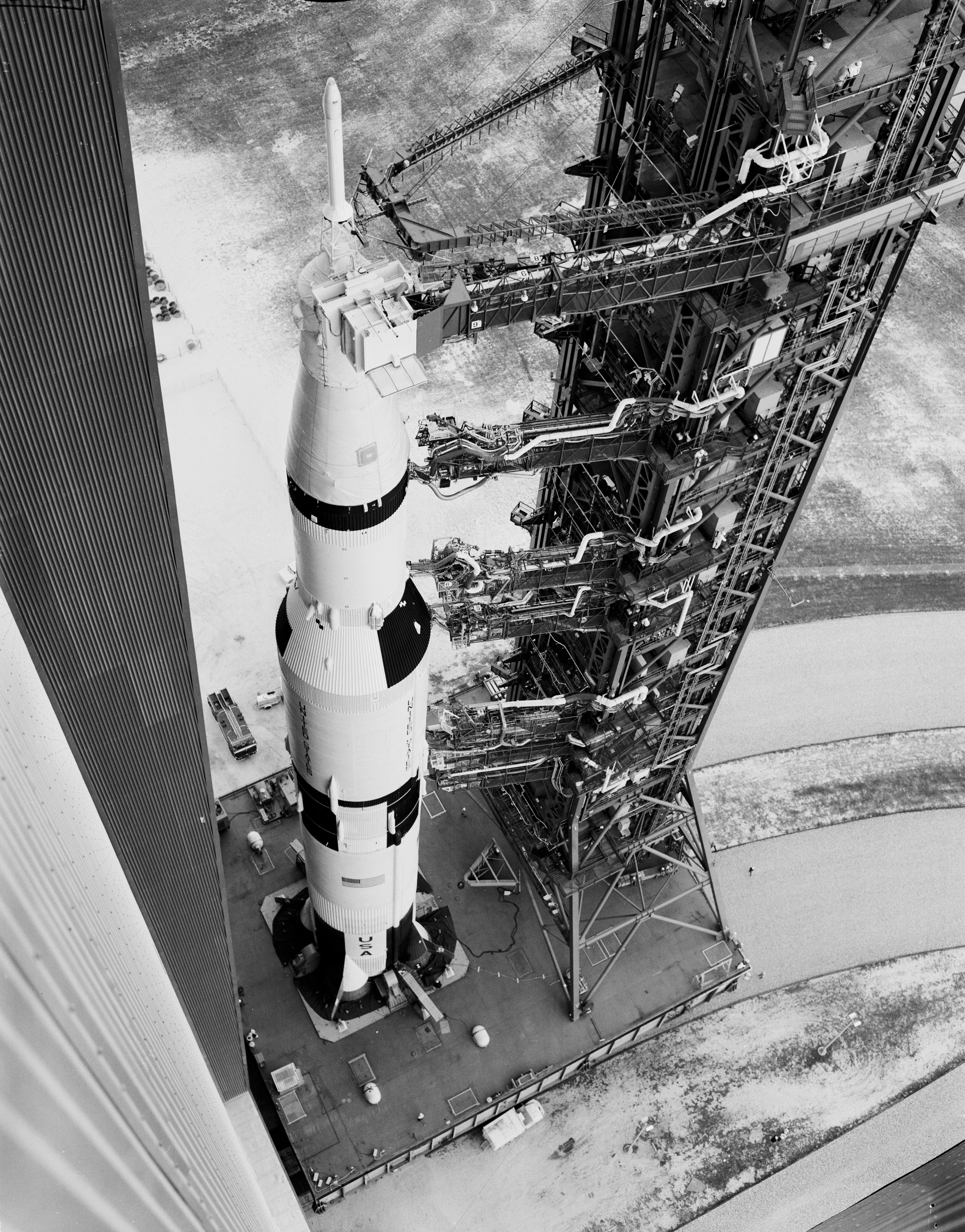
Kenneth S. Kleinknecht, Command and Service Module manager at the Manned Spacecraft Center in Houston, was pleased with CSM-020 when it arrived from North American Aviation, though he was annoyed that it came wrapped in flammable mylar. The contrast with Apollo 1 was eloquent: that spacecraft had arrived with hundreds of unresolved issues; CSM-020 arrived with twenty-three, most of them routine.
The payload was completed by LTA-2R, a simulated lunar module: a flight-type descent stage without landing gear, its fuel tanks filled with a water–glycol mixture and its oxidiser tanks with freon. Its ascent stage carried no flight systems at all — it was ballasted aluminium, instrumented to record vibration, acoustics and structural integrity. LTA-2R stayed inside the Spacecraft-Lunar Module Adapter, SLA-9, throughout the flight.
A year of stacking in the assembly building
The S-IC first stage arrived by barge on March 13, 1967, and was erected in the Vehicle Assembly Building four days later; the S-IVB third stage and the Instrument Unit arrived on March 17. The S-II second stage was not ready, so the dumbbell-shaped spacer already used for Apollo 4 — the same height, the same mass and all the electrical connections — was substituted so testing could proceed. The S-II arrived in May and was stacked and mated into the rocket on July 7.
Apollo 6 was the first vehicle to use High Bay 3 of the VAB, and its air conditioning was quickly found to be inadequate; portable high-capacity units were brought in to keep equipment and workers cool. Delays accumulated: in April, staff and equipment were tied up with Apollo 4; work on the arms of Mobile Service Launcher 2 went slowly; and the CSM itself, due in late September, slipped by two months.

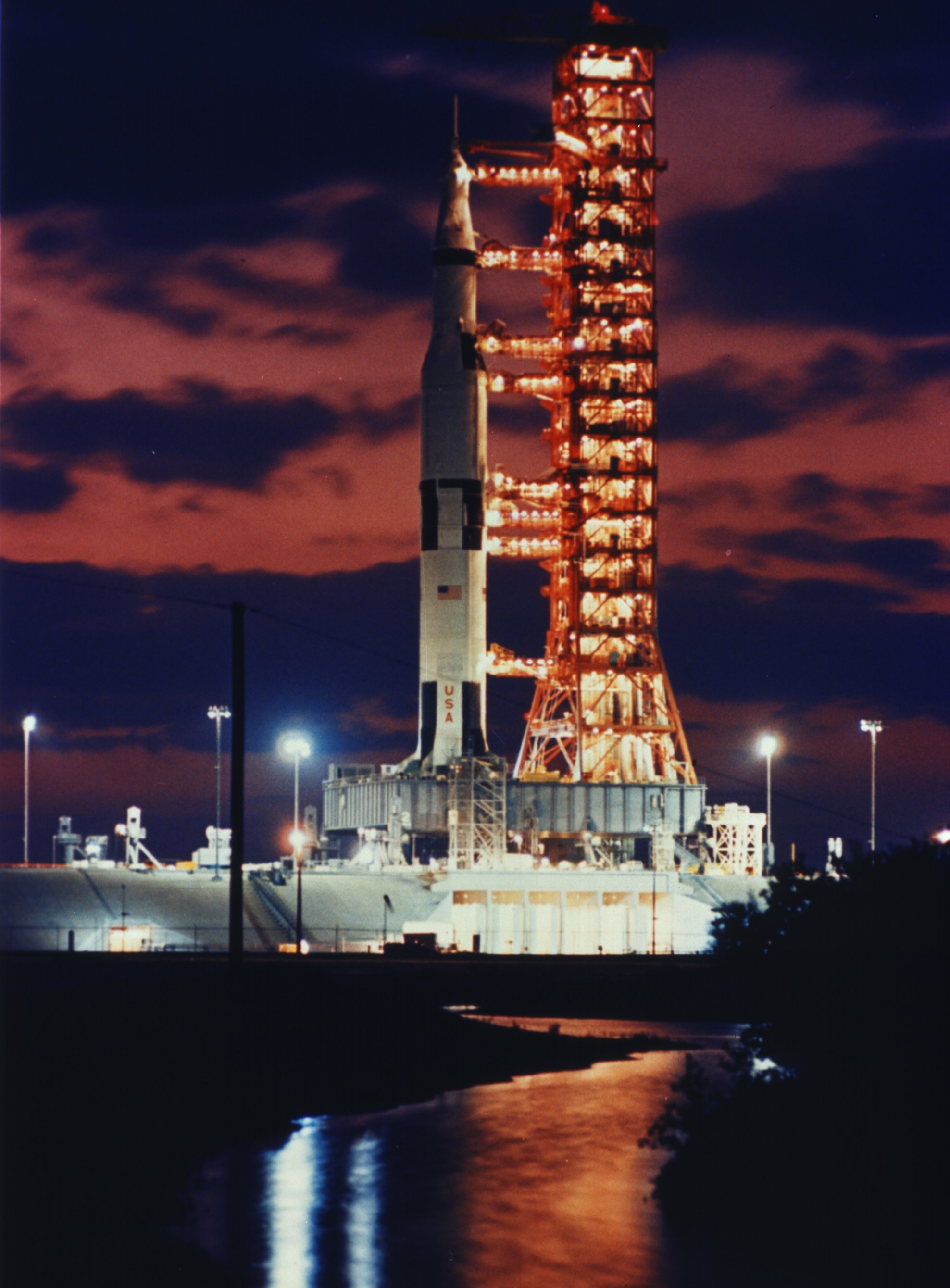
After Apollo 4 launched on November 9, 1967, the pace picked up. The CSM was erected on top of the launch vehicle on December 11, 1967, and the stack rolled out to Launch Complex 39A on February 6, 1968. The rollout took all day, much of it in heavy rain; the crawler-transporter had to halt for two hours when communications failed, and the vehicle did not reach the pad until after dark. High winds kept the mobile service structure away for two days.
The flight readiness test concluded on March 8, 1968, and at a review three days later Apollo 6 was cleared for launch subject to completing certain tests and action items. Launch, first set for March 28, slipped to April 1 and then April 3 after trouble with guidance system equipment and with fuelling. The final countdown began on April 3; all subsequent problems were fixed within the built-in holds and did not delay the mission.
Two good minutes, then pogo
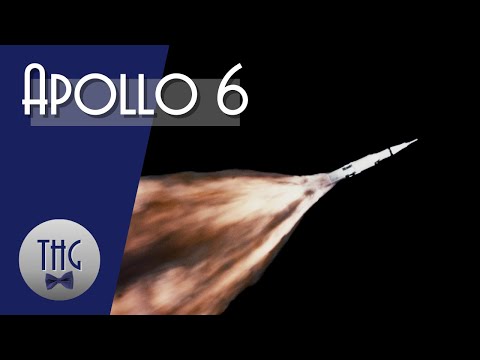
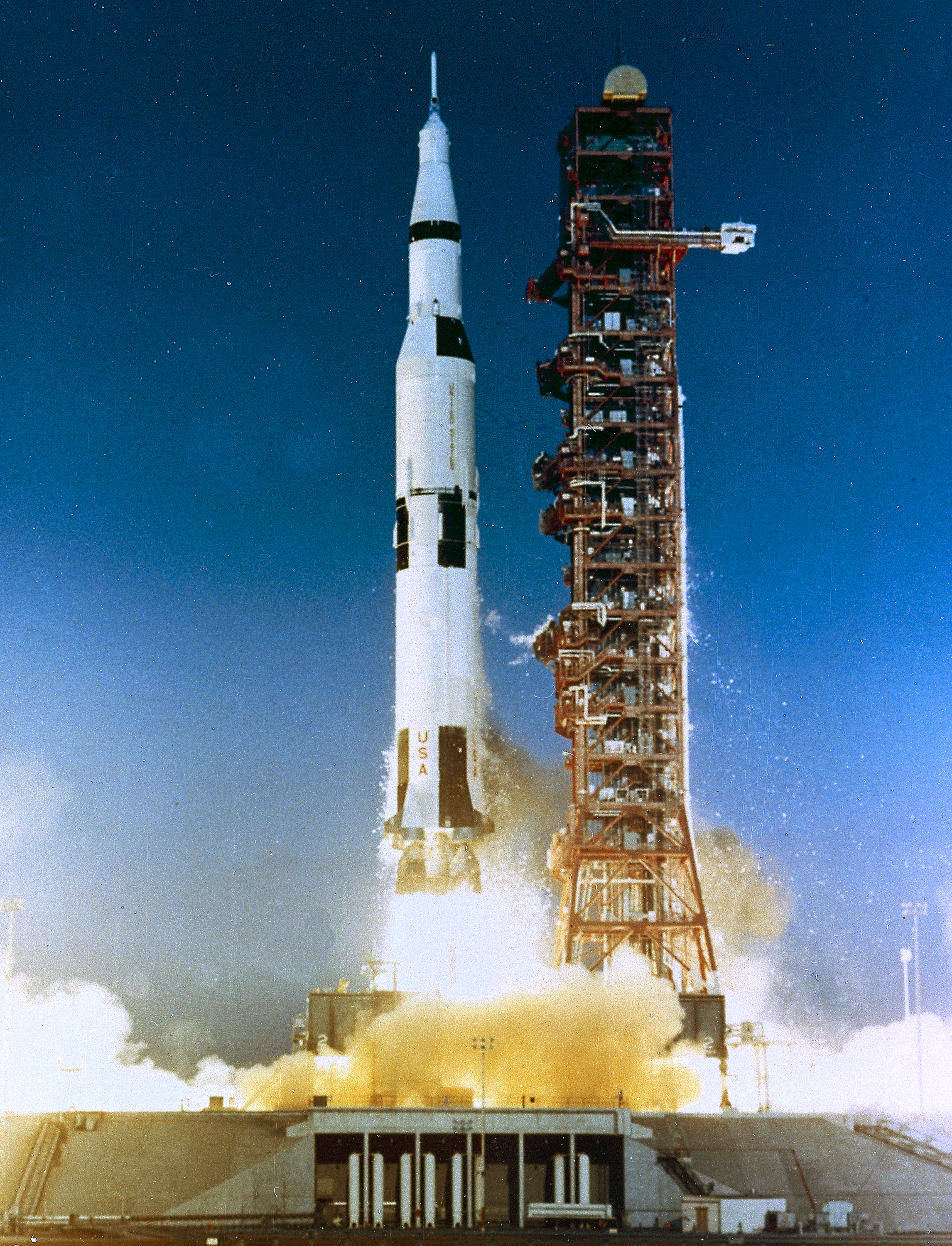
Liftoff came on April 4, 1968, at 7:00:01 am Eastern Standard Time. For the first two minutes the Saturn V behaved normally. Then, as the S-IC first stage burned, pogo oscillations — a longitudinal vibration — shook the whole vehicle. The thrust fluctuations subjected the rocket to ±0.6 g (5.9 m/s²) when it had been designed for a maximum of 0.25 g (2.5 m/s²). The vehicle suffered no damage other than the loss of one panel of the SLA adapter.
George Mueller, NASA Associate Administrator for Manned Space Flight, explained the mechanism to a House Committee on Government Operations hearing in homely terms: engine thrust is never perfectly uniform, because combustion is not; the pipe carrying propellant from the tanks to the engine has, by virtue of its length, a resonant frequency of its own, "just like an organ pipe"; and the structure of the vehicle behaves "much like a tuning fork", oscillating longitudinally if struck in the right way. Pogo is the interaction between those frequencies.
Two J-2 engines out: one wounded, one shut down by mistake
With the first stage jettisoned, the trouble moved to the J-2 engines of the S-II. Engine number two began performing poorly 225 seconds after liftoff and worsened abruptly at T+319 seconds. At T+412 seconds the Instrument Unit shut it down altogether, and two seconds later engine number three shut down as well. The fault lay in engine two; but a cross-connection of wires carried the shutdown command to engine three, which had been running normally.
The Instrument Unit compensated: the three remaining engines burned 58 seconds longer than planned, and the S-IVB had to burn 29 seconds longer than usual, with a slight additional performance loss. The compensation worked, but it was not free.
An orbit that was not the planned one
Because of the degraded ascent, the CSM and S-IVB were inserted into a parking orbit of 173.14 km by 360.10 km (93.49 by 194.44 nautical miles) instead of the planned 190 km circular orbit. The deviation did not preclude continuing the mission. During the first revolution the S-IVB manoeuvred, changing its attitude relative to the horizon to qualify the landmark-tracking techniques future astronauts would use. Then, after the standard two orbits to assess readiness for trans-lunar injection, the S-IVB was ordered to restart. It did not.
The alternate profile: the SPS as a third stage
Flight director Clifford E. Charlesworth and his team in Mission Control fell back on a pre-planned alternative: use the service module's Service Propulsion System (SPS) engine to raise the spacecraft into a high-apogee, low-perigee orbit that would bring about re-entry, as had been done on Apollo 4. That plan would satisfy some of the mission objectives. The SPS burned for 442 seconds to reach the planned apogee of 22204 km (11989 nautical miles).
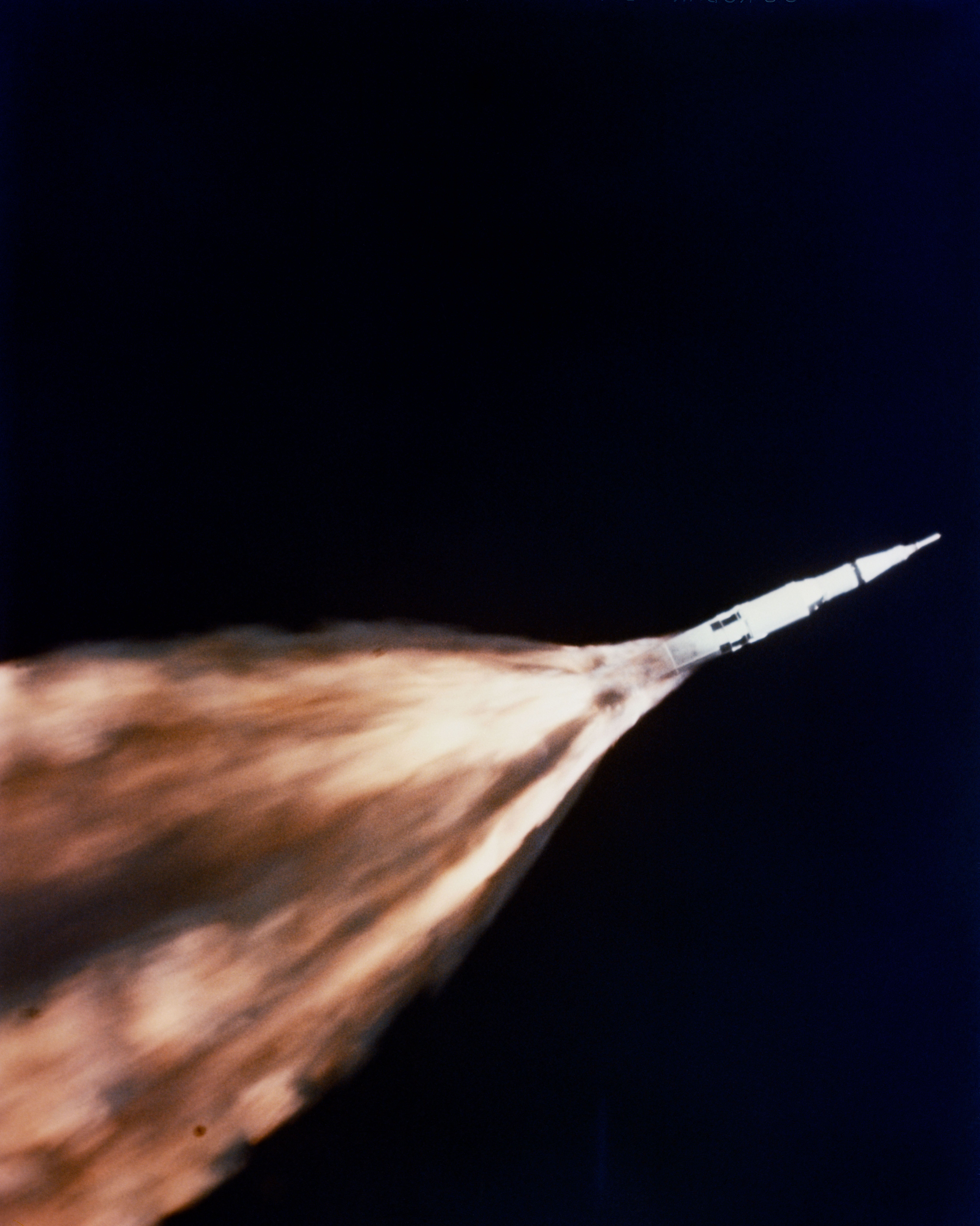
The price was re-entry energy. There was no longer enough propellant for the second SPS burn that was to accelerate the capsule, so the spacecraft entered the atmosphere at about 10000 m/s (33000 ft/s) instead of the planned 11000 m/s (37000 ft/s) that would have simulated a lunar return. The high altitude did yield an unexpected harvest: while up there, the command module returned data on how far the skin of the spacecraft would protect future astronauts from the Van Allen belts.
Splashdown and recovery
About ten hours after launch the command module landed 80 kilometres (43 nautical miles) from the planned touchdown point, in the North Pacific north of Hawaii, and was lifted aboard USS Okinawa. The service module was jettisoned just before re-entry and burned up. The S-IVB's orbit gradually decayed until the stage re-entered the atmosphere on April 26, 1968.
The Saturn V carried several cameras meant to be ejected and later recovered. Three of the four aboard the S-IC failed to eject and were destroyed, and only one of the two on the S-II was recovered — the one that had filmed stage separation. The failure was attributed to a lack of nitrogen pressure in the bottles that were to cause the ejection. The command module's motion picture camera was to film launch and re-entry, but because the mission ran about ten minutes longer than planned, the re-entry events were not filmed. A 70 mm still camera did work, pointed at Earth through the hatch window with a haze-penetrating film and filter combination: it covered parts of the United States, the Atlantic, Africa and the western Pacific, and its images, with better colour balance and higher resolution than photographs from previous American crewed missions, proved excellent for cartographic, topographic and geographic study.
The diagnosis
At the post-launch press conference, Apollo Program Director Samuel C. Phillips conceded that "there's no question that it's less than a perfect mission", while adding that reaching orbit after losing two engines was "a major unplanned accomplishment". Mueller called it "a good job all around, an excellent launch, and, in balance, a successful mission", though he later admitted that Apollo 6 "will have to be defined as a failure".

Pogo was a well-known phenomenon; NASA believed it had detuned the Saturn V — prevented it from vibrating at its natural frequencies. It had not. Close to a thousand government and industry engineers were put on the problem. The fix for damping pressure oscillations in the F-1 and J-2 engines was to fill the cavities in the valves feeding them with helium shortly before liftoff, as a shock absorber.
The S-II and S-IVB failures were traced to the J-2 itself, the engine common to both stages. The J-2 carries an augmented spark igniter (ASI), in effect a miniature rocket engine mounted at the top centre of the engine: cryogenic propellant is fed into it at a rate low enough for a spark plug to ignite the mixture, and the resulting flame is robust enough to light the main flow at start-up. Post-mission tests showed that the propellant lines feeding the ASI could fail in vacuum. Those lines had a metal bellows section to allow for thermal expansion; in ground testing the cold propellants formed a layer of frost on the LOX line and of liquid air on the LH2 line, and that layer damped the vibrations. In vacuum there is no such protection.
On Apollo 6 the LH2 line to engine number two's ASI failed while the LOX line kept feeding liquid oxygen to the igniter. The excess oxygen injected into a hydrogen-rich chamber produced a very high temperature in the igniter area and burned through the engine dome; the resulting loss of pressure made the Instrument Unit issue a shutdown signal. The wiring error carried that signal to engine three, whose own loss of pressure triggered a second shutdown signal that, through the same cross-wiring, shut down engine two. The remaining three engines kept running. A similar failure of igniter propellant lines most likely prevented the single J-2 of the S-IVB from restarting.
For later flights the bellows were replaced with rigid bends and the lines strengthened. Engineers also debated configuring the emergency detection system to abort automatically in the event of excessive pogo; Director of Flight Crew Operations Deke Slayton opposed it, and work began instead on a pogo abort sensor that would leave the judgement to the crew. By August 1968 it was clear that pogo could be handled without such a sensor and the work was abandoned. As for the lost SLA panel, the cause lay in its honeycomb structure: as the rocket accelerated through the atmosphere, the cells expanded because of trapped air and water and tore the adapter surface free. The answer was to drill small holes to let trapped gases escape and to add a thin layer of cork to absorb moisture.
The decision: the next Saturn V would carry a crew
NASA's response was enough to satisfy the Senate Committee on Aeronautical and Space Sciences, which reported in late April that the agency had quickly analysed and diagnosed the Apollo 6 abnormalities and taken corrective action. After detailed analysis of the Saturn V's performance and of the fixes planned for future vehicles, engineers at the Marshall Space Flight Center in Alabama concluded that a third uncrewed Saturn V flight was unnecessary. The next Saturn V to fly, on Apollo 8, would carry a crew; Apollo 7, the first crewed Apollo mission, would go up on a Saturn IB.
It remains a striking decision: two engines shut down, a stage that would not restart, a vibration that exceeded the design limit more than twofold, and yet the vehicle was declared fit to fly with people aboard eight months later. The justification was that every failure had been explained down to its root cause, that the corrections were verifiable, and that the flight itself had demonstrated remarkable margin — the rocket reached orbit on three second-stage engines instead of five.
A flight nobody watched
There was little press coverage of Apollo 6. On the day of the launch, Martin Luther King Jr. was assassinated in Memphis; four days earlier, President Lyndon B. Johnson had announced that he would not seek re-election. The most troubled mission of the Apollo programme was flown, analysed and turned into the permission slip for going to the Moon with almost nobody watching.
After the mission, CM-020 was transferred to the Smithsonian Institution. The Apollo 6 command module is on display at the Fernbank Science Center in Atlanta, Georgia.
Images
Elsewhere
- Smithsonian National Air and Space MuseumApollo Launches - AS-502 (Apollo 6) ↗
- Smithsonian National Air and Space MuseumHatch, Apollo Command Module, Apollo 6 ↗
- Smithsonian National Air and Space MuseumCommand Module, Apollo 6 (CM 020) ↗
- AlamyApollo 6 Launch, 1968 ↗
- AlamyApollo 6 Recovery, 1968 ↗
- Project Apollo ArchiveApollo 6 Saturn V during rollout (NASA Photo ID S68-21356) ↗
- NASA (Flickr)Apollo 6 launch - from chase plane ↗
- NASA.govFiftieth Anniversary of the Launch of Apollo 6 – 4 April 1968 ↗
- NASA.gov55 Years Ago: The Flight of Apollo 6 ↗
- Texas ArchiveApollo 6 | A Journey to the Moon through Texas ↗
- Internet ArchiveRecovery - Apollo 6 ↗