Walter Cunningham Apollo 7 lecture Starmus 2019 Zurich June 25, 2019
Video from the channel Leo Bakker Flight and Space about Apollo 7, linked on its Above Ten Thousand entry. Duration: 37:54. Language: English. Video type: News.
What it's about
Lecture by Walter Cunningham, lunar module pilot of Apollo 7, at the 2019 Starmus festival in Zurich. Cunningham looks back on what he calls the golden age of crewed spaceflight: the test missions in Earth orbit, the profile of the first astronauts and the attitude toward risk that, in his view, made the Apollo program possible.
Context
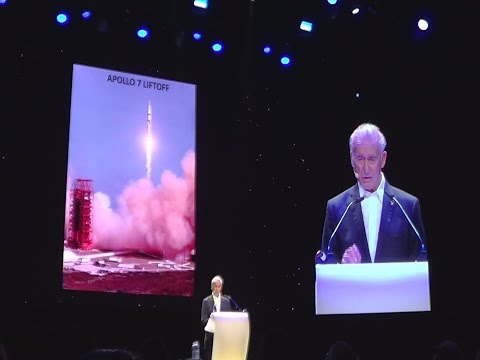
Cunningham recounts that in 1961 he was a Marine Corps fighter pilot with about 2,000 hours in jets, was working on a physics doctorate at UCLA and held a part-time job at the RAND Corporation. He heard Alan Shepard's Freedom 7 launch on the radio, and two and a half years later shared an office with him: in 1963 he was one of the 14 selected for the third group of astronauts. He joined NASA earning $13,050 a year and, when he left almost eight years later, was earning about $25,000; he adds that civilian astronauts had no life insurance. His crew was set to fly the mission called Apollo 2, which was cancelled, and he became part of the backup crew. After the Apollo 1 fire, which killed Gus Grissom, Ed White and Roger Chaffee, he was assigned to the first crewed flight, Apollo 7, with Wally Schirra as commander. They launched 21 months after the accident, with about 1,040 changes made to the spacecraft.
What it implies
According to Cunningham, the mission met its planned eleven days, tested the spacecraft's systems and broadcast the first live television from space, which earned the crew an Emmy. He considers it the longest and most ambitious test flight of a new flying machine. He presents Apollo 7, 8, 9, 10 and 11 as successive steps toward the Moon landing and recalls Jack Schmitt's speech to Congress about the Taurus-Littrow valley. He concludes that exploring means managing risk, not eliminating it, compares Apollo to Magellan's expedition and credits the success to the combined work of about 400,000 people from government and industry.