Apollo program · NASA · Crewed
Apollo 14
- Jan 31, 1971, 9:03 PM
- Launch date
- 3
- Crew size
- 9 days
- Duration
- Success
- Outcome
Apollo 14 in the news
July 7, 2026
The Artemis II crew participates in the dedication of the Apollo 14 Moon tree at the Lunar Receiving Park at NASA's Johnson Space Center. This tree is a second-generation Apollo Moon tree of the…


Apollo 14 was the third mission to land on the Moon and the first to touch down in the lunar highlands. It lifted off on 31 January 1971 under the command of Alan Shepard, the first American in space, with Stuart Roosa flying the command module Kitty Hawk and Edgar Mitchell piloting the lunar module Antares. Its target, the Fra Mauro formation, was the site Apollo 13 had been unable to reach, and its success was seen as vital to the future of the programme. The mission nearly failed twice before landing. Docking between the command ship and the lander would not engage through almost two hours of attempts, and in lunar orbit a faulty switch threatened to trigger an automatic abort during descent, forcing engineers to devise a workaround in the computer's logic on the fly; the landing radar then took its time to lock on. Even so, Shepard set Antares down on 5 February closer to its target than any other Apollo landing. During two moonwalks totalling 9 hours and 23 minutes, Shepard and Mitchell deployed a suite of scientific experiments, used a two-wheeled handcart flown only on this mission, and tried in vain to reach the rim of Cone crater, falling short by about 20 metres. They brought back some 42 kg of samples, including the rock nicknamed Big Bertha, which research in 2019 suggested is probably a fragment of Earth. Shepard also hit two golf balls on the Moon, the mission's best-remembered moment. Meanwhile Roosa carried out the first intensive programme of scientific observation from lunar orbit and photographed the future Apollo 16 landing site. The crew splashed down in the Pacific on 9 February 1971 and were the last to be quarantined after returning from the Moon. The seeds Roosa carried grew into the Moon trees planted around the world.
Payload
The Apollo 14 spacecraft comprised command and service module CSM-110 "Kitty Hawk", weighing 29,229 kg at launch with propellants, and lunar module LM-8 "Antares", weighing 15264 kg, launched by Saturn V SA-509. On the surface the crew deployed the ALSEP experiments package, with a passive seismometer, an active seismic experiment using geophones, thumpers and mortars, a suprathermal ion detector, a cold cathode ion gauge and a charged particle detector, plus a laser ranging retroreflector still in use and a portable magnetometer carried on the second moonwalk. Tools and samples travelled on the MET handcart, whose tyres were the first to roll on the Moon. In orbit the command module carried the Hycon topographic camera, Hasselblad cameras and the transmitters used for the bistatic radar experiment. Several hundred tree seeds also flew aboard, the origin of the Moon trees.
| Crew | Role | Agency | Extravehicular activity |
|---|---|---|---|
| Alan Bartlett Shepard Jr. | Commander | NASA · United States | — |
| Stuart Allen Roosa | Command module pilot | NASA · United States | — |
| Edgar Dean Mitchell | Lunar module pilot | NASA · United States | — |
History
A crew led by a pioneer
Apollo 14 was the eighth crewed flight of the Apollo programme, the third Moon landing ever made and the first to set down in the lunar highlands. Its commander was Alan Shepard, one of the original Mercury Seven and the first American in space, aboard Freedom 7 on 5 May 1961. Soon after that suborbital hop, Ménière's disease, an inner-ear disorder, grounded him, and he spent the following years as Chief Astronaut, running the Astronaut Office. Experimental surgery in 1968 restored his flight status. At 47 he became the oldest US astronaut to fly up to that time, and he remains the oldest person ever to walk on the Moon.
His two crewmates were rookies from the fifth astronaut group, selected in April 1966. Command Module Pilot Stuart Roosa, aged 37, had been a smoke jumper before joining the Air Force in 1953, went on to fly fighters and in 1965 graduated from the Aerospace Research Pilot School at Edwards. Lunar Module Pilot Edgar Mitchell, aged 40, joined the Navy in 1952, flew fighters from carriers, passed through the same school, served on the Apollo 9 support crew and was backup Lunar Module Pilot for Apollo 10.
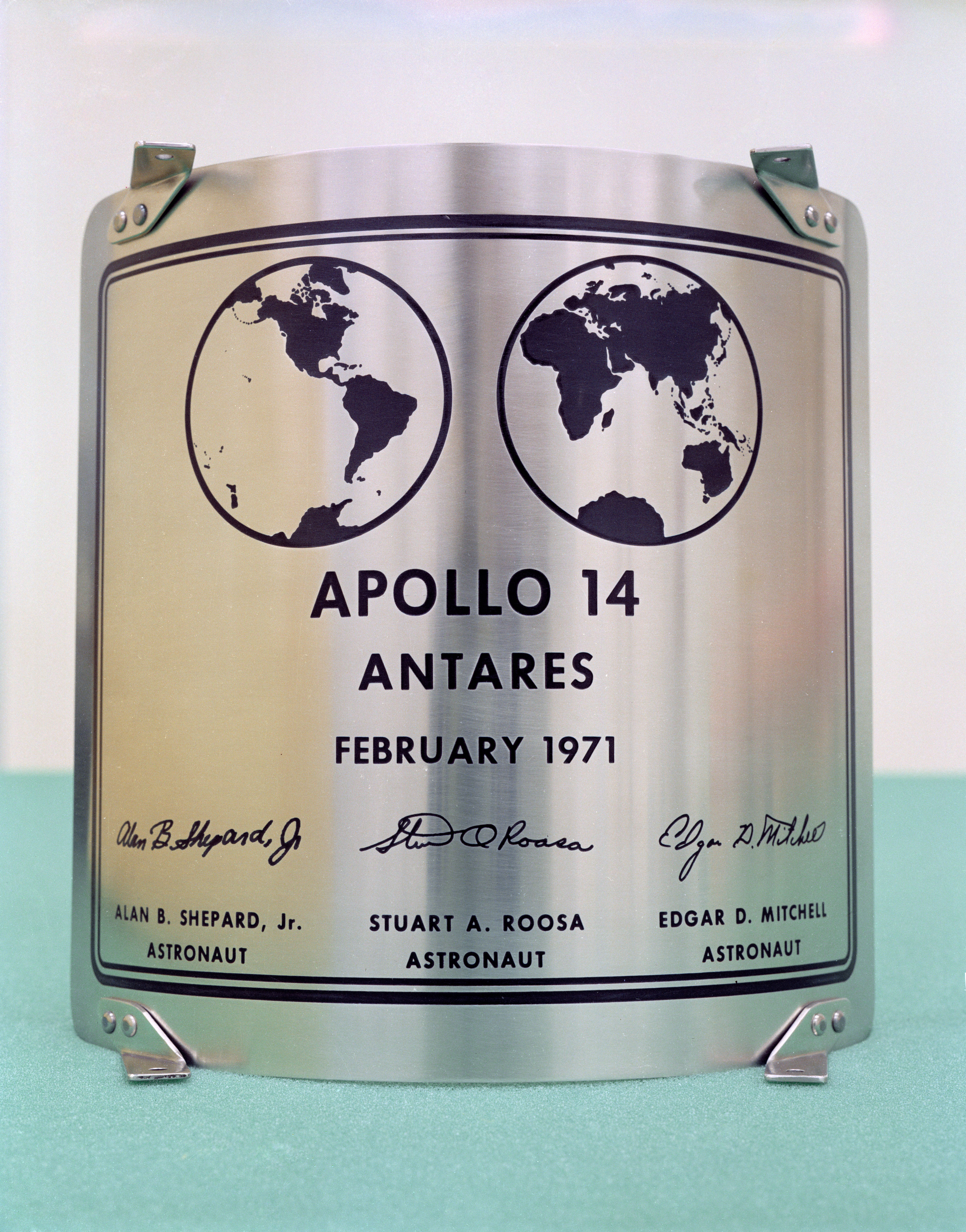
The crew's path to the Moon was not straightforward. Deke Slayton, Director of Flight Crew Operations and himself a Mercury veteran, had first put Shepard's team forward for Apollo 13. NASA management judged that Shepard, who had not flown since 1961, needed more training time and swapped the crews: Jim Lovell, Ken Mattingly and Fred Haise took Apollo 13, and Shepard, Roosa and Mitchell moved to Apollo 14. The backup crew was Eugene Cernan, Ronald Evans and Joe Engle; with Harrison Schmitt in place of Engle, the same group would later fly Apollo 17. The support crew comprised Philip Chapman, Bruce McCandless, William Pogue and Gordon Fullerton, and the capsule communicators included Fred Haise, who put to use his training for a landing site he had never reached. The flight directors were Pete Frank, Glynn Lunney, Milt Windler and Gerry Griffin.
From postponement to a new destination
The prime and backup crews for Apollos 13 and 14 were announced on 6 August 1969. Apollo 14 was pencilled in for July 1970, but in January of that year the budget cuts that cancelled Apollo 20 led NASA to plan two missions a year, pushing Apollo 14 towards October or November. The Apollo 13 accident then delayed it further: on 7 May 1970 Administrator Thomas Paine announced that it would launch no earlier than 3 December and would head for the area Apollo 13 had failed to reach. On 30 June 1970, after the accident report and a review of the required spacecraft changes, the date slipped to no earlier than 31 January 1971.
Before Apollo 13 aborted, Apollo 14 had been bound for Littrow crater in Mare Serenitatis, where volcanic features were suspected. Once Apollo 13 was home, planners concluded that its own target, near Cone crater in the Fra Mauro formation, was scientifically more valuable. Fra Mauro consists of debris thrown out by the impact that formed Mare Imbrium, offering a chance to sample material from deep inside the Moon, and the young, deep Cone crater should have punched through everything laid down since that event, promising rocks that could be dated. The flight path also allowed orbital photography of the Descartes Highlands, a candidate for a later landing. The chosen landing point lay slightly closer to Cone than the one assigned to Apollo 13.
Nineteen months of preparation
The crew trained together for 19 months, longer than any Apollo crew before them. On top of the normal workload they had to oversee the command and service module changes that followed the Apollo 13 investigation, a job Shepard largely handed to Roosa. Mitchell later recalled that they knew a second failure in a row would probably have ended the Apollo programme.
The switch of target reshaped geology training. Field trips moved from volcanic landscapes to impact sites such as the Ries crater in West Germany and an artificial crater field dug in Arizona's Verde Valley. The training was blunted by Shepard's limited enthusiasm, which set the tone for Mitchell; Harrison Schmitt suggested the commander had other priorities, such as returning to space after a decade and delivering success after the near-disaster of Apollo 13. Roosa, by contrast, prepared intensively for his time alone: he persuaded geologist Farouk El-Baz, who had trained Mattingly, to coach him, pored over maps of the ground track with him, and practised observations from his T-38 jet at a speed and height that mimicked the view from lunar orbit.
To avoid another last-minute crew change caused by exposure to illness, as had happened on Apollo 13, NASA introduced the Flight Crew Health Stabilization Program: from 21 days before launch the crew lived at Kennedy Space Center, with contacts restricted to their wives, the backup crew and essential staff, all of whom were examined and immunised. The spacecraft had arrived in Florida in November 1969, and the stacked vehicle rolled out of the Vehicle Assembly Building to Pad 39A on 9 November 1970.
Spacecraft and rocket: learning from Apollo 13
The spacecraft comprised command and service module CSM-110, named Kitty Hawk, and lunar module LM-8, named Antares. Roosa chose the name of the North Carolina town where the Wright brothers first flew in 1903; Mitchell picked the star in Scorpius the crew would use to align the lander for its descent. According to NASA data, the command and service module weighed 29,229 kg at launch with propellants, of which 5758 kg was the command module and 23,471 kg the service module. The lunar module totalled 15264 kg: an ascent stage of 2303 kg dry carrying 2370 kg of propellant, and a descent stage of 2237 kg dry, including stowed surface equipment, carrying 8354 kg of propellant.
The changes between Apollo 13 and 14 ran deeper than between earlier missions. Apollo 13 had been crippled by an exploding oxygen tank whose internal wiring had been damaged during ground testing, when thermostatic switches never designed for the voltage applied let the contents overheat. The tanks were redesigned with suitable thermostats, and a third tank was added on the opposite side of the service module, fitted with a valve so it could be isolated to feed only the command module. Wiring in the bay where the explosion occurred was sheathed in stainless steel, anomaly warnings were made more prominent, an emergency water supply was stowed in the command module, and an emergency battery identical to those of the lunar module descent stage was placed in the service module. The lander gained anti-slosh baffles in its descent propellant tanks to stop the low-fuel light coming on too early, as it had on Apollos 11 and 12.
The Saturn V, designated SA-509, was similar to those used for Apollos 8 to 13. At 2,950,867 kg it was the heaviest vehicle NASA had yet flown, 1730 kg heavier than Apollo 13's. To tame the pogo oscillations that had shut down the centre engine of Apollo 13's second stage early, engineers added a helium accumulator in that engine's liquid oxygen line, a backup cutoff device and a simplified propellant utilisation valve on each of the five J-2 engines.
Surface instruments and the MET handcart
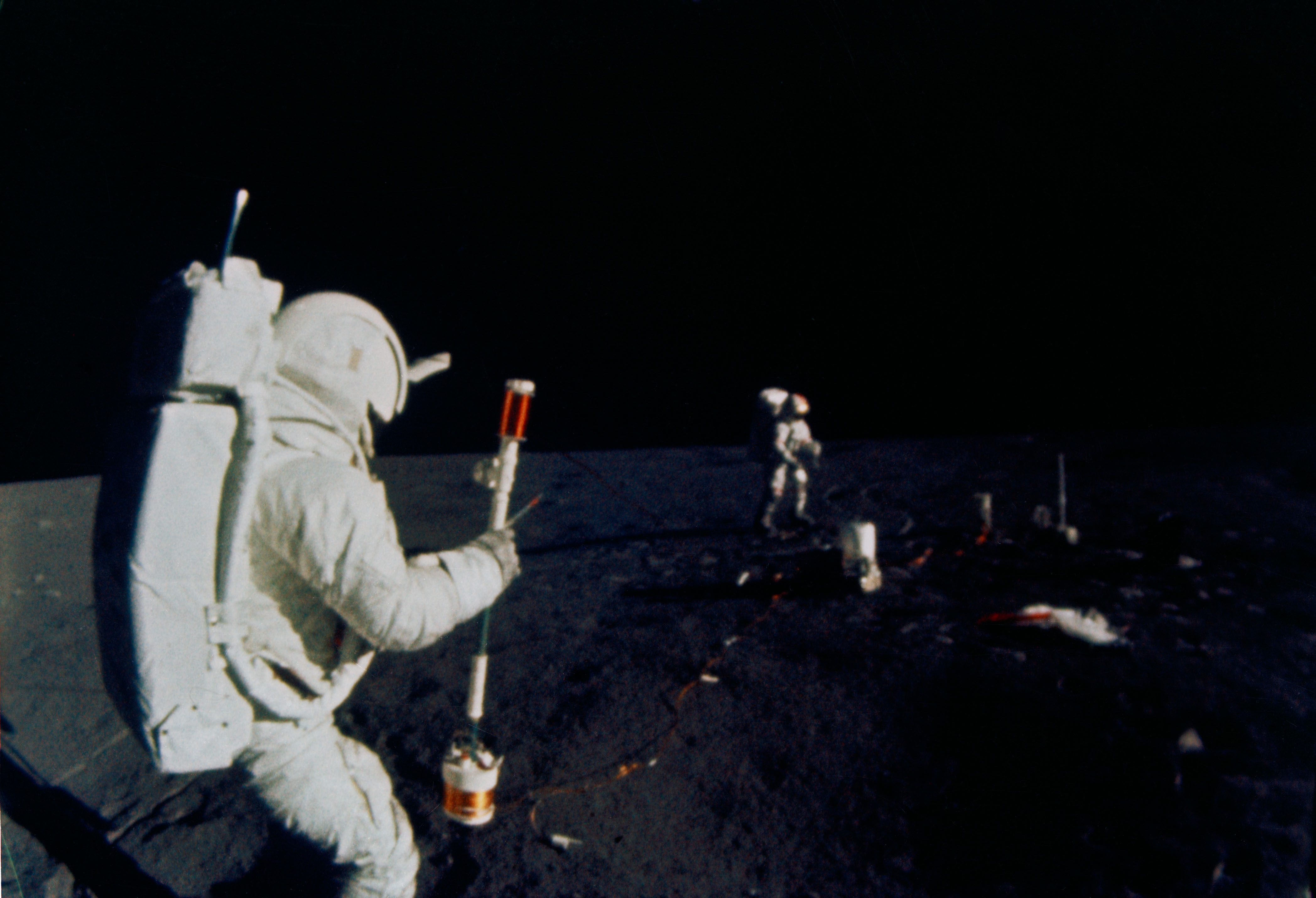
The Apollo Lunar Surface Experiments Package (ALSEP) carried a passive seismometer, an active seismic experiment, a suprathermal ion detector, a cold cathode ion gauge and a charged particle lunar environment experiment. Flown alongside it, but outside the package, were a laser ranging retroreflector and a portable magnetometer. The seismometer would be calibrated by the impact of the discarded ascent stage and, together with the Apollo 12 instrument, would seed a lunar seismic network. The active experiment used geophone lines and small thumper charges, plus four mortars that were never fired for fear of damaging nearby instruments. The retroreflector, a passive target for lasers fired from Earth, allows the Earth-Moon distance and its changes to be measured; those of Apollos 11, 14 and 15 are the only Apollo crew experiments still returning data.
The logistical novelty was the Modular Equipment Transporter (MET), a two-wheeled handcart flown only on this mission that let the crew pull tools and samples instead of carrying them. Its nitrogen-filled tyres, developed by Goodyear, were the first to roll on the Moon. The mission also introduced a hose set allowing the two moonwalkers to share cooling water if one backpack failed, and Shepard became the first person on the lunar surface to wear the red commander's stripes, added so the astronauts could be told apart in photographs.
A delayed launch and a stubborn docking
Apollo 14 lifted off from Launch Complex 39A at Kennedy Space Center on 31 January 1971 at 21:03:02 UTC, after a weather hold of 40 minutes and 2 seconds for clouds and rain, the first such delay of the programme. Among the spectators were Vice President Spiro Agnew and Prince Juan Carlos of Spain. A faster trajectory than planned recovered the lost time.
The first scare came after translunar injection. Roosa separated the command ship from the third stage and turned it round to dock with the lunar module, but the latches would not engage. For nearly two hours he tried repeatedly while Mission Control weighed options: without extracting the lander there could be no landing, and two failures in a row might end the programme. In the end, the suggestion to try again with the docking probe retracted worked. The third stage was sent to crash into the Moon, and its impact made the Apollo 12 seismometer ring for more than three hours.
Descent: a treacherous switch and a silent radar
The spacecraft entered lunar orbit on 4 February at 06:59:43 UTC with a main-engine burn of 370.84 seconds. For the first time, the command ship carried the lander down to the low descent orbit, increasing the hover time available over rough terrain.
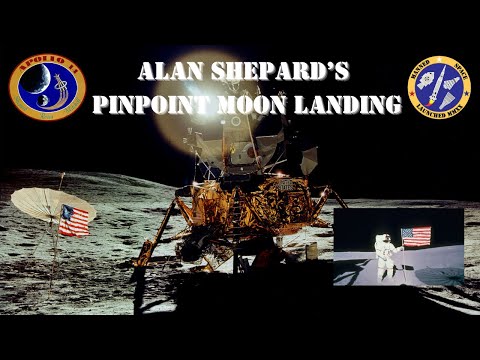
Once undocked, Antares developed two serious faults. Its computer began receiving an abort signal from a faulty switch, perhaps caused by a loose ball of solder. If the signal recurred after descent engine ignition, the computer would abort the landing automatically. Tapping the panel only cleared it briefly. NASA and MIT teams worked out a fix: since the software could not be changed from the ground, the workaround made the computer believe an abort had already happened, so it would ignore the signal. Mitchell keyed it in minutes before ignition. During powered descent the landing radar failed to lock on to the surface; after its breaker was cycled it acquired a signal at around 6,700 m, when mission rules demanded an abort if it was still out at 3,000 m. Shepard set Antares down at 09:18:11 UTC on 5 February, closer to its target than any of the six landings, on a slope that tilted the lander by 8 degrees.
First moonwalk: setting up the laboratory
Stepping on to the surface, Shepard remarked that it had been a long way, but they were there. A communications problem delayed the first extravehicular activity, which began at 14:42 UTC. The pair unloaded equipment, deployed the ALSEP and the flag and prepared the MET, all on live television. Mitchell laid out the two 94 m geophone lines and fired the thumpers, five of the 21 failing to go off. The excursion lasted 4 hours, 47 minutes and 50 seconds.
Second moonwalk: in search of Cone's rim
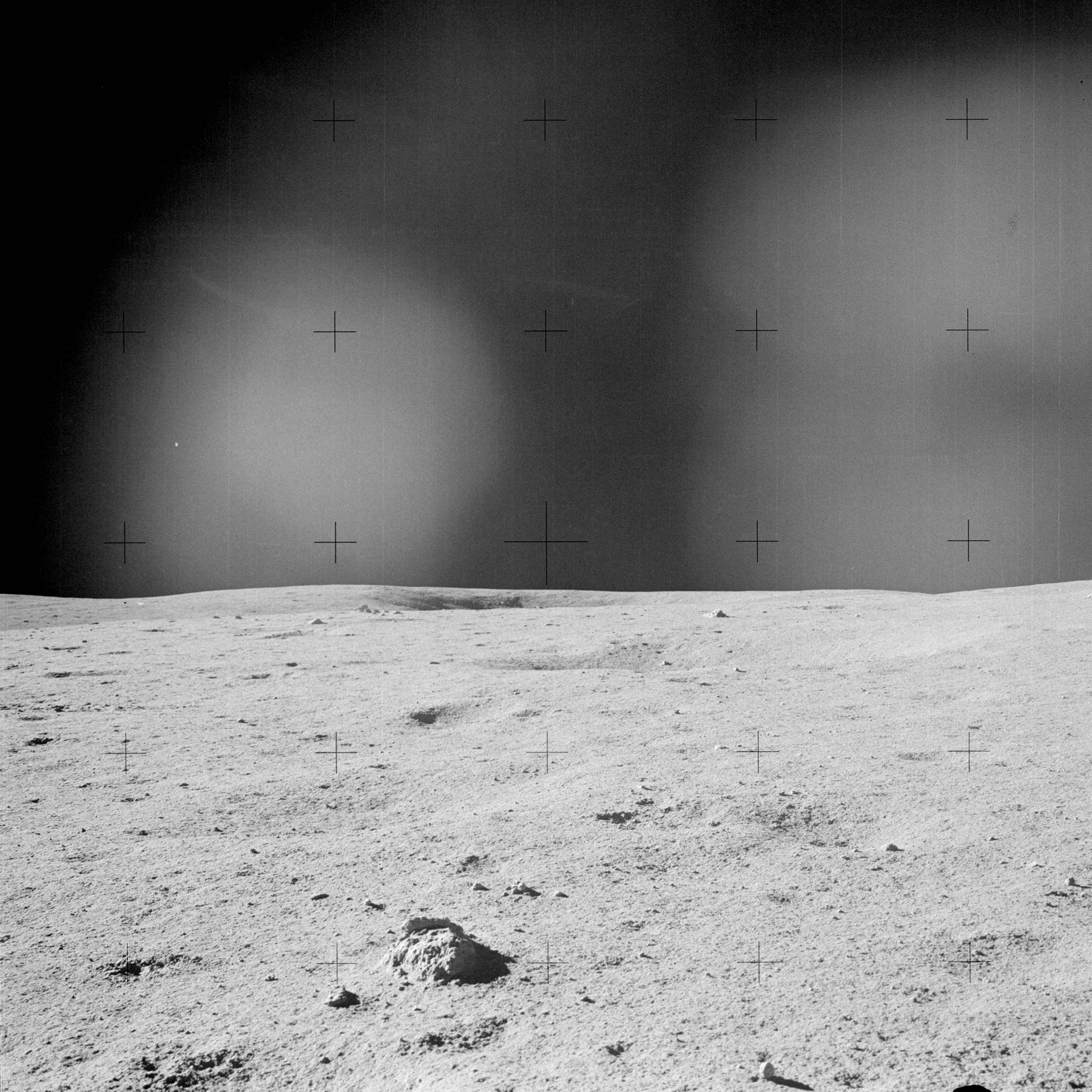
The second excursion aimed for the rim of Cone crater. The rolling ground surprised the astronauts: craters meant to serve as landmarks looked nothing like the orbital maps, and they consistently overestimated how far they had walked. Houston, with no pictures, could only hear their laboured breathing. After cresting a ridge they took for the rim and finding more terrain beyond, exhausted, they were told by Haise to sample where they stood and head back. Later analysis showed they had come within about 20 m of the rim, and Lunar Reconnaissance Orbiter images place their tracks and the MET's within 30 m. The episode underlined the need for a vehicle with navigation, the Lunar Roving Vehicle already planned for Apollo 15.
Golf at Fra Mauro
Back near the lander and in view of the camera, Shepard performed the stunt he had planned for years: he had fitted a Wilson six-iron head to a sampling tool handle and, swinging one-handed, struck two golf balls, declaring that the second went "miles and miles". Mitchell threw a scoop handle like a javelin. The second moonwalk lasted 4 hours, 34 minutes and 41 seconds. Shepard gave the club to the USGA Museum and a replica to the National Air and Space Museum. In February 2021, for the 50th anniversary, imaging specialist Andy Saunders enhanced the photographs and estimated that the first ball travelled about 24 yards and the second 40. Across both excursions the pair spent 9 hours and 23 minutes outside, and 33 hours and 31 minutes on the surface.
The samples and the Big Bertha puzzle
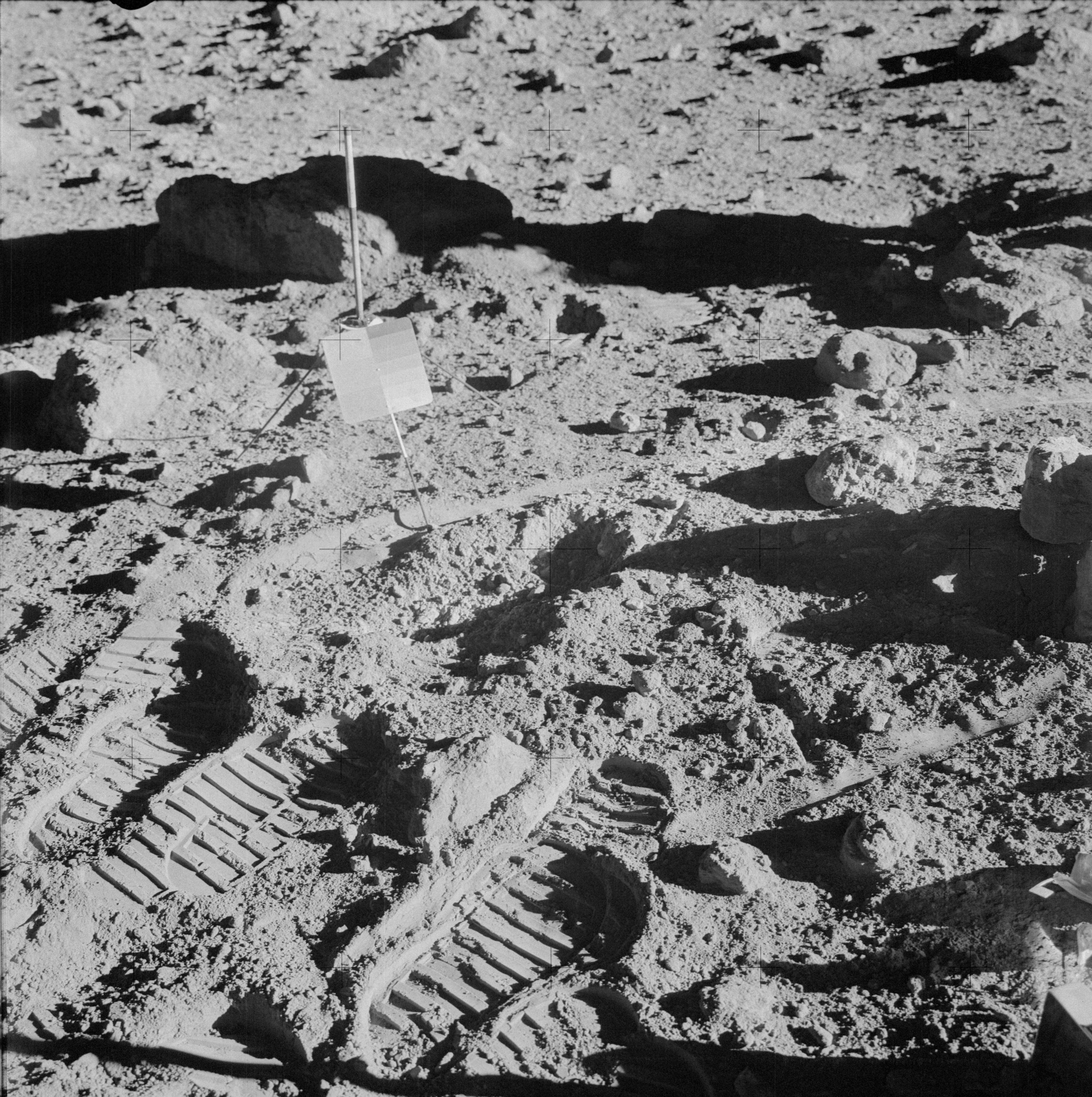
The crew brought back some 42 kg of rock and soil, mostly breccias, rocks made of fragments welded together by the heat and pressure of impacts. Basalts, found as clasts within the breccias, proved richer in aluminium and formed 4.0 to 4.3 billion years ago, earlier than the volcanism at the mare sites visited by other missions. The scientific haul was debated: some geologists welcomed the close approach to Cone but regretted how poorly the samples were documented, and geologist Don Wilhelms lamented that the crater's flank, in his view the most important single point astronauts reached, yielded only 16 Hasselblad photographs out of a mission total of 417 and just 962 g of rock apart from sample 14321, known as Big Bertha. That 8.998 kg rock sprang a surprise in January 2019, when a Curtin University team found granite, quartz and zircons with an Earth-like chemistry and an age of about four billion years, suggesting it is a terrestrial meteorite that landed on the Moon and one of the oldest Earth rocks known.
Roosa alone in orbit
While his crewmates were on the surface, Roosa spent almost two days alone aboard Kitty Hawk, carrying out the first intensive programme of scientific observation from lunar orbit, much of it inherited from Apollo 13. The Hycon topographic camera, meant to map the Descartes Highlands, soon suffered a shutter fault later traced to a tiny fragment of aluminium. Although about half of the photographic targets were lost, Roosa imaged Descartes with a Hasselblad and confirmed it as a suitable landing site for Apollo 16. He also photographed the impact point of Apollo 13's third stage, spotted the glint of Antares and its long shadow, recorded the Gegenschein and the Sun-Earth L2 Lagrangian point, and aimed the spacecraft's transmitters at the Moon for a bistatic radar experiment probing the regolith.
Return, splashdown and quarantine
Antares lifted off on 6 February at 18:48:42 UTC and, in the first direct first-orbit rendezvous of a landing mission, docked with Kitty Hawk at the first attempt, even though its abort guidance system failed just before. The discarded ascent stage struck the Moon and was registered by the Apollo 12 and 14 seismometers. The 350.8-second trans-Earth injection burn came on the 34th lunar revolution. On the way home the crew tested the oxygen system with low tank densities and at a high flow rate, with the in-flight spacewalks of later missions in mind, and ran a navigation exercise simulating lost communications. Mitchell, without NASA's knowledge, conducted card-based extrasensory perception experiments.
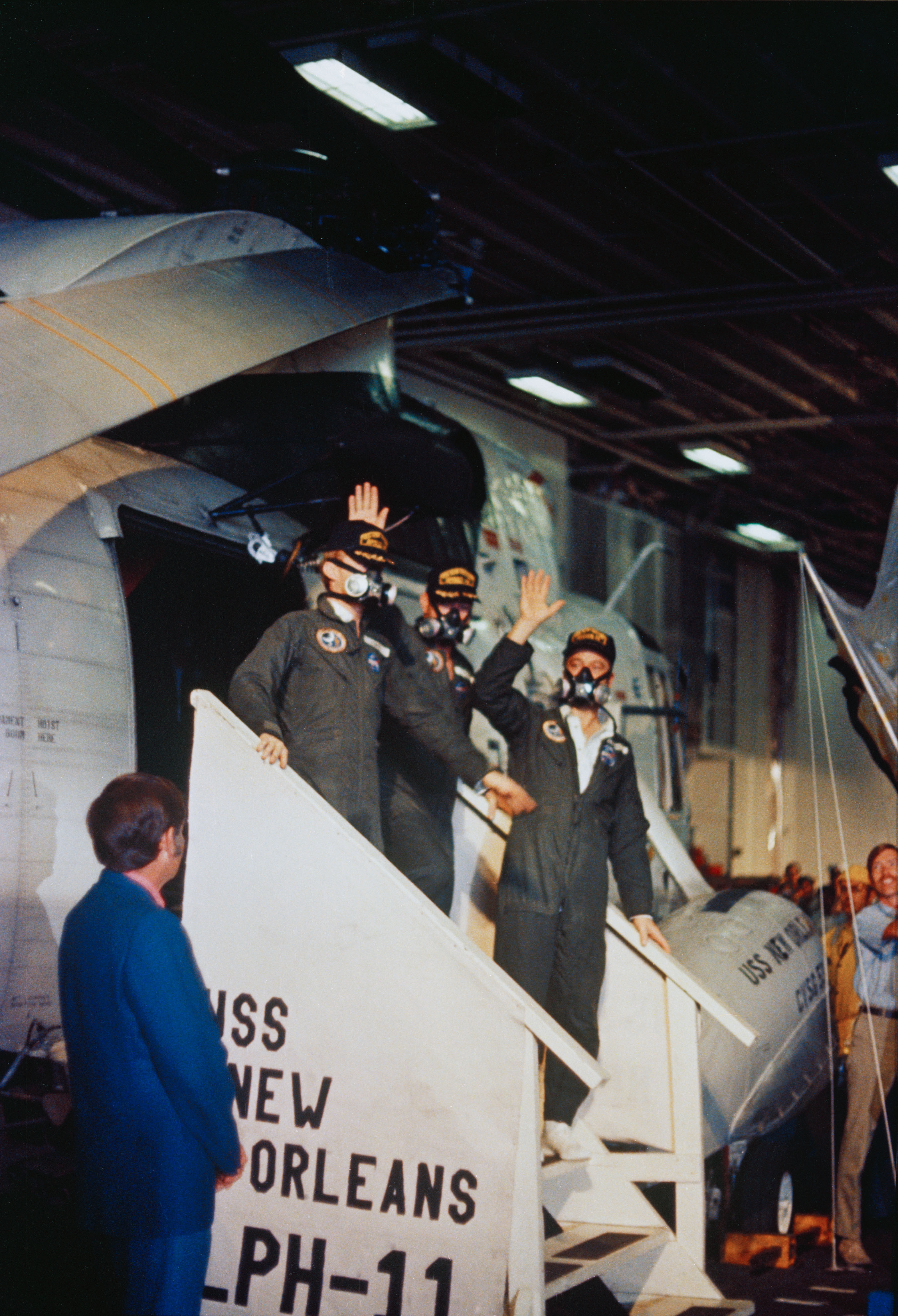
Kitty Hawk splashed down in the South Pacific on 9 February 1971 at 21:05 UTC, after a mission elapsed time of 216 hours, 1 minute and 58 seconds, south of American Samoa, and the recovery ship USS New Orleans picked up the crew. Via Pago Pago and Honolulu, the astronauts continued their quarantine in the Lunar Receiving Laboratory until 27 February 1971. They were the last lunar explorers to be quarantined and the only Apollo crew isolated both before and after flight.
Moon trees, emblem and legacy
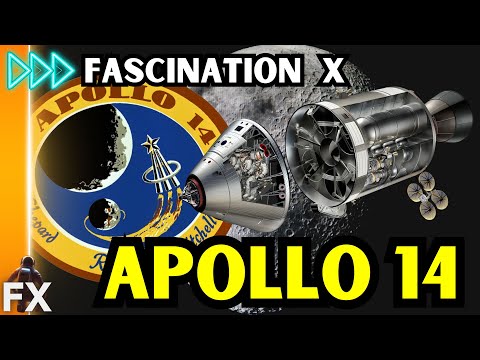
Roosa, who had worked in forestry as a young man, carried several hundred tree seeds. Germinated after the flight, they became the so-called Moon trees, distributed around the world and, in 1975 and 1976, handed to state forestry associations for the US Bicentennial. The mission emblem, by Jean Beaulieu from a sketch by Shepard, shows the astronaut pin trailing a comet tail from Earth to the Moon: through the former head of the Astronaut Office, the whole corps was flying there in spirit. The backup crew answered with a Road Runner and Wile E. Coyote parody that they hid throughout the spacecraft and even in the MET.
Command module Kitty Hawk is displayed at the Apollo/Saturn V Center of the Kennedy Space Center Visitor Complex; the service module burned up on re-entry. Antares' descent stage and the rest of the surface equipment remain at Fra Mauro, at 3.65° S, 17.47° W, and in 2009 the Lunar Reconnaissance Orbiter photographed them as the most visible Apollo hardware at the time, returning in 2011 from a lower altitude. Apollo 14 restored confidence in the programme after Apollo 13 and left a lesson that shaped the missions that followed: on the Moon, without a vehicle or navigation aids, even a nearby goal can stay just out of reach.
Images
Elsewhere
- NASA Apollo Lunar Surface JournalApollo 14 Image Library — índice completo de fotografías lunares y de entrenamiento ↗
- NASA.govGalería oficial de la misión Apolo 14 ↗
- NASA.govAlunizaje del Apolo 14: bandera de EE. UU. junto al módulo lunar Antares ↗
- NASA ScienceNueva vista del emplazamiento de alunizaje del Apolo 14 ↗
- NASA NSSDCFicha e imágenes de la misión Apolo 14 en el NSSDC ↗
- Lunar and Planetary InstituteFotografía de la misión Apolo 14 ↗
- Lunar and Planetary InstituteApollo Image Atlas — fotografías del Apolo 14 desde órbita y superficie ↗
- Lunar and Planetary InstitutePanoramas de superficie del Apolo 14 recompuestos a partir de negativos Hasselblad ↗
- WikipediaFotografía panorámica lunar del Apolo 14 ↗
- Wikimedia CommonsCategoría Apollo 14 en Wikimedia Commons ↗
- Flickr — NASA on The CommonsÁlbumes del Apolo 14 en el archivo de NASA en Flickr Commons ↗
- Space.comApolo 14: los astronautas 'novatos' llevan el golf a la Luna ↗