Did you know…
Did they really land on the Moon?
Short answer
Yes, and not just once: six Apollo missions — 11, 12, 14, 15, 16 and 17 — landed between July 1969 and December 1972. Twelve people walked on the surface, bringing back almost 400 kilograms of lunar samples. Four of those moonwalkers are still alive (as of October 2026).

Six moon landings, not one
The question is often phrased in the singular, as if there had been only one landing. There were six. Apollo 11 touched down on July 20, 1969; Apollo 12 did so on November 19 of that same year; Apollo 14, on February 5, 1971; Apollo 15, on July 30, 1971; Apollo 16, on April 20, 1972; and Apollo 17, on December 11, 1972. Apollo 13 never landed because of a malfunction, though it too returned with photographs. On every mission that did land, one crew member stayed in the command module, in lunar orbit, while the other two descended to the surface in the lunar module.
Twelve people, four still alive
Twelve human beings have walked on the lunar surface, all of them during the Apollo program, between 1969 and 1972. Of those twelve, four are still alive: Buzz Aldrin, David Scott, Charles Duke and Harrison Schmitt. Their names appear on the list of moonwalkers published by NASA.
What they brought back
The six missions that landed returned nearly 400 kilograms of lunar samples. That material is the least spectacular and most solid part of the matter. Added to it are the experiments deployed on the surface, covering soil mechanics, meteoroids, seismology, heat flow, laser distance measurement, magnetic fields and solar wind. Among them was the Apollo 11 retroreflector, a square 46-centimeter aluminum panel holding one hundred fused-silica prisms, one of the laser reflectors that are still targeted from Earth today to measure the distance to the Moon with a precision of about two centimeters. The evidence, in this case, is not photographs: it is objects that can be touched and experiments that can be repeated.
More questions
Moon and Mars
How does neil armstrong look like?
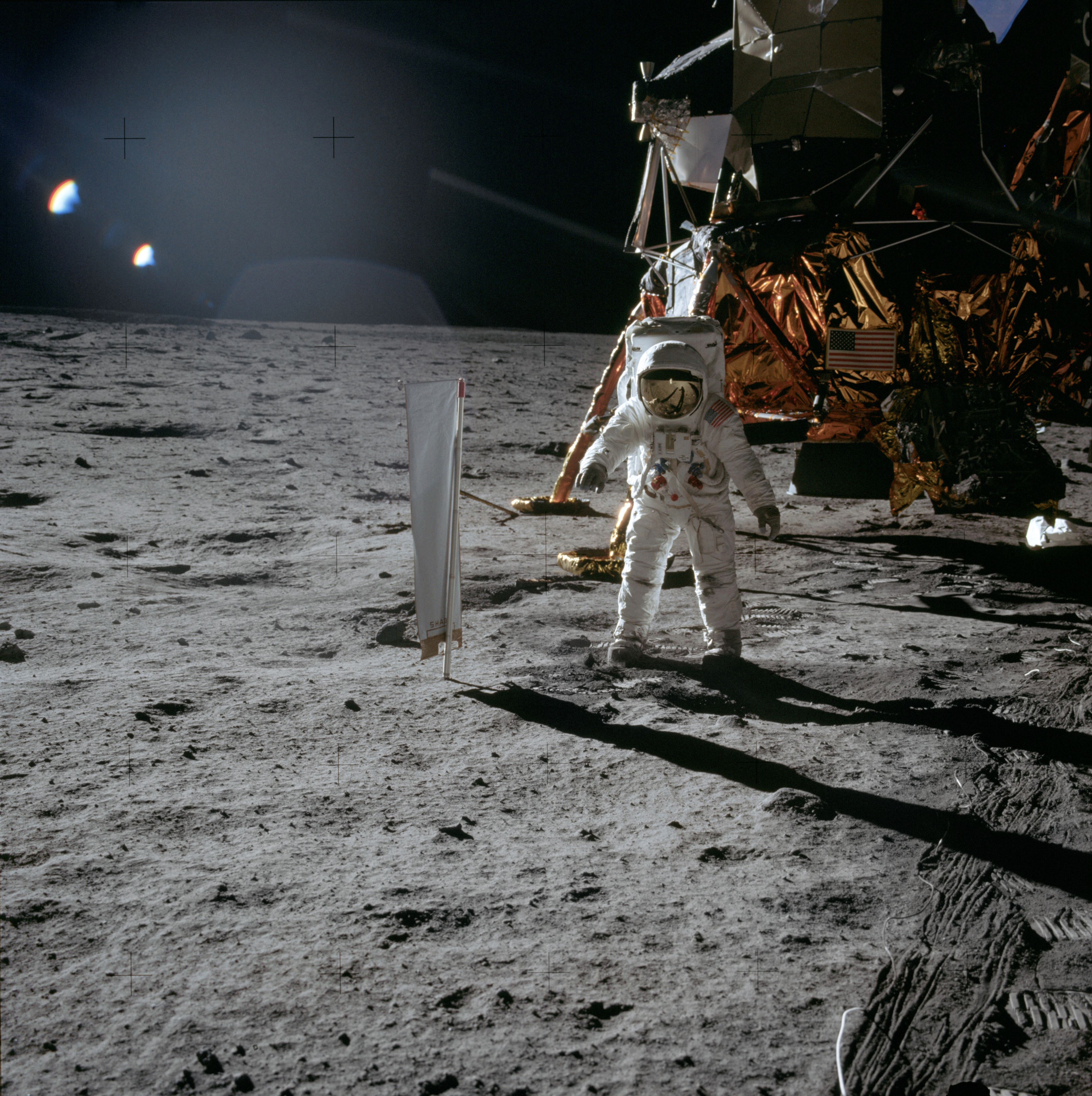
The face most people picture is not his: the gold-visored astronaut in the famous Apollo 11 photograph is Buzz Aldrin, shot by Armstrong. Armstrong himself is… more…

Richard Dorrell (CC BY SA), vía commons Moon and Mars
How does the moon affect the tides?
By pulling unevenly on it. Tidal forces vary inversely as the cube of the distance, so the near side of the Earth is tugged harder than the far side: one… more…
Moon and Mars
Why does neil armstrong have a hollywood star?
Strictly he does not have a star. Armstrong, Aldrin and Collins share four circular monuments resembling the Moon, one at each corner of Hollywood and Vine… more…
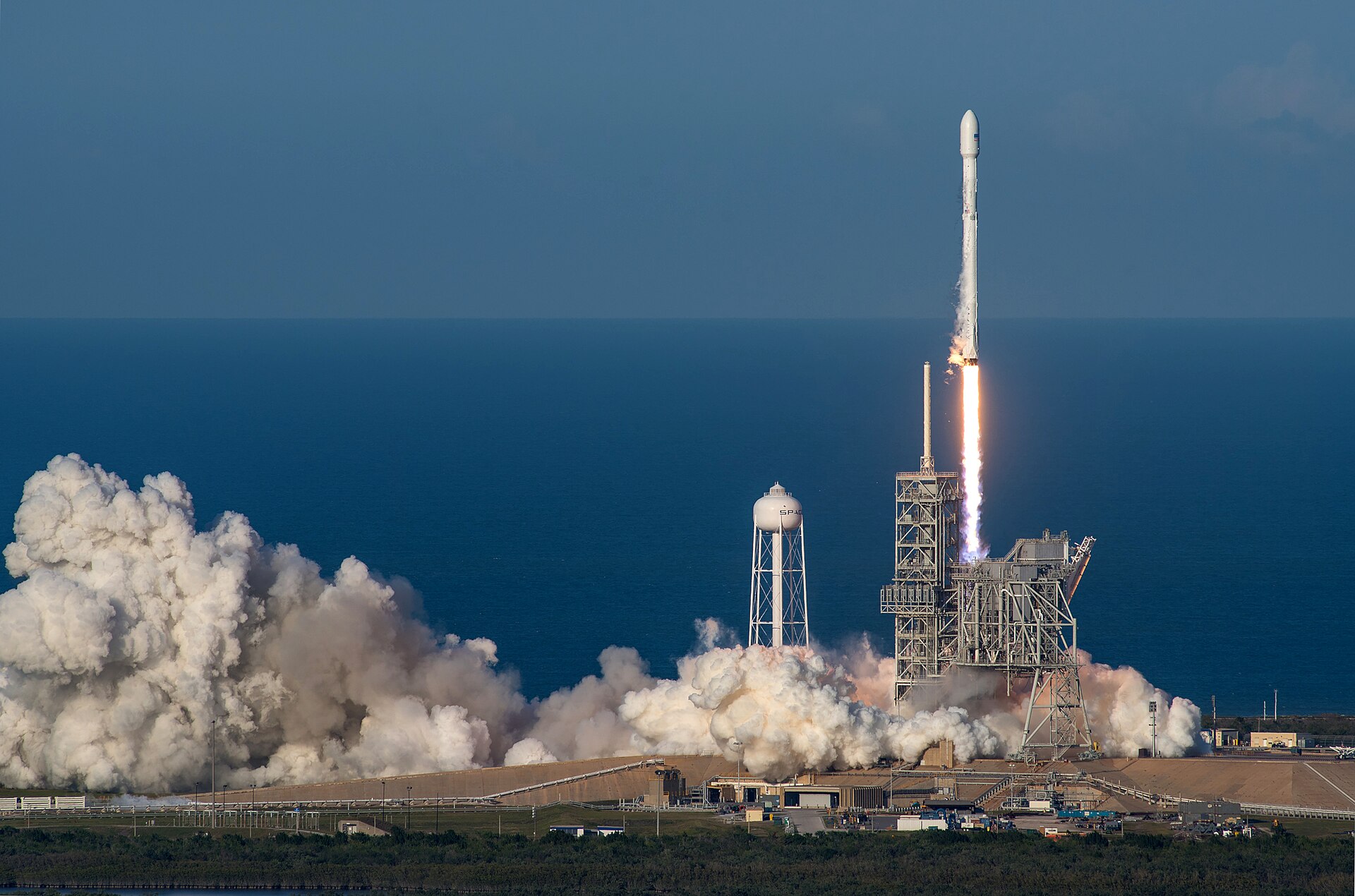
Foto: SpaceX (CC0) Moon and Mars
Why did falcon 9 hit the moon?
Because a spent upper stage on a lunar trajectory has no mission and no way to steer. A Falcon 9 upper stage from the January 2025 Firefly Blue Ghost 1 launch… more…
Moon and Mars
How much apollo 11 cost?
NASA never published a price for Apollo 11 on its own; what is documented is the program. The United States spent $25.8 billion on Project Apollo between 1960… more…
Moon and Mars
How much time neil armstrong spent on moon?
Armstrong and Aldrin spent 21 hours, 36 minutes on the Moon's surface, almost all of it inside the lunar module Eagle. Armstrong stepped onto the surface… more…
