Apollo program · NASA · Crewed
Apollo 16
- Apr 16, 1972, 5:54 PM
- Launch date
- 3
- Crew size
- 11 days 1 hr
- Duration
- Success
- Outcome


-1600.webp)


-1600.webp)


Apollo 16 was the tenth crewed flight of NASA's Apollo program and the fifth of the six missions that put astronauts on the Moon. Flown from 16 to 27 April 1972, it was the second of the "J missions", which combined three-day surface stays, a much heavier science load and the battery-powered Lunar Roving Vehicle. Its target was the Descartes Highlands, making it the first expedition to explore the Moon's ancient upland crust rather than a lava plain. The crew was commanded by John Young, a veteran of two Gemini flights and of Apollo 10, with Charles Duke as Lunar Module Pilot and Ken Mattingly as Command Module Pilot — the same Mattingly who had been pulled from Apollo 13 days before launch over a rubella exposure. The command module was named Casper and the lunar module Orion. They left Launch Complex 39A at the Kennedy Space Center aboard Saturn V AS-511. The outbound trip brought a string of minor glitches, and the most serious came just before descent: oscillations in the backup gimbal system of the service module's main engine kept flight controllers debating an abort for several hours. The landing was finally approved roughly six hours late, but the mission was shortened by a day in exchange. Young and Duke spent 71 hours on the surface, made three moonwalks totalling 20 hours and 14 minutes, drove 26.7 km in the rover and brought back 95.71 kg of rock and soil, including Big Muley, the largest single rock of the Apollo program. Mattingly meanwhile mapped and measured the Moon from orbit with the service module's instrument bay, and on the way home he stepped outside in deep space to retrieve the camera film. The mission's most lasting result was to overturn the idea that had drawn it to Descartes: geologists expected volcanic rocks and found impact breccias instead. That upset taught lunar science to distrust earthly analogues and showed that the lunar highlands were shaped chiefly by meteorite bombardment. Casper is now on display at the U.S. Space & Rocket Center in Huntsville, Alabama.
Payload
Apollo 16 carried two crewed spacecraft. The first was command and service module CSM-113 "Casper", with a launch mass of 30,354 kg including propellants and expendables: 5840 kg for the command module and 24,514 kg for the service module. The service module housed hydrogen-oxygen fuel cells, the tanks for the SPS main engine and a Scientific Instrument Module (SIM) bay with a panoramic camera, a mapping camera, a laser altimeter, gamma-ray, X-ray fluorescence and alpha-particle spectrometers, a mass spectrometer on an extendable boom, and the PFS-2 Particles and Fields Subsatellite, released into lunar orbit at the end of the mission. The second craft was lunar module LM-11 "Orion", 16,445 kg with propellants: the ascent stage weighed 2385 kg dry with 2378 kg of propellant, and the descent stage 2810 kg dry including stowed surface equipment, with 8872 kg of propellant. The descent stage carried the Lunar Roving Vehicle; the ALSEP experiment package — passive seismometer, active seismic experiment with explosive thumpers and mortars, heat flow experiment and surface magnetometer, powered by a SNAP-27 radioisotope generator —; the Far Ultraviolet Camera/Spectrograph; the Lunar Portable Magnetometer; the four-panel Cosmic Ray Detector; and the Solar Wind Composition foil, now with added platinum. The crew also flew an electrophoresis experiment, the ALFMED light-flash experiment, Biostack and the MEED microbial ecology device.
| Crew | Role | Agency | Extravehicular activity |
|---|---|---|---|
| John Watts Young | Commander | NASA · United States | — |
| Thomas Kenneth Mattingly II | Command module pilot | NASA · United States | — |
| Charles Moss Duke Jr. | Lunar module pilot | NASA · United States | — |
History
A J mission to the highlands
By the time Apollo 16 was being prepared, landing on the Moon had become routine enough for the emphasis to shift from engineering to science. The J missions, begun with Apollo 15, brought a surface vehicle, more instruments and three days on the Moon. Since Apollo 16 was the next-to-last expedition and had no major new surface hardware to prove, scientists saw it as a chance to probe the Moon's early history, which they hoped to read in the highlands — the oldest parts of the crust. No crew had yet walked there. Apollo 14 and Apollo 15 had returned ancient material, but from ground tied to the huge Imbrium impact basin, and researchers suspected that other processes might dominate away from Imbrium.
The crew
Commander John Young was 41 and a Navy captain. He had joined NASA in 1962 with the second astronaut group, flown Gemini 3 with Gus Grissom in 1965 — becoming the first American outside the Mercury Seven to reach space — followed by Gemini 10 with Michael Collins in 1966 and Apollo 10 as command module pilot in 1969. Apollo 16 made him the second American, after Jim Lovell, to fly four times.
Command Module Pilot Ken Mattingly, 36, was a Navy lieutenant commander from the fifth astronaut group of 1966. He had served on the support crews of Apollo 8 and Apollo 9 and even trained in parallel as a potential Apollo 11 backup. Originally on the Apollo 13 prime crew, he was removed three days before that launch after an exposure to rubella that traced back to Charles Duke, who had caught it from one of his children. Mattingly never fell ill; Jack Swigert took his seat.
Lunar Module Pilot Duke, another Group 5 rookie and an Air Force lieutenant colonel, had been on the Apollo 10 support crew and was the capsule communicator heard during the Apollo 11 landing. At 36 he became the youngest of the twelve men who walked on the Moon. The three were named as the prime crew on 3 March 1971.
The backup crew — Fred Haise, Stuart Roosa and Edgar Mitchell — had all flown to the Moon before. Deke Slayton had first pencilled in Haise with William Pogue and Gerald Carr, in line for Apollo 19, but once Apollos 18 and 19 were cancelled in September 1970 there was little point in training newcomers for a dead-end slot, and Pogue and Carr moved to Skylab. The support crew, who kept the rules, flight plan and checklists current, were Anthony England, Karl Henize, Henry Hartsfield, Robert Overmyer and Donald Peterson. Flight directors Pete Frank, Philip Shaffer, Gene Kranz, Donald Puddy, Gerry Griffin, Neil Hutchinson and Charles Lewis shared the shifts in Houston.
Insignia and call signs
The patch, drawn by Barbara Matelski of the Manned Spacecraft Center graphics shop from the crew's own ideas, shows an eagle over a red, white and blue shield against a grey lunar backdrop, with the NASA vector circling the Moon. Sixteen stars on the blue border mark the mission number, alongside the names Young, Mattingly and Duke. Young and Duke called their lander Orion because they wanted a star-related name that was easy to say over the radio; Mattingly picked Casper, after the friendly cartoon ghost, to lighten a flight that was serious enough already.
Choosing Descartes
The Ad Hoc Apollo Site Evaluation Committee, chaired by Noel Hinners of Bellcomm, met in April and May 1971 to choose the Apollo 16 and 17 sites and agreed that both should be in the highlands. For Apollo 16 the candidates were the Descartes region west of Mare Nectaris and the crater Alphonsus; Tycho had also been suggested but was too far from the equator and too rough on approach. Geologist Dan Milton had spotted an unusually bright area at Descartes in Lunar Orbiter photographs and proposed a volcanic origin, an idea that spread quickly because the central highlands looked like volcanic terrain on Earth. Alphonsus had attractive targets of its own, but its samples risked contamination by the Imbrium impact. Descartes' distance from earlier landing sites was also a bonus for the seismometer network laid down since Apollo 12.
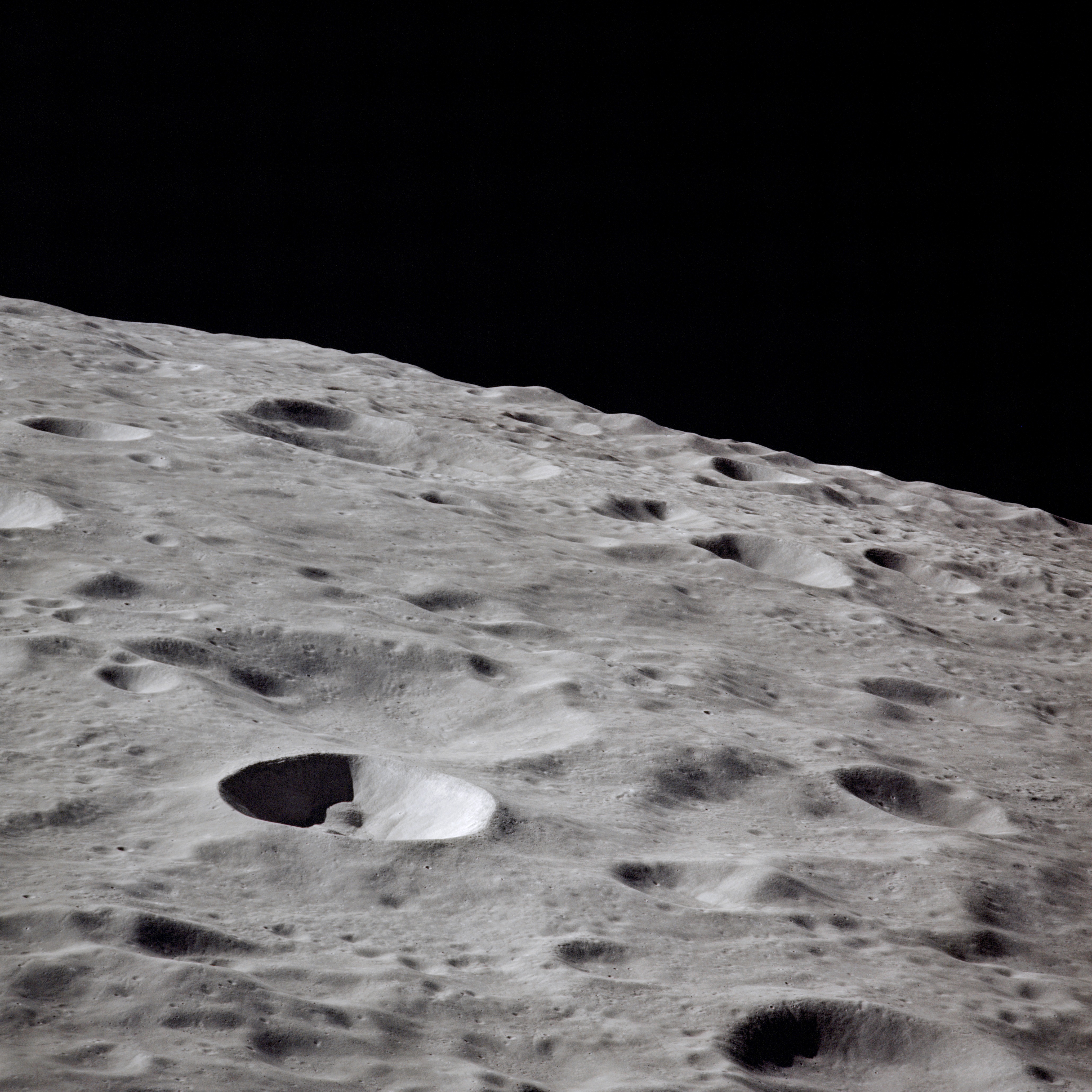
On 3 June 1971 the committee picked Descartes. Apollo 14 orbital photography showed the terrain was safe, and the exact spot was placed between two young craters, North Ray and South Ray, 1,000 and 680 m across, which had punched through the regolith like natural drill holes and exposed bedrock. The Cayley and Descartes formations, presumed volcanic, became the main sampling targets.
Geology training
Young and Duke, together with backup commander Haise, went through an extensive field-geology programme. Mitchell, still busy with Apollo 14, joined the trips in September 1971; until then Tony England, later the surface CAPCOM, or one of the geologist instructors stood in. Because volcanism was expected, much of the training focused on volcanic rock, though Young later said the other field work proved more useful. In July 1971 the crew went to Sudbury, Ontario — the first time U.S. astronauts trained in Canada — where a 97 km crater left by a meteorite some 1.8 billion years ago displays the shatter cones typical of impact. They also worked at the Nevada Test Site, whose nuclear craters stood in for lunar ones. The field trips grew into major exercises with up to eight astronauts and dozens of support staff.
Having backed up Apollo 13, itself a landing mission, Young and Duke could devote about 40 percent of their time to surface operations. Young reckoned some 350 hours of training were done in suits, which he considered essential to learn the limits of the equipment. They studied samples from earlier flights and listened to the principal investigators behind each instrument — preparation that let them recognise on the Moon that the expected volcanic rocks simply were not there, even when Houston's geologists were slow to believe them. Mattingly learned to read geological features from the air by overflying the field sites in an aircraft and trained on the SIM bay instruments.
The rocket and the delays
The launch vehicle was Saturn V AS-511, the eleventh to fly and the ninth with a crew, nearly identical to Apollo 15's. Four retrorockets that Apollo 15 had dropped from the S-IC first stage to save weight were restored, bringing the total back to eight, after analysis showed that the spent Apollo 15 stage had drifted closer than expected to the rest of the vehicle.
Hardware began reaching the Kennedy Space Center in July 1970. Launch was set for 17 March 1972, but a burst bladder in the command module's reaction control system during testing, doubts over an explosive cord meant to separate the lunar module, and a problem with Duke's suit pushed the flight to the next window on 16 April. The stack, rolled out of the Vehicle Assembly Building on 13 December 1971, went back inside on 27 January 1972 and returned to Pad 39A on 9 February. The formal countdown started on 10 April and ran with only the planned holds.
Surface science equipment
Like every landing since Apollo 12, Apollo 16 carried an ALSEP, a station of experiments powered by a SNAP-27 radioisotope generator and designed to keep working after the crew left. It comprised a passive seismometer extending the Apollo 12, 14 and 15 network; an active seismic experiment with a line of small "thumper" charges wired to geophones and four mortars to be fired remotely later; a heat flow experiment that required drilling two 3 m holes; and a surface magnetometer. NASA intended to calibrate the seismometer by crashing the lander's ascent stage nearby, an impact of known mass, speed and location.
The crew also took a portable magnetometer for readings at geology stops, and even an Apollo 12 sample stripped of its "soft" magnetism to see whether the trip would restore it (it did, though more weakly). The standout instrument was George Carruthers' Far Ultraviolet Camera/Spectrograph from the Naval Research Laboratory, which made the first astronomical observations from the Moon. Set up in the lander's shadow, it was aimed at nebulae, stars and Earth itself; Carruthers later said the most striking results were the Earth images — the first ultraviolet views of the planet from afar, revealing its hydrogen envelope, polar auroras and tropical airglow belt. A four-panel cosmic ray detector and the solar wind composition foil, now with platinum added to cut contamination, rounded out the kit.
The PFS-2 subsatellite
The service module's science bay also held the Particles and Fields Subsatellite PFS-2, twin of the PFS-1 released by Apollo 15 eight months earlier. It was meant to measure charged particles and magnetic fields around the Moon from an orbit between 89 and 122 km and last at least a year. The shortened mission ruled out the manoeuvre that would have set up that orbit, so it was released lower, and lunar mass concentrations pulled it down on 29 May 1972 after 424 revolutions.
Launch and the outbound coast
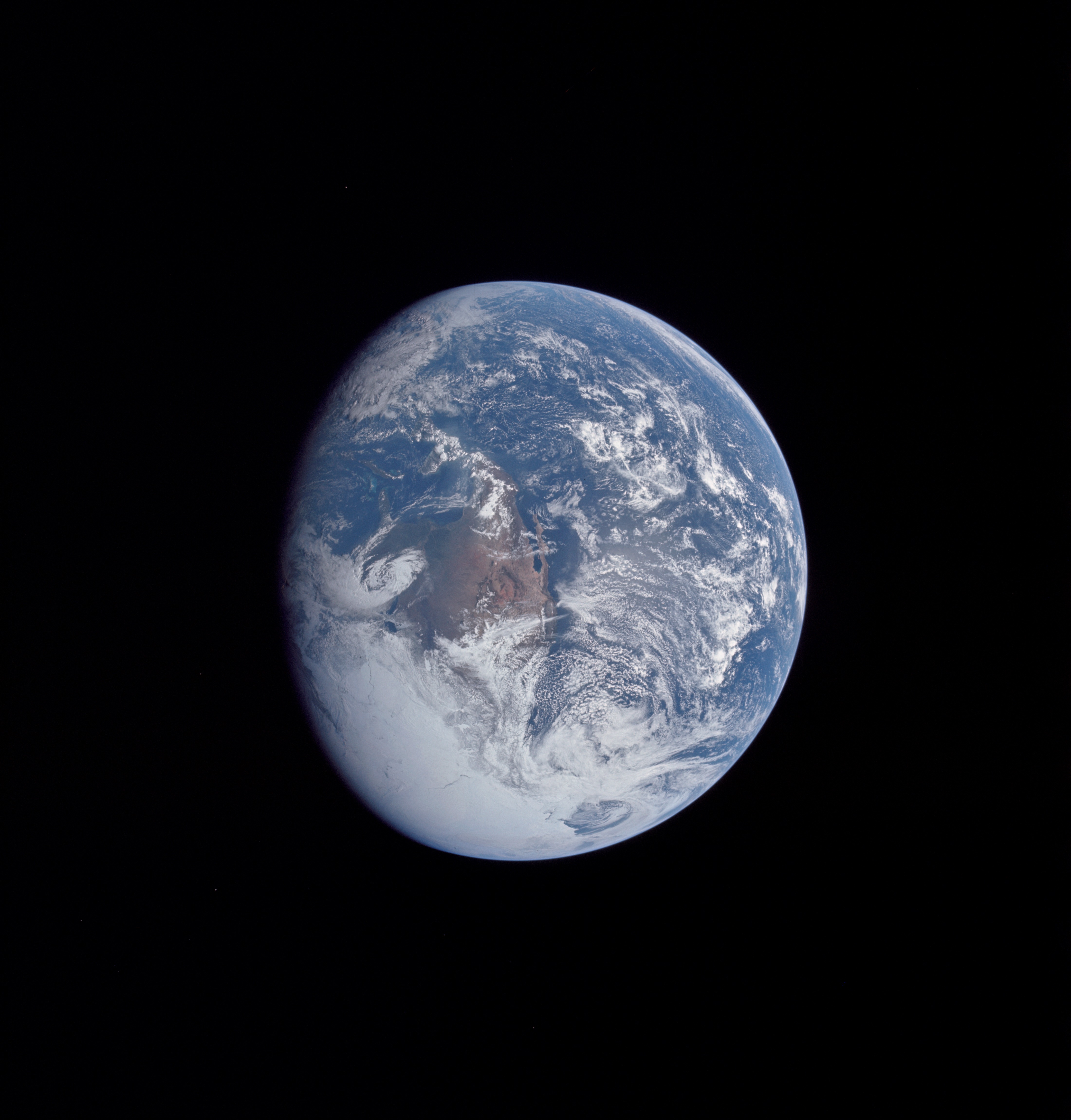
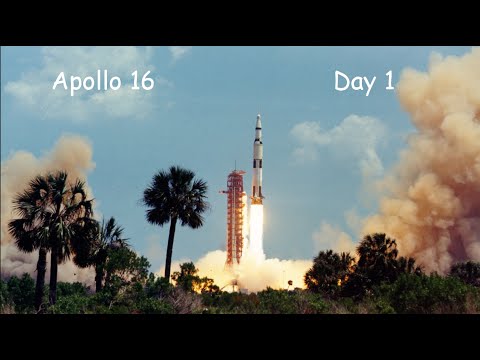
Apollo 16 lifted off at 12:54 pm EST (17:54:00 UT) on 16 April 1972. The first two stages performed cleanly and the spacecraft reached Earth orbit just under twelve minutes later. After working around small problems with the environmental control system and the S-IVB's attitude control, the crew saw the third stage relight after two orbits for just over five minutes, sending them moonward at about 35,000 km/h. Mattingly separated, turned and docked with the lunar module and extracted it without trouble.
The crew soon noticed particles streaming from what looked like a torn patch of the lander's skin — Duke estimated five to ten per second — but an inspection inside the LM found nothing serious. On day two, some 181,000 km out, they ran an electrophoresis experiment with red and blue polystyrene particles to test whether weightlessness allowed purer separations, and made a brief course correction with the main engine. Mattingly had to realign the guidance platform on the Sun and Moon after a gimbal lock. Day three brought the ALFMED experiment on the light flashes astronauts saw with their eyes shut, attributed to cosmic rays, and a suited rehearsal of landing day. At 59 hours, 19 minutes and 45 seconds, 330,902 km from Earth and 62,636 km from the Moon, they crossed into the lunar sphere of influence.
Lunar orbit and the engine scare
On day four, at an altitude of 20,635 km, the SIM bay door was jettisoned. Behind the Moon, the SPS engine fired for 6 minutes and 15 seconds to brake into a 108.0 by 315.6 km orbit, and a second burn lowered the low point to 19.8 km.
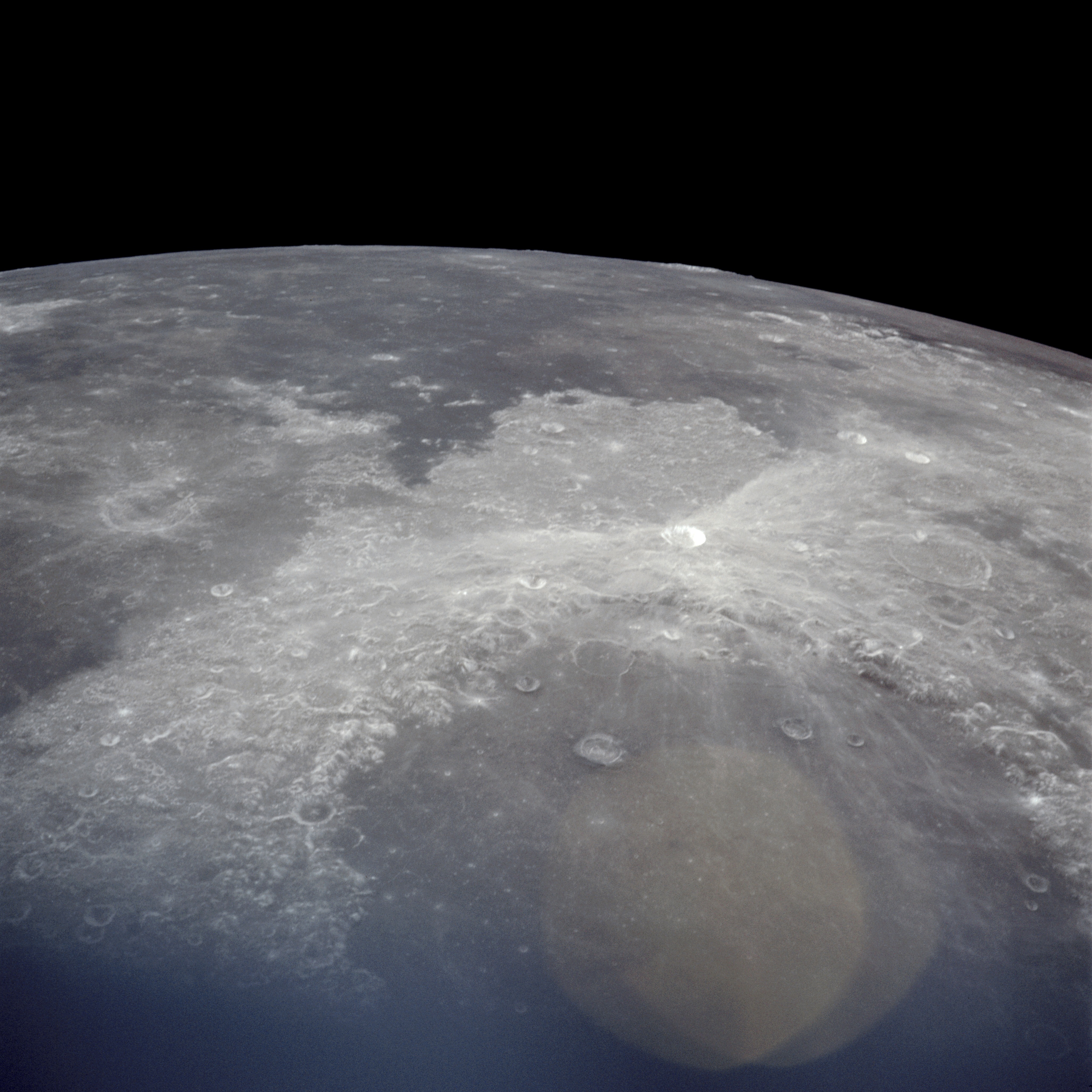
On day five, with the mass spectrometer boom stuck half-extended, Young and Duke powered up Orion and undocked 96 hours and 13 minutes into the flight. Mattingly was preparing to climb to a higher, near-circular orbit when a test of the main engine revealed oscillations in its backup gimbal system. Mission rules called for the two craft to redock in case the landing was scrubbed and the lander's engines had to bring the crew home; instead they flew in formation while Houston studied the data. After several hours controllers concluded the fault could be worked around and cleared the landing.
Down to Descartes
Powered descent began about six hours late and from a higher starting altitude than on any earlier mission, 20.1 km. By about 4,000 m Young could see the whole landing area, and at about 2,200 m the lander pitched forward into its final attitude. Orion touched down at 104 hours, 29 minutes and 35 seconds — 02:23:35 UT on 21 April — about 270 m north and 60 m west of the target, a miss made irrelevant by the rover. The delay forced a replan: the crew would spend one day less in lunar orbit after the surface stay, and the third moonwalk was cut from seven hours to five to protect their sleep.
First moonwalk
Stepping off the ladder, Young became the ninth person to walk on the Moon and greeted "mysterious and unknown Descartes", promising that Apollo 16 would change its image; Duke followed as the tenth. They unloaded the rover, the ultraviolet camera and the rest of the gear. The rover's rear steering failed at first but came back soon after. Throughout the stay Young drove and Duke navigated, the standard split on J missions.
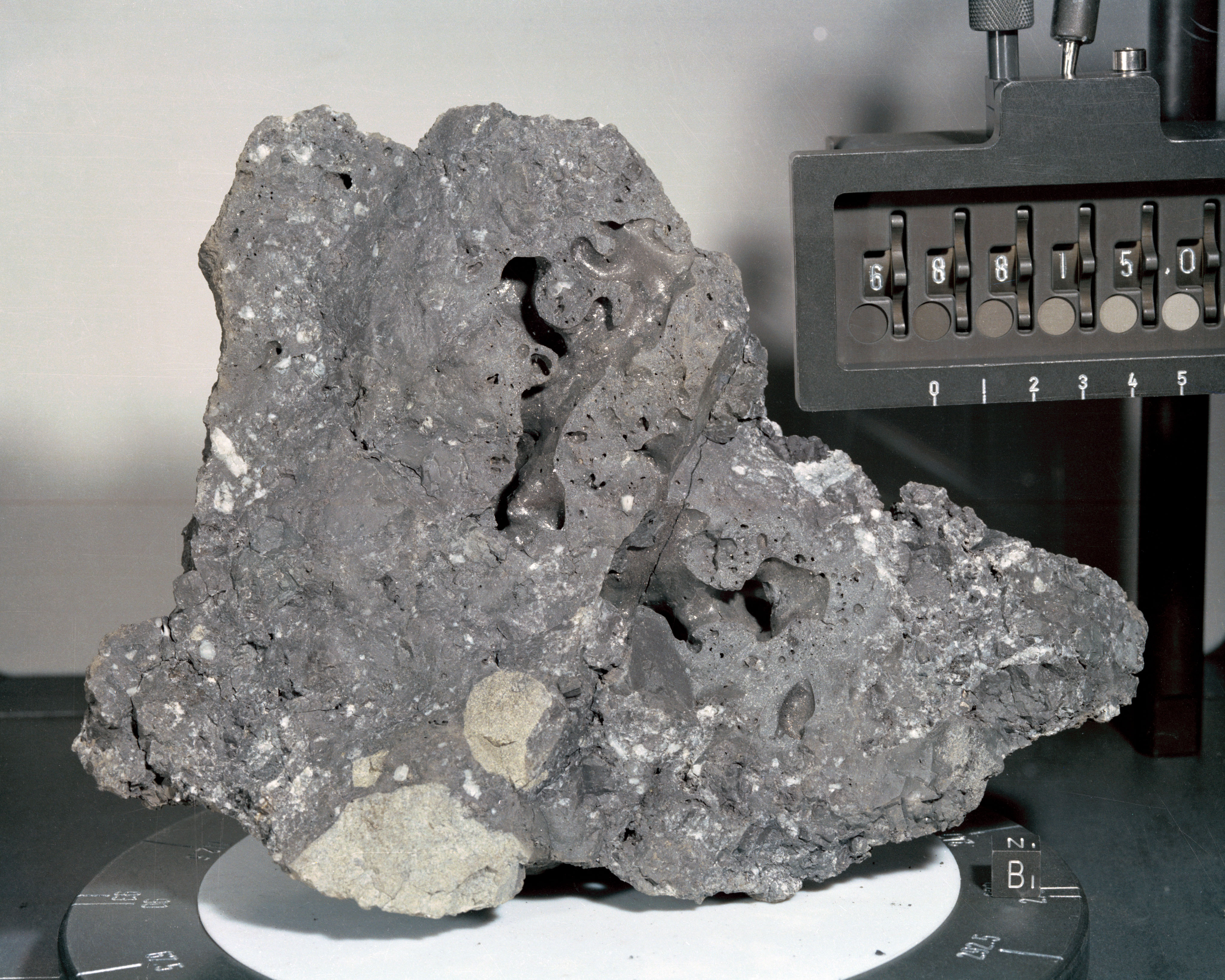
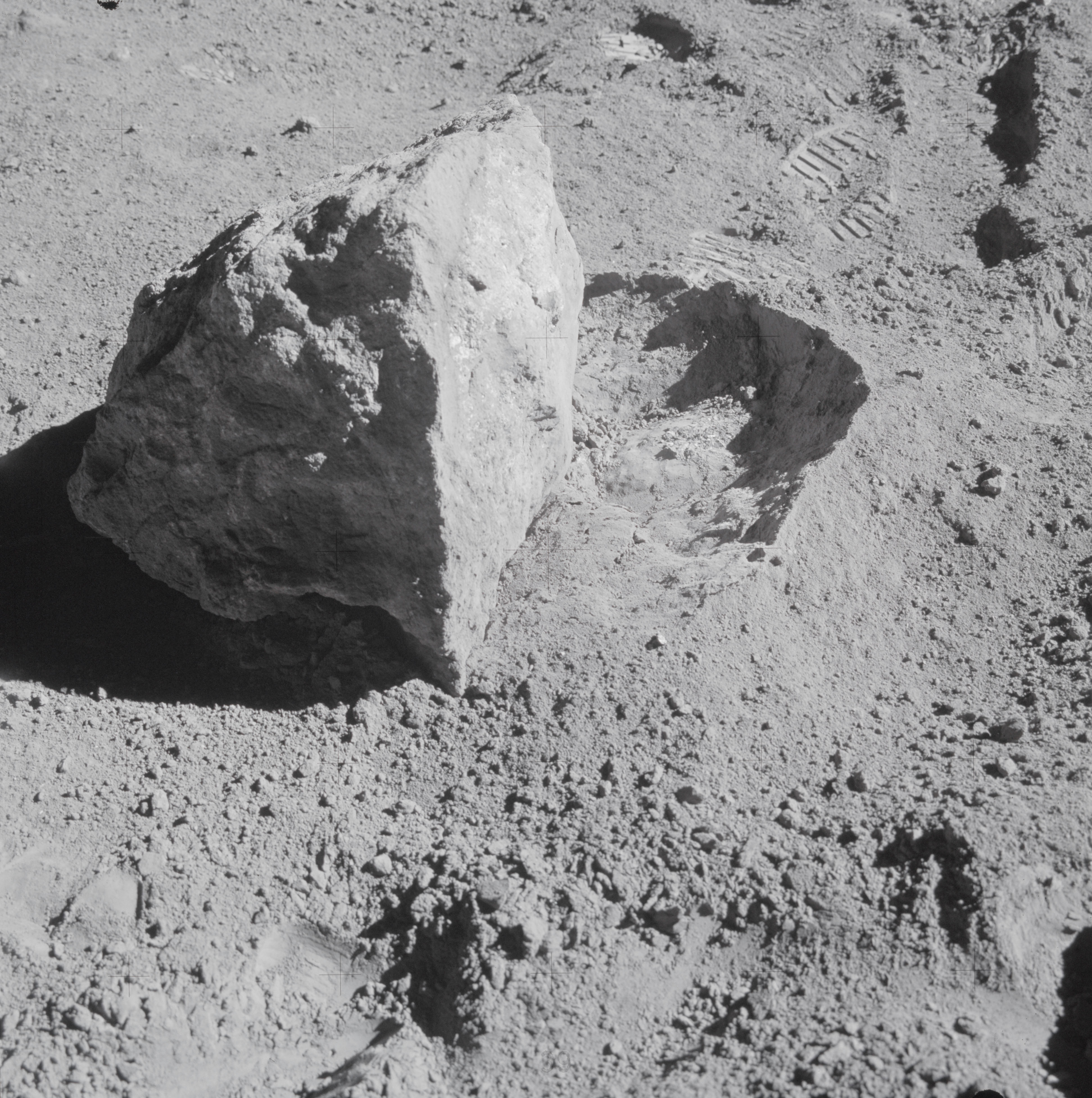
After the ALSEP was deployed came the day's most regrettable moment: Duke had already emplaced the first heat flow probe when Young, unable to see his feet in the bulky suit, snagged its cable with his leg and tore it out. Houston ruled out a repair as too time-consuming. About four hours into the EVA they drove to Plum Crater on the rim of Flag Crater, 1.4 km from the lander, hoping it had dug through the regolith to the Cayley Formation. There, at Houston's request, Duke picked up the largest rock returned by any Apollo crew, a breccia nicknamed Big Muley after mission geology chief William Muehlberger. At Buster Crater they photographed Stone Mountain and South Ray and Young set up the portable magnetometer. Scientists were already beginning to doubt the volcanic model: there was no volcanic rock in sight. Before closing out, Young staged the famous "Grand Prix" rover demonstration, filmed by Duke on 16 mm after the Apollo 15 attempt had been spoiled by a camera fault. The EVA lasted 7 hours, 6 minutes and 56 seconds.
Second moonwalk
Day two's goal was to climb the roughly 20-degree slope of Stone Mountain to a group of five craters known as Cinco. At 3.8 km from the lander and 152 m above the valley floor, they reached the greatest height above the LM of any Apollo mission, with a view of South Ray that Duke called spectacular. Further stations followed: at Station 5, a 20 m crater, they sought Descartes material free of South Ray ejecta; at Station 6 they hoped to sample the Cayley Formation; at Station 8, on a South Ray ray, they spent an hour collecting black and white breccias and plagioclase-rich crystalline rocks — and there Young knocked off the rover's rear fender extension while going to help Duke. They spent about 40 minutes at the "Vacant Lot" of Station 9, and at the final stop, between the ALSEP and the lander, drove a double core tube and ran penetrometer tests. Houston granted them ten extra minutes, and at 7 hours, 23 minutes and 26 seconds the EVA beat the Apollo 15 record.
Third moonwalk
The last surface day was devoted to North Ray, the largest crater visited by any Apollo crew: a kilometre wide and 230 m deep. From its rim, 4.4 km from the lander, they photographed the interior and walked to a boulder taller than a four-storey building, House Rock, pitted by micrometeoroids; its samples dealt the final blow to the volcanic hypothesis. Driving on towards Station 13 they set a lunar speed record of about 17.1 km/h downhill, and beneath "Shadow Rock" they scooped permanently shadowed soil. Before climbing in, Duke left a photograph of his family, signed on the back, and a medallion marking the Air Force's 25th anniversary; Young parked the rover about 90 m east at the so-called VIP site so that its camera, remotely operated from Houston, could film the liftoff. The final EVA lasted 5 hours and 40 minutes. All told, the pair spent 71 hours on the Moon, 20 hours and 14 minutes of it outside, drove 26.7 km and collected 95.71 kg of samples.
Mattingly alone
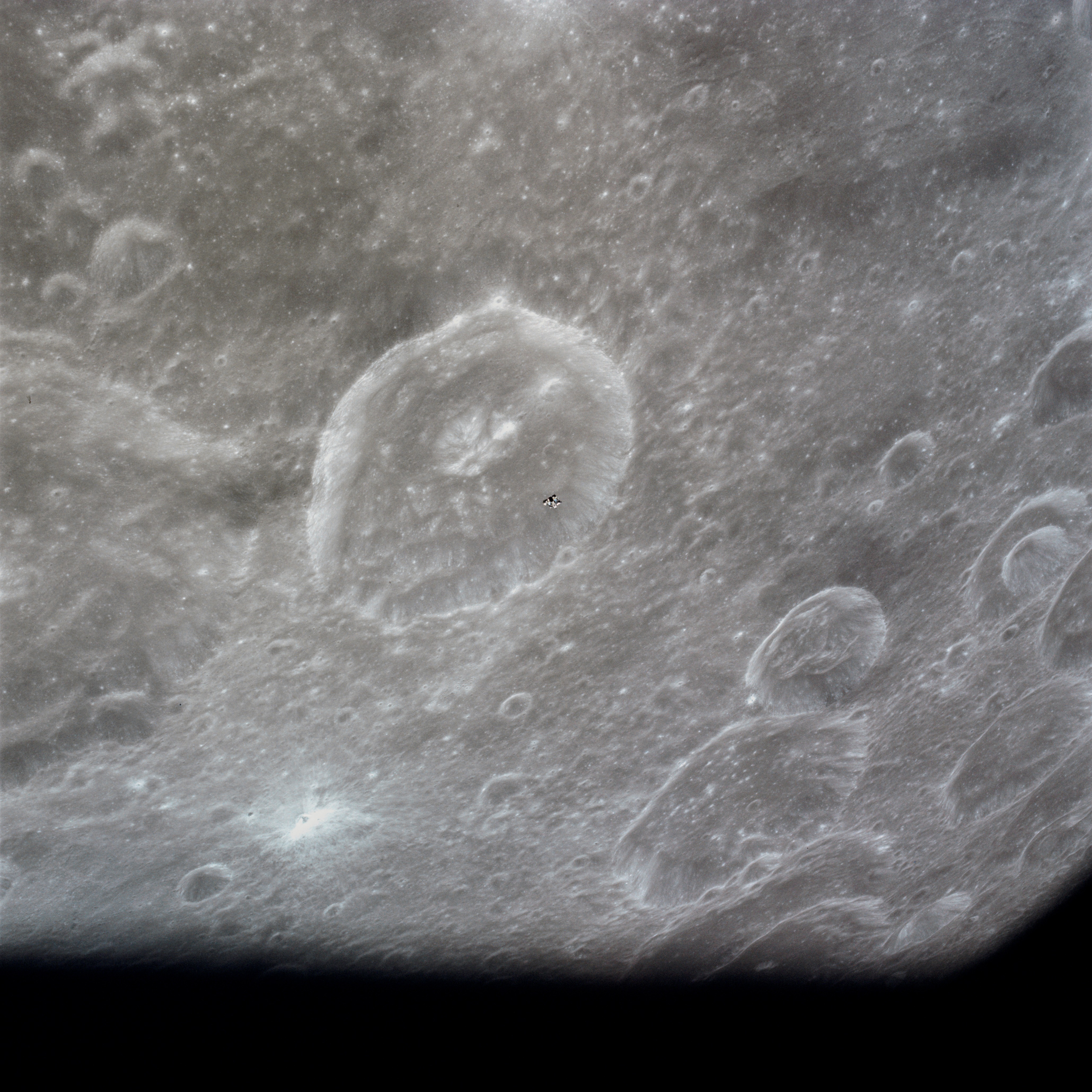
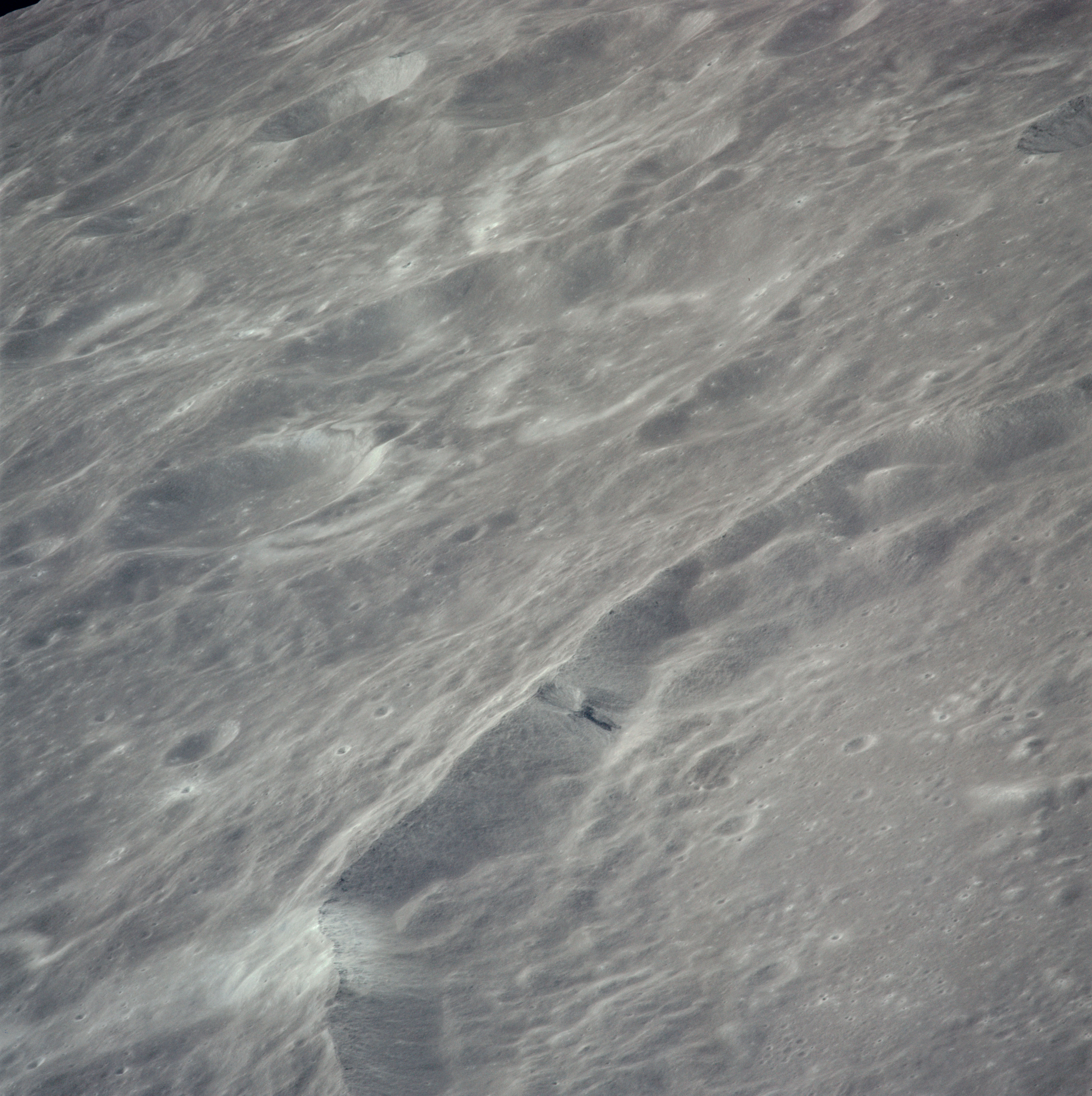
Mattingly had meanwhile moved Casper into a 98.3 by 125.6 km orbit to work the SIM bay, a schedule made tighter still by the early return. Problems piled up: switching on the panoramic camera triggered the master alarm through a power drain — possibly from heaters that came on at the same moment — many frames were overexposed, the mapping camera had trouble with its glare shield, and the laser altimeter slowly lost accuracy before failing just ahead of its final use. The mass spectrometer boom, which never fully retracted, ended up stuck near full extension and had to be jettisoned. Even so, the panoramic camera caught the Descartes area with Orion visible, and Mattingly, the first command module pilot to use binoculars, reported that from orbit the Descartes Formation looked unremarkable.
Liftoff, a lost lander and the subsatellite
Cleared by CAPCOM James Irwin, the ascent stage lifted off as the rover's camera tracked its first moments, reaching lunar orbit six minutes later at about 5,000 km/h. After docking, Young and Duke cleaned the cabin to keep dust out of Casper and transferred the samples. When the ascent stage was cast off the next day it began to tumble — probably because a switch had not been set before it was sealed — and could not make the burn that was to crash it near the seismometer. It stayed in orbit; its impact site remains unknown, though a 2023 study points to 29 May 1972. The crew then released PFS-2, and on the 65th lunar orbit the main engine — the one that had caused the scare — fired flawlessly to send them home.
A deep-space walk and the way home
On the return leg, about 320,000 km from Earth, Mattingly went outside for close to an hour and a half to retrieve film cassettes from the SIM bay cameras, with Duke standing in the hatch. It was only the second spacewalk ever made in deep space, far from any planet, and remains one of just three, all from J missions. During it he set up MEED, an experiment unique to Apollo 16 that tested how microbes respond to space. The penultimate day included a twenty-minute press conference answering journalists' questions.
Shortly before entry the command module separated from the service module, which burned up in the atmosphere. The capsule hit the atmosphere at about 11 km/s, its heat shield reaching between 2,200 and 2,480 °C. Splashdown came 265 hours, 51 minutes and 5 seconds after launch, at 19:45:05 UT on 27 April 1972, some 350 km southeast of Kiritimati (Christmas Island). The carrier USS Ticonderoga recovered the crew, who were on board 37 minutes later.
What was learned
Laboratory work confirmed that the Cayley Formation was not volcanic. The Descartes Formation was harder to judge, since it was unclear which rocks came from it, but Stone Mountain showed no sign of volcanism either, and the samples closely resembled those from Fra Mauro, the Apollo 14 site. Geologists conceded that they had been so sure of a volcanic origin that they ignored dissent, and had leaned too heavily on Earth analogues even though the Moon shares little of Earth's geological history. They concluded that the Moon has few if any volcanic mountains. The ultraviolet imagery, for its part, led to the discovery of two new auroral belts around Earth.
After the flight
Young and Duke went on to back up Apollo 17. Duke left NASA in December 1975. Young served as Chief Astronaut from 1974 to 1987, commanded the first Space Shuttle flight, STS-1, in 1981 and STS-9 in 1983, becoming the first person to fly into space six times; he retired in 2004. Mattingly commanded STS-4 in 1982 and STS-51-C in 1985, the year he left the agency.
Casper reached North Island Naval Air Station near San Diego on 5 May 1972. Three days later, equipment used to drain leftover toxic reaction control propellant exploded in a hangar, sending 46 people to hospital for observation and gashing one of the capsule's panels. Transferred from NASA to the Smithsonian in November 1973, it is now shown at the U.S. Space & Rocket Center in Huntsville. The S-IVB third stage was deliberately crashed into the Moon, but a communications failure left its location unknown until January 2016, when the Lunar Reconnaissance Orbiter found it in Mare Insularum, some 260 km southwest of Copernicus crater. The rover remains at Descartes. And in 2006, after Hurricane Ernesto swept through Bath, North Carolina, an eleven-year-old boy found a metal sheet bearing a faded copy of the mission patch; NASA confirmed it was a piece of Apollo 16's Saturn V first stage and in 2011 invited the family to the launch of STS-135, the last Shuttle flight.
Images
Elsewhere
- NASAJohn Young saluting the flag, Apollo 16 ↗
- NASAApollo 16 on the Moon at Descartes ↗
- NASA ScienceApollo 16 Lands in the Lunar Highlands ↗
- NASA ScienceApollo 16 Moon Panorama ↗
- Smithsonian National Air and Space MuseumApollo 16 mission overview ↗
- Smithsonian National Air and Space MuseumCommand Module, Apollo 16 ↗
- The Planetary SocietyApollo 16 mission page ↗
- LROC (Arizona State University)Apollo 16 50th Anniversary: A New Landscape ↗
- LROC (Arizona State University)Apollo 16, Footsteps Under High Sun ↗
- Lunar and Planetary InstituteApollo 16: The View from Lunar Orbit ↗
- Lunar and Planetary InstituteApollo Image Atlas ↗
- Sky & TelescopeApollo 16 in Pictures: The Most Dazzling Place ↗
Videos


Show the 37 more







![Apollo 16 Remastered (50th Anniversary) [4K]](https://i.ytimg.com/vi/yqdU6EQzclc/hqdefault.jpg)


![[4k, 60 fps] Apollo 16 Lunar Rover "Grand Prix" (1972 April 21, Moon)](https://i.ytimg.com/vi/az9nFrnCK60/hqdefault.jpg)





Did you know… about Apollo 16
- How high did astronauts jump on the moon?
Not very high: a few tens of centimetres at best, despite gravity being one sixth of Earth's at 1.62 m/s². A pressurised suit and a life-support backpack made…