Apollo program · NASA · Crewed
Apollo 17
- Dec 7, 1972, 5:33 AM
- Launch date
- 3
- Crew size
- 12 days 13 hr
- Duration
- Success
- Outcome


-1600.webp)


-1600.webp)


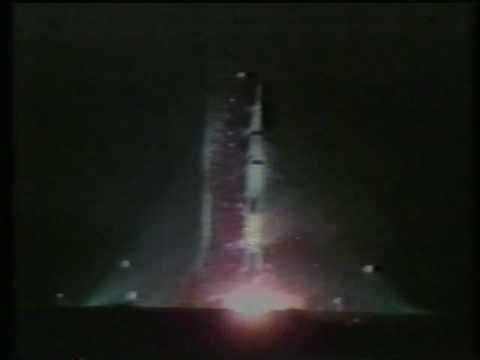
Apollo 17 was the eleventh and final crewed mission of NASA's Apollo programme and the sixth, and most recent, human landing on the Moon. It lifted off at night on December 7, 1972 aboard Saturn V SA-512, the only night launch of a crewed Saturn V, and splashed down in the Pacific on December 19. Commander Gene Cernan and lunar module pilot Harrison Schmitt, the only professional geologist ever to walk on the Moon, landed the lunar module Challenger in the Taurus-Littrow valley, while Ronald Evans stayed in lunar orbit aboard the command module America. The site was chosen to sample ancient highland rock and look for young volcanic activity. In about 75 hours on the surface the pair made three rover-assisted moonwalks, deployed the ALSEP science station and found the famous orange soil at Shorty crater, made of ancient volcanic glass. Evans ran the orbital science instruments and logged more time in lunar orbit than anyone before or since. The mission set records for duration, surface EVA time and returned samples, and Cernan became the last person to walk on the Moon. No human left low Earth orbit again until Artemis II in April 2026.
Payload
Apollo 17 carried command and service module CSM-114 America and lunar module LM-12 Challenger, joined by adapter SLA-21, with the third Lunar Roving Vehicle stowed on the lander. On the surface the crew deployed the ALSEP, comprising a heat flow experiment, a lunar surface gravimeter, an atmospheric composition mass spectrometer, a seismic profiling experiment with explosive charges and a dust and ejecta detector. The rover also carried a traverse gravimeter and the surface electrical properties experiment, both unique to this mission, and a neutron probe was placed in a drill hole. In orbit, the service module's scientific instrument bay held a lunar sounder, an infrared scanning radiometer and a far-ultraviolet spectrometer, plus mapping and panoramic cameras and a laser altimeter. The command module flew the BIOCORE experiment with five pocket mice, the Biostack container of microorganisms, seeds and eggs, and a device to study the light flashes seen by the crew.
| Crew | Role | Agency | Extravehicular activity |
|---|---|---|---|
| Eugene Andrew "Gene" Cernan | Commander | NASA · United States | — |
| Ronald Ellwin Evans | Command module pilot | NASA · United States | — |
| Harrison Hagan "Jack" Schmitt | Lunar module pilot | NASA · United States | — |
History
The last flight of a shrinking programme
Apollo 17 was the final crewed flight of NASA's Apollo programme and the sixth, and so far last, expedition to put people on the lunar surface. Its schedule changed radically along the way: the tentative plan drawn up in 1969 had it flying in September 1971, but the Apollo 13 abort and the spacecraft changes that followed pushed every later mission back. Once Apollo 20 was cancelled in early 1970 and Apollo 18 followed in September 1970, NASA limited itself to two Apollo flights a year and Apollo 17 became the closing act of crewed lunar exploration for that generation.
The December 1972 date also had a political side. President Richard Nixon had been badly shaken by Apollo 13 and, fearing another crisis during his re-election campaign, at first left the mission's funding out of the budget. He was persuaded to accept a December flight, safely after the November presidential election.
A geologist on the Moon
Under the usual rotation, a backup crew flew as prime crew three missions later, so the Apollo 14 backups named in 1969, Gene Cernan, Ronald Evans and former X-15 pilot Joe Engle, were in line for Apollo 17. Harrison Schmitt, a professional geologist, had backed up Apollo 15 and would have flown on Apollo 18. When Apollo 18 disappeared, the scientific community pressed for a real geologist to land, and NASA assigned Schmitt as lunar module pilot. Deke Slayton then chose Cernan and Evans over the remaining Apollo 15 backups, Dick Gordon and Vance Brand, despite objections from Jim McDivitt, who pointed to Cernan's January 1971 crash of a Bell 47G helicopter into the Indian River. Cernan asked to keep Engle but was told Schmitt would fly regardless; the crew was announced on August 13, 1971.
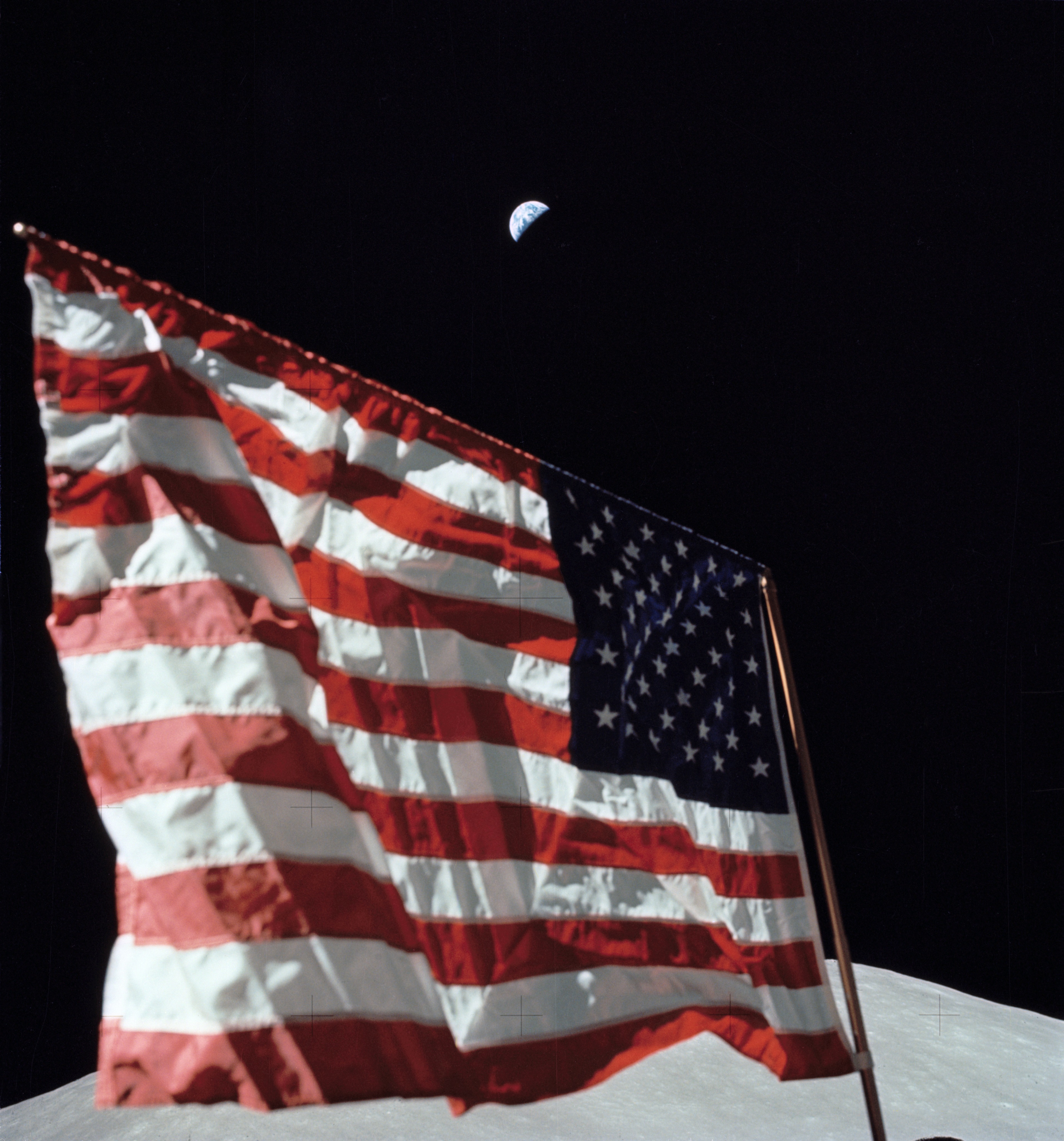
Cernan, a 38-year-old Navy captain from the 1963 astronaut group, had flown Gemini 9A in 1966 and Apollo 10 in 1969. Evans, 39, a Navy lieutenant commander from the 1966 group, had supported Apollo 7 and Apollo 11. Schmitt, a 37-year-old civilian with a Harvard doctorate in geology, came from the first scientist group of 1965. Evans and Schmitt were rookies. The original backup crew, the Apollo 15 trio of David Scott, Alfred Worden and James Irwin, was removed in May 1972 over the postal covers affair and replaced by John W. Young, Charles Duke and Stuart Roosa. Robert F. Overmyer, Robert A. Parker and C. Gordon Fullerton formed the support crew.
Insignia and call signs
Robert McCall designed the patch from the crew's ideas: the face of Apollo, modelled on the Apollo Belvedere in the Vatican Museums, set against an American eagle, with three white stars for the crew, the Moon, Saturn and a distant galaxy, and gold added to the national colours to announce a hoped-for golden age of spaceflight. The command module was named America, as a thank-you to the public and a nod to nineteenth-century sailing ships, and the lunar module Challenger, chosen over Heritage because Cernan felt it described the future better.
Choosing Taurus-Littrow
As the last landing and a J-mission with three surface days and a rover, Apollo 17 was aimed at an unvisited, high-priority site. Copernicus, the highlands near Tycho, Tsiolkovskiy on the far side and an area south-west of Mare Crisium were ruled out in turn; the last because a Soviet probe could reach it, as Luna 20 soon did. The final shortlist was Alphonsus, Gassendi and the Taurus-Littrow valley. Planners wanted old highland rock far from Mare Imbrium, young volcanic material and little overlap with Apollo 15 and 16 ground tracks, and Al Worden had seen apparently volcanic features in the valley from orbit. The site selection board unanimously recommended Taurus-Littrow in February 1972.
Training
The crew made fourteen geology field trips, against a single one for Apollo 11, beginning at Big Bend National Park in October 1971 and, from June 1972, at sites chosen to mimic the landing area. Trainers such as Gordon Swann worried that Cernan would simply defer to Schmitt, but the pair divided the work well, and William R. Muehlberger later said Schmitt was in effect running the mission from the Moon. Evans trained separately, flying over geological targets with geologist-pilot Dick Laidley and studying lunar geology with Farouk El-Baz.
Hardware and launch
The stack comprised CSM-114, LM-12, adapter SLA-21 and the launch escape system on Saturn V SA-512, the twelfth of fifteen built to fly. Vacuum-chamber tests led to replacement of the lunar module's rendezvous and landing radars and of the rover's steering motors. The rocket rolled out to Pad 39-A on August 28, 1972, watched by 5,000 local residents. Launch was set for 9:53 p.m. EST on December 6, but the sequencer halted the count at T−30 seconds because it had not registered the manual pressurisation of the third-stage oxygen tank: the only hardware-caused launch delay of the programme. Apollo 17 lifted off at 12:33 a.m. EST on December 7, 1972, the only night launch of a crewed Saturn V, before some 500,000 spectators.
Outbound
After trans-lunar injection, Evans docked with and extracted the lunar module, and the spent S-IVB was steered into the Moon, triggering the Apollo 12, 14, 15 and 16 seismometers. Mission clocks were advanced by 2 hours and 40 minutes, Evans fixed a stubborn docking latch, and the crew photographed the whole Earth in the image now known as The Blue Marble. Lunar orbit insertion came on December 10.
On the surface
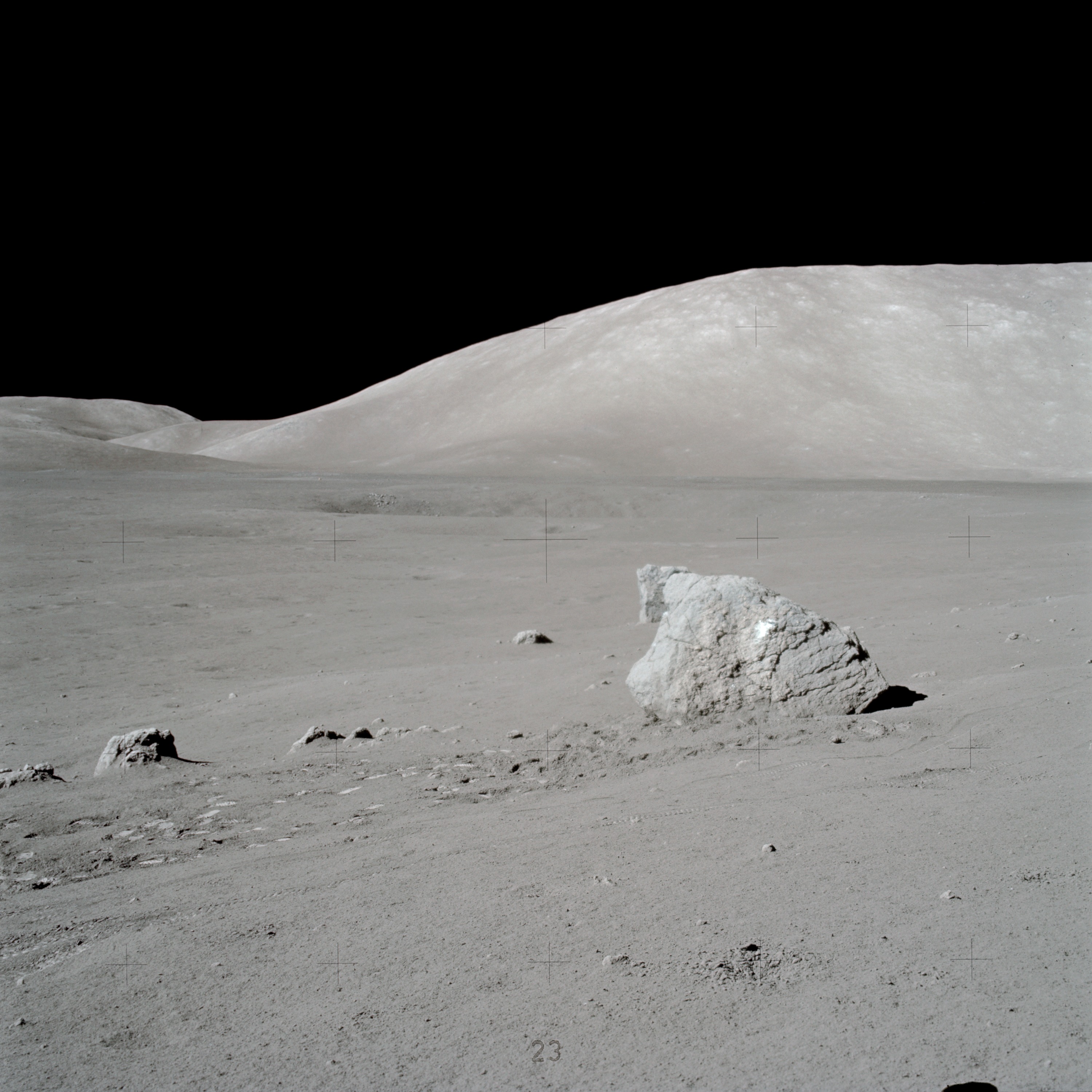
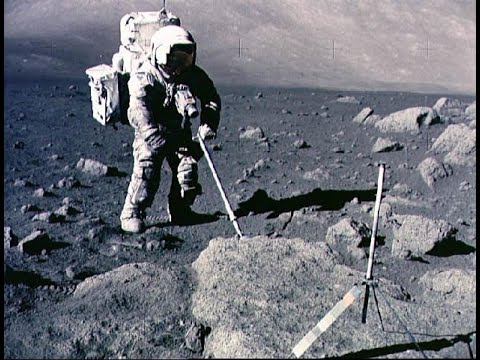
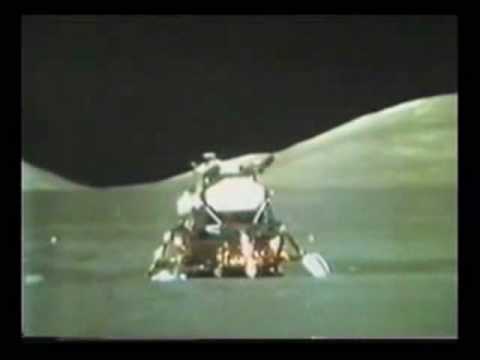
Challenger landed at 2:55 p.m. EST on December 11, about 200 m east of target. Over roughly 75 hours, Cernan and Schmitt made three EVAs. On the first they set up the rover, the ALSEP and seismic charges; a hammer snapped off a rover fender extension. On the second, after a fix of taped paper maps devised in Houston and relayed by John Young, they reached Nansen crater, 7.6 km from the lander, the farthest anyone has gone from a pressurised spacecraft on another world, and found orange soil at Shorty crater: volcanic glass beads from a lava fountain more than 3.5 billion years old, exposed by an impact less than 20 million years ago. That EVA lasted 7 hours 37 minutes. The third, the last Apollo moonwalk, explored the North Massif and Sculptured Hills, visited Tracy's Rock and Van Serg crater and yielded Samples 70215 and 76535. Cernan dedicated the Friendship Rock to the nations of Earth, unveiled the plaque and became the last person to step off the Moon.
Evans in orbit
Alone in America, Evans ran the SIM bay instruments, photographed Eratosthenes, Copernicus and Mare Orientale by earthshine, sketched the solar corona, reported transient lunar phenomena near Grimaldi and performed the plane change for rendezvous. His roughly 148 hours in lunar orbit remain a record.
Return and legacy
Challenger lifted off on December 14 and docked about two hours later; its ascent stage was then crashed into the Moon. On the way home Evans made a 65-minute deep-space EVA to retrieve film, the last of the programme. America splashed down on December 19, 1972, 6.4 km from USS Ticonderoga. The mission set records for the longest landing mission, the longest surface stay, total lunar EVA time of 22 hours 4 minutes, about 115 kg of samples and 75 lunar orbits, and no one left low Earth orbit again until Artemis II in April 2026. None of the crew flew again; America is displayed at Space Center Houston, and a sample container sealed at station 3 was not opened until 2022.
Images
Elsewhere
- NASA Image and Video LibraryThe Blue Marble — Earth as seen from Apollo 17 ↗
- NASA Image and Video LibraryHarrison Schmitt next to a huge, split lunar boulder at station 6 ↗
- NASA Image and Video LibraryAstronaut Eugene Cernan next to the lunar roving vehicle ↗
- NASA Image and Video LibraryPanoramic view of the Taurus-Littrow landing site ↗
- NASA Image and Video LibraryHarrison Schmitt collecting lunar samples at Station 5 ↗
- NASA Image and Video LibraryEugene Cernan salutes the American flag on the lunar surface ↗
- NASA Image and Video LibraryThe lunar module Challenger at the Taurus-Littrow site ↗
- NASA Image and Video LibraryHarrison Schmitt standing near a large boulder at Station 6 ↗
- NASA Apollo Lunar Surface JournalApollo 17 Lunar Surface Journal ↗
- NASA Johnson Space Center HistoryApollo 17 Mission Gallery ↗
- Apollo Flight JournalApollo 17 Flight Journal ↗
- The Planetary SocietyApollo 17 ↗
Videos


Show the 26 more







Did you know… about Apollo 17
- When did astronauts last walk on the moon?
Apollo 17, in December 1972. Eugene Cernan and Harrison Schmitt landed in the Taurus-Littrow valley on 11 December 1972, worked on the surface for three days…
- How long astronauts stay on moon?
So far, between about 21 hours and three days. Apollo 11 spent roughly 21 and a half hours on the lunar surface in July 1969; Apollo 17, the last landing…
- How many astronauts have walked on the moon?
Twelve. Between July 1969 and December 1972, twelve NASA astronauts set foot on the lunar surface across six Apollo landings, from Neil Armstrong and Buzz…
- When did astronauts walk on the moon?
Twelve astronauts walked on the Moon between July 1969 and December 1972, on six Apollo landings. Neil Armstrong and Buzz Aldrin were first, stepping out on…
- When did astronauts go to the moon?
Twelve people have walked on the Moon, all between July 1969 and December 1972. Apollo 11 landed on 20 July 1969 with Neil Armstrong and Buzz Aldrin. Five…