Apollo program · NASA · Crewed
Apollo–Soyuz
- Jul 15, 1975, 7:50 PM
- Launch date
- 9 days 1 hr
- Duration
- Success
- Outcome
-1600.webp)


-1600.webp)
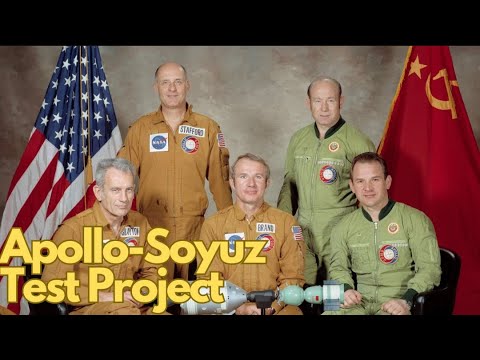
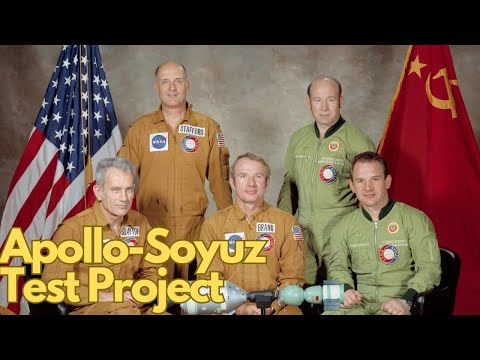
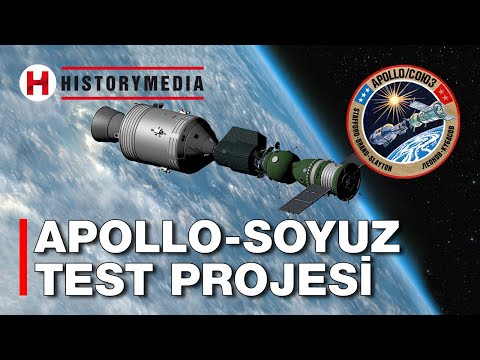
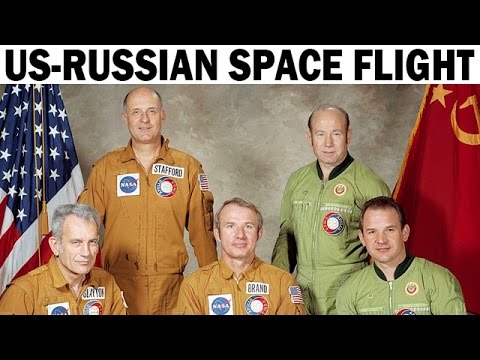
Apollo–Soyuz, known in the United States as the Apollo–Soyuz Test Project and in the Soviet Union as the Soyuz–Apollo experimental flight, was the first international crewed space mission. In July 1975 an Apollo spacecraft with three American astronauts docked in low Earth orbit with Soyuz 19 and its two Soviet cosmonauts, and the crews spent almost two days working together. The handshake between commanders Thomas Stafford and Alexei Leonov became the defining image of Cold War détente. The project grew out of contacts between NASA and the Soviet Academy of Sciences from 1970 onward and was sealed by the agreement signed by Richard Nixon and Aleksey Kosygin on 24 May 1972. Its key technology was the jointly developed APAS androgynous docking system, together with a NASA-built docking module that acted as adapter and airlock between Apollo's pure-oxygen cabin and the nitrogen–oxygen atmosphere of Soyuz. Soyuz 19 lifted off from Baikonur on 15 July 1975, and Apollo, with Stafford, Vance Brand and Deke Slayton aboard, followed hours later on a Saturn IB from Launch Complex 39B at Kennedy Space Center. They docked on 17 July, exchanged visits, gifts and messages from Brezhnev and President Ford, ran joint experiments — including an artificial solar eclipse — and flew a second docking with Soyuz as the active partner. Soyuz landed on 21 July, while Apollo stayed in orbit until the 24th with its own programme of astronomy, Earth observation and materials experiments. The splashdown was marred by thruster propellant fumes entering the cabin, which put the three astronauts in hospital in Honolulu. It was the last flight of an Apollo spacecraft and the last American crewed flight until the first Space Shuttle mission in 1981. Its technical heir, APAS, returned for the Shuttle–Mir dockings and remains in use on the International Space Station, and its example of cooperation paved the way for the large space partnerships that followed.
Payload
Apollo CSM-111 with a NASA-built docking module (airlock and adapter to the APAS system) and an experiment package: five joint experiments with Soyuz 19 — among them the artificial solar eclipse, ultraviolet absorption and zone-forming fungi — and 23 independent ones such as the multipurpose furnace, crystal growth, electrophoresis, helium glow, Earth observation, Doppler tracking and geodynamics, plus the S150 X-ray proportional counter and an extreme-ultraviolet telescope.
| Crew | Role | Agency | Extravehicular activity |
|---|---|---|---|
| Thomas P. Stafford | Commander | NASA · United States | — |
| Vance D. Brand | Command module pilot | NASA · United States | — |
| Donald K. Slayton | Docking module pilot | NASA · United States | — |
| Aleksey A. Leonov | Commander · Soyuz 19 commander | Soviet space program · Russia | — |
| Valeriy N. Kubasov | Flight engineer · Soyuz 19 flight engineer | Soviet space program · Russia | — |
History
A handshake negotiated in the middle of the Cold War
Apollo–Soyuz was a product of détente, yet its roots went back more than a decade. After John Glenn's orbital flight in 1962, letters exchanged between John F. Kennedy and Nikita Khrushchev led to talks between NASA Deputy Administrator Hugh Dryden and the Soviet scientist Anatoly Blagonravov. Their agreement, formalised in October of that year while the Cuban Missile Crisis was unfolding and announced at the United Nations on 5 December 1962, was modest: weather-satellite data exchange, a study of the Earth's magnetic field and joint tracking of the Echo II balloon satellite. Kennedy even sounded Khrushchev out on a joint crewed Moon landing, but the president's assassination in November 1963 and Khrushchev's removal in October 1964 pushed the two programmes back into open competition.
For the rest of the decade each side gave the other's achievements little coverage, and the Soviet press went as far as using a photograph of the Apollo 14 launch to illustrate an attack on the Vietnam War. The thaw came at the turn of the decade. In October 1970 Mstislav Keldysh, president of the Soviet Academy of Sciences, answered a letter from NASA Administrator Thomas Paine proposing a cooperative mission, and technical representatives from both countries met that month at Star City, the cosmonaut training centre outside Moscow. In January 1971 Henry Kissinger, Richard Nixon's foreign-policy adviser, told NASA's George Low that as long as he stuck to space he was free to commit to whatever he wanted with his Moscow counterparts.
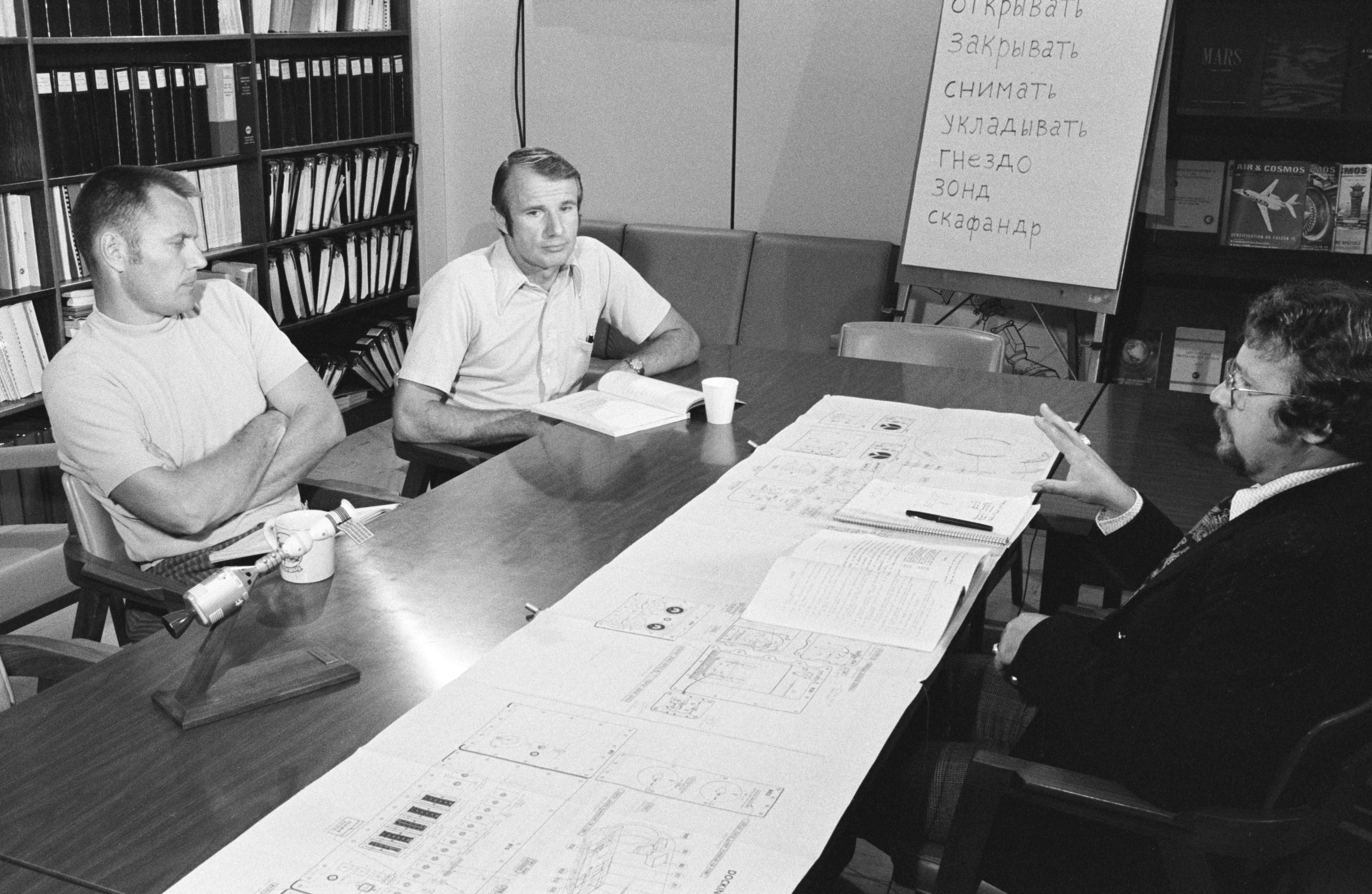
Between June and December 1971 engineers from both sides met in Houston and Moscow to work out how two spacecraft built on opposite philosophies could dock. Political endorsement came at the summit between Nixon and Premier Aleksey Kosygin, who on 24 May 1972 signed an agreement on cooperation in science and technology that committed both countries to a joint flight in July 1975. From then on, the fixed date acted as its own engine: unlike the arms-control talks, the project had a deadline and hardware to build, which left little room for political stalling.
Two engineering cultures face to face
Cooperation required bridging something deeper than language. Soviet spacecraft were designed around automation, with few manual controls and heavy reliance on ground control, whereas Apollo was meant to be flown by highly trained astronauts. Moscow described Apollo as extremely complex and dangerous; in Houston, Johnson Space Center director Christopher Kraft pointed out that NASA relied on redundant components to carry on after a failure, while each Soyuz component had a single function and a failure meant landing as soon as possible. The American astronauts' opinion of Soyuz was so poor that Glynn Lunney, the US project manager, had to ask them to stop airing it in public: NASA feared that any slight might make the Soviets walk away.
Those differences surfaced again and again. Designer Caldwell Johnson later recalled that the Soviets preferred to prove their systems on uncrewed flights, while NASA built elaborate ground facilities to simulate space; each side favoured the approach it was used to.
The androgynous docking system and the docking module
The core technical problem was docking. Both countries used probe-and-drogue systems that were similar in concept but incompatible, and in both one vehicle always had to be the active partner. Caldwell Johnson argued that future gear should be androgynous, so that either craft could dock or undock without active help from the other. In November 1971 the Americans put forward a four-guide androgynous mechanism and the Soviets answered with a counterproposal; on the Soviet side the key figure was Vladimir Syromyatnikov, a 37-year-old mechanical designer specialising in docking systems. The outcome was APAS, the Androgynous Peripheral Attach System, whose design is credited to engineer Bill Creasy and which NASA and the Soviet Academy of Sciences developed jointly.
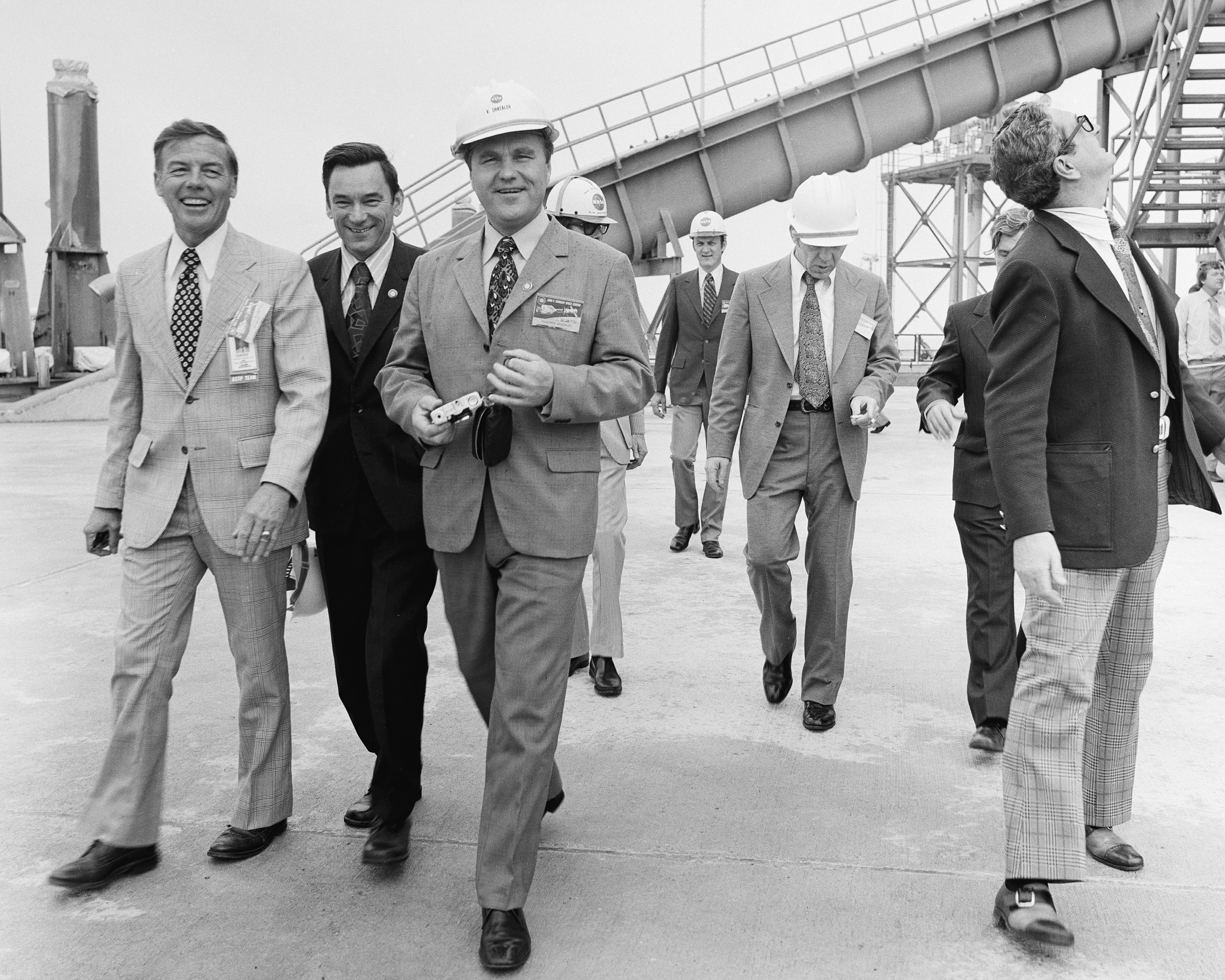
Because the surplus Apollo hardware lacked that collar, NASA designed and built a docking module that served both as adapter and as airlock. One end mated with Apollo through the probe-and-drogue gear used with the Lunar Module and Skylab; the other carried the APAS collar, which Soyuz 19 flew in place of its usual system. The airlock was essential because Apollo flew on pure oxygen at about 34 kPa, while Soyuz used a nitrogen–oxygen mix at sea-level pressure, about 100 kPa. The module, listed at 2012 kg, rode to orbit inside the adapter on the S-IVB stage and had to be extracted by the crew, just like a Lunar Module.
The Soyuz version built for the project, the 7K-TM, derived from the two-seat design adopted after Soyuz 11, replaced batteries with solar panels so it could fly without a station, and could operate during the docked phase at a reduced pressure of about 70 kPa to ease transfers. Six were built: two flew uncrewed under Kosmos names, a third flew crewed as Soyuz 16, a full-dress rehearsal of the Soviet half flown by Anatoly Filipchenko and Nikolai Rukavishnikov, a fourth stood fully fuelled as a hot backup at the launch site, and the sixth, the cold backup, flew in 1976 with the MKF-6 multispectral camera in place of the APAS adapter.
The crews and their preparation
The American crew was commanded by Thomas Stafford, a veteran of three flights who as commander of Apollo 10 had come within a few miles of the lunar surface, and a US Air Force brigadier general — the first general officer to fly in space. With him flew command module pilot Vance Brand, who had learned the Apollo spacecraft as backup for Apollo 15 and had twice served as a backup Skylab commander, and docking module pilot Donald "Deke" Slayton. Slayton had been picked as one of the Mercury Seven in April 1959, but an irregular heartbeat kept him grounded until 1972; as head of the astronaut office he eventually assigned himself to this mission, his only spaceflight. Jack Swigert had originally been slated as command module pilot but was dropped before the announcement over the Apollo 15 postal covers affair.
The Soviet crew was Alexei Leonov, the first person to walk in space on Voskhod 2 in March 1965, and flight engineer Valery Kubasov, who had flown on Soyuz 6 in 1969 and carried out pioneering welding experiments. Both had been due to fly Soyuz 11 in 1971 but were stood down when Kubasov was suspected of having tuberculosis. Soyuz carried only two because the changes needed for the cosmonauts to wear Sokol suits during launch, docking and reentry took up cabin space.
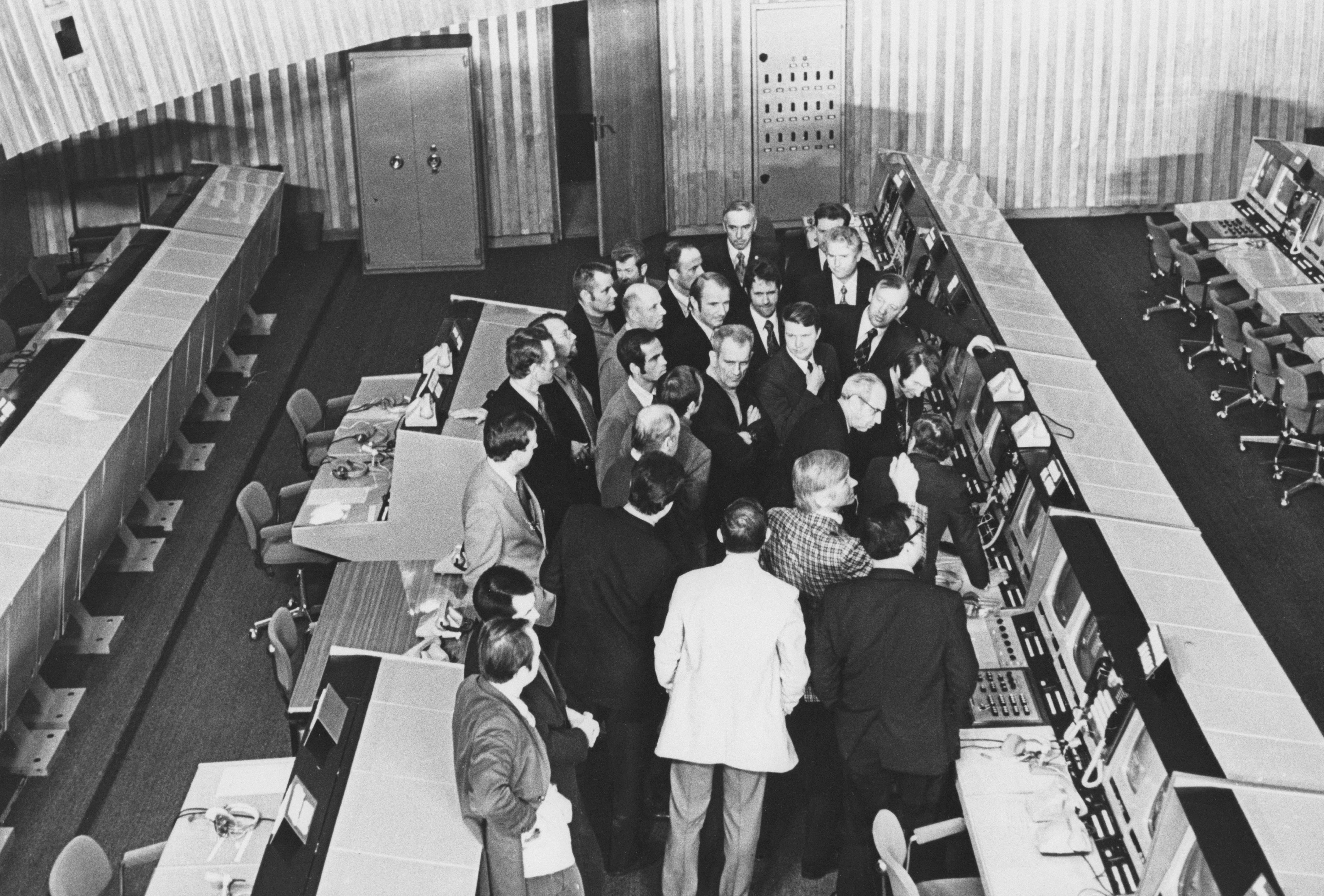
The support crew comprised Karol Bobko, Robert Crippen, Robert Overmyer and Richard Truly, and the flight directors were Pete Frank, Neil Hutchinson, Don Puddy and Frank Littleton. Preparation broke new ground: for the first time a foreign crew was allowed to inspect a Soviet spacecraft before flight, as well as the launch and training sites. The crews rehearsed in each other's simulators until joint procedures felt routine, and each learned the other's language; Leonov later joked that three languages were spoken on the mission — Russian, English and "Oklahomski", after Stafford's drawl.
15 July 1975: two launches in one day
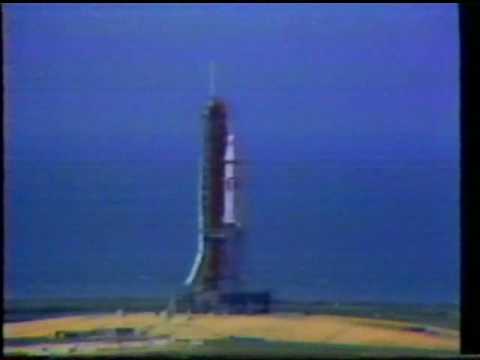
Soyuz 19 lifted off from Baikonur at 12:20 UTC and reached an initial orbit of 220.8 by 185.07 km inclined at 51.8 degrees. It was the first Soviet mission televised live at launch, in orbit and at landing. Seven and a half hours later, at 19:50 UTC, a Saturn IB (SA-210) rose from Launch Complex 39B at Kennedy Space Center carrying Stafford, Slayton and Brand; Slayton remarked that it had been worth waiting sixteen years. After orbital insertion the crew separated from the S-IVB, turned around and docked with the docking module to extract it, Stafford achieving an alignment within a hundredth of a degree even though Earth glare washed out his sight.
That night brought the first snag: Brand could not remove the docking probe from the tunnel because a misplaced pyrotechnic connector blocked the tool. The fix was left until morning, when the crew worked through it with guidance from the ground. Apollo's communications ran through the ATS 6 satellite which, via the Buitrago station in Spain, gave the crew 55 minutes of contact with Houston on each 87-minute revolution — three times the usual coverage.
16–17 July: the chase and the docking
As Apollo closed in orbit by orbit, the Soviet crew tried in vain to repair their black-and-white television camera and circularised their orbit at about 225 km. On 17 July, after radio contact was made — Slayton spoke Russian and Kubasov replied in English — Apollo completed its approach. Stafford flew in to contact, recorded at 16:09 UTC in the mission data, at 0.25 m/s. Leonov announced that Soyuz and Apollo were "shaking hands now", and Stafford asked that Professor Konstantin Bushuyev, the Soviet project director, be told it had been a soft docking.
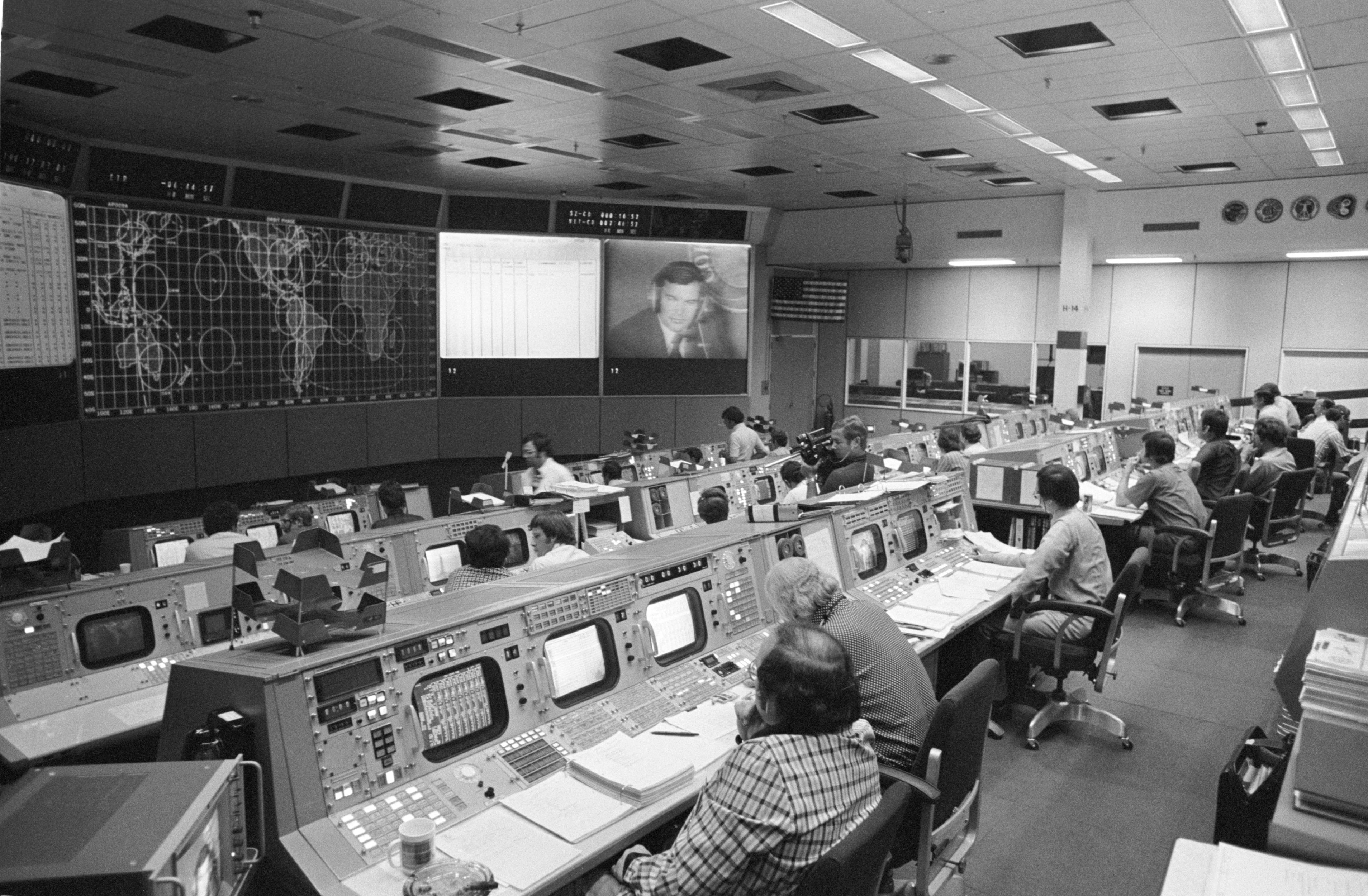
When the docking module was opened, a strong smell of burnt glue caused brief concern before it dissipated. Once pressures were equalised, Stafford opened the Soyuz hatch about three hours after docking and the two commanders shook hands over the French city of Metz; NASA had planned for the moment to happen over Bognor Regis in England, but a delay moved it. The crews heard a message from Leonid Brezhnev and spoke with President Gerald Ford, who talked for nine minutes instead of five and had the five men scrambling to swap the three available headsets.
18–19 July: transfers, television and experiments
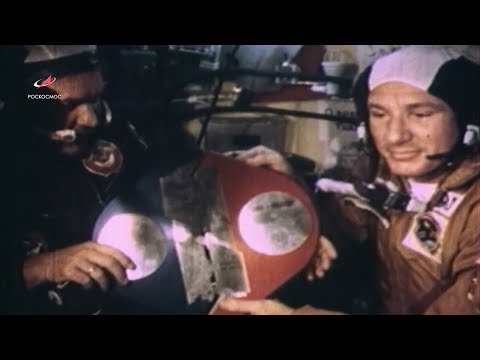
The crews visited each other repeatedly, ate together, exchanged flags, signed the Fédération Aéronautique Internationale certificates, joined the two halves of a commemorative medallion and swapped tree seeds that were later planted in both countries. Kubasov and Brand gave televised tours, Stafford showed Leonov around the command module in Russian, and a press conference was held from orbit. In all, Stafford spent 7 hours 10 minutes aboard Soyuz, Brand six and a half hours and Slayton an hour and 35 minutes, while Leonov spent nearly six hours on the American side and Kubasov nearly five.
On 19 July, after almost 44 hours together, the ships separated. Apollo positioned itself between the Sun and Soyuz to create an artificial eclipse so the cosmonauts could photograph the solar corona. Slayton then flew a second docking with Soyuz as the active partner; Earth glare again blinded the sight and an inadvertent roll-thruster firing set the stack swaying, although his arrival at 0.18 m/s stayed within the system's limits. The final undocking, performed by Leonov, led into the ultraviolet absorption experiment: Apollo flew around Soyuz at 150, 500 and 1000 metres, bouncing light off retroreflectors to measure atomic oxygen and nitrogen in the upper atmosphere. Per the mission data, the ships were docked for a total of 1 day, 23 hours, 7 minutes and 3 seconds.
Soyuz returns; Apollo flies on alone
Soyuz 19 landed on the Kazakh steppe on 21 July, broadcast live, with Kubasov first out of the capsule. Apollo stayed up for another three and a half days working through 23 independent experiments, among them the multipurpose furnace (MA-010), extreme ultraviolet survey (MA-083), crystal growth (MA-085), helium glow (MA-088), electrophoresis and Earth observation (MA-136) led by Farouk El-Baz. On 23 July the crew jettisoned the docking module for the Doppler tracking experiment (MA-089), which alongside geodynamics (MA-128) compared two ways of detecting mass anomalies from orbit; the module re-entered and burned up in August 1975.
.jpg)
The flight also carried astronomy. The Naval Research Laboratory's S150 X-ray proportional counter found soft X-ray emission from the supernova remnant MSH 14-63 and 0.716-second pulsations from the binary SMC X-1, though its background rose until it could barely see anything. The extreme-ultraviolet telescope discovered two sources, the white dwarfs HZ 43 and Feige 24. In biology, embryologist Jane Oppenheimer examined how weightlessness affected fish eggs, and both crews shared the zone-forming fungi experiment.
24 July: splashdown and toxic fumes
The deorbit burn came about 13 seconds early. During descent the Earth landing system switches were not armed on time; Brand, who blamed cabin noise, deployed the drogues manually and at that moment the cabin filled with fumes. The pressure relief valve, about 0.6 metres from the roll thrusters, drew in unburnt propellant — nitrogen tetroxide and monomethylhydrazine — for roughly 30 seconds. Apollo splashed down at 21:18:24 UTC in the Pacific near Hawaii, about 7300 metres from the recovery ship USS New Orleans, and ended up upside down. Brand passed out; Stafford unstrapped, reached the oxygen masks, held one over Brand's face until he came round and passed another to Slayton. All three spent two weeks in hospital in Honolulu, where tests also revealed a lung lesion in Slayton that proved benign. It was also the last recovery of a NASA crew by the US Navy until Artemis II in 2026.
Legacy
Apollo–Soyuz was the last flight of an Apollo spacecraft and the last American crewed flight for almost six years, until STS-1 on 12 April 1981. Right after the Saturn IB launch, work began converting LC-39B and the Vehicle Assembly Building for the Space Shuttle. Stafford left NASA in November 1975 to command the Air Force Flight Test Center at Edwards; Slayton directed the Shuttle approach and landing tests and Brand developed its entry techniques. The United States spent US$245 million on the project; Soviet spending is unknown.
APAS had a long line of descendants. A mechanically incompatible derivative, APAS-89, flew on the Kristall module of Mir and, after a test with Soyuz TM-16 in 1993, served twenty years after the flight for STS-71, the first Shuttle–Mir docking. The Shuttle used it to the end of its career to dock with Mir and the International Space Station, where PMA-1 still links the Zarya module to the US segment. Politically, high-level cooperation soon faded — Soviet and Cuban involvement in Angola over the winter of 1975-1976 buried détente — and part of the American press derided the project as a costly space circus, yet NASA judged that it had laid a technical and managerial foundation for future joint ventures.
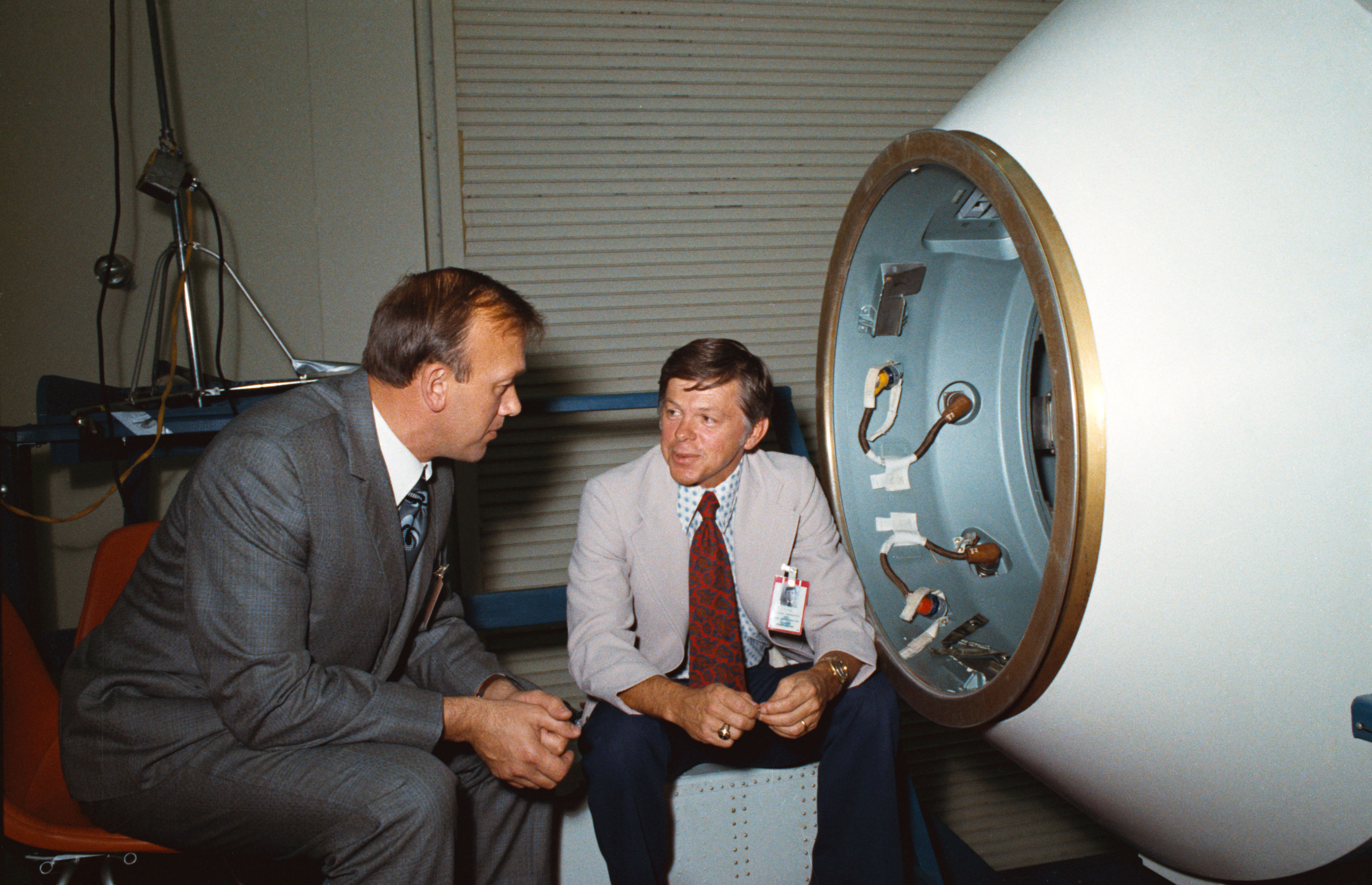
Stafford and Leonov became lifelong friends: Leonov was godfather to Stafford's younger children, and Stafford delivered a eulogy at his funeral in October 2019. Asteroid 2228 Soyuz-Apollo is named after the mission. The command module is displayed at the California Science Center in Los Angeles and the Soyuz 19 descent module at the RKK Energiya museum in Korolyov, while the National Air and Space Museum in Washington shows the docked configuration using unflown hardware.
Images
Elsewhere
- NASA Image and Video LibraryAmerican & Soviet engineers examine ASTP docking set-up ↗
- NASA Image and Video LibrarySimulations — ASTP Docking Module ↗
- Smithsonian National Air and Space MuseumApollo-Soyuz Test Project Simulator ↗
- Smithsonian National Air and Space MuseumApollo-Soyuz Test Project — Johnson Space Center ↗
- Smithsonian National Air and Space MuseumSoviet Engineers, Apollo-Soyuz Test Project ↗
- Space.comApollo-Soyuz Test Project: 1st U.S.-Russian Spaceflight Pictures ↗
- TIMEApollo-Soyuz: See Photos From the Historic Mission ↗
- NASA History40 Years Ago: The Handshake in Space ↗
- WikipediaApollo–Soyuz Test Project — galería fotográfica ↗
- Wikimedia CommonsAnimación de la maniobra de acoplamiento ASTP ↗
- Wikimedia CommonsSala de control de la misión ASTP ↗
- NASA History DiagramsCutaway (despiece) del módulo de acoplamiento Apollo-Soyuz — diagramas técnicos ASTP ↗