Apollo program · NASA · Uncrewed
Apollo 4
- Nov 9, 1967, 12:00 PM
- Launch date
- 8 hr 37 min
- Duration
- Success
- Outcome

_-_KSC-1600.webp)


-017-1600.webp)


_501_ROLL-OUT_-_CAPE-1600.webp)


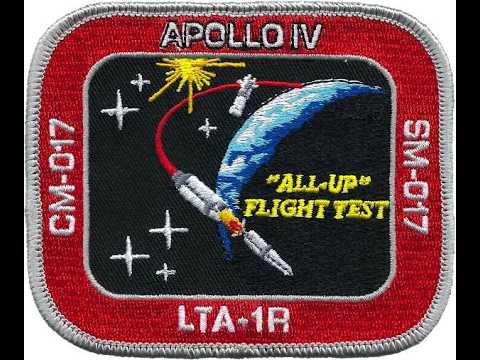
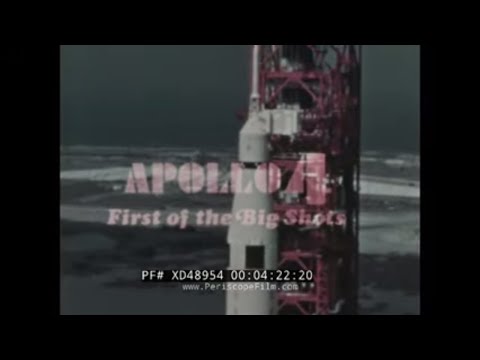
Apollo 4, launched on November 9, 1967, was the first flight of a Saturn V and the first mission to leave the Kennedy Space Center, inaugurating Launch Complex 39A, built expressly for the lunar giant. It carried no crew but everything else: it was NASA's first all-up test, the method imposed by George Mueller in late 1963 under which the rocket had to fly complete from the very first attempt, all three stages live and a working spacecraft on top, instead of being qualified one element at a time. The gamble removed four missions from the schedule in exchange for demanding that everything work first time. The vehicle, designated SA-501, flew the S-IC and S-II stages for the first time and demonstrated the S-IVB's first in-space restart — the very manoeuvre that would later send Apollo crews towards the Moon. Its payload was CSM-017, a Block I command and service module fitted with several Block II features, the heat shield among them, and LTA-10R, a lunar module test article housed in the SLA-8 adapter. The flight was prepared through nearly two years of delay: schedule, cost and quality trouble at North American Aviation, cracks in the second stage, and the searching inspection that followed the Apollo 1 fire, which turned up 1,407 defects in the spacecraft. After a countdown demonstration test that dragged on for three weeks, lift-off came at 12:00:01 UTC with a roar that buffeted the Vehicle Assembly Building and the press facilities. After two parking orbits, the third stage restart and a service module burn raised the apogee to 18,092 kilometres; coming back down, a second burn of 281 seconds drove the command module into the atmosphere at 11,168 metres per second, the speed of a return from the Moon, to test the heat shield under real conditions. The capsule splashed down in the North Pacific eight hours, thirty-six minutes and fifty-nine seconds after lift-off and was recovered by the carrier USS Bennington. NASA called the mission a complete success: the Saturn V worked, and a landing before the end of the decade stopped being a promise and became a schedule.
Payload
Apollo 4 carried neither crew nor scientific payload: its cargo was the hardware that had to be qualified for the lunar flights. Atop SA-501 rode CSM-017, a Block I command and service module made up of command module CM-017 and service module SM-020, with a launch mass of 81,253 pounds. Being Block I it had no docking system for a lunar module, but it carried several Block II features that could not wait for a crewed flight: a Block II heat shield — the main object of the test — a Block II CM-to-SM umbilical connector, Block II VHF and S-band antennae, and the seals of the hatch redesigned after the Apollo 1 fire, flight-qualified through a test panel fitted in place of the window. With no crew aboard, the cabin had no couches, controls or displays, and special equipment allowed Mission Control to operate its systems remotely. Inside the SLA-8 adapter, above the third stage, rode LTA-10R, a lunar module test article: a flight-type descent stage without landing gear, its fuel and oxidiser tanks filled with a mixture of water, glycol and freon, topped by an aluminium ascent-stage mock-up with ballast and no flight systems. Adapter and article were instrumented to measure ascent loads, and LTA-10R never separated: it was destroyed when the S-IVB re-entered. The manifest was completed by two motion-picture cameras mounted on the launch vehicle to film first-stage separation, ejected and recovered in the Atlantic, and an automatic 70 mm camera in the command module that took 755 colour photographs of the Earth.
History
The rocket that had to be proven
When President John F. Kennedy proposed in 1961 that the United States land an astronaut on the Moon and return him safely before the decade was out, one of the first great choices still open was which launch vehicle would do it. NASA settled on the Saturn C-5, a three-stage rocket built on developments already under way, approved in 1962 with a first test launch pencilled in for 1965 and a first crewed flight for 1967; in early 1963 the C-5 was redesignated Saturn V. Late in 1962 the agency also closed the mission-mode debate in favour of lunar orbit rendezvous, in which the third stage, the S-IVB, would push the whole Apollo spacecraft towards the Moon and only a separate landing craft would descend to the surface. No existing pad could handle a rocket of that size, so NASA announced a new complex on the Florida coast, first called the Launch Operations Center and renamed the John F. Kennedy Space Center after the president's assassination in November 1963. Apollo 4 was the first flight to leave that centre and the debut of Launch Complex 39, built expressly for the Saturn V.
Three earlier flights carrying Apollo hardware — AS-201, AS-203 and AS-202, all in 1966 and all successful — had used the smaller Saturn IB. That rocket did not use the new facilities, but it shared the S-IVB with the Saturn V and let much of the payload be flight-qualified without expending one of the giants. The Kennedy Space Center historians Charles D. Benson and William B. Flaherty summed up the value of that run: the Apollo-Saturn IB launches of 1966 exposed and then corrected the major automation problems of pads 34 and 37, and without that trial-and-error progress SA-501 — "the toughest launch in Apollo's history" — would have been far more difficult.
The all-up gamble
The decision that defines Apollo 4 was taken in late 1963, and it was about method rather than hardware. George Mueller, head of NASA's Office of Manned Space Flight, came from military missile work and had seen all-up testing succeed on the Air Force's Minuteman: fly the complete vehicle from the very first attempt, every stage live and a working spacecraft on top, instead of qualifying one element at a time. In a memo he directed that the first Saturn IB flight and the first Saturn V flight both be uncrewed but complete, that the second of each type repeat the exercise without a crew, and that the third carry astronauts. The approach cut against the habit of Wernher von Braun's team at the Marshall Space Flight Center, who tested new rockets stage by stage. Apollo managers accepted it with misgivings: incremental testing was safer, but it would inevitably push the landing past 1970. All-up testing removed four missions from the schedule in exchange for demanding that everything work the first time. Apollo 4 was the first time NASA applied it.
Vehicle and spacecraft
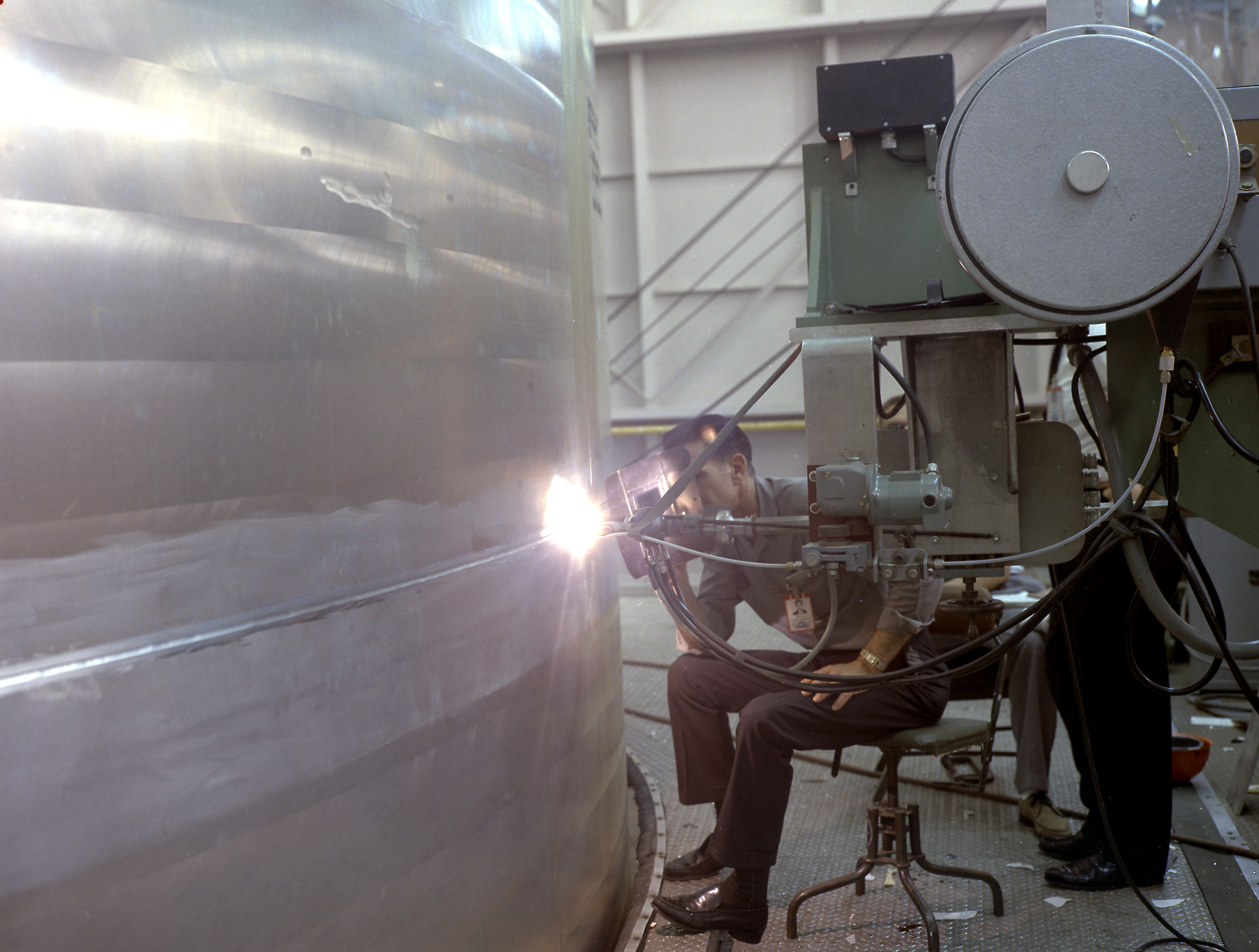
SA-501 was a complete Saturn V. The first stage, the S-IC, burned almost 2000 metric tons of propellant in under three minutes of powered flight and carried eight solid-propellant retrorockets to guarantee separation. The second stage, the S-II, built by North American Aviation, consumed about 425 metric tons in some six minutes through five Rocketdyne J-2 engines developing close to 4.5 million newtons; its aft interstage was jettisoned once the stages parted. The third stage, the S-IVB, from Douglas Aircraft, carried a single J-2 of 889,600 newtons that could be shut down in space and restarted, with two auxiliary propulsion modules for roll control, and burned roughly 105 metric tons across its two firings. Above it sat IBM's instrument unit, a ring 6.6 metres across and less than a metre tall, weighing about 10 metric tons, housing the avionics that flew the whole stack.
The payload was CSM-017, a Block I command and service module — the series meant for testing and for the early Earth-orbital flights, without the ability to dock with a lunar module — made up of command module CM-017 and service module SM-020. CM-017 was the second fully functional command module delivered to NASA; the first, CM-012, was the Apollo 1 spacecraft and was destroyed in the fire. SM-020 had originally been assigned to the second Saturn V test and took the place of SM-017, damaged in an explosion and scrapped. Because no Block II spacecraft would fly uncrewed, several Block II features were built into CSM-017 for certification: a heat shield to Block II standard, a Block II CM-to-SM umbilical connector, Block II VHF and S-band antennae, and changes to the hatch, whose seals were flight-qualified by replacing the window with a test panel. Special equipment let Mission Control operate the spacecraft's systems remotely, and an automatic camera was to photograph the Earth through one of the windows. With no crew aboard, the module had no couches, controls or displays. Inside the spacecraft-to-LM adapter, SLA-8, rode LTA-10R, a lunar module test article: a flight-type descent stage without landing gear, its tanks filled with a mixture of water, glycol and freon, topped by an aluminium ascent-stage mock-up carrying ballast and no flight systems. Adapter and test article were instrumented to measure the loads of the climb to orbit, and LTA-10R was destroyed when the S-IVB re-entered.
Nearly two years of delay
In January 1965 Major General Samuel C. Phillips, the Apollo Program Director, scheduled SA-501 for January 1967, with two further Saturn V launches to follow that year. Few in the programme believed the date. An explosion in a liquid oxygen line serving Complex 39 threatened weeks of slippage. North American Aviation, contractor for both the S-II second stage and the command and service module, was in trouble on schedule, cost and quality on both counts — severely enough that Phillips led a team to its California plant in late 1965 and reported his findings to Mueller. Cracks were found in the S-II, delaying its acceptance firings. Meanwhile the pieces reached the Cape: the S-IVB on August 14, 1966, aboard a Pregnant Guppy aircraft, the S-IC by barge on September 12, the CSM on December 24, and at last the S-II on January 21, 1967, with the aft interstage on the 31st. To keep the work moving, the vehicle was stacked in the Vehicle Assembly Building with a spool-shaped spacer standing in for the missing second stage.
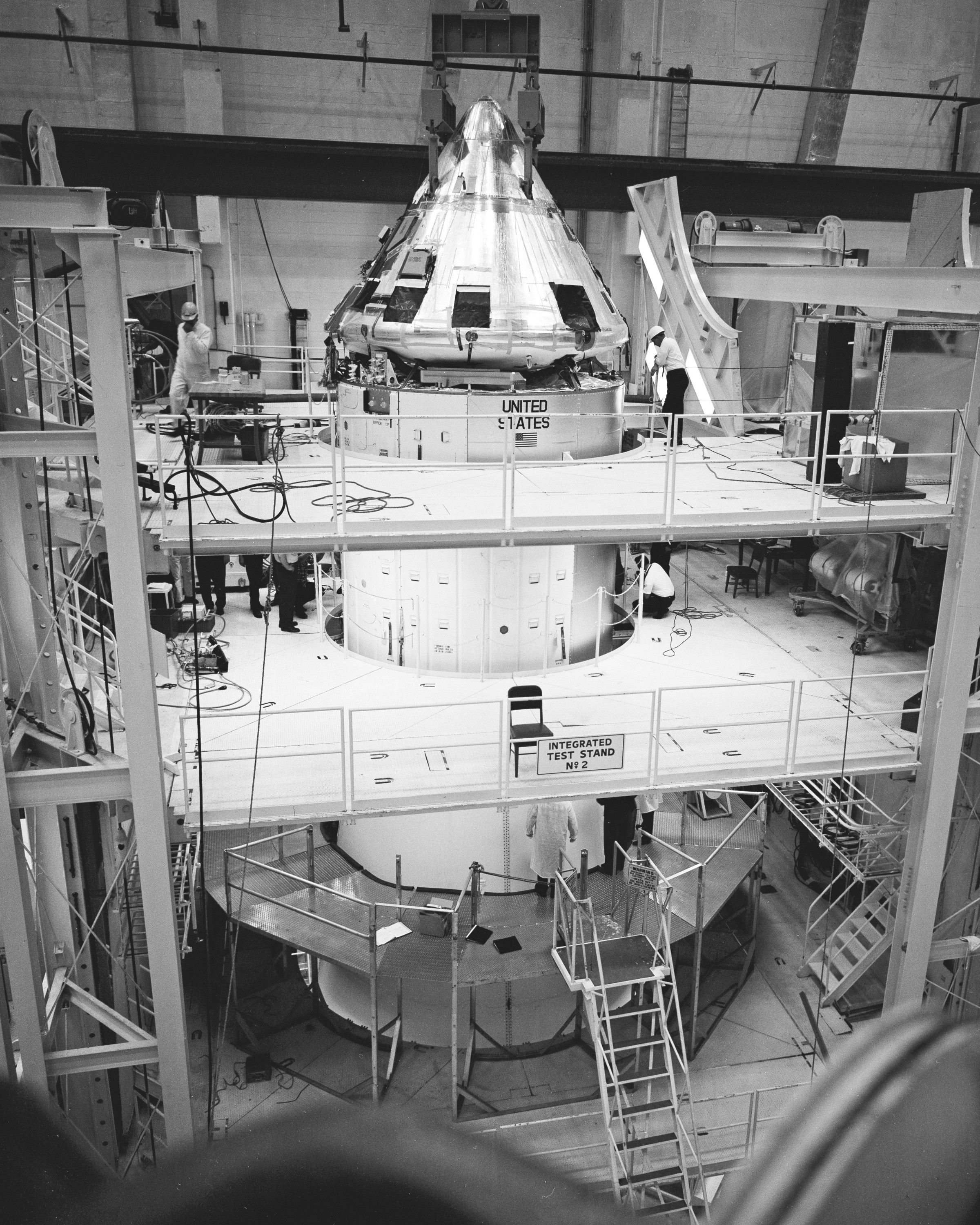
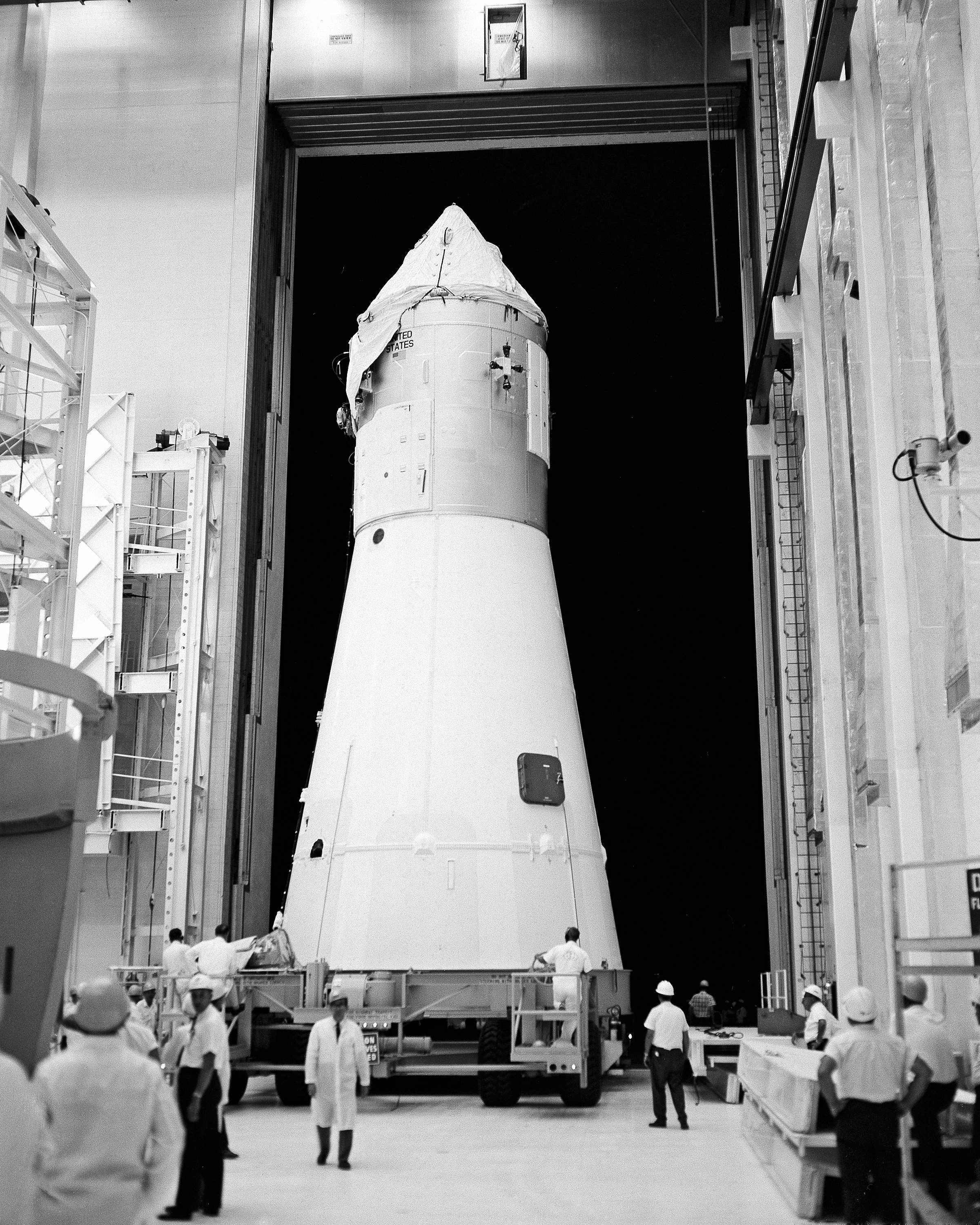
The Apollo 1 fire of January 27, 1967 threw the schedule into further doubt. SA-501 was uncrewed, but NASA wanted its spacecraft examined closely all the same: inspection turned up 1,407 defects, many of them haphazardly routed wires with damaged insulation, prime material for a short circuit. Other troubles surfaced, among them a surplus bolt lodged out of place in one of the J-2 engines — NASA was as concerned with how it got there as with recovering it. A March 1967 meeting listed twelve hundred outstanding Saturn V problems that the technicians proposed to clear at eighty a day. On May 24 it was announced that the S-II would be pulled for inspection after hairline cracks appeared in another example under construction; the work was finished by mid-June, after which the CSM returned to the stack and vehicle and spacecraft stood fully assembled for the first time. On August 26, 1967 the stack rolled out to Pad 39A aboard the crawler-transporter, joined two days later by the mobile service structure. It was the first time a NASA spacecraft had been assembled away from its launch site, sheltering hardware and people from Florida's heat and humidity.
The countdown demonstration test, set for September 20, did not begin until the evening of the 27th. By October 4 it had reached minus forty-five minutes when a computer failed; the count was reset to thirteen hours before launch and resumed on October 9, with further computer and equipment failures until an exhausted launch team was given a two-day break. The test finished on October 13, having taken three weeks instead of a little over one. With the world watching, NASA public affairs chief Julian Scheer carried the press's scepticism about whether Apollo 4 would ever fly to Administrator James E. Webb, in a heated meeting that Webb ended by saying he would announce the launch date when he chose to. A flight readiness review on October 19 cleared the mission conditionally, and on November 2 Phillips moved the launch from the 7th to the 9th, worried about leaks in the Teflon seal rings and drain valves of the liquid oxygen tanks after so long standing in the Florida sun.
Launch
The count began on November 6, 1967 at 10:30 pm EST with propellant loading: 89 trailer-truck loads of liquid oxygen, 28 of liquid hydrogen and 27 rail cars of RP-1, the rocket's refined kerosene. It ran about 56 and a half hours, and this time the problems were few and minor, absorbed by the built-in holds.
Apollo 4 lifted off on November 9 at 7:00 am EST, 12:00:01 UTC. The five F-1 engines ignited eight seconds before release and sent a roar across the Kennedy Space Center far beyond what had been expected: although the Complex 39 pads stood more than five kilometres from the Vehicle Assembly Building, the sound pressure buffeted the building, the Launch Control Center and the press facilities, shaking dust from the control centre ceiling onto the controllers' consoles. William Donn of Columbia University called the blast one of the loudest noises, natural or artificial, in human history, nuclear explosions excepted. In the CBS trailer the commentator Walter Cronkite and producer Jeff Gralnick held their hands against the observation window to keep it from shattering as ceiling tiles came down; Cronkite would remember Apollo 4 as the most frightening space mission he ever covered.
The flight
The launch placed the S-IVB and the CSM in a near-circular parking orbit of about 190 kilometres, the same one the lunar missions would use. After two revolutions the S-IVB was restarted in space for the first time, simulating the translunar injection burn, and threw the stack into a highly elliptical orbit with an apogee of 17,218 kilometres and a perigee deliberately set 84.6 kilometres below the Earth's surface, which guaranteed both a high-speed re-entry for the command module and the destruction of the spent stage. Shortly afterwards the CSM separated and fired its service module engine to raise the apogee to 18,092 kilometres. Past apogee the same engine burned again for 281 seconds to raise the re-entry speed to 11,168 metres per second (36,639 ft/s) at an altitude of 120 kilometres and a flight path angle of −6.93 degrees, reproducing the conditions of a return from the Moon: the heat shield was the real object of the exercise.
The command module splashed down in the North Pacific northwest of Midway Island, about 8.6 nautical miles (16 kilometres) from the target point, eight hours, thirty-six minutes and fifty-nine seconds after lift-off. Its descent was watched from the deck of the aircraft carrier USS Bennington, the prime recovery ship, which within two hours had picked up the capsule and one of its parachutes — the first time an Apollo parachute was recovered for inspection. The spacecraft went to Hawaii for deactivation and then to North American's plant at Downey, California, for post-flight analysis.
Cameras and the pictures of the Earth
Two motion-picture cameras rode on the Saturn V to film the separation of the first stage and the interstage. Their work done, they were ejected and parachuted into the Atlantic in pods fitted with radio beacons, recovered about 870 kilometres downrange of the Kennedy Space Center. Inside the command module an automatic 70 mm camera photographed almost the whole disc of the Earth: over two hours and thirteen minutes, as the craft approached and passed apogee, it took 755 colour images through the left-hand forward window at altitudes between 13,510 and 18,092 kilometres. They were the highest-altitude colour photographs taken to that date; the resolution was too coarse for detailed scientific data, but the images interested Earth scientists all the same.
Assessment and aftermath
Every launch vehicle and spacecraft system performed satisfactorily. All three Saturn V stages burned slightly longer than predicted, leaving the vehicle in an orbit about a kilometre higher than planned and well within tolerance; a burn eleven seconds longer than scheduled brought the command module into the atmosphere a little faster and at a slightly shallower angle than intended, again within tolerance, and not through any fault of the guidance system — whose performance was exemplary — but because the burn was commanded from the ground. The environmental control system held the cabin within acceptable pressures and temperatures throughout, rising by only 5.6 °C during atmospheric entry.
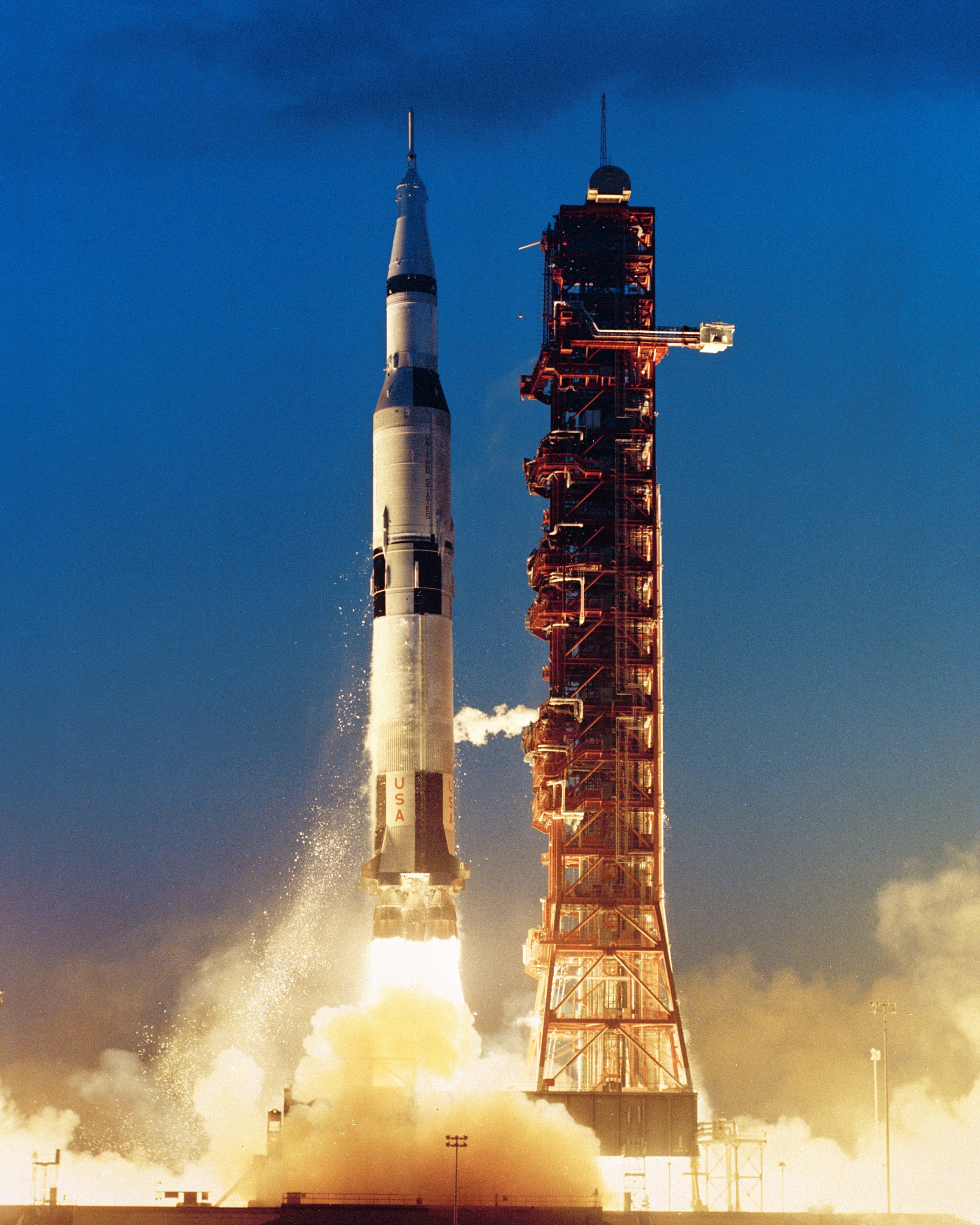
President Lyndon Johnson said the whole world had seen the awesome sight of the first launch of the largest rocket ever flown, a symbol of the power the nation was harnessing for the peaceful exploration of space. Von Braun called it an expert launching all the way through, from lift-off exactly on time to the performance of every single stage. In his history of the Saturn V, Roger E. Bilstein wrote that the flawless mission elated the entire NASA organisation. Mueller said the flight had dramatically increased confidence and showed that astronauts could land on the Moon by mid-1969.
Apollo 4 was also the first mission flown under the official numbering scheme Mueller approved on April 24, 1967: the crewed flight that never left the pad was retroactively named Apollo 1 at the request of the crew's widows, and the sequence resumed at four, with no Apollo 2 or Apollo 3. The second Saturn V, Apollo 6, flew on April 4, 1968 and gave more trouble — pogo oscillation in the first stage and an early second-stage engine shutdown — but a third uncrewed test was judged unnecessary: the Saturn V first flew with a crew on Apollo 8 and, except on Apollo 9, carried astronauts towards the Moon on every mission that followed.
CM-017 itself passed to the Smithsonian Institution in January 1969 and was displayed there for a year; in January 1974 it travelled by road from Andrews Air Force Base in Maryland to the North Carolina Museum of Life and Science. It was later shown at NASA's Stennis Space Center, where it stayed until 2017, and it is now on public display at the centre's visitor facility, the Infinity Science Center in Pearlington, Mississippi.
Images
Elsewhere
- Smithsonian National Air and Space MuseumCommand Module, Apollo 4 ↗
- Smithsonian National Air and Space MuseumApollo 4 — mission story ↗
- WikipediaApollo 4 ↗
- Space.comSpace History Photo: Apollo 4 Launch ↗
- Space.comAmazing Apollo 4: NASA's 1st Saturn V Moon Rocket Test Flight in Photos ↗
- NASAApollo 4 Liftoff ↗
- NASA55 Years Ago: Apollo 4, the First Flight of the Saturn V ↗
- The Planetary SocietyApollo 4 Launch ↗
- National ArchivesApollo 4 — National Archives catalog record ↗
- NSSDCA (NASA Goddard)Apollo 4 — spacecraft details ↗
- Cradle of Aviation MuseumThe Saturn V Rocket ↗
- Drew Ex MachinaApollo 4: The First Flight of the Saturn V ↗