Did you know…
Why apollo 11 name?
Short answer
After the Greek god Apollo and the mission's place in a renumbered sequence. Abe Silverstein, a NASA official, named the Mercury and Apollo programs. Eleven is just the ordinal of the Apollo flights: because of the 1967 fire, there was never an Apollo 2 or an Apollo 3.

A god for a program
The name didn't come from a contest. Abe Silverstein, the NASA official responsible for spaceflight development, named both Mercury and Apollo, and with Mercury the precedent had already been set of giving crewed projects the names of gods and heroes from mythology. Apollo was the Greek god of archery, prophecy, poetry and music and, above all, of the sun, which he drove across the sky each day in his golden chariot: an image that gave the program the scale it was looking for. NASA publicly announced "Project Apollo" at the conference held on 28 and 29 July 1960.
A numbering with a gap
The number is more mundane: it marks the flight's position in the list of Apollo missions, a list that was reordered after the 1967 tragedy. Mission AS-204, whose crew died in a cabin fire during a pad test, was redesignated Apollo 1 in honour of the astronauts. The first Saturn V launch, planned for November 1967, was then called Apollo 4, and no mission was ever designated Apollo 2 or Apollo 3. That is why the count jumps ahead, and why the eleventh name arrived sooner than the number of flights actually made would suggest.
What the number doesn't say
It's worth not reading the eleven as a count of Moon-landing attempts: the eleven names don't correspond to eleven trips to the Moon, and the first of them never even flew. Within each mission, moreover, the crew gave its own call signs to the spacecraft: in July 1969 the command module was named Columbia and the lunar module Eagle, and it was those names, not the program's number, that were heard in the descent communications.
More questions
Moon and Mars
How does neil armstrong look like?
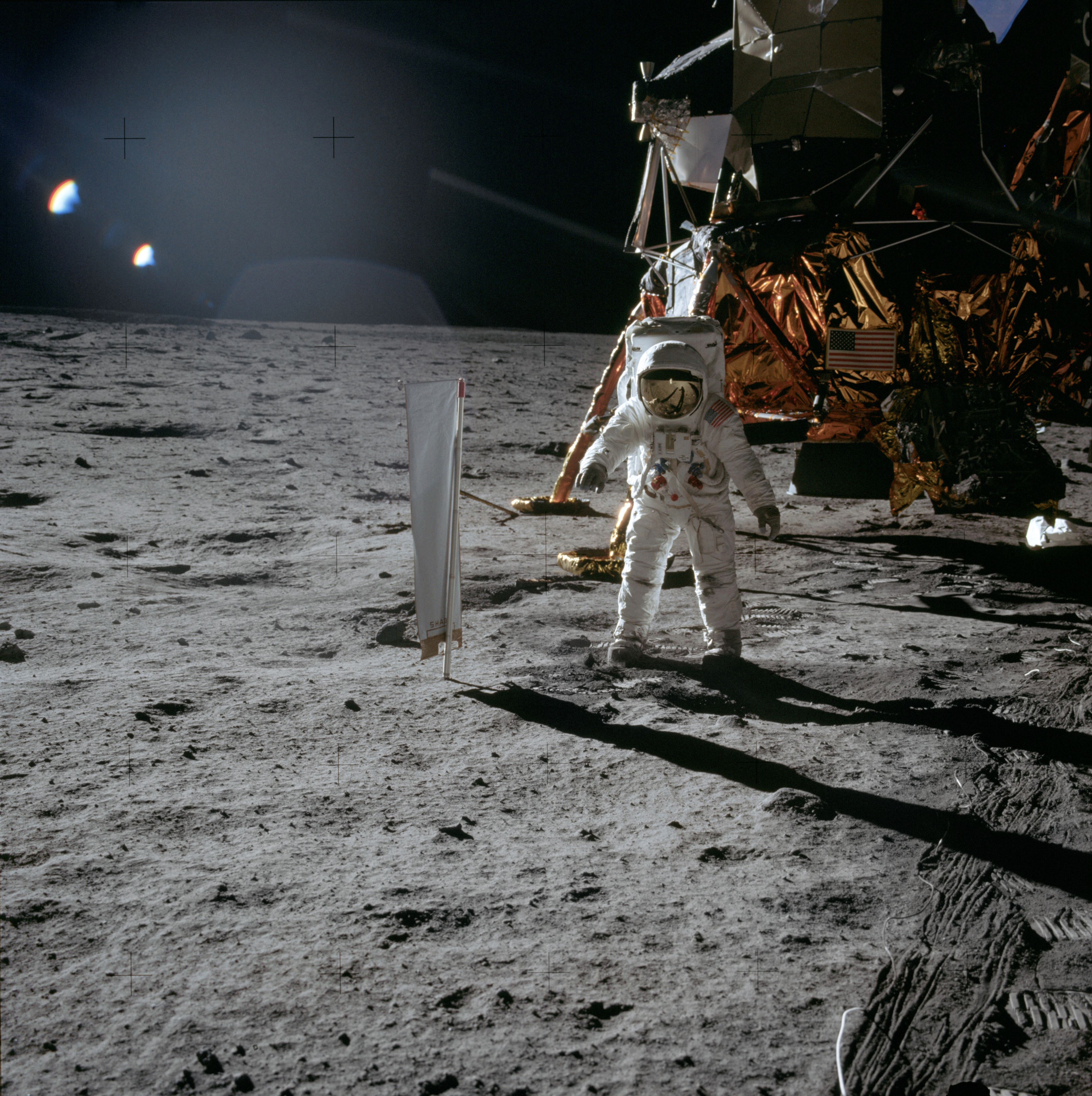
The face most people picture is not his: the gold-visored astronaut in the famous Apollo 11 photograph is Buzz Aldrin, shot by Armstrong. Armstrong himself is… more…

Richard Dorrell (CC BY SA), vía commons Moon and Mars
How does the moon affect the tides?
By pulling unevenly on it. Tidal forces vary inversely as the cube of the distance, so the near side of the Earth is tugged harder than the far side: one… more…
Moon and Mars
Why does neil armstrong have a hollywood star?
Strictly he does not have a star. Armstrong, Aldrin and Collins share four circular monuments resembling the Moon, one at each corner of Hollywood and Vine… more…

Foto: SpaceX (CC0) Moon and Mars
Why did falcon 9 hit the moon?
Because a spent upper stage on a lunar trajectory has no mission and no way to steer. A Falcon 9 upper stage from the January 2025 Firefly Blue Ghost 1 launch… more…
Moon and Mars
How much apollo 11 cost?
NASA never published a price for Apollo 11 on its own; what is documented is the program. The United States spent $25.8 billion on Project Apollo between 1960… more…
Moon and Mars
How much time neil armstrong spent on moon?
Armstrong and Aldrin spent 21 hours, 36 minutes on the Moon's surface, almost all of it inside the lunar module Eagle. Armstrong stepped onto the surface… more…
