Apollo program · NASA · Uncrewed
AS-203
- Jul 5, 1966, 2:53 PM
- Launch date
- Success
- Outcome

-1600.webp)

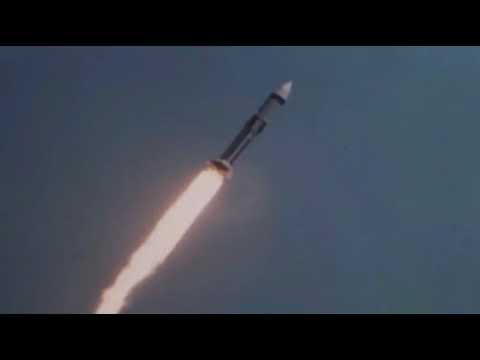
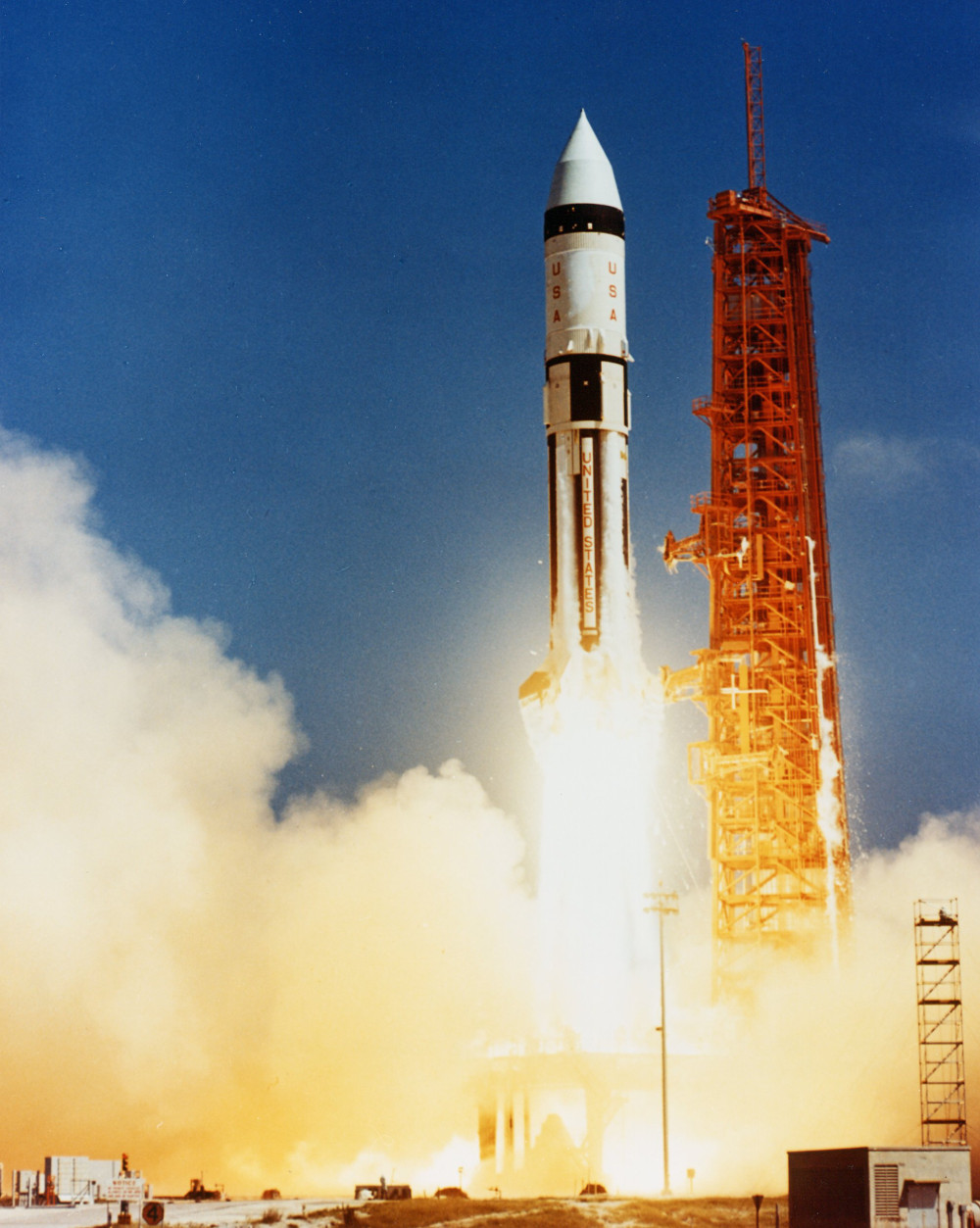
AS-203 was the second flight of the Saturn IB series and the only Apollo mission to lift off with no spacecraft aboard. Launched from Complex 37B at Cape Kennedy on 5 July 1966, it replaced the command and service module with an aerodynamic nose cone for one narrow purpose: to leave an S-IVB stage in orbit with a large residual of liquid hydrogen in its tank and watch how that propellant behaves in weightlessness. Behind so narrow an objective lay the technical knot of the lunar plan. The Saturn V had to shut down its third stage in a parking orbit, coast in free fall and relight the J-2 engine for translunar injection. That required certainty that the hydrogen would stay settled over the tank outlet and that the lines and turbopump would be cold enough for a restart. AS-203 flew an S-IVB already built to the Saturn V S-IVB/V configuration, with continuous propulsive venting, LOX ullage thrusting, anti-vortex screens, special baffles, internal instrumentation and two television cameras looking into the hydrogen tank. In its essentials the flight was flawless. After holds totalling one hour, 53 minutes and 17 seconds caused by the failure of one of the two cameras, the vehicle lifted off on the first attempt and placed its payload in an orbit of 185.2 by 187.3 km with a period of 88.21 minutes. Propellant control and the restart systems performed within tolerances over the first two orbits, and the Marshall Space Flight Center report concludes that all flight objectives were successfully accomplished. The two remaining orbits were spent pushing the vehicle with tests beyond the Saturn V profile, the last of them a pressure rise test with the hydrogen tank closed and the oxygen tank venting down. The common bulkhead burst during a two-minute gap in coverage, and the Trinidad radar saw only pieces. The mission was still classified as a success: the destruction came after every primary objective had been met, and during a test intended precisely to locate the structural limit. In September the Douglas Aircraft Company declared the S-IVB design ready for the Saturn V.
Payload
AS-203 carried no Apollo spacecraft. An aerodynamic nose cone took the place of the command and service module, and the real payload that reached orbit was the S-IVB-203 stage itself together with its Instrument Unit. The object of the experiment was the propellant left inside: the tanks were deliberately loaded out of balance — the oxygen tank short, at roughly 60 per cent, and the hydrogen tank to its maximum — so that engine cutoff would leave about 8,850 kg (19,500 lbm) of liquid hydrogen in orbit, the residual a Saturn V S-IVB would hold in its parking orbit. The experimental equipment was mounted on the stage: two television cameras with their lights on the forward dome of the hydrogen tank — one failed before launch and the flight was made with the other alone — an internal instrumentation array with painted markings and an additional level probe, and the systems specific to the test (continuous propulsive venting, LOX ullage thrusting, S-IVB/V anti-vortex screens, aluminized mylar insulation and an ambient helium sphere for repressurization). The vehicle also carried, on behalf of the Manned Spacecraft Center, a subcritical cryogenic nitrogen storage experiment intended to demonstrate the feasibility of such systems in low gravity.
History
A rocket that flew without a spacecraft
AS-203 was the second flight of the Saturn IB series and the odd one out among the three uncrewed rehearsals that preceded crewed Apollo operations: it carried no spacecraft at all. Where AS-201 and AS-202 flew a real command and service module to exercise the heat shield on re-entry, AS-203 replaced the payload with a plain aerodynamic nose cone. The reason was not economy but physics: without the mass of a spacecraft, the upper stage could reach orbit with a large reserve of liquid hydrogen still in its tank, and that hydrogen was, in effect, the mission's payload.
The primary objective, stated without ambiguity in the Marshall Space Flight Center flight evaluation report (MPR-SAT-FE-66-12), was to conduct the S-IVB liquid hydrogen experiment using a stage already built to the S-IVB/V design that would fly as the third stage of the Saturn V. Three further objectives were attached to it: to demonstrate launch vehicle guidance operation, to establish the launch vehicle environment, and to carry a subcritical cryogenic storage experiment on behalf of the Manned Spacecraft Center. The report records that all flight objectives were successfully accomplished.
Hydrogen that will not sit still
The problem AS-203 was built to settle was the technical knot at the centre of the lunar plan. The Saturn V flight profile required the third stage to shut down after inserting the spacecraft into an Earth parking orbit, coast there in free fall, and then restart its J-2 engine to throw the stack towards the Moon. Nobody had ever done that with liquid hydrogen.
.jpg)
In weightlessness a propellant stops behaving like a liquid with a flat surface at the bottom of its tank: it floats, disperses, clings to the walls and can leave the feed line drawing gas. Restarting the J-2 demanded two things at once — that the hydrogen be settled over the tank outlet at the moment of ignition, and that the lines and turbopump be cold enough to accept it without cavitating. The intended answer was a continuous propulsive vent that turns boil-off hydrogen into a minimal residual acceleration, of the order of 2 x 10⁻⁵ g, enough to hold the liquid against the aft end through the orbital coast, backed by baffles and deflectors inside the tank. All of it had been computed and tested on the ground; no ground test could reproduce hours of real weightlessness.
An S-IVB turned into a laboratory
The stage that flew on AS-203 was an S-IVB of nominally 17.98 m in length and 6.60 m in diameter, powered by a single gimbal-mounted J-2 engine delivering 877,000 N (200,000 lbf) of thrust in vacuum, with a nominal propellant capacity of 103,510 kg (228,500 lbm). Its two tanks — hydrogen forward, oxygen aft — shared a common bulkhead, a detail that would prove decisive.
On that base a singular vehicle was assembled. The Marshall report lists the differences from the S-IVB-201 flown the previous February: a continuous propulsive venting system on the hydrogen tank; a LOX ullage thrusting system providing 124.6 N (28 lbf), the thrust-to-weight equivalent of the 311.4 N (70 lbf) auxiliary propulsion engines of the Saturn V stage; S-IVB/V anti-vortex screens in both tanks; aluminized mylar insulation on the hydrogen dome; an ambient helium sphere for repressurization; and special baffles and liquid deflectors, needed because the propellant loads were deliberately abnormal.
That is the heart of the experiment: the oxygen tank was short-loaded to roughly 60 per cent and the hydrogen tank filled to its maximum, so that engine cutoff would leave a residual of about 8,850 kg (19,500 lbm) of liquid hydrogen in orbit — the quantity a Saturn V S-IVB would hold in its parking orbit. The propellant utilization system was flown open loop, its valve in the null position, so that it would not try to correct the apparent imbalance between oxidizer and fuel.
To watch what happened inside, two television cameras and their lights were installed on the forward dome of the hydrogen tank, together with an internal instrumentation array, painted markings on the walls and an additional level probe. AS-203 was, quite literally, a flight flown to look inside a tank.
Cape Kennedy, spring 1966
In the spring of 1966 the decision was taken to fly AS-203 ahead of AS-202, because the command and service module intended for the latter had slipped; that is why the third vehicle of the series flew second. The S-IVB stage reached Cape Kennedy on 6 April 1966, the S-IB first stage six days later and the Instrument Unit two days after that. Erection began at Pad 37B on 19 April, the first Saturn IB launch from that complex.
The test campaign repeated the troubles that had dogged AS-201, including cracked solder joints in the printed-circuit boards, of which more than 8,000 had to be replaced. It was an uncomfortable reminder that in 1966 the Saturn IB was still a young vehicle.
Countdown and ascent
The terminal countdown proceeded without major problems until T-15 minutes, when loss of signal was indicated from television camera 2 — one of the central instruments of the experiment. Efforts to recover it accumulated holds totalling one hour, 53 minutes and 17 seconds, to which a two-minute hold to verify the Bermuda radar was added. In the end the decision was made to fly with television system 1 alone, and the vehicle lifted off from Launch Complex 37B at 9:53:17 in the morning, Eastern time, on 5 July 1966, on the first attempt.
AS-203 was launched on an azimuth of 90 degrees east of north and rolled into its proper flight azimuth of 72 degrees east of north. Its liftoff weight was 538,247 kg. The actual trajectory ran somewhat high: at S-IVB cutoff the altitude was 0.12 km greater and the range 6.93 km shorter than nominal, with space-fixed velocity 0.6 m/s below nominal. J-2 cutoff came at 433.35 seconds, 2.90 seconds earlier than predicted. Ten seconds later, at orbital insertion, velocity was 0.8 m/s above nominal, which produced an orbit with a perigee of 185.2 km and an apogee of 187.3 km and a period of 88.21 minutes — a near-circular orbit of about 190 km.
Everything else worked. First-stage thrust ran 1.55 per cent above prediction; guidance and control behaved as expected, with no excessive body rates and no instabilities detected; staging was clean; the emergency detection system, again flown open loop, generated no false abort signals; and structural analysis found no indication that pogo had occurred. The instrumentation held up as well: of the 1434 measurements active at liftoff, 98.8 per cent performed satisfactorily. The one notable mechanical anomaly was an S-IVB fuel recirculation chilldown shutoff valve that failed to close after engine start command.
The first two orbits: the planned experiment
The orbital plan reproduced, as closely as the Saturn IB's payload capability allowed, the sequence the Saturn V would execute from J-2 cutoff through restart. The difference was the clock: what could occupy up to three orbits on a Saturn V was compressed into a single orbit on S-IVB-203, leaving the rest of the flight free for other tests.
The results were what NASA needed to hear. Propellant control functioned within tolerances: during orbital insertion the hydrogen was successfully held in place by the LOX ullage thrusting system and by the tank baffles and deflectors, and once in orbit the continuous vent system was enough to keep it positioned throughout the coast. The restart systems — fuel repressurization, recirculation chilldown, fuel lead during simulated restart, the anti-vortex screen, LOX recirculation chilldown and the storage bottles — functioned satisfactorily in general and, in the words of the report, gave confidence that a J-2 restart under Saturn V conditions could be accomplished. The pictures from the surviving camera proved better than expected in quality and duration, apart from losses attributable to ground station problems.
Orbits three and four: testing to destruction
With the essential work done, the two remaining orbits were given over to experiments that went beyond the Saturn V profile and aimed at understanding liquid hydrogen in low gravity for future cryogenic stage designs: a free-coast experiment to observe and counter the negative acceleration imparted to the propellant by residual aerodynamic drag; rapid tank depressurizations through the non-propulsive vents; and finally a closed-tank pressure rise test.
That last test consisted of closing the continuous and non-propulsive vents of the hydrogen tank and letting the pressure climb through self-pressurization driven only by external heating, while the oxygen tank was depressurized through the ullage thrusting system. It was, deliberately, a probe of the structural limits of the common bulkhead under a reversed pressure differential.
The numbers were eloquent. The hydrogen ullage pressure was 8.51 N/cm2 (12.35 psi) when the tank was closed and 25.97 N/cm2 (37.7 psi) some 5360 seconds later, roughly one orbit on: a rise rate of 11.71 N/cm2 per hour (17.0 psi/hr) against the 2.20 N/cm2 per hour (3.2 psi/hr) computed on the assumption of homogeneous liquid heating alone. The difference was attributed to heating of the ullage gases, which developed a pronounced thermal stratification: the gradient between the liquid surface and the forward dome went from roughly 5.55 K at the start to about 107.7 K at the end. Over that same ninety-minute period the oxygen tank ullage pressure fell from 16.2 to 3.4 N/cm2 (23.5 to 5 psi).
The common bulkhead lets go
The end came unobserved. Bursting of the common bulkhead must have occurred within the two-minute interval between loss of telemetry at Cape Kennedy and the Trinidad radar detection, which no longer showed a vehicle but several pieces. Telemetry was never re-acquired. Extrapolating the pressure histories of both tanks confined the bulkhead burst pressure differential to 23.4 plus or minus 0.3 N/cm2 (34 plus or minus 0.5 psi), consistent with an earlier failure recorded during a full-scale structural test programme at facilities in Sacramento, California, where the bulkhead had given way at a reverse differential pressure of 23.9 N/cm2 (34.7 psi). NASA concluded that a spark or an impact must have ignited the propellants, causing an explosion.
A success with the vehicle destroyed
That the stage was destroyed did not make the mission a failure, and not out of leniency: the destruction came after every primary objective had been met, and it came during a test whose declared purpose was precisely to explore how much the bulkhead would take. AS-203 was classified as a success. The subcritical cryogenic nitrogen storage experiment, flown for the Manned Spacecraft Center to demonstrate the feasibility of subcritical cryogenic storage and delivery systems in a low-gravity environment, was conducted satisfactorily and met all of its objectives.
In September the Douglas Aircraft Company, builder of the S-IVB, declared the design ready for use on the Saturn V. The restartable stage concept, the largest unknown standing between Earth orbit and the Moon, had been validated in flight.
The legacy of S-IVB-203
AS-203 left no spectacular photographs and no crew to tell the story, and its unofficial name — Apollo 3, from the order in which it flew — never quite stuck. Its importance is measured on another scale: without the certainty that liquid hydrogen could be controlled for hours in orbit and that the J-2 could be lit again afterwards, translunar injection would have been a gamble. Two and a half years later the S-IVB of Apollo 8 performed exactly that manoeuvre over the Pacific and sent three men to the Moon. The television camera that in July 1966 stared into a hydrogen tank aboard a rocket with no spacecraft was, in that light, one of the most profitable instruments of the programme.
Images
Elsewhere
- NASAThis Week in NASA History: Apollo AS-203 Launches ↗
- NASA55 Years Ago: Apollo AS-203 Mission Tests Liquid Hydrogen Behavior ↗
- NASAThis Week in NASA History: Apollo AS-203 Launches — July 5, 1966 ↗
- FlickrAS-203 Launch ↗
- FlickrAS-203 — edited NASA image of the Saturn IB for a test flight ↗
- DVIDSSaturn I AS-203 Launch ↗
- Drew Ex MachinaAS-203: NASA's Odd Apollo Mission ↗
- Next SpaceflightAS-203 | Saturn IB ↗
- Space Launch NowSaturn IB | Apollo AS-203 ↗
- Internet ArchiveSaturn I AS-203 Launch (NASA/Marshall Space Flight Center) ↗
- Space Coast DailyThis Day in History: Apollo AS-203 Launches From Kennedy Space Center ↗