Apollo program · NASA · Uncrewed
AS-201
- Feb 26, 1966, 4:12 PM
- Launch date
- 37 min
- Duration
- Success
- Outcome


_en_el_instante_del_despegue-1600.webp)

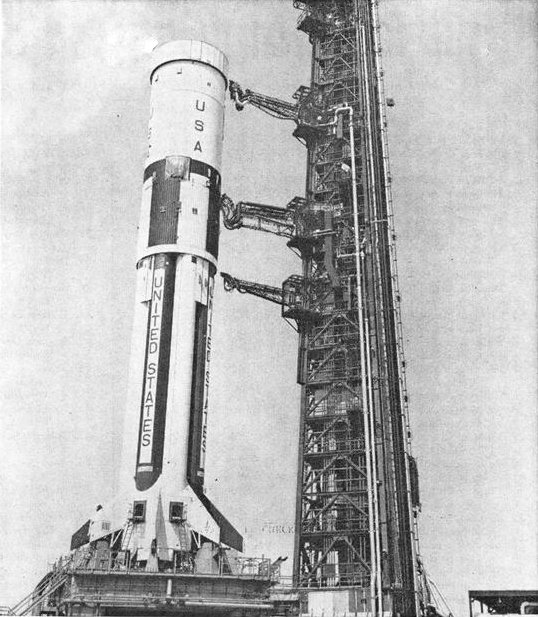

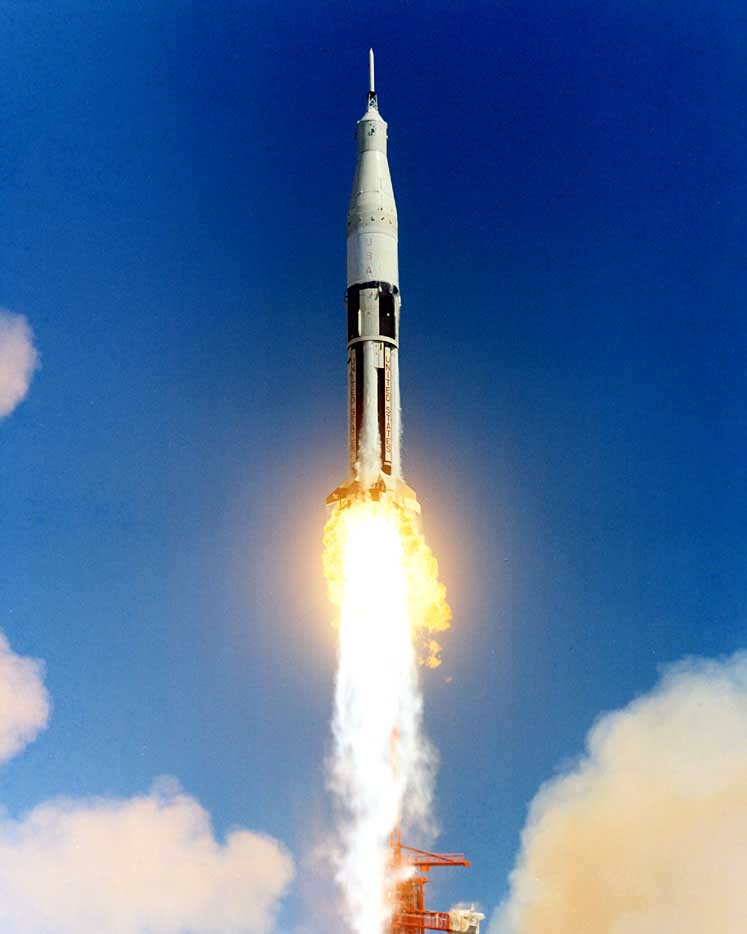

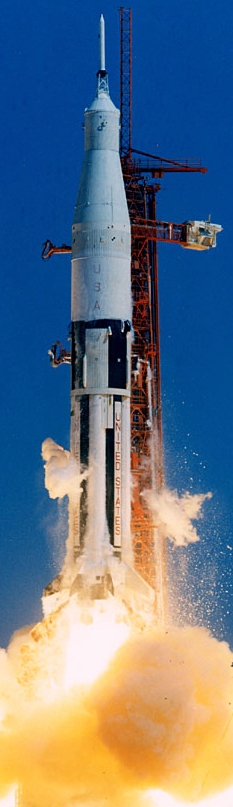

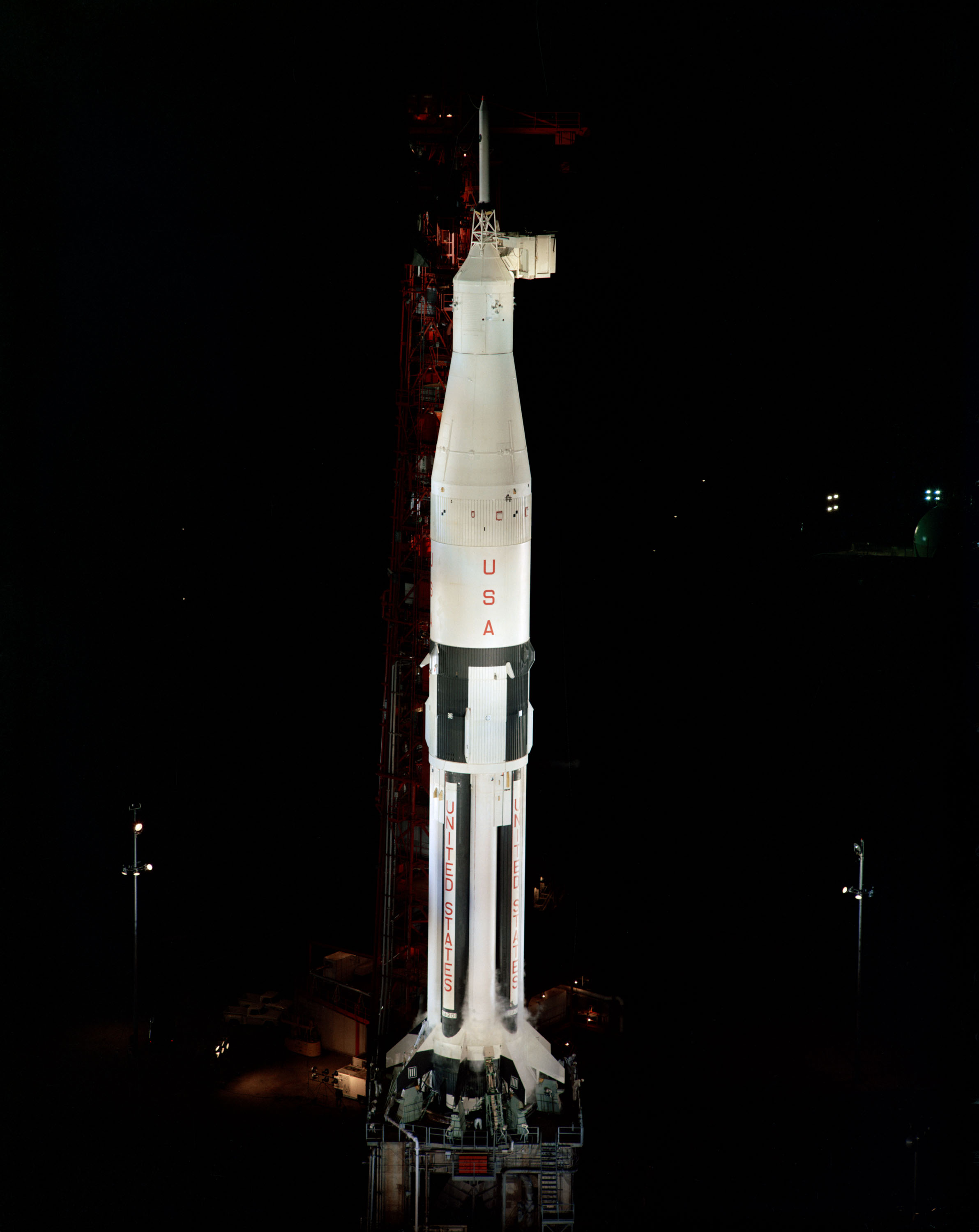
AS-201 —also designated SA-201, and known as Apollo 1-A or simply Apollo 1 until the 1967 pad fire reserved that name for the crew of Grissom, White and Chaffee— was the first uncrewed test flight of a complete production Block I Apollo command and service module and, at the same time, the maiden flight of the Saturn IB launch vehicle. It flew on 26 February 1966 from Launch Complex 34 at Cape Kennedy on a suborbital trajectory lasting a little over half an hour: orbit was never the aim. The point was to expose the spacecraft to the conditions of a re-entry from low Earth orbit and to prove that rocket and spacecraft worked together in real flight. The vehicle brought together hardware that had never flown as a set. The Saturn IB paired an S-IB first stage derived from the Saturn I, with eight H-1 engines and thrust raised to 1.6 million pounds, with an entirely new S-IVB second stage powered by a liquid-hydrogen J-2 engine —the same engine that would later drive the upper stages of the Saturn V— and with an Instrument Unit that the lunar rocket would inherit as well. On top rode command module CM-009, service module SM-009, a Block I launch escape system and the first spacecraft–LM adapter (SLA) ever flown. The profile called for an east-by-southeast launch into a high ballistic trajectory, separation of the spacecraft from the upper stage, two firings of the service propulsion system engine, and re-entry of the command module for a splashdown in the South Atlantic. All of it happened: the command module came down about 72 kilometres from the planned point some thirty-seven minutes after lift-off and was aboard the aircraft carrier USS Boxer two hours later. The official programme report lists every primary and detailed test objective as accomplished. The flight was not flawless. The service propulsion engine ran properly for only about eighty seconds before helium pressurant reached the combustion chamber through a ruptured oxidiser line; an electrical failure left the command module without steering control during re-entry, and a short circuit spoiled part of the measurements planned for that phase. None of it undermined the central result: the heat shield held, and the Saturn IB–Apollo combination was cleared to continue, first with AS-203 and AS-202 and later with the crewed flights of the programme.
Payload
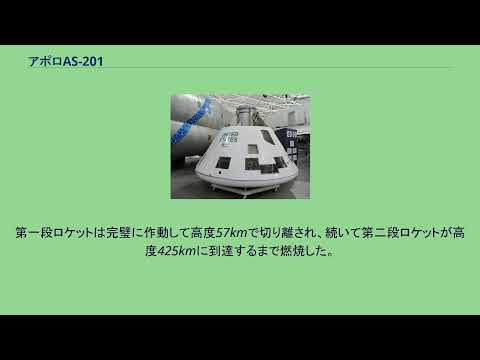
AS-201 carried no payload in the usual sense: the payload was Apollo test hardware itself. Above the S-IVB second stage rode a complete Block I command and service module —command module CM-009, the second production Block I command module to fly, and service module SM-009, the first production article of its kind— joined to the launch vehicle by the first spacecraft–LM adapter (SLA) ever flown and topped by a Block I launch escape system with its boost protective cover. None of those items flew in full production configuration. CM-009 had no guidance and navigation system, no crew couches, displays or associated equipment, carrying instead a control programmer that ran the mission sequence and an emergency detection system wired in open loop. SM-009 swapped its fuel cells for batteries and omitted the S-band communications equipment. Flight instrumentation —heat shield pressure measurements, service propulsion engine behaviour, data from the reaction control and environmental control systems— was, together with the structure itself, the reason for the flight: the mission flew no external experiments and no satellites, only the hardware that had to be qualified before a crew could be put aboard.
History
Why the flight was needed
By early 1966 the Apollo programme had settled its lunar architecture, yet nothing resembling the real spacecraft had flown. With a single exception, every command and service module launched until then had been a boilerplate article without working systems. AS-201 ended that run: it carried the second production Block I command module and the first production Block I service module, stacked on the first Saturn IB. In practice it was the entrance exam that Apollo hardware had to pass before real missions.
Block I predated the choice of lunar orbit rendezvous, so the spacecraft had no way of docking with a lunar module and carried preliminary designs of several subsystems; it was also heavier than the Block II that would eventually fly crews to the Moon. CM-009 further departed from the production configuration by omission: it had no guidance and navigation system, no crew couches, no displays and none of the associated equipment, and it added a control programmer and an emergency detection system wired in open loop. SM-009 replaced the electricity-generating fuel cells with batteries and left out the S-band communications equipment. Riding with the spacecraft were a Block I launch escape system with its boost protective cover and the first spacecraft–LM adapter ever flown, the truncated cone joining spacecraft to launch vehicle.
The rocket making its debut underneath
The Saturn IB was the uprated Saturn I, a vehicle that had already flown ten times in the programme. The S-IB first stage, built by Chrysler around eight Rocketdyne H-1 engines, raised total thrust from 1.5 million pounds to 1.6 million. The deeper change sat above it: the old second stage gave way to the S-IVB, driven by a single liquid-hydrogen J-2 engine. That same engine would power the S-II second stage of the Saturn V, and a version of the S-IVB with a J-2 restartable in space would serve as the Moon rocket's third stage. The vehicle also introduced a new guidance and control package, the Instrument Unit, likewise destined for the Saturn V. Testing the Saturn IB therefore meant testing half the lunar rocket's architecture in advance.
Assembly and testing at Cape Kennedy
The pieces reached the Cape through the autumn of 1965. The S-IB stage came first, on 14 August 1965, carried by the barge Promise; the S-IVB arrived on 18 September, the Instrument Unit on 22 October, the command module three days later and the service module on 27 October. The first stage was erected at the pad soon after arriving, and the second joined it on 1 October. Once some problems were cleared, the Instrument Unit was mated to the S-IVB on 25 October, and the command and service module was mated to the stack on 26 December.
The schedule suffered from an unexpected direction. The RCA 110A computer meant to automate testing of the rocket was ten days behind and would not reach the Cape before 1 November, which left little to do at the pad through mid-October. Once it arrived it kept causing trouble with punch cards and with capacitors that behaved poorly under a protective coating. Even so, launch vehicle testing stayed on schedule. December ran around the clock: the spacecraft's fuel systems were checked by day and the rocket was tested by night. Those weeks left an early computing anecdote behind — according to Frank Bryan, a launch vehicle operations engineering staff member at Kennedy Space Center, the computer could not cope with the roll from 2400 to 0001 at midnight and "turned into a pumpkin". In the end the plugs-out tests showed that the rocket could run on its own.
The countdown
The launch had already been postponed three times, by weather and by a sub-cable failure. The terminal countdown of 26 February 1966 went satisfactorily, though several holds added up to three hours and twenty-seven minutes of lost time. The largest was a replenishing problem in the S-IB gaseous nitrogen control pressure system, caused by insufficient flow from the ground supply through a 0.160 cm orifice once vehicle purges began at T-35 seconds; a bypass was planned for later flights.
There was also a very late abort. When pressure in one of the S-IVB fuel tanks dropped below the allowed limit, the onboard computer stopped the launch four seconds before lift-off. The fault was easy to fix, but it was doubted that it could be done inside the window; after a simulated launch and one hundred and fifty seconds of simulated flight had shown that the rocket could operate at the lower tank pressure, the attempt was reinstated.
The flight
AS-201 lifted off at 16:12:01 UT on 26 February 1966 from Launch Complex 34. It left on an azimuth of 100 degrees east of north and rolled onto the proper flight azimuth of 105 degrees. The actual trajectory came very close to nominal: at S-IVB cutoff the altitude was 0.73 kilometres higher and the range 31.0 kilometres longer than planned, with space-fixed velocity 8.0 metres per second above nominal at first stage cutoff and 0.5 metres per second below it at second stage cutoff.
Propulsion behaved well. First stage thrust came out 0.06 % low and specific impulse 0.28 % high against prediction; total flowrate, 0.34 % low, was the main reason inboard engine cutoff came 0.89 seconds late, and the outboard engines shut down 5.48 seconds after the inboards, slightly later than predicted, because a fuel depletion sensor in the sump of tank F4 tripped early — most likely bubbles in the propellant draining through the sump. The second stage J-2 took 3.6 seconds to build thrust against the 2.9 expected, blamed on a colder environment slowing the main oxidiser valve. The scheduled mixture ratio shift came 14.2 seconds early and cut back from 5.50:1 to 5.1:1 instead of the predicted 5.23:1, so the stage burned 9.8 seconds longer than expected. Guidance and control worked without excessive body rates or instabilities, with a maximum angle of attack of -3.5 degrees in yaw and a peak wind of 70 metres per second at 14 kilometres altitude, around eighty seconds into flight.
The first stage took the vehicle to roughly 57 kilometres; from there the S-IVB lifted it to about 425 kilometres. Spacecraft separation from the upper stage occurred at approximately 845 seconds, and the command and service module coasted on by itself to some 488 kilometres. The service propulsion system engine then fired to drive the spacecraft back into the atmosphere: the first burn lasted one hundred and eighty-four seconds and the second ten, proving the restart capability in space that any crewed lunar flight would depend on. The command module entered the atmosphere at about 8.3 kilometres per second, with the heat shield exposed to the heating rate of roughly 200 Btu per square foot per second written into the mission objectives. Splashdown came 37 minutes and 19.7 seconds after lift-off, about 72 kilometres from the planned point in the South Atlantic; USS Boxer had the capsule aboard two hours later.
Three anomalies
Three problems were logged. The service module engine ran properly for only about eighty seconds: a break in an oxidiser line let helium used to pressurise the tanks mix with the oxidiser and reach the combustion chamber, degrading performance. An electrical system failure left the command module without steering control during re-entry. And a short circuit prevented part of the measurements planned for that very phase from being taken. The last two were traced to incorrect wiring and were easily corrected.
What AS-201 left behind
Despite the anomalies, the Apollo programme summary report records every objective — primary and detailed — as accomplished: structural integrity and compatibility of the space vehicle; separation of the S-IVB from the S-IB, of the launch escape system and boost protective cover from the spacecraft, of the spacecraft from the S-IVB/Instrument Unit/adapter assembly and of the command module from the service module; flight data on launch vehicle propulsion, guidance and electrical systems and on the spacecraft's heat shield, service propulsion system including restart, environmental control, communications, command and service module reaction control systems, stabilisation and control, earth landing system and electrical power; evaluation of the emergency detection system in open loop; and a demonstration of the facilities supporting launch, mission conduct and recovery.
With that harvest, the Saturn IB was cleared to continue its research and development series, and the Apollo spacecraft showed it could survive a re-entry equivalent to one from low Earth orbit. CM-009 did not retire afterwards: it went on to serve in drop tests at White Sands Missile Range and is today on display at the Strategic Air Command & Aerospace Museum in Ashland, Nebraska.
Images
Elsewhere
- NASAFeb. 26, 1966: Launch of Apollo-Saturn 201 ↗
- NASA55 Years Ago: Apollo AS-201 Test Flight ↗
- NASAThis Week in NASA History: First Flight of Saturn IB ↗
- NASAThe Apollo Spacecraft Chronology, Vol. IV, Part 1 (1966 Jan-Mar) ↗
- Space Center HoustonMission Monday: Apollo-Saturn 201 flight debuts Saturn IB rocket ↗
- FlickrApollo/Saturn-1B rocket (AS-201) on pad with full moon overhead ↗
- Aerospace.photoApollo-Saturn 201 (AS-201), the first Saturn IB launch vehicle ↗
- This Day in Aviation26 February 1966, 16:12:01.37 UTC — AS-201 launch ↗
- This Day in AviationAS-201 — This Day in Aviation ↗
- This Day in AviationSA-201 — This Day in Aviation ↗
- Naval History and Heritage CommandUA 539.18 USS Boxer (LPH-4) Collection — AS-201 recovery ↗
- AlamyApollo-Saturn 201 (AS-201) launch, Feb. 26, 1966 ↗