Fighter · Military · United States
Vought F4U Corsair
- May 29, 1940
- First flight
- In service
- Status


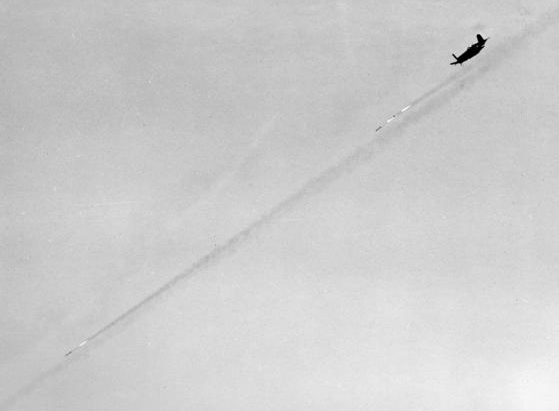


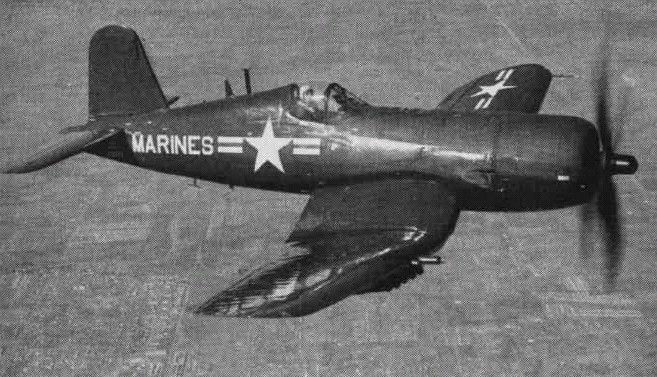


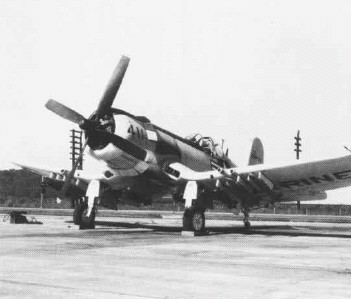


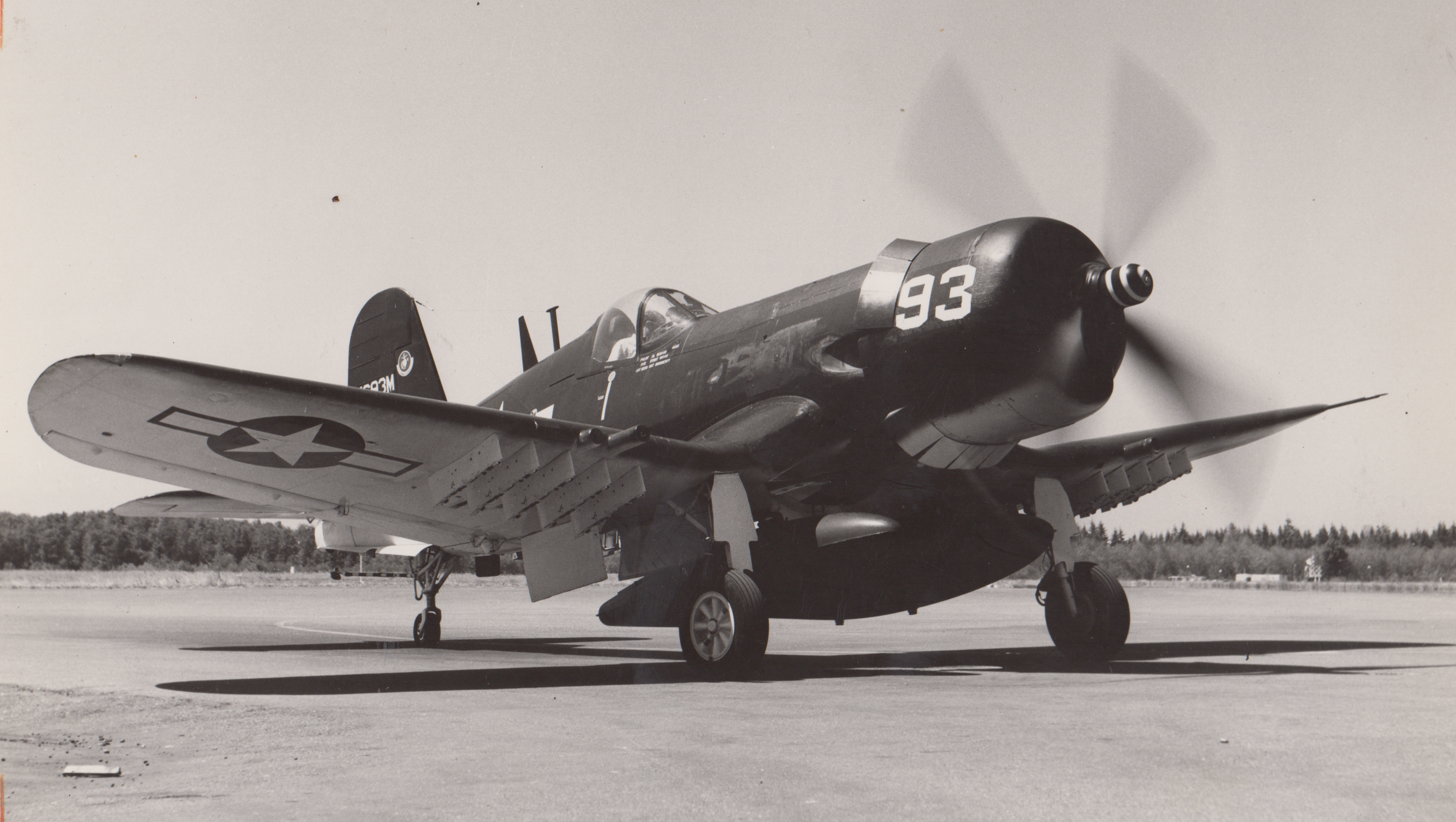


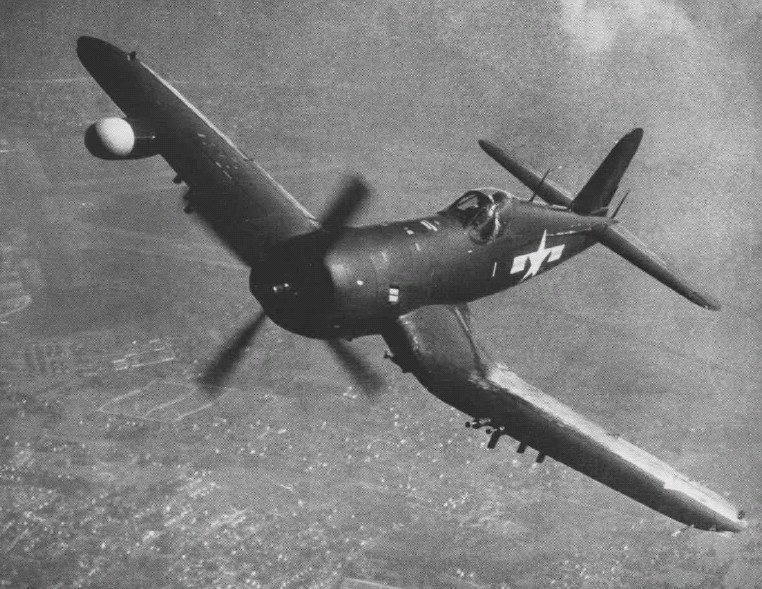


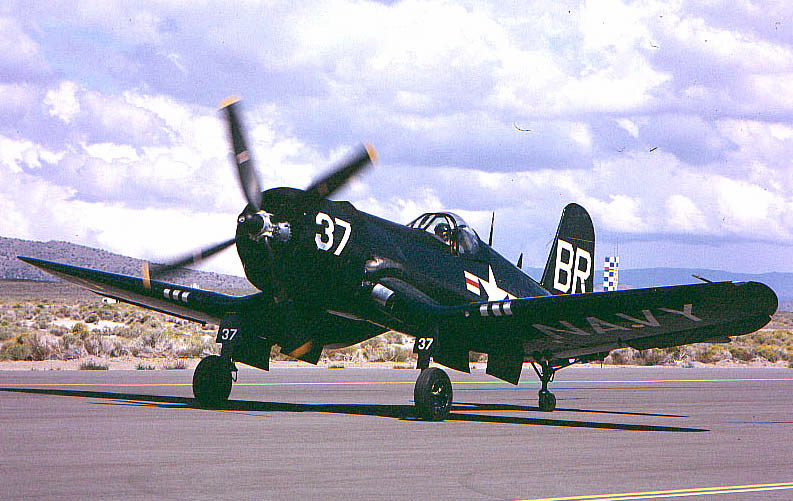


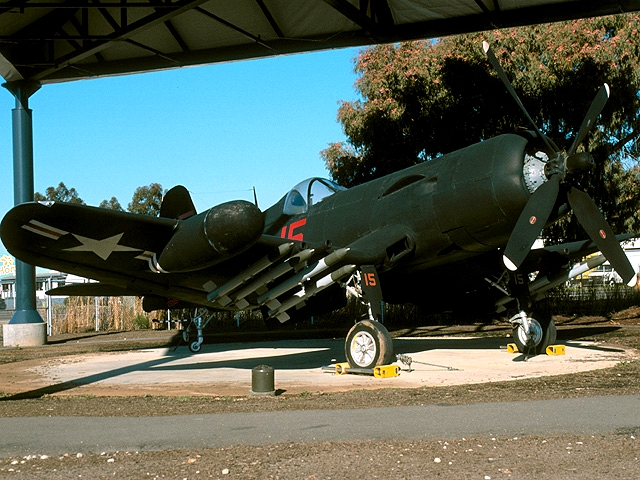


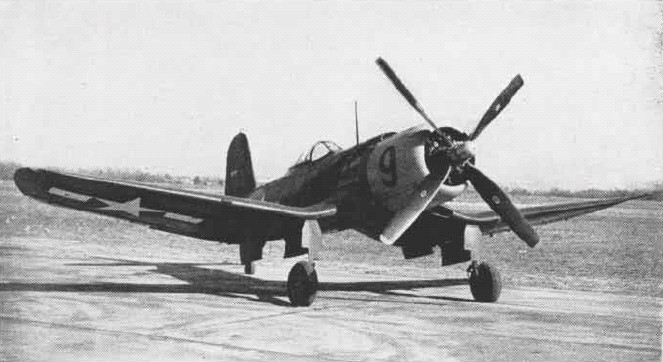


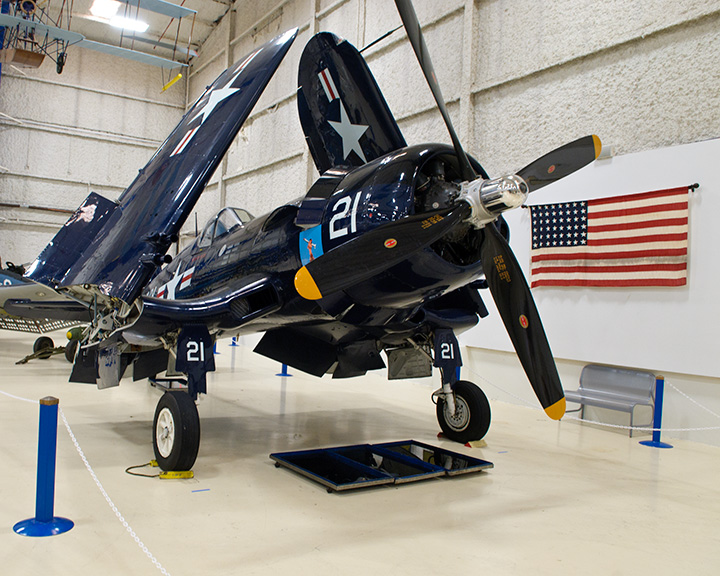
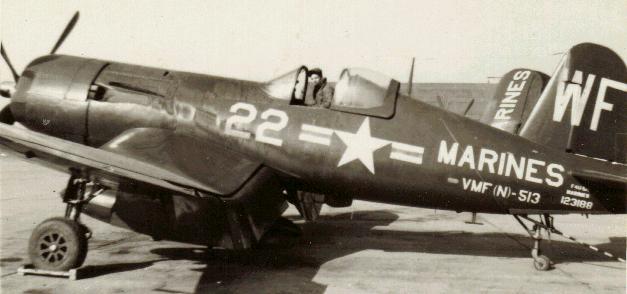

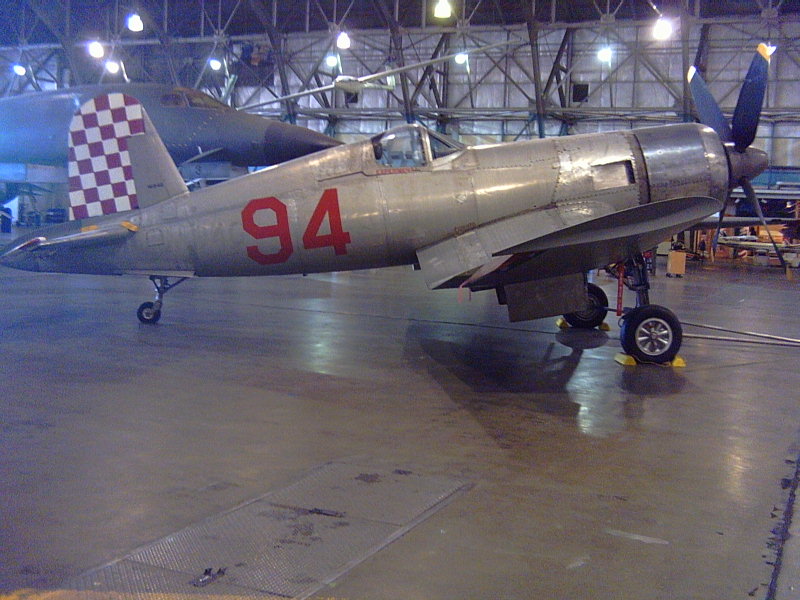
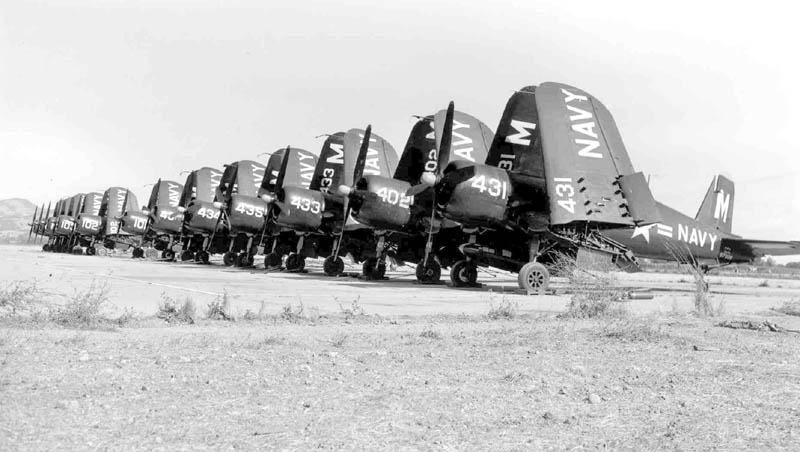


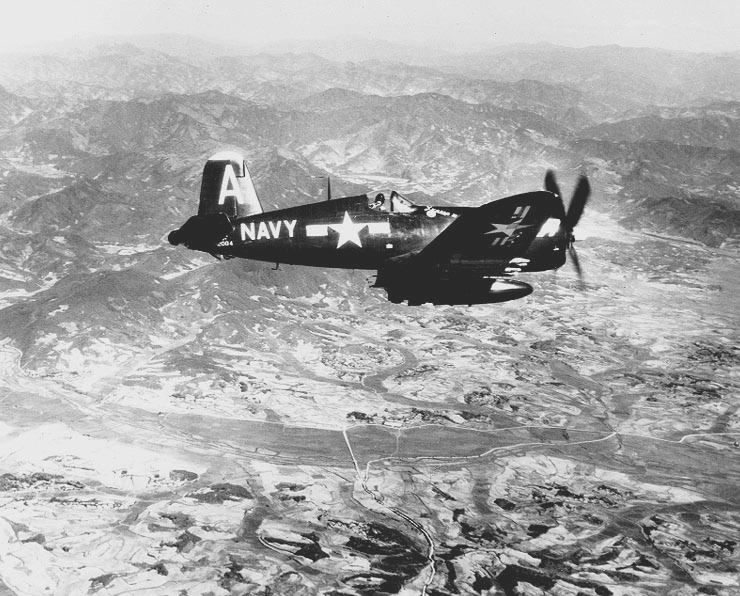


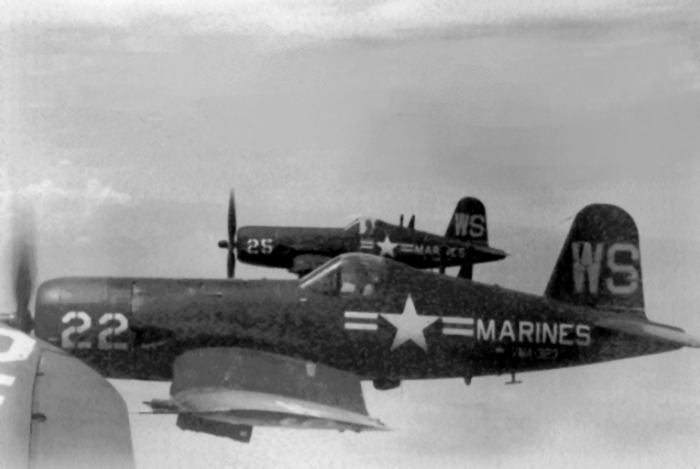


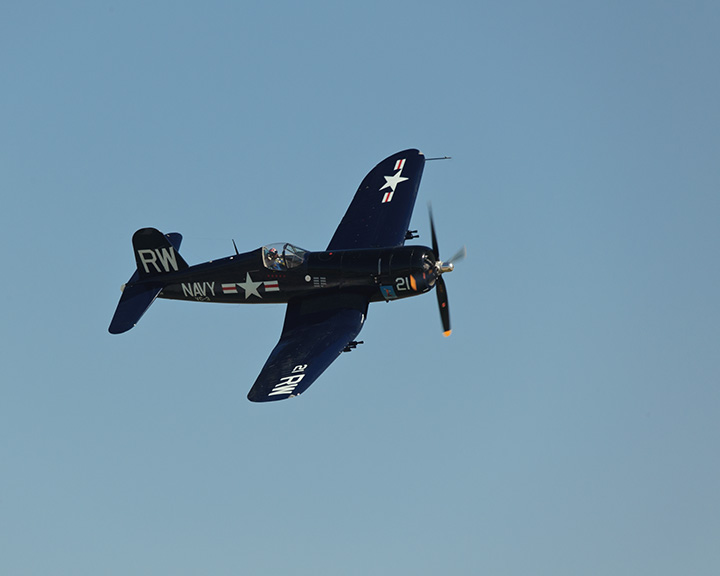


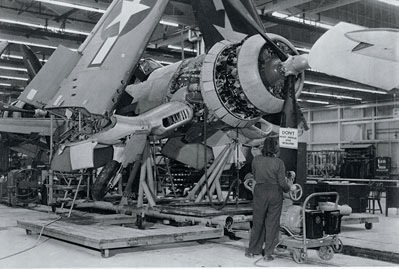


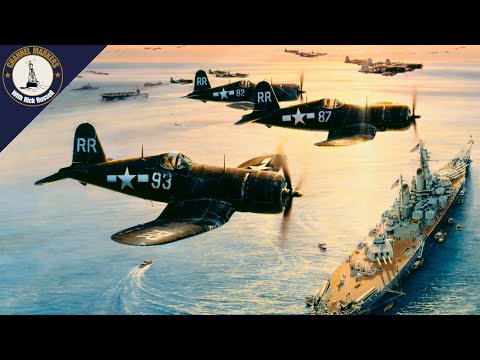
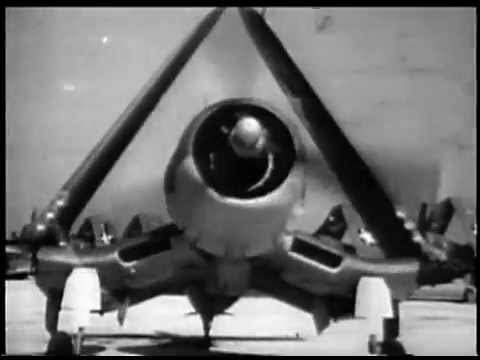
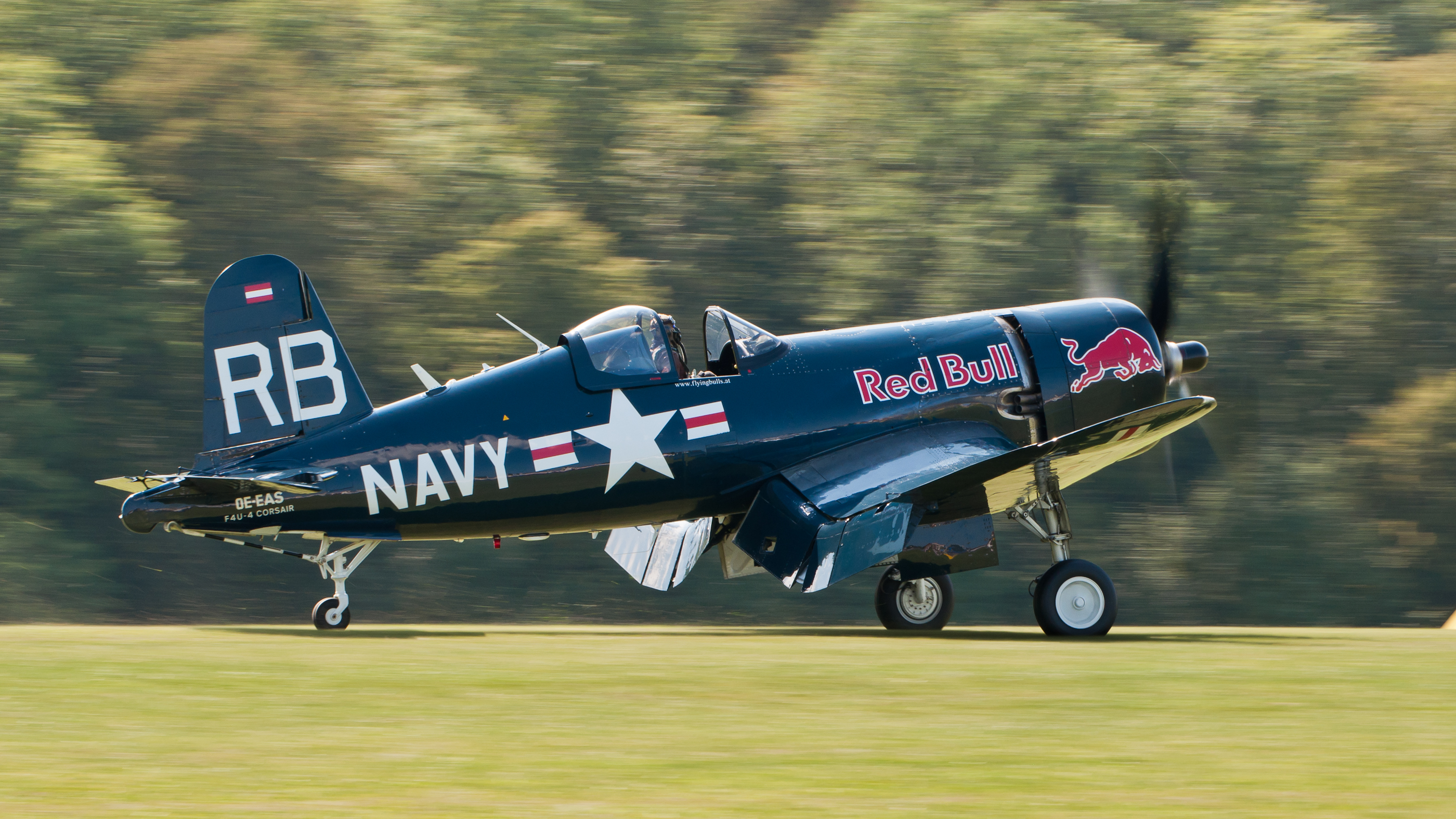
The Vought F4U Corsair is an American single-engine fighter designed for carrier operations and instantly recognisable by its inverted gull wing. Chance Vought developed it in response to a 1938 Navy competition; the prototype first flew on 29 May 1940 and production ran until 1953, the longest production life of any American piston-engined fighter. Besides Vought, Goodyear (as the FG) and Brewster (as the F3A) built it under licence. What made the Corsair important was an unusual blend of speed, toughness and load-carrying ability. It was the first American single-engine fighter to exceed 400 mph in level flight, yet it matured into a fighter-bomber able to lift up to 4,000 pounds of bombs. Navy and Marine Corps pilots credited it with a kill ratio of better than 11 to 1 in the Second World War. Its path into service was rough. Early deck trials exposed poor visibility, a bouncy undercarriage and a vicious left-wing stall, so the Navy initially standardised on the Grumman F6F Hellcat and handed the Corsair to the Marines, who flew it from land bases in the Solomon Islands from February 1943. It was Britain's Fleet Air Arm that first operated it routinely from carriers. After 1945 the Corsair stayed in front-line service. In Korea it flew mainly close support and night intruder missions, while French Naval Aviation (the Aéronavale) used it in Indochina, at Suez, in Algeria and at Bizerte, and received the very last examples built. Its final combat came in 1969, in the so-called Football War between Honduras and El Salvador. Altogether 12,571 Corsairs were built in 16 distinct models. It remains an icon of naval aviation: Connecticut has adopted it as its official state aircraft, and several museums display restored examples.
Related events
- Chance Milton Vought is born
- Rex Beisel, designer of the Corsair, is born
- Leonard S. "Luke" Hobbs is born
- Chance Vought begins working in aviation
- Eugene Ely takes off from a US Navy cruiser
- Eugene Ely lands on a ship in San Francisco
- Gregory Boyington is born
- Duralumin begins to be used in aircraft structures
- Chance Vought builds aircraft in a Long Island apartment
- David Ingalls becomes the US Navy's first ace
- Rex Beisel, among the first qualified aeronautical engineers in the US
- Boyington flies for the first time, in a Jenny biplane
- Hobbs joins McCook Field as a test engineer
- Rex Beisel designs the TS-1 for the US Navy
- A Vought VE-7 is the first aircraft to take off from the USS Langley
- Pratt & Whitney hires Luke Hobbs as a research engineer
- Chance Vought dies
- Rex Beisel joins Chance Vought
- Clyde Pangborn makes the first nonstop crossing of the Pacific
- Yokosuka becomes the Japanese Navy's naval air arsenal
- Kenneth Walsh enlists in the Marines as a private
- Hobbs becomes chief engineer at Pratt & Whitney
- Gregory Boyington enters naval aviation as a cadet
- Pratt & Whitney begins work on the R-2800 Double Wasp
- Kenneth Walsh earns his wings at Pensacola as an enlisted pilot
- The XR-2800 Double Wasp engine delivers 1,850 hp in tests
- The Bf 109E appears
- Design work on the Corsair begins
- Tetsuzo Iwamoto fights his first combat over Nanchang
- The US Navy requests proposals for a new carrier-based fighter
- Vought presents Rex Beisel's fighter project to the US Navy
- The US Navy accepts Rex Beisel's proposal
- Vought moves from East Hartford to Stratford
- XF4U-1 mock-up approved
- The Corsair prototype ends up on a golf course
- Spitfires suffer engine cuts under negative g
- The US Navy forces a change to the XF4U's armament
- The Mitsubishi A6M Zero appears over China
- First flight of the XF4U-1 Corsair
- The XF4U-1 exceeds 400 mph between Stratford and Hartford
- The repaired Corsair prototype passes to military hands for testing
- Production design of the F4U-1 completed
- Boyington leaves the Marines to join the Flying Tigers
- Formal acceptance trials of the XF4U-1 begin
- The US Navy issues the letter of intent for the F4U
- Frank Walker graduates from MIT and joins Pratt & Whitney
- The US Navy orders 584 F4U-1s
- Iwamoto protects the fleet from the Zuikaku during the attack on Pearl Harbor
- Japanese carrier attack on Pearl Harbor
- John Thach uses his maneuver in combat for the first time, at Midway
- Kenneth Walsh becomes an officer
- Carrier qualification trials of the Corsair on the Wolverine, Core and Charger
- Boyington returns to the Marine Corps
- The US flies and measures the captured Zero
- Boyington leaves the Flying Tigers
- Battle of the Coral Sea
- Japan loses over a hundred veteran aviators at Midway
- An almost intact Zero falls into American hands at Akutan
- The first production Corsair flies
- First F4U-1 delivered to the US Navy
- The Battle of Guadalcanal begins
- Landing on Guadalcanal
- Corsair trials aboard the USS Sangamon
- VMF-124, the first Marine unit with the Corsair, is formed at Camp Kearny
- VF-12, the first US Navy unit with the Corsair
- A Corsair F4U-1 goes to testing at the NACA laboratory at Langley
- Tom Blackburn falls into the sea during the North Africa landings
- Vought redesigns the Corsair's ammunition boxes to make them interchangeable
- VMF-124 is declared fully operational with the Corsair
- Admiral Yamamoto is killed, shot down by P-38s over Bougainville
- Each Corsair receives a set of spare ammunition boxes
- The US Navy and USAAF teach pilots to avoid tight turning fights
- The US commissions fifteen aircraft carriers in one year
- Fighter squadron VF-17 is formed with the Corsair
- The F6F Hellcat enters service
- The first Corsairs with the R-2800-8W engine reach the front
- Vought and Sikorsky separate
- The Battle of Guadalcanal ends
- The first VMF-124 Corsairs arrive at Guadalcanal
- The "Valentine's Day Massacre" over Kahili
- More Marine squadrons switch to the Corsair
- VF-12 passes carrier landing qualification with the Corsair
- Kenneth Walsh's first victories with the Corsair
- Large Japanese raid of Operation I on Guadalcanal
- Kenneth Walsh, the first Corsair ace
- William Gise, commander of VMF-124, dies
- American landing on New Georgia to take the Munda airfield
- The Royal Navy receives its first Corsairs
- A training Corsair falls into Lake Michigan from the USS Wolverine
- The Allies decide to isolate Rabaul rather than take it
- Boyington is given command of a Corsair squadron
- The Munda airfield falls and passes into Allied hands
- Walsh is shot down over Vella Lavella after attacking a Japanese raid
- Walsh attacks some 50 Japanese fighters alone over Kahili
- VMF-214 is reorganized at Espíritu Santo
- VMF-124 leaves the Solomons combat zone
- VMF-214 pilots choose the name "Black Sheep"
- First combat mission of the "Black Sheep" (VMF-214)
- Corsair no. 02449 crashes at Espíritu Santo
- VF-17 "Jolly Rogers" arrives in the Pacific with Corsairs
- The Black Sheep challenge the Japanese over Kahili
- Tetsuzo Iwamoto arrives at Rabaul
- VF-17 carrier-lands its Corsairs on the Essex and the Bunker Hill
- Landing at Bougainville and the shoot-down of Robert Hanson
- The Japanese Navy sends its carrier air groups to defend Rabaul
- Carrier strike on Rabaul
- VF-17 Corsairs refuel on the Bunker Hill and the Essex during the attack on Rabaul
- VF-17 defends the carriers in the Armistice Day attack on Rabaul
- Fleet Air Arm squadron 1830 operates Corsairs from HMS Illustrious
- The US Navy authorizes lightening land-based Corsairs
- First major Allied fighter sweep over Rabaul
- Second sweep over Rabaul: Boyington claims four kills
- Boyington scores his 25th victory over Rabaul
- The Marines test loading the Corsair's armament
- VMF-214 flies its last mission and is disbanded
- Marine Corsairs provide close support at Peleliu from the captured airfield
- The US Navy compares the Corsair with the P-51B Mustang
- Hobbs becomes vice president of engineering at United Aircraft
- Corsair production reaches 300 aircraft per month
- The first carrier-borne Corsairs, on the USS Enterprise
- Tetsuzo Iwamoto is promoted to officer
- Robert Hanson scores 20 victories in 17 days
- VF-17 returns to combat from Piva Yoke
- Lindbergh flies in combat as a civilian in the Pacific
- Pappy Boyington is taken prisoner by the Japanese
- Corsairs support the invasion of the Philippines
- 1944 fighter conference: pilots prefer the Corsair
- Boyington ties the record of 26 victories and goes down over Rabaul
- George Ashmun, Boyington's wingman, dies over Rabaul
- Ike Kepford shoots down four aircraft over Tobera and escapes thanks to water injection
- Kepford shoots down two more fighters and his Corsair bounces on landing
- Walsh receives the Medal of Honor from Roosevelt
- Robert Hanson dies at Cape St George
- American carrier strike on Truk
- Japanese naval aviation abandons Rabaul
- Roosevelt approves Boyington's Medal of Honor
- The first RNZAF Corsairs arrive at Espíritu Santo
- Alan Vickers's Corsair crashes on the deck of HMS Illustrious
- VMF-113 scores its first victories with the Corsair over Ponape
- Ike Kepford ends his combat service as the US Navy's first ace
- British Corsairs enter combat from aircraft carriers
- The US Navy finally accepts the F4U for carrier operations
- The F4U-1D enters service
- Richard Bong breaks Eddie Rickenbacker's victory record
- RNZAF Nos. 20 and 21 Squadrons enter service with the Corsair
- Lindbergh flies Corsair missions from Green Island
- Lindbergh flies his first combat mission with a Corsair squadron
- The Germans capture the British Corsair JT404 intact in Norway
- Lindbergh attacks with three 1,000-lb bombs under a Corsair
- Lindbergh drops the first 2,000-lb bomb on the atoll
- Lindbergh attacks with one 2,000-lb bomb and two 1,000-lb bombs
- The first kamikaze attacks, in Leyte Gulf
- A kamikaze sinks the escort carrier USS St. Lo
- Hiroyoshi Nishizawa dies
- Marine Corsairs embark on the USS Essex
- End of Hellcat production
- End of Zero production
- The F4U-4 enters service
- Vought builds F4U-4 Corsair no. 97143
- Pratt & Whitney develops the R-2800-32W E series for the F4U-5
- Japan recovers a Corsair ditched off its coast
- The British fleet operates off Japan with many New Zealand pilots
- First Marine ground attacks from an aircraft carrier
- A Japanese bomber sets the USS Franklin ablaze with the new VMF-214 aboard
- The FG-1D that now flies at Duxford enters service
- Corsairs in the Battle of Okinawa
- The Marines claim 87 kills in a single day
- A Corsair shoots down a Ki-45 with its propeller over Okinawa
- Kenneth Walsh's last victory
- A VMF-113 Corsair returns to Okinawa with part of its wing torn off
- Jefferson DeBlanc overflies Kyushu without meeting opposition
- Takijiro Onishi takes his own life after the surrender
- Robert Hampton Gray sinks the Amakusa and wins Canada's last Victoria Cross
- Pappy Boyington is liberated
- Boyington returns to the US after captivity
- Truman presents the Medal of Honor to Boyington in person
- The Hellcat leaves front-line service and the F4U-5 arrives
- The British Pacific Fleet is left out of London's victory parade
- No. 14 Squadron RNZAF takes its Corsairs to Japan
- First flight of the XF4U-5
- New Zealand retires the Corsair
- Vought moves from Connecticut to Dallas
- Rex Beisel becomes vice president of United Aircraft
- An F2G Super Corsair wins the Thompson Trophy at Cleveland
- Corsairs enter combat in Korea
- The Corsair F4U-5NL "Devotion" is built
- The Korean War breaks out with the Valley Forge as the only carrier in the area
- Marine Corsairs attack near Inchon from the USS Sicily
- Corsairs support the Marines at the Chosin Reservoir
- Hudner lands his Corsair beside Jesse Brown's in Korea
- F4U-6 contract (later AU-1)
- Corsair 97143 fights in Korea
- Luke Hobbs receives the Collier Trophy for the J57
- First flight of the AU-1
- Squadron VF-104 is created with Corsair FG-1Ds
- The US Navy's VF-104, equipped with Corsair FG-1Ds, is born
- First flight of the XF4U-7 prototype
- Jesse Folmar shoots down a MiG-15 with a Corsair
- The last of the 111 AU-1s is delivered
- VF-104 receives the Corsair F4U-5
- The last F4U-7 is delivered to France
- Flottille 14F, the first French unit with the F4U-7
- The last Corsair (no. 12,571) leaves Dallas
- Korean War armistice
- Marine Corsairs are transferred to France for Indochina
- French F4U-7s return from Indochina aboard the Dixmude
- Japanese ace Tetsuzo Iwamoto dies
- The last Corsairs are withdrawn from US Navy front-line service
- Hobbs becomes vice chairman of the board of United Aircraft
- Ira Kepford retires from the naval reserve
- The Argentine Navy begins operating the Corsair F4U-5
- French Corsairs bomb Egypt in the Suez crisis
- The US Navy strikes off the FG-1D that now flies at Duxford
- Saburo Sakai publishes his memoirs
- The naval reserve stops flying the Corsair
- Boyington publishes his memoirs "Baa Baa Black Sheep"
- Luke Hobbs retires
- Corsair Flottille 17F is created at Hyères
- The Aéronavale tests the SS.11 missile on the Corsair
- French Corsairs attack in the Bizerte crisis
- France retires its last Corsair F4U-7
- Air racing is reborn at Reno
- The Argentine Navy retires its Corsairs
- The Football War, the Corsair's last combat
- Captain Soto shoots down three Salvadoran aircraft in a Corsair
- The Planes of Fame Air Museum buys a veteran F4U-1 Corsair from Bougainville
- The Smithsonian publishes Hobbs's book on the Wright engines
- Rex Beisel, designer of the Corsair, dies
- The series "Baa Baa Black Sheep" premieres
- The Planes of Fame Air Museum's F4U-1 flies again
- Corsair 97143 reaches the US after serving in Honduras
- Luke Hobbs dies
- Honduras stops operating the Corsair
- Joe Tobul buys Corsair 97143
- Jiro Horikoshi, designer of the Zero, dies
- Jim Tobul flies for the first time at the Oshkosh festival
- Last flight of Fernando Soto's Corsair FAH-609
- Ira Kepford dies
- Lynn Garrison's Corsair N693M crashes in San Diego
- Pappy Boyington dies
- First flight of the Raptor
- Corsair 97143 flies again
- The Tobuls' Corsair makes its air show debut
- The Association française des avions historiques buys the Corsair F4U-5NL
- Kenneth Walsh, the first Corsair ace, dies
- Saburo Sakai dies
- Restoration of Ray Dieckman's FG-1D is completed
- Joe Tobul dies
- Fernando Soto Henríquez dies
- Max Alpha Aviation buys the Corsair F4U-5NL
- Corsair no. 02465 is recovered from Lake Michigan
- Corsair 97143 flies again after its second restoration
- Squadron VMA-513 is disbanded after 69 years of service
- Jim Tobul finishes fourth at Reno with his Corsair
- Adam Makos's book "Devotion" is published
- Corsair no. 02449 arrives in the US as N2449
- The film "Devotion" is released
- Flying Legends buys the Corsair F4U-5NL "Devotion"
Related sheets
Category
Vought F4U Corsair in the news
A cowling says a lot about an airplane. Think of a Vought F4U Corsair, de Havilland Canada DHC-2 Beaver, Cirrus SR22, or even a Sopwith Camel. If you spot any of these models rolling out of a…
Three-view drawing


History
A 1938 competition and the XF4U-1
In February 1938 the US Navy's Bureau of Aeronautics issued two requests for proposals, one for a twin-engined fighter and one for a single-engined type. For the latter it asked for the highest attainable speed, a stalling speed no higher than 70 mph, a range of 1,000 miles and four guns, plus room in the wing for small anti-aircraft bombs, a period notion that envisaged dropping them onto enemy bomber formations.
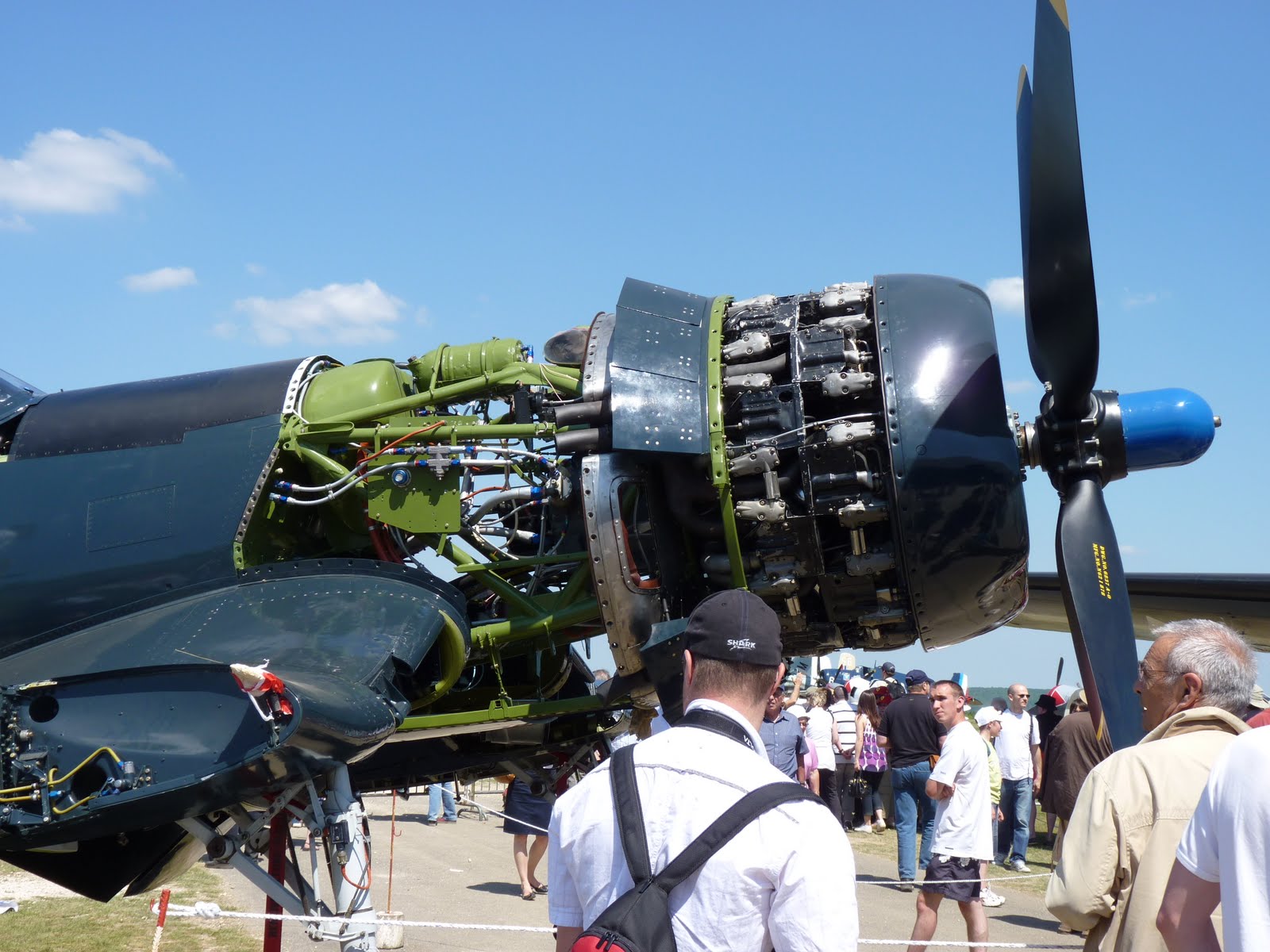
That June the Navy contracted Vought for a prototype, known in the factory as the V-166B and to the Navy as the XF4U-1, bureau number 1443. Rex Beisel led the design team. After the mock-up was inspected in February 1939, work moved quickly around a prototype of the Pratt & Whitney R-2800 Double Wasp, an 18-cylinder, two-row radial rated at 1,805 hp. It was the first airframe conceived from the outset for that engine, and the result combined the most powerful engine, the largest propeller and probably the biggest wing of any naval fighter yet built.
Lyman A. Bullard Jr. made the first flight on 29 May 1940, which ended in a hurried landing when the elevator trim tabs failed through flutter. On 1 October 1940 the XF4U-1 averaged 405 mph between Stratford and Hartford, becoming the first American single-engine fighter to pass 400 mph. Testing confirmed an excellent climb but also forced requirements to be rewritten: full-power dives reached 550 mph at the cost of damaged control surfaces and panels, and the required spin recovery proved impossible without an anti-spin parachute.
Reports from the war in Europe persuaded the Navy that the planned armament was too light, and in November 1940 it asked for three .50-calibre machine guns in each wing panel. Formal acceptance trials began in February 1941, and on 30 June that year Vought received an order for 584 F4U-1s, which inherited the Corsair name from the company's late-1920s O2U scout biplane.
A radical design: engine, wing and undercarriage
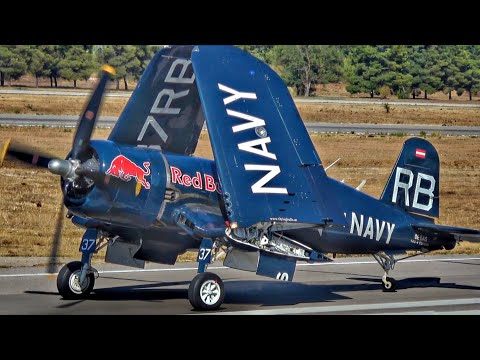
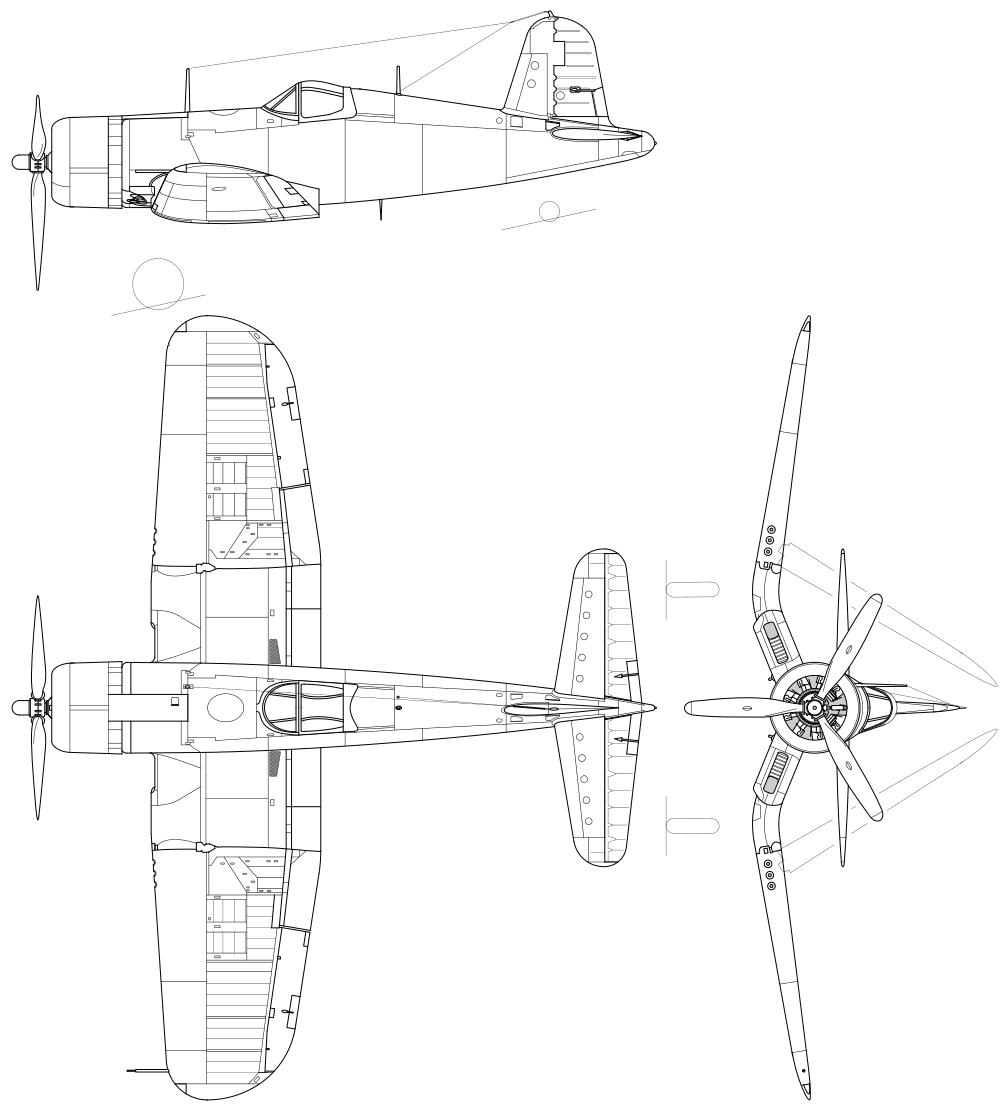
The F4U was built around the largest engine then available, the 2,000 hp R-2800, turning a three-bladed Hamilton Standard propeller 13 feet 4 inches across. Such a large propeller created a problem: the main gear had to retract rearwards to leave room for the folding wing, and with the chosen wing chord the legs would have been impractically long. The answer was the inverted gull wing, which shortened the struts and let wing and fuselage meet at the lowest-drag angle without root fairings, although the bent wing was heavier and harder to build.
The Corsair was the first Navy aircraft whose undercarriage retracted into fully enclosed wells, the legs rotating through 90 degrees and disappearing behind doors. Oil coolers and supercharger intakes sat in the inner wing, fed through leading-edge openings instead of external scoops. The large aluminium fuselage panels were spot-welded, a new technique that did away with most rivets, yet the Corsair was also the last American fighter to use fabric on parts of the outer wings, the ailerons, the elevators and the rudder.
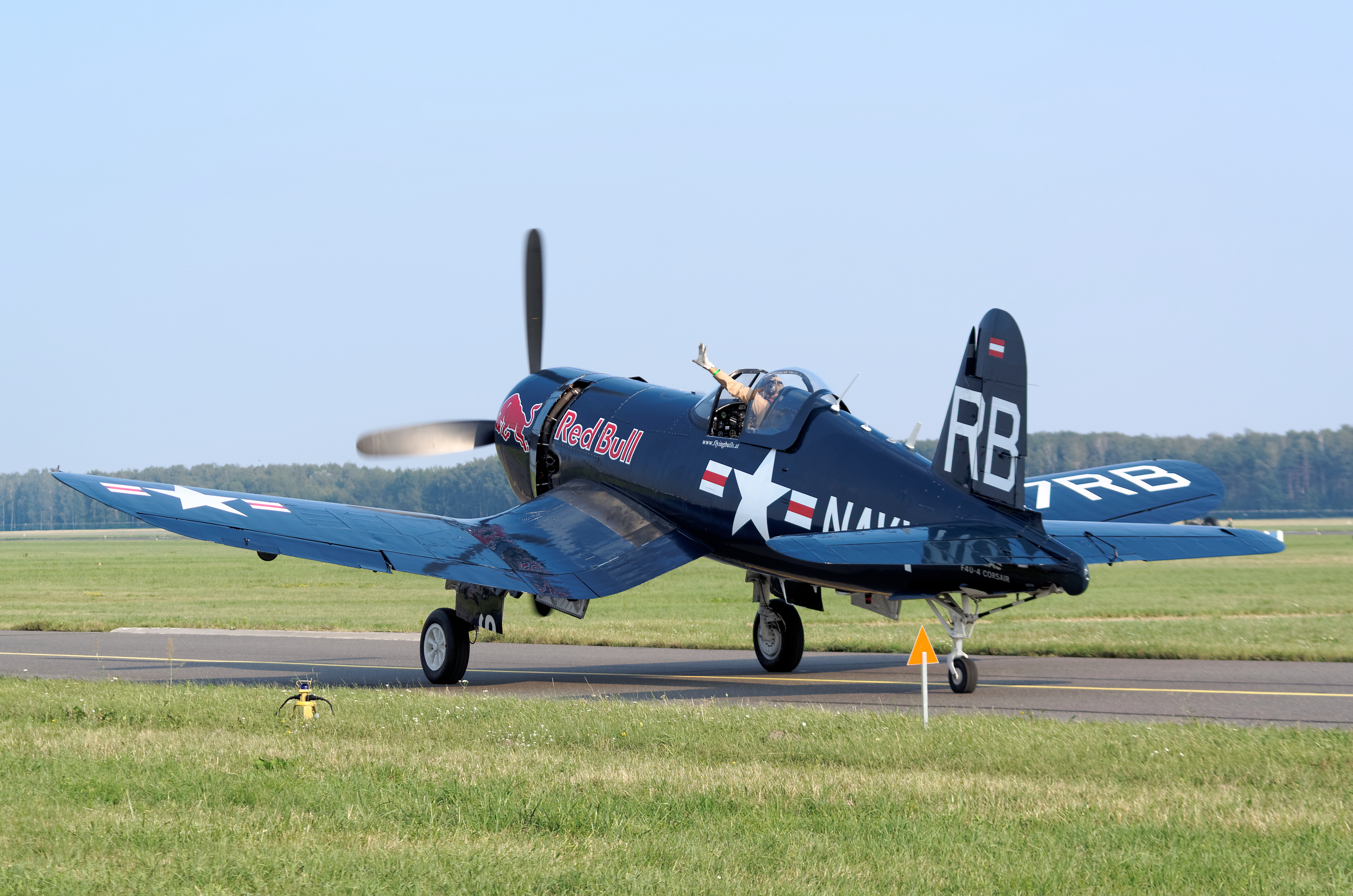
The production F4U-1 differed considerably from the prototype. Six wing-mounted .50-calibre M2 Browning guns displaced the wing fuel tanks, so a 237-gallon self-sealing tank went in ahead of the cockpit, which moved back by 32 inches. Other additions were 150 pounds of armour, an internal 1.5-inch bullet-proof windscreen, NACA slotted flaps, longer-span ailerons and the 2,000 hp R-2800-8. With its mechanically supercharged engine the F4U-1 was much faster than the Hellcat and only 13 mph slower than the turbocharged Republic P-47 Thunderbolt.
Teething troubles and a change of owner
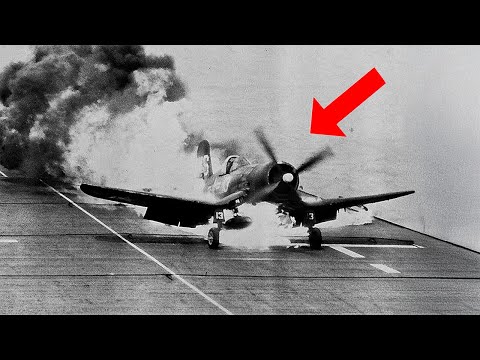
Carrier trials in 1942 uncovered serious faults. The left wing could stall without warning at low speed, and a sudden burst of throttle in a go-around was enough to roll the aircraft over. The cockpit, set far back behind an extremely long nose, left the pilot nearly blind on approach; oil from the cowl flaps sprayed the windscreen, and the oleo struts bounced the aircraft along the deck. Early pilots gave it unflattering names such as "hosenose" and "Widow Maker".
The fixes came one at a time: a small stall strip on the right-wing leading edge evened out the stall, the upper cowl flaps were fixed shut, and a bleed valve in the gear legs ended the bouncing. Meanwhile the more docile, easier-to-build Hellcat had entered service, and the Navy chose it for its carriers. The Corsair went to the Marine Corps, which had no need to land on decks and used it from shore bases to devastating effect. The Navy did not clear the F4U for shipboard use until April 1944, after a longer oleo strut had been fitted.
Three production lines
Demand soon outstripped Vought's capacity. According to the company, the first production Corsair flew on 25 June 1942 and the Navy accepted its first two in July. By the end of 1944 Vought was delivering 300 aircraft a month, one every 82 minutes, and combined output peaked in May 1944 at 596 acceptances in a single month: 254 from Vought, 220 from Goodyear and 122 from Brewster. Vought built 2,814 F4U-1s.
Goodyear built the FG-1 to the same specification and delivered just over four thousand, more than a third of all wartime Corsairs; many of its FG-1As left the line with manually folding wings and no hydraulic mechanism because they were destined for land-based squadrons. Brewster fared far worse. Labour disputes slowed its output, the Navy cancelled the contract in July 1944 after only 735 deliveries, and defective wing fittings led to its F3As being barred from aerobatics. None reached American front-line units.
Baptism of fire in the Solomons
Twelve F4U-1s of Marine squadron VMF-124 landed at Henderson Field, Guadalcanal, on 12 February 1943. Their debut two days later was the fiasco remembered as the "Saint Valentine's Day Massacre": escorting B-24s over Kahili, the Americans lost ten aircraft, two of them Corsairs, against no more than four Japanese fighters. The Marines learned quickly. By May VMF-124 had the first Corsair ace, Kenneth A. Walsh, who finished the war with 21 victories and stressed that altitude was everything, since the Corsair beat the Zero in every respect except slow-speed manoeuvring and climb.
VMF-214, Gregory "Pappy" Boyington's "Black Sheep", became famous over the stretch of the Solomons known as "The Slot", Boyington scoring 22 kills in the F4U. Three Corsair pilots received the Medal of Honor in the Second World War: Walsh, for two missions in August 1943; Boyington, for a campaign running from September 1943 to January 1944 that ended with his shoot-down and capture over Rabaul; and Robert M. Hanson of VMF-215, posthumously. On the Navy side, VF-17 kept its Corsairs and in November 1943 used them to cover the carrier strike on Rabaul, refuelling aboard Bunker Hill and Essex. The first squadron to operate effectively from an American carrier was VMF-124 itself, aboard Essex in December 1944, when the kamikaze threat demanded more fighters at sea.
Pacific fighter-bomber
From early 1944 the Marines explored the Corsair's potential for close support of amphibious landings. Charles Lindbergh, a civilian adviser for United Aircraft, flew with them to study how to stretch its payload and range, and got airborne with 4,000 pounds of bombs: a 2,000-pounder on the centreline and a 1,000-pounder under each wing. By early 1945 the Corsair had become a fully fledged "mudfighter" delivering bombs, napalm and HVAR rockets, and could even carry the large Tiny Tim rocket. It fought over Palau, Iwo Jima and Okinawa, where infantrymen called it "The Angel of Okinawa".
The wartime balance sheet
Figures compiled at the end of the war credit F4Us and FGs with 64,051 operational sorties for the Navy and Marines, 44 per cent of all fighter sorties, of which only 9,581 were flown from carriers. Their pilots claimed 2,140 air victories against 189 losses in air combat, a ratio above 11 to 1, though partly because the type moved into ground attack as the war went on and met fewer enemy fighters. The Corsair also dropped 15,621 short tons of bombs, 70 per cent of all those released by US fighters. Anti-aircraft fire claimed 349 Corsairs and another 692 were lost on non-combat flights, a reminder of how demanding the aircraft was.
With the Fleet Air Arm
Lacking a carrier fighter with enough range, the Royal Navy received its first 95 F4U-1s as the Corsair Mk I in mid-1943, followed by Vought, Brewster and Goodyear batches that brought the total to 2,012 aircraft. To fit its carriers' hangars it clipped 8 inches from each wingtip, which also curbed the aircraft's tendency to float on landing. The British raised the seat, fitted a bulged canopy and adopted the curving approach used with the Seafire, so that they put the Corsair to work from carriers before the US Navy did.
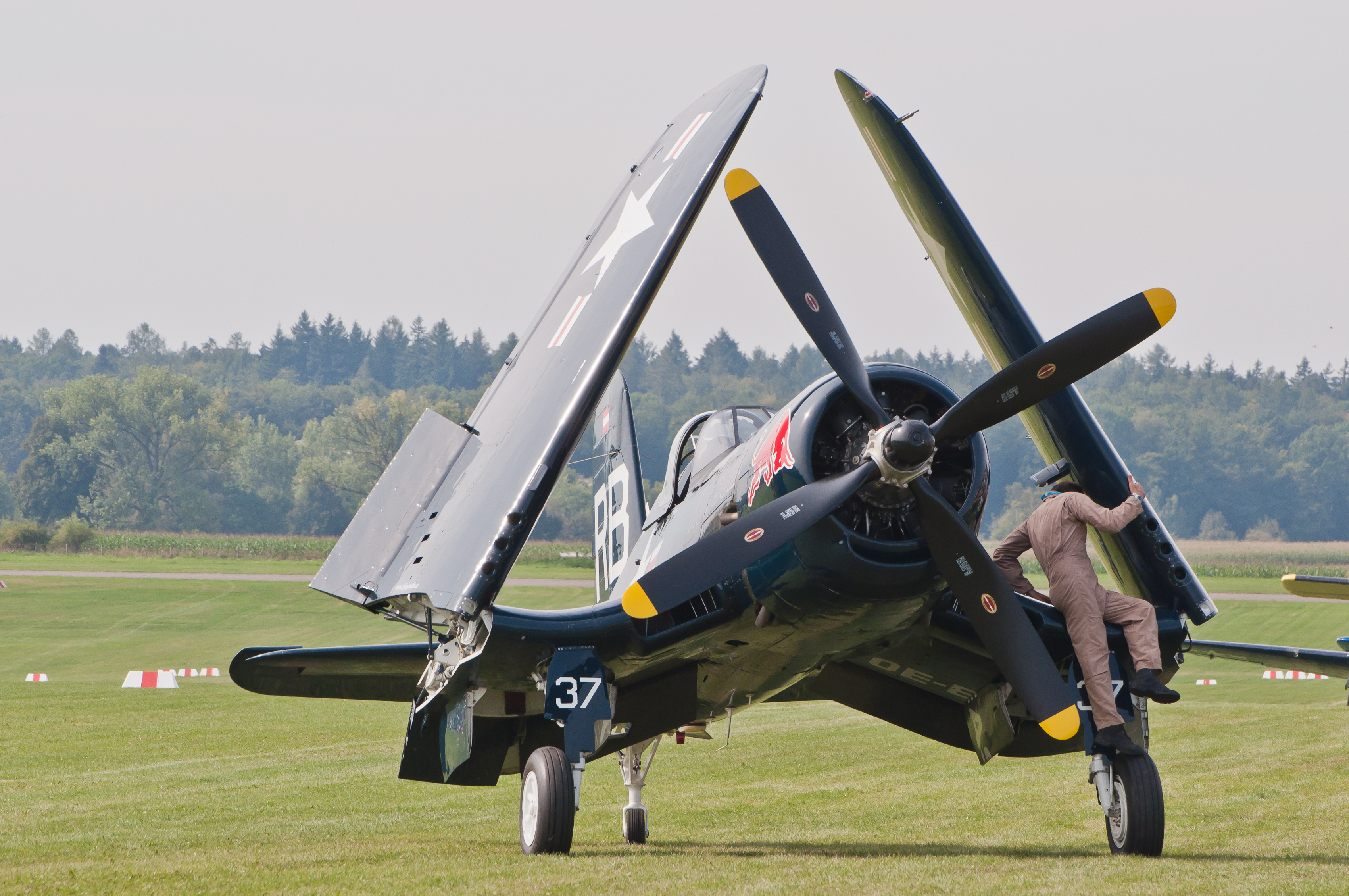
The first unit, 1830 Naval Air Squadron, formed on 1 June 1943. British Corsairs covered the 1944 strikes on the battleship Tirpitz and, with the British Pacific Fleet, attacked targets in South East Asia and Japan. On 9 August 1945 Canadian Lieutenant Robert Hampton Gray attacked Shiogama harbour and sank the escort Amakusa with a 1,000 lb bomb before crashing into the sea; he was awarded Canada's last Victoria Cross posthumously. With no means to pay for their Lend-Lease aircraft, the British pushed many Corsairs overboard off Brisbane at the end of the war.
New Zealand and captured Corsairs
The Royal New Zealand Air Force received some 424 Corsairs, which equipped 13 squadrons. The first arrived at Espiritu Santo in March 1944, and by late that year the F4U equipped all ten of its Pacific fighter squadrons, used mostly for close support. No. 14 Squadron flew it in Japan with the occupation force until its retirement in 1947.
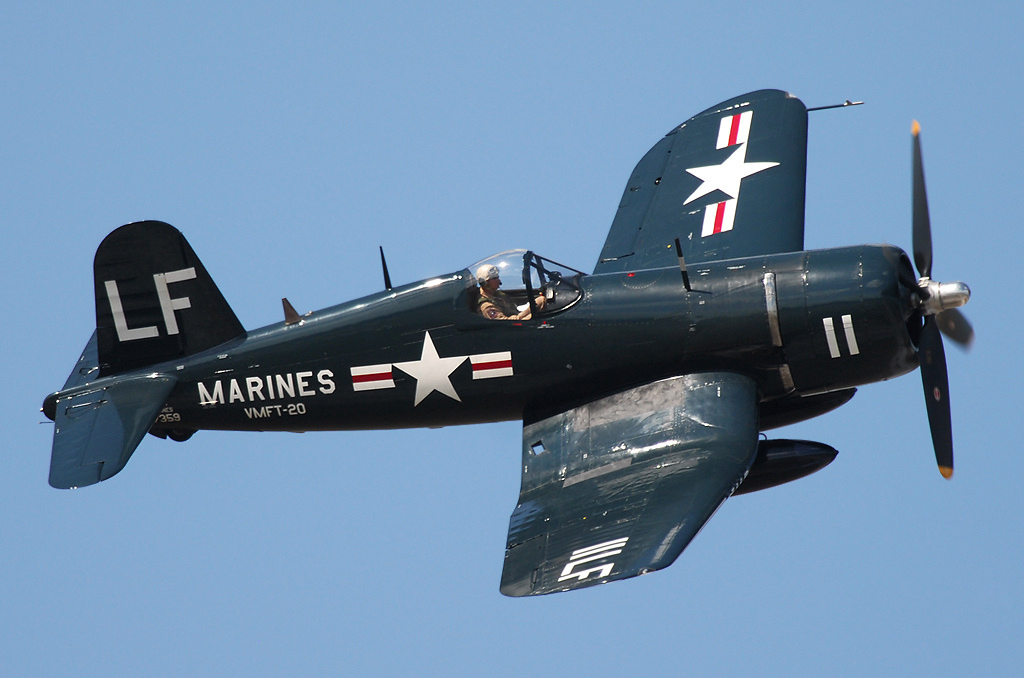
In July 1944 a Fleet Air Arm Corsair force-landed in Norway and was captured intact by the Germans, who took it to the Rechlin test centre. In 1945 American troops found another F4U in Japan that the Japanese had patched up with fabric and parts from crashed aircraft.
Post-war versions: F4U-4, F4U-5 and AU-1
The F4U-4, delivered from early 1945, was the last version to see action in the Second World War. Its 2,100 hp R-2800-18W had a two-stage supercharger and gave 2,450 hp with water-alcohol injection, and it introduced a four-bladed propeller. The earlier F4U-1D had brought water injection and permanent rocket rails, while the F4U-1C swapped the machine guns for four 20 mm cannon. Night fighters carried radar in a pod on the right wing, among them the F4U-2, F4U-4N and F4U-5N, and there were photo-reconnaissance versions too.
The F4U-5, first flown on 21 December 1945, added the R-2800-32(E) engine, automatic supercharger controls, a modernised cockpit and, for the first time, all-metal wings. The AU-1, originally the F4U-6, was a Marine attack version with extra armour, oil coolers moved inboard and a simplified supercharger for low-level work, able to carry 8,200 lb of bombs. Separately, the F2G "Super Corsair" with the huge 28-cylinder Wasp Major was built only in tiny numbers; surplus examples went on to win the Thompson Trophy in 1947 and 1949.
Korea
From 1950 to 1953 Corsairs served in Korea as the AU-1, F4U-4B, F4U-4P, F4U-5N and F4U-5NL, nearly always in close support with cannon, napalm, bombs and rockets. The MiG-15 outclassed it in the air, although on 10 September 1952 Marine Captain Jesse G. Folmar shot one down when it made the mistake of turning with him, before he was himself shot down. At night F4U-5Ns hunted convoys, trains and the Po-2 biplanes that harassed United Nations troops; Lieutenant Guy Bordelon of VC-3 became the Navy's only ace of the war and the only American ace in Korea to fly a piston-engined aircraft. Lieutenant Thomas J. Hudner received the Medal of Honor for deliberately crash-landing his F4U-4 beside the downed aircraft of his squadron mate Jesse L. Brown, one of the Navy's first African American aviators, in an attempt to save him.
In French service
France needed a close-support aircraft for its carriers, and Vought built the final version, the F4U-7, for it. The prototype flew on 2 July 1952; 94 were built, and the last Corsair of all was rolled out on 31 January 1953. The US Navy paid for them under the Military Assistance Program. Flotille 14F, based at Karouba in Tunisia, was the first unit to receive them.
In Indochina, 14F flew 25 AU-1s passed on by the Marines in 1954 and, in three months that included support of Dien Bien Phu, logged 959 combat sorties. In October 1956 Flotilles 14F and 15F took part in Operation Musketeer at Suez, wearing yellow and black recognition stripes. The Corsair units then deployed to Algeria until 1962 and in July 1961 supported French paratroopers during the Bizerte crisis. The Aéronavale operated 163 Corsairs in all and retired the last in September 1964, as the new carriers Clemenceau and Foch ushered in the jet age.
The Football War: the last fight
Corsairs saw combat for the last time in July 1969, in the short war between Honduras and El Salvador, flying with both air forces. On 17 July Honduran Captain Fernando Soto shot down a Cavalier Mustang and two Salvadoran FG-1s, in what are regarded as the last combats between propeller-driven aircraft anywhere.
Legacy and survivors
Infantrymen called the Corsair "The Sweetheart of the Marianas", while naval aviators used less flattering names such as "Ensign Eliminator", for the many training hours it took to master, or the more neutral "Bent-Wing Bird". The Allied story that the Japanese called it "Whistling Death" is not supported by Japanese sources. Connecticut has made it the official state aircraft because of its links with Vought-Sikorsky, Pratt & Whitney and Hamilton Standard.
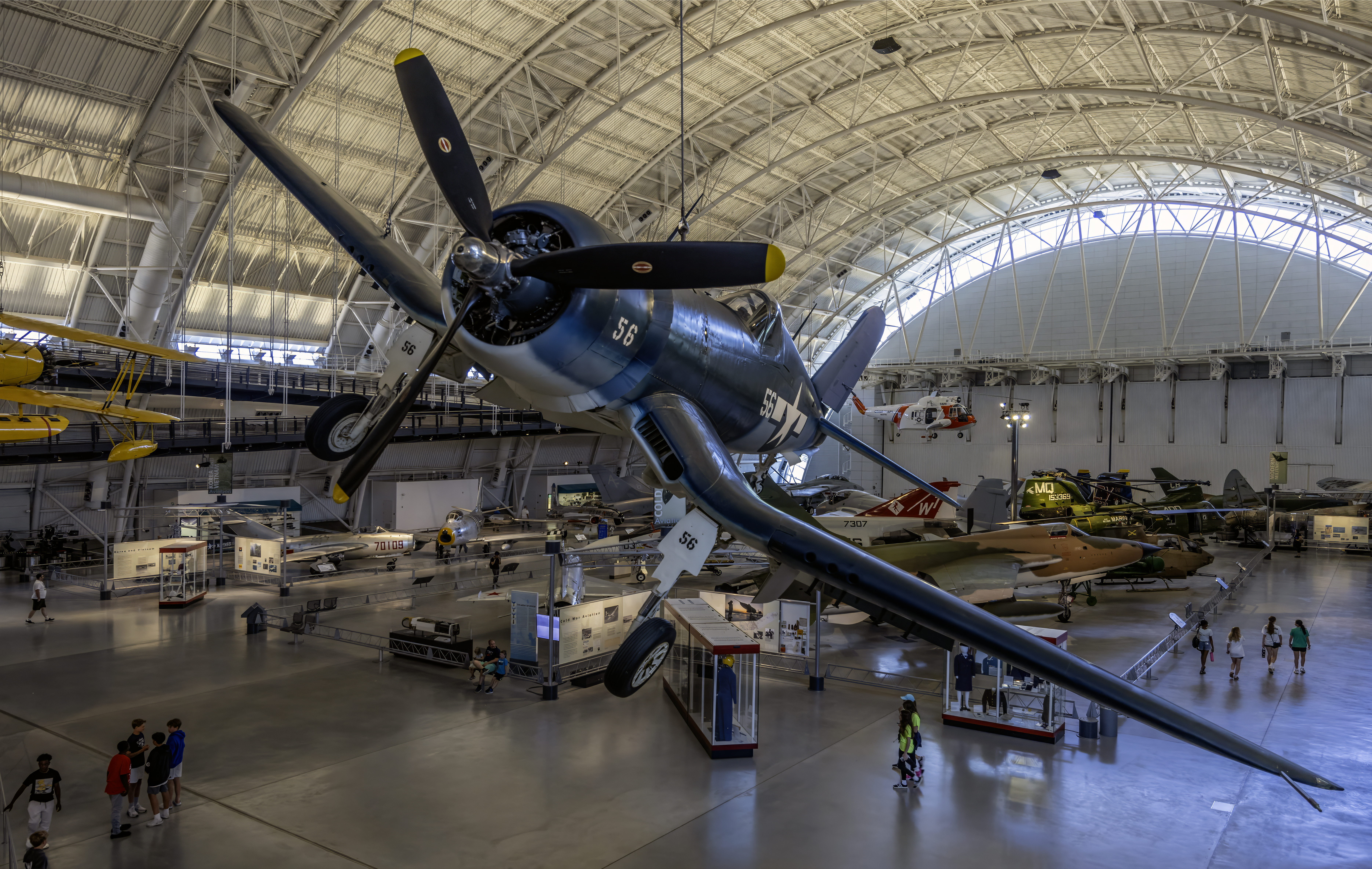
Among the survivors is the National Air and Space Museum's F4U-1D, bureau number 50375, delivered to the Navy on 26 April 1944. It served with VF-10 aboard Enterprise and with VF-89, then as an instructional airframe for mechanics; during restoration it turned out to carry a fin from another aircraft, a trace of those trainees' work. The museum spent 9,315 hours restoring it, painted it as a VMF-113 Corsair over Eniwetok in 1944, and moved it into its Washington building on the night of 27-28 January 1981.
Variants
| XF4U-1 | XF4U-5 | F4U-7 | AU-1 (F4U-6) | F2G-1 | F2G-2 | F3A-1 | F3A-1A | F3A-1D | F4U-1 | F4U-1A | F4U-1B | F4U-1C | F4U-1D | F4U-1P | F4U-2 | F4U-3 | F4U-4 | F4U-4B | F4U-4C | F4U-4K | F4U-4N | F4U-4P | F4U-5 | F4U-5N | F4U-5NL | F4U-5P | FG-1 | FG-1A | FG-1D | FG-4 | XAU-1 | XF2G-1 | XF4U-3B | XF4U-4 | |
|---|---|---|---|---|---|---|---|---|---|---|---|---|---|---|---|---|---|---|---|---|---|---|---|---|---|---|---|---|---|---|---|---|---|---|---|
| First flight | May 29, 1940 | December 21, 1945 | July 2, 1952 | — | — | — | — | — | — | — | — | — | — | — | — | — | — | — | — | — | — | — | — | — | — | — | — | — | — | — | — | — | — | — | — |
| Powerplant | XR-2800-4 | R-2800-32W | 1 × R-2800-18W | R-2800-83W | — | — | R-2800-8 | R-2800-8W | R-2800-8W | 1 × R-2800-8 | 1 × R-2800-8 | — | — | R-2800-8W | R-2800-8W | R-2800-8W | — | 1 × R-2800-18W | — | R-2800-18W | — | — | — | 1 × R-2800-32W | — | — | — | R-2800-8 | — | R-2800-8W | — | R-2800-83W | R-4360-4 | R-2800-16 | — |
| Power per engine | — | — | 2,100 hp Best value in this row | — | — | — | — | — | — | 1,999 hp | 1,999 hp | — | — | — | — | — | — | 2,100 hp Best value in this row | — | — | — | — | — | — | — | — | — | — | — | — | — | — | — | — | — |
| Length | — | — | 10.5 m Best value in this row | — | — | — | — | — | — | 10.2 m | 10.2 m | — | — | — | — | — | — | 10.3 m | — | — | — | — | — | 10.2 m | — | — | — | — | — | — | — | — | — | — | — |
| Wingspan | — | — | 12.5 m | — | — | — | — | — | — | 12.5 m | 12.5 m Best value in this row | — | — | — | — | — | — | 12.5 m Best value in this row | — | — | — | — | — | 12.5 m | — | — | — | — | — | — | — | — | — | — | — |
| Height | — | — | 4 m | — | — | — | — | — | — | 4.9 m Best value in this row | 4.9 m | — | — | — | — | — | — | 4.5 m | — | — | — | — | — | 4.5 m | — | — | — | — | — | — | — | — | — | — | — |
| Wing area | — | — | — | — | — | — | — | — | — | — | 29.2 m² Best value in this row | — | — | — | — | — | — | 29.2 m² Best value in this row | — | — | — | — | — | — | — | — | — | — | — | 29.2 m² Best value in this row | — | — | — | — | — |
| Empty weight | — | — | — | — | — | — | — | — | — | 4,074 kg | 4,074 kg | — | — | — | — | — | — | 4,175 kg | — | — | — | — | — | 4,392 kg | — | — | — | — | — | 3,944 kg Best value in this row | — | — | — | — | — |
| MTOW | — | — | — | — | — | — | — | — | — | — | 6,354 kg | — | — | — | — | — | — | — | — | — | — | — | — | — | — | — | — | — | — | — | — | — | — | — | — |
| Top speed | — | — | — | 626 km/h | — | — | — | — | — | — | 671 km/h | — | — | 684 km/h | — | — | — | 718 km/h | — | — | — | — | — | 755 km/h Best value in this row | — | — | — | — | — | — | — | — | — | — | — |
| Max speed altitude | — | — | — | 4,267 m | — | — | — | — | — | — | — | — | — | — | — | — | — | — | — | — | — | — | — | — | — | — | — | — | — | — | — | — | — | — | — |
| Cruise speed | — | — | — | — | — | — | — | — | — | 299 km/h | 299 km/h | — | — | — | — | — | — | 346 km/h | — | — | — | — | — | 365 km/h Best value in this row | — | — | — | — | — | — | — | — | — | — | — |
| Service ceiling | — | — | — | — | — | — | — | — | — | 11,278 m | 11,250 m | — | — | — | — | — | — | 12,649 m Best value in this row | — | — | — | — | — | 12,619 m | — | — | — | — | — | — | — | — | — | — | — |
| Initial climb rate | — | — | — | — | — | — | — | — | — | 15.7 m/s | 14.7 m/s | — | — | — | — | — | — | 19.7 m/s Best value in this row | — | — | — | — | — | — | — | — | — | — | — | — | — | — | — | — | — |
| Range | — | — | — | — | — | — | — | — | — | 1,633 km | 1,633 km | — | — | — | — | — | — | 1,617 km | — | — | — | — | — | 1,802 km Best value in this row | — | — | — | — | — | — | — | — | — | — | — |
| Ferry range | — | — | — | — | — | — | — | — | — | — | 2,400 km | — | — | — | — | — | — | — | — | — | — | — | — | — | — | — | — | — | — | — | — | — | — | — | — |
| Max weapons load | — | — | — | 3,719 kg Best value in this row | — | — | — | — | — | — | — | — | — | — | — | — | — | 1,814 kg | — | — | — | — | — | 2,268 kg | — | — | — | — | — | — | — | — | — | — | — |
| Crew | — | — | 1 Best value in this row | — | — | — | — | — | — | 1 Best value in this row | 1 Best value in this row | — | — | — | — | — | — | 1 Best value in this row | — | — | — | — | — | 1 Best value in this row | — | — | — | — | — | — | — | — | — | — | — |
| Units built | 1 | 3 | 94 | 111 | 5 | 5 | 735 | — | — | 2,814 Best value in this row | — | — | 200 | 1,685 | — | — | — | 2,052 | 297 | — | 1 | 1 | 9 | 223 | 214 | 72 | 30 | — | 965 | 1,997 | 2 | 1 | — | 1 | 7 |
Images
Elsewhere
- Planes of Fame Air MuseumVought F4U-1A Corsair BuNo 17799, Planes of Fame Air Museum ↗
- EAA Aviation MuseumChance Vought F4U-4 Corsair N6667, EAA Aviation Museum ↗
- CAF Airbase GeorgiaGoodyear FG-1D Corsair, CAF Airbase Georgia ↗
- The Museum of FlightGoodyear FG-1D Corsair, The Museum of Flight ↗
- Lewis Air LegendsFG-1D Corsair, Lewis Air Legends ↗
- European AirshowsCorsair G-FGID, historic display performer ↗
- Warbird DepotF4U-1A Corsair of Planes of Fame, Warbird Depot ↗
- Smithsonian National Air and Space MuseumVought F4U-1D Corsair, National Air and Space Museum ↗
- Smithsonian National Air and Space MuseumThe long journey of the F4U-1D Corsair to the museums ↗
- AirHistory.netGoodyear FG-1D Corsair Mk.IV KD431, Fleet Air Arm Museum ↗
- AirHistory.netGoodyear FG-1D Corsair Mk.IV KD431 (second view) ↗
- JetPhotosFG-1D Corsair warbird photo ↗