Vought F4U Corsair variant
Vought F4U Corsair F3A-1
The F3A-1 was the F4U-1 Corsair built under licence by the Brewster Aeronautical Corporation at its Johnsville, Pennsylvania, plant. Held back by labour disputes and the company's poor management, it reached the production line late: 735 were built before the Navy cancelled the contract on 1 July 1944. Some 430 went to Britain's Fleet Air Arm as the Corsair Mk III, while the rest served in the United States with Navy and Marine Corps operational training units.

- 735
- Units built
History
A struggling manufacturer and a promising fighter
In late 1941 the Brewster Aeronautical Corporation was delivering its last F2A Buffalos to the US Navy and its order book was almost empty. The United States, expecting to enter the war within months, wanted to make use of all its industrial capacity, and in early November 1941 it was decided to give Brewster licence production of the Vought F4U-1, a fighter that looked very promising at the time. The first order was for 260 aircraft, designated F3A-1 under the Navy system (the letter A identified Brewster as manufacturer). Five weeks later the United States was at war; orders poured in and by spring 1942 the total stood at 1088 aircraft. In December 1941, after Pearl Harbor, Goodyear, which had no experience of aircraft construction, had also been tasked with building its own F4U-1 as the FG-1.
Strikes, fraud and Navy takeover
The company had a record of fraud, mismanagement and inefficient production. As the war industries swelled, the workforce it hired was often poorly skilled and poorly motivated, and illicit strikes were constant; even sabotage was suspected. The Navy installed a new president, the founder regained control in early 1942 and was sued for financial misdeeds, and on 18 April 1942 the Navy simply seized the company and put George Conrad Westervelt, former head of the Naval Aircraft Factory, in charge. In mid-May a new board was appointed, with Brewster now building the F3A-1 under licence at its Johnsville plant in Warminster Township, Pennsylvania.
A trickle of aircraft
While the whole industry was reorganising, things moved even more slowly at Brewster because of repeated labour disputes and bad blood between management and unions. Goodyear's first FG-1 flew in February 1943; the first F3A-1 did not fly until April. Optimism still prevailed, and a final contract for 420 more aircraft was signed, so that Brewster was due to deliver 1508 F3A-1s. What should have been the start of mass production was a trickle: two aircraft in May, as many in June and July, and none in August. Output rose in the autumn, but by 31 December 1943 Brewster had delivered 136 F3A-1s, against 377 FG-1s from Goodyear. Deliveries then became satisfactory: 119 F3A-1s were delivered in May 1944, a record (vought.org gives 122 Brewster aircraft accepted that month, when total Corsair output peaked).
Contract cancelled
Delays had piled up and, with unions and management locked in a simmering conflict that threatened more strikes, the Navy cancelled the outstanding contracts on 1 July 1944. Only the sixteen aircraft in final assembly were delivered; the last F3A-1 accepted, BuNo 11286 (the 728th built), was received on 14 July. In all, 735 F3A-1s left the lines; the highest serial allotted was 11293. The Navy could afford this because Vought and Goodyear were delivering enough Corsairs for its own needs and for the British and New Zealanders. Brewster reported a large loss, decided to shut down in October 1944 and was dissolved by its shareholders on 5 April 1946.
A defective aircraft?
A widely repeated account holds that poor-quality wing fittings caused several aircraft to lose their wings, that the type was speed-restricted and barred from aerobatics as a result, and that no F3A-1 reached front-line units. Historian Phil Listemann, writing for Aerostories, disputes this: in his view production ended for industrial reasons and because of the company's very poor management, not because of quality problems for which nobody offers concrete proof. He argues that, had there been such problems, the Navy would not have waited for the 735th aircraft to stop production, and the British did not complain about the aircraft they received. Nor was use only in the United States and in training units a sign of distrust: the Navy and Marine Corps assigned batches of identical new aircraft to that role to ease maintenance.
Corsair Mk III for the Fleet Air Arm
The British received 430 Brewster Corsairs, more than half of the firm's output, as the Corsair Mk III, delivered between February and May 1944. English Wikipedia splits them into 334 F3A-1s and 96 F3A-1Ds, but Listemann maintains that the F3A-1D fighter-bomber (equivalent to the F4U-1D and FG-1D, with the water-injected R-2800-8W, no leading-edge tanks and racks for 454 kg bombs) was never built: it was due in August or September 1944 and the July shutdown ended the project. What Brewster did do, from BuNo 11208 onwards, was deliver F3A-1s fitted with the R-2800-8W engine.
With the Navy and the Marines
The Navy used just over 300 F3A-1s, in two batches. The first 174 went to the operational training units VF-OTU 4 and VF-OTU 5 at Jacksonville, Florida, which trained Navy and Marine pilots in the final phase of instruction before they moved on to the Corsair; from 1 September 1944 these were merged into MF-OTU. After the British deliveries were completed, production resumed for a few weeks for the Navy, which assigned these last F3A-1s mainly to Marine units that gave refresher training to pilots back from a combat tour or converted them to the Corsair before posting to a unit in theatre, the equivalent of the Army Air Forces' replacement training units. They flew mixed fleets of F3A-1s, FG-1s and F4U-1s.
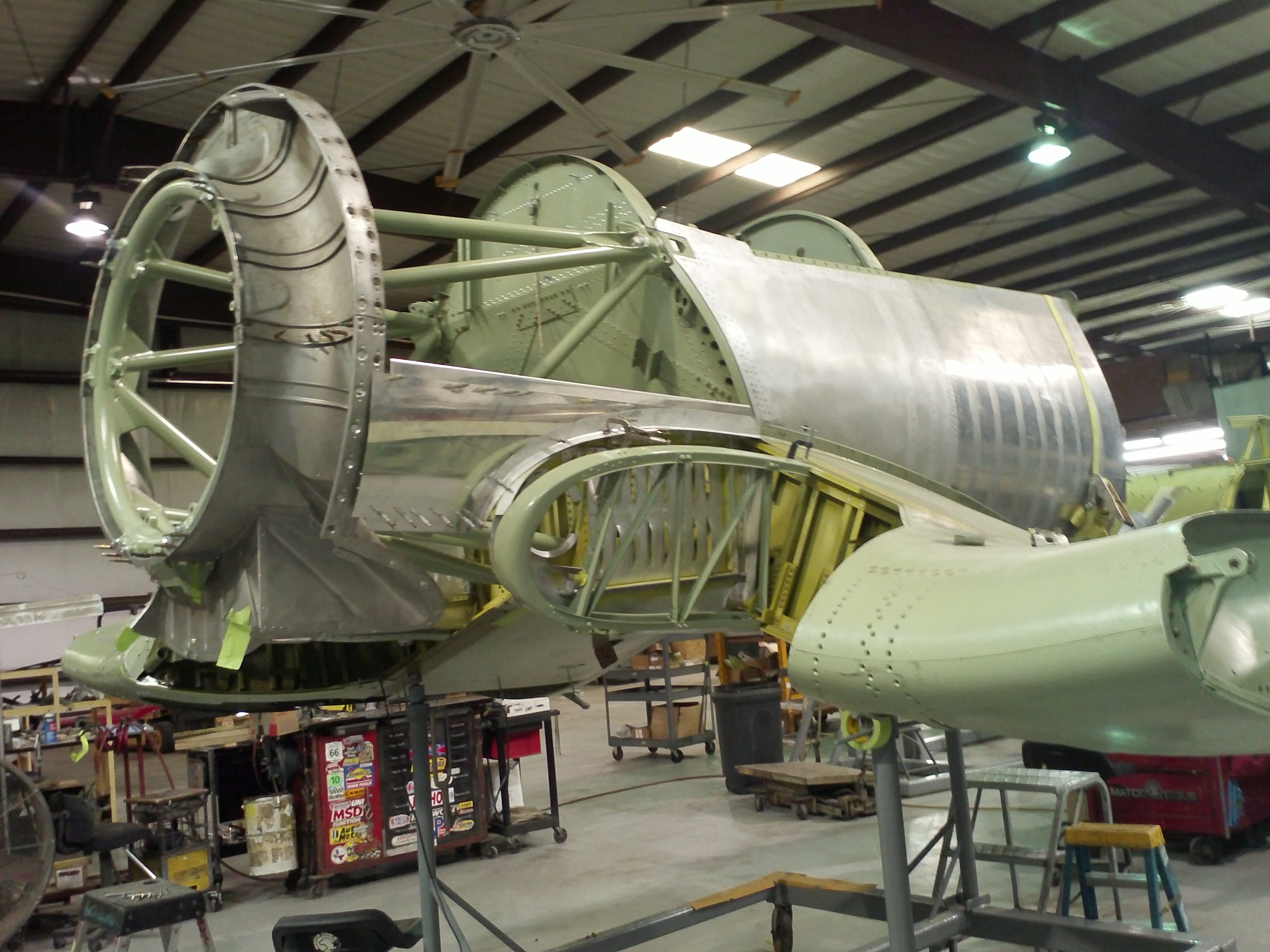
One example is BuNo 11289, the 731st built, accepted on 7 July 1944. In August 1944 it was assigned to MAG-91 at Cherry Point, North Carolina, flying with squadrons VMF-911, VMF-912, VMF-913 and VMF-914; in May 1945 it moved to the group headquarters as the mount of Lieutenant Colonel Joseph M. Renner. A photograph shows rocket rails under its wings, yet its record shows no conversion to F3A-1D, and the MAG-91 inventory of 30 June 1945 listed 13 F3A-1s, 36 FG-1s, 14 F4U-1s and a single FG-1D.
End of service
By the end of the war more than half of the Navy's 305 F3A-1s had already been struck off charge, through accidents (over a hundred, around twenty of them fatal), wear or other causes such as airframes twisted by over-violent pull-outs; Listemann considers this in line with other types used for training in the United States. As the Navy decided to keep only fighter-bombers after the war, the F3A-1s, being pure fighters, were progressively withdrawn; the last three (BuNos 11240, 11283 and 11289) left the records on 31 May 1947.
Multimedia


