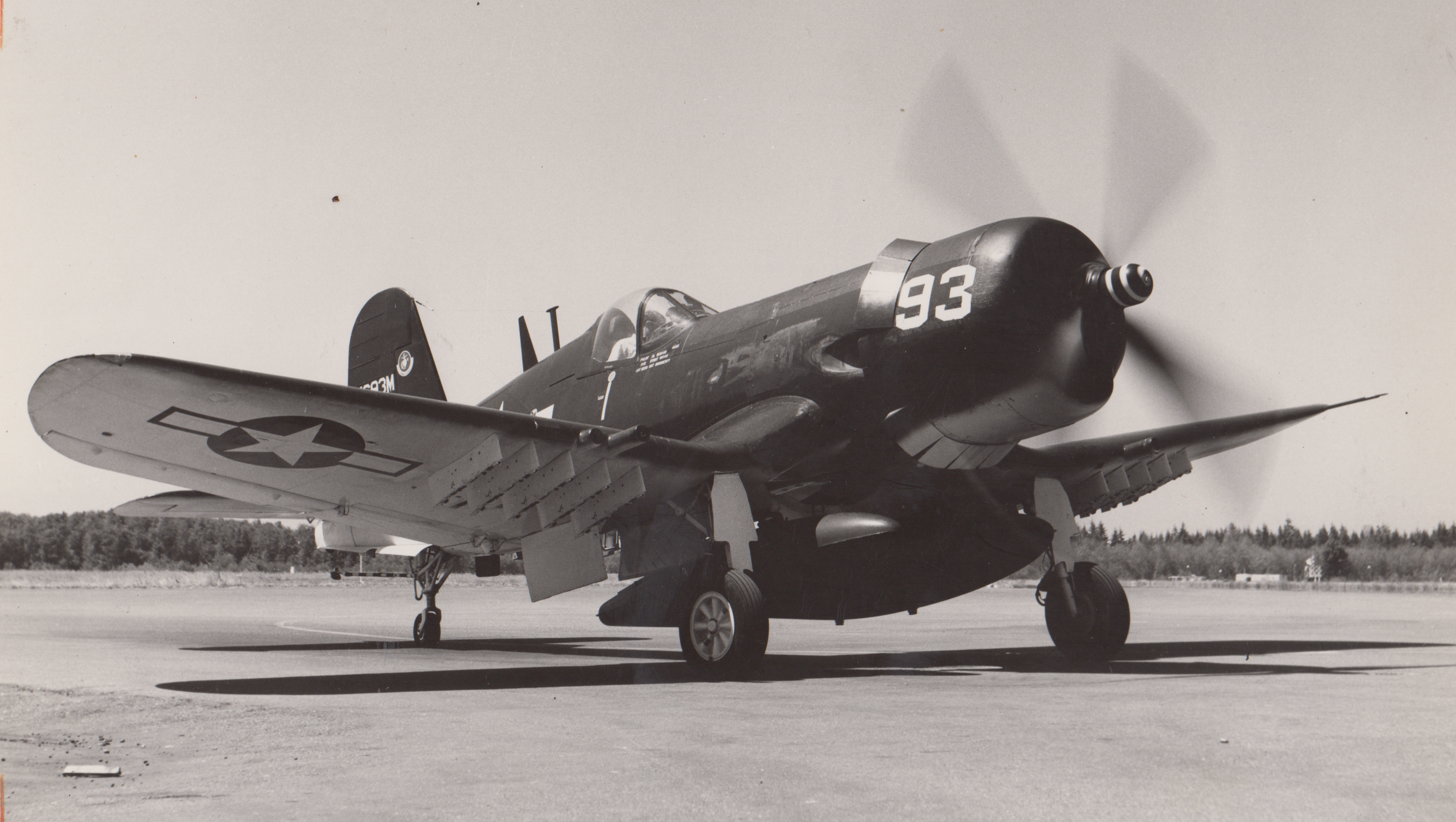
Vought F4U Corsair variant
Vought F4U Corsair F4U-7
The F4U-7 was the last Corsair built and the only one designed from the outset for a foreign customer: the French Aéronavale, which received it through the US Mutual/Military Assistance Program. It combined the armoured ground-attack airframe of the AU-1 with the R-2800-18W engine of the F4U-4. Ninety-four were built at Dallas in 1952-1953. It fought at the end of the Indochina War, at Suez (1956), in Algeria and at Bizerte (1961), and was retired in 1964.

- July 2, 1952
- First flight
- 94
- Units built
History
Origins
The F4U-7 was the last Corsair model to leave the Chance Vought line and the only one conceived from the start for a foreign customer: the Aéronavale, the air arm of the French Navy. In the early 1950s, with the Indochina War under way, the French wanted a carrier-based close-air-support aircraft more capable than the second-hand Hellcats, Helldivers and Bearcats they had been given. The Korean War had turned Washington into the paymaster of that effort, and the aircraft was funded through the US Military Assistance Program: technically the US Navy bought it and handed it over to France.
The Aéronavale asked for a Corsair that combined the ground-attack capability of the AU-1 — the armoured version then being built for the Marines — with the performance of the F4U-4 fighter. The answer was an AU-1 airframe, with armour plate under the fuselage, oil coolers moved into the fuselage and underwing pylons, powered by the F4U-4's water-injected Pratt & Whitney R-2800-18W of 2,100 hp under a revised cowling. According to Tom Cleaver, who worked on the restoration of one example, the engines were taken from F4U-4s because they were no longer in production, and the cowling was not interchangeable with the F4U-4's: the F4U-7 was an AU-1 with an F4U-4 engine, not an F4U-4 with metal wings.
Production and characteristics
The XF4U-7 prototype made its test flight on 2 July 1952. Ninety-four aircraft were built at the Dallas plant (79 in 1952 and 15 in 1953), according to the English and French Wikipedias and HistoryNet; Cleaver gives 96, built between June and Christmas Eve 1952, which does not match the other sources. The last of the batch, which was also the last Corsair of a production run begun before the Second World War, rolled out on 31 January 1953, placing it among the last piston-engined fighters still in production anywhere.
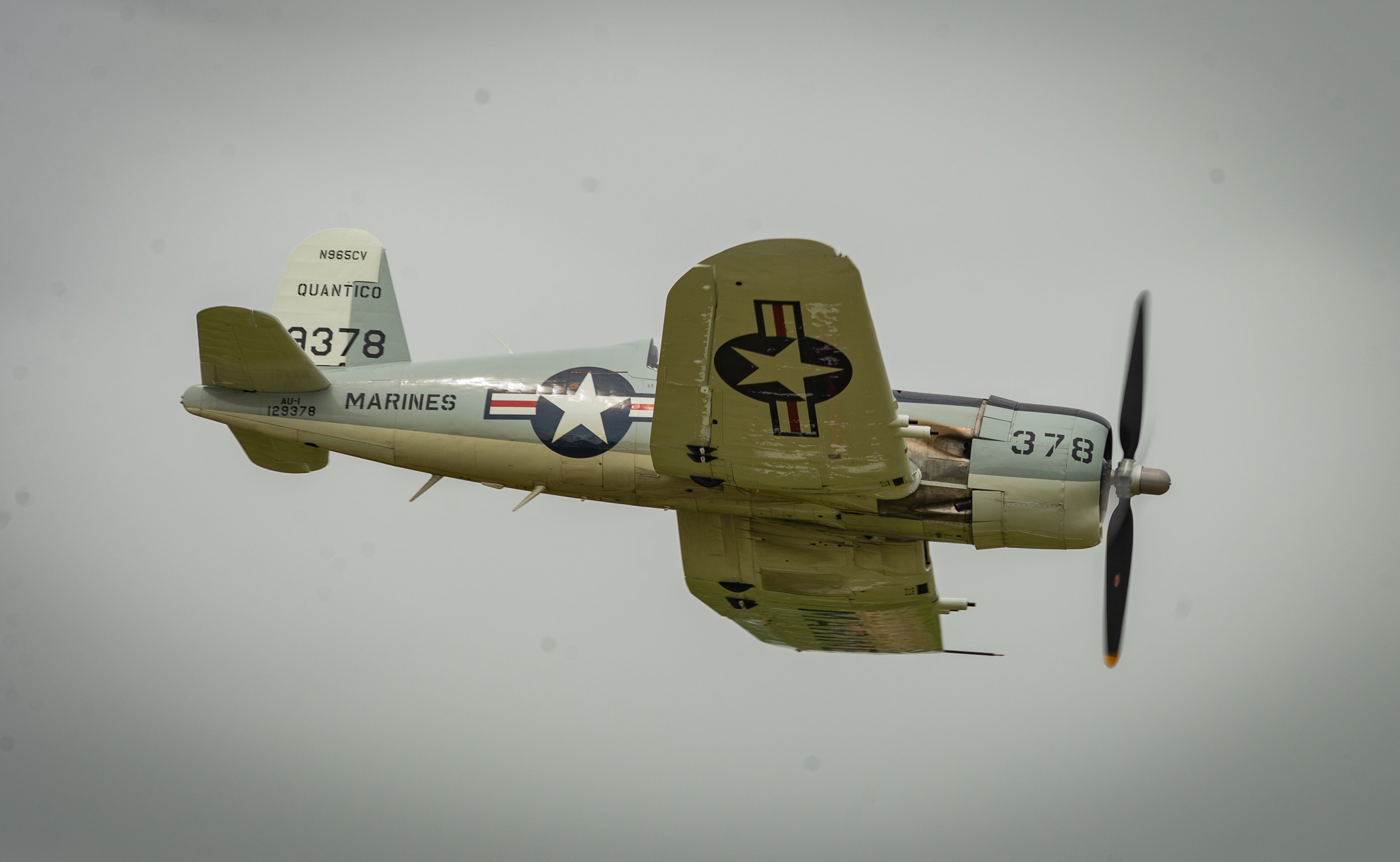
Vought's data sheet, partly estimated from the R-2800-18 engine and the AU-1 airframe, gives a maximum speed of about 718 km/h, an initial climb rate of nearly 20 m/s, a service ceiling of about 12.6 km and a cruise speed of about 346 km/h. Armament was four 20 mm cannon, or ten 127 mm rockets under the wings, or one 1000-lb (about 454 kg) bomb on the centreline rack, or two 500-lb (about 227 kg) bombs on the wing pylons.
Arrival in France and Indochina
The first unit to receive it was Flottille 14F, formed in January 1953 at Karouba air base near Bizerte, Tunisia; the English Wikipedia dates the first delivery to 15 January 1953, while Cleaver places the first French acceptances at NAS Oceana from October 1952. It also equipped 15F and 12F, the latter from August 1953.
In spring 1954, with Dien Bien Phu besieged, 14F's pilots reached Da Nang on 17 April without their aircraft; the next day the carrier USS Saipan delivered 25 Korean-veteran AU-1s from the Marines. The campaign was flown with those aircraft, not with F4U-7s: 959 combat sorties and 1,335 flight hours in three months, with six aircraft damaged and two shot down by the Viet Minh (Cleaver speaks of six aircraft and two pilots lost). Dien Bien Phu fell on 7 May and the ceasefire came on 21 July 1954. 14F's F4U-7s were then ferried to Da Nang aboard Bois Belleau and flew during the French disengagement; in September 1954 they were loaded aboard Dixmude for France, arriving in November. In 1956 Flottille 15F returned to South Vietnam with F4U-7s.
Suez
The F4U-7's best-known action was Operation Musketeer, the Anglo-French intervention at the Suez Canal in November 1956. Flottilles 14F and 15F took 36 Corsairs aboard the carriers Arromanches and La Fayette, painted with yellow-and-black recognition stripes; according to Cleaver they made up a quarter of the allied carrier strike aircraft. They were tasked with destroying Egyptian Navy ships at Alexandria, a mission thwarted by the presence of US Navy ships; on 3 November sixteen F4U-7s attacked airfields in the Nile Delta. One aircraft was lost to anti-aircraft fire — 14F's commanding officer was killed — and another in an accident, and two more were damaged on landing back aboard. Flying up to four sorties a day per pilot, the Corsairs dropped 25 tons of bombs and fired more than 500 rockets and 16,000 20 mm rounds, and sank an Egyptian torpedo boat. It was the Corsair's last major combat operation.
Algeria and Bizerte
After disembarking at the end of 1956, the three flottilles moved to Telergma and Oran in Algeria, flying close air support and helicopter escort; in April 1958 they were joined by the new 17F, formed at Hyères, whose first aircraft was the F4U-7 and which used it mainly for training until April 1962. Between 1955 and 1962 the F4U-7s of 12F, 14F, 15F and 17F, with some borrowed AU-1s, flew in the Algerian War, and in February and March 1958 also from Bois Belleau, the only carrier involved in that conflict. In early 1959 12F tested the SS.11 wire-guided anti-tank missile on the F4U-7, the pilot steering it by hand from about two kilometres while flying with the other hand; the trials were reportedly effective, but the weapon was not used in combat.

In July 1961, after Tunisia blockaded the French base at Bizerte on 17 July, Corsairs of 12F and 17F escorted the paratroopers dropped as reinforcements, and between 19 and 21 July the Aéronavale flew more than 150 sorties against Tunisian troops and vehicles. Three aircraft were damaged by ground fire and, according to HistoryNet, none was lost.
Retirement and survivors
The Aéronavale used 163 Corsairs in all: 94 F4U-7s and 69 AU-1s. 12F gave up the type in August 1963 to become the first F-8E(FN) Crusader flottille, and 14F, the last unit flying it, retired it in 1964; HistoryNet dates the retirement to 28 September 1964. Some examples were preserved in museums and others went to private owners. BuNo 133722, accepted in February 1953 and serving with 15F at Suez, returned to the United States, flew again in August 1976 after restoration, wore its Suez markings once more and toured Europe before passing in 1996 to the Tillamook Air Museum. BuNo 133693, bought in 1964 by Lynn Garrison and registered N693M, was destroyed in a crash in San Diego in 1987.
Multimedia