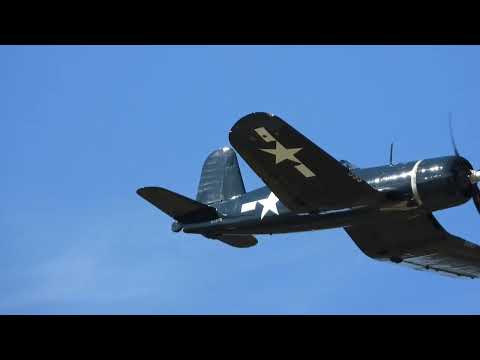
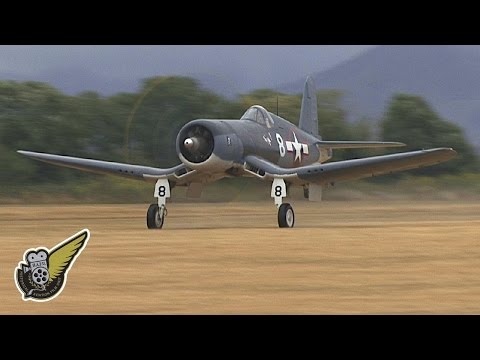
Vought F4U Corsair variant
Vought F4U Corsair FG-1D
The Goodyear FG-1D is the Corsair built under licence by Goodyear Aircraft at Akron, Ohio, equivalent to the Vought F4U-1D fighter-bomber. Goodyear delivered 1,997 of this model within an FG-1 series that reached 4,007 aircraft, about a third of all wartime Corsairs. It served with U.S. Navy and Marine Corps squadrons and with the post-war Naval Reserve; Britain's Fleet Air Arm received 457 as the Corsair Mk IV and the Royal New Zealand Air Force 60, which flew in the occupation of Japan. The Salvadoran Air Force flew it until 1976 and lost two in combat in the 1969 Football War, the last clashes between piston-engined fighters.

- 1,997
- Units built
History
Goodyear enters aviation
After Pearl Harbor, in December 1941, the U.S. Navy tasked Goodyear (a company that, according to Aerostories magazine, knew nothing about aircraft construction at the time) with building its own version of the F4U-1 under the designation FG-1, in parallel with Brewster (F3A). Goodyear Aircraft's Akron, Ohio, plant converted successfully: the first FG-1 flew in February 1943, deliveries began in April and by the end of that year 377 aircraft had been handed over (378 according to Spanish Wikipedia). Some FG-1As left the line with fixed, non-folding wings, intended for land-based Marine units.
From F4U-1D to FG-1D
The F4U-1D appeared in April 1944 in answer to the Navy's need for fighter-bombers. It used the water-injected R-2800-8W Double Wasp, worth up to 250 hp more; it deleted the leading-edge fuel tanks and added two underwing pylons, each able to carry a 1,000 lb bomb or a drop tank, plus permanent rocket rails and a one-piece blown canopy that became standard. Vought introduced the changes and Goodyear and Brewster followed some weeks later, not always identically: the first FG-1Ds, delivered at the end of July 1944, did not get the water-injected engine but the classic R-2800-8, and rocket rails under the folding wings arrived from late summer 1944. Aerostories also warns that underwing pylons alone do not identify an FG-1D: the MAG-91 inventory of 30 June 1945 listed 36 FG-1s and a single FG-1D.
Production
Goodyear built 1,997 FG-1Ds, according to Seattle's Museum of Flight, and delivered 4,007 FG-1 series Corsairs in all by the end of the war, about a third of the Corsairs produced during the conflict. According to the National Naval Aviation Museum, by the end of the war Goodyear Corsairs were flying with over 50 Navy and Marine Corps squadrons ashore and aboard carriers. FG-1Ds of Marine squadron VMF-323 flew over Okinawa in 1945.
Museum examples
The Museum of Flight's FG-1D (serial number 88382) was delivered to the Navy in April 1945 and served aboard USS Intrepid. It then passed to the Naval Reserve and by 1950 was based at Naval Air Station Sand Point; in July that year Commander Ralph Milleson ditched it in Lake Washington after a non-fatal mid-air collision with another Corsair. The aircraft lay under about 58 metres of water until it was recovered in 1983 and restored; it is on loan from the National Naval Aviation Museum in Pensacola. That museum holds FG-1D Bureau Number 92246, which entered service in June 1945 and flew mainly with the Naval Air Reserve until it was stricken from the inventory in 1976. The Museum of Flight lists a wingspan of about 12.5 metres, a top speed of about 668 km/h and a 2,250 hp R-2800 engine.
Corsair Mk IV in the Fleet Air Arm
British naval aviation received 857 Goodyear Corsairs as the Corsair Mk IV: 400 FG-1s and FG-1As and 457 FG-1Ds. The Mk II and Mk IV were the only British versions to see combat. At the end of the war, since Lend-Lease aircraft had to be paid for or returned, Royal Navy Corsairs were pushed overboard into Moreton Bay, off Brisbane.
New Zealand and the occupation of Japan
Sixty FG-1Ds reached the Royal New Zealand Air Force late in the war; until then it had flown mainly F4U-1s and F4U-1Ds. After the Japanese surrender No. 14 Squadron was re-formed with newer FG-1Ds, whose cost the United States covered by extending Lend-Lease, and in March 1946 it moved to Iwakuni as part of the British Commonwealth Occupation Force (J-Force). Its pilots flew armed patrols to protect arms and bomb dumps, locate hidden ammunition and check schoolyards for forbidden military parades, and watched the sea between Japan and Korea to turn back people-smuggling boats. In February 1948 the squadron moved to Hōfu to replace Australian Mustangs. In 29 months in Japan it logged 6,225 flying hours in 6,109 sorties. Once J-Force was to be wound up, twenty Corsairs were stacked at one end of the airfield and set alight (October 1949, according to the source), as they were judged to be at the end of their useful life and not worth shipping back to New Zealand. The only airworthy survivor of the New Zealand fleet is FG-1D NZ5648/ZK-COR, owned by the Old Stick and Rudder Company at Masterton.
El Salvador and the Football War
The Salvadoran Air Force operated 20 FG-1Ds, alongside five F4Us, from 1957 to 1976. On 17 July 1969, during the war with Honduras, Honduran Captain Fernando Soto, flying F4U-5 FAH-609, shot down two Salvadoran FG-1Ds, FAS-203 and FAS-204 (English Wikipedia calls them FG-1s); Captains Salvador Cezeña Amaya and Guillermo Reynaldo Cortés were killed, the latter the highest-ranking casualty of the war. Those combats were the last ever fought between piston-engined fighters.

Multimedia