Flying the Vought F4U "Corsair" Fighter (1944)
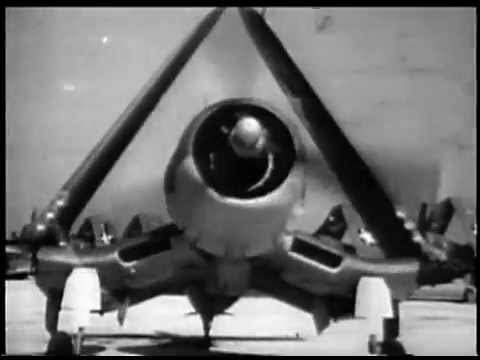
Video from the channel ZenosWarbirds about Vought F4U Corsair, linked on its Above Ten Thousand entry. Duration: 21:05. Language: English. Video type: Archive footage.
What it shows
Training film for pilots of the Vought F4U Corsair that walks through, with a real aircraft on the ground and in flight, the complete handling of this carrier-based fighter. It starts with engine start-up: with the ignition off, the propeller is turned three or four times, a cartridge is loaded into the starter, the auxiliary pump raises fuel pressure to about 17 pounds, and the engine is primed for 4 to 7 seconds depending on whether it is cold or warm. This is followed by the hydraulic deployment of the folding wings, with the hinge pins locked, and taxiing in S-turns to compensate for the poor forward visibility.
In flight, we see the runway take-off, at 45 inches of manifold pressure and 2,700 rpm (up to 53.5 inches if needed), and the carrier-type take-off with half flaps, 20 to 30°. Then comes the climb at military power, about 3,000 feet per minute and limited to 5 minutes, and the supercharger gear changes as altitude is gained; cruise settings; stalls, abrupt and with the left wing dropping (around 77 knots with flaps at 30° and power off); the dive with the canopy closed above 300 knots and not exceeding 7 g, and aerobatics such as the loop and the Immelmann at around 210 knots or the slow roll at around 180.
When and where it was filmed
This is period footage filmed at a land airfield with a runway. It distinguishes between early F4Us, which had a checklist switch on the panel, and later models, which had the checklists engraved on plates. It ends with a simulated carrier landing on the ground on a platform, guided by the landing signal officer up to the order to cut power.
Context
The film stresses the torque of the large radial engine, which requires setting the trim tabs before take-off (6° of rudder to the right, 6° of aileron with the right wing down, and 1° nose-up). It details the fuel system: a pressurized, self-sealing main tank of 230 gallons, the only one with a gauge, and two 57-gallon tanks in the outer wings, which are used first, starting with the left one; in combat overload the aircraft carries 344 gallons internally and 160 in a droppable belly tank, 504 total. Its final message is that nothing about the Corsair escapes good piloting technique.