How A ‘Rejected’ Design Won The Pacific Air War | Vought F4U Corsair
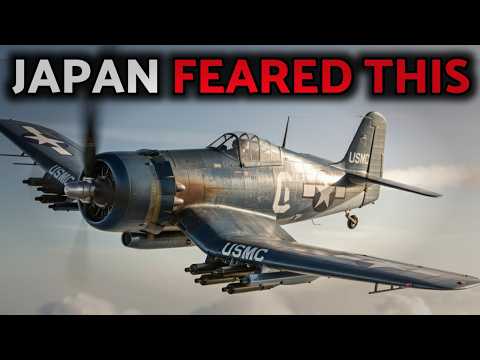
Video from the channel AeroDepth about Vought F4U Corsair, linked on its Above Ten Thousand entry. Duration: 17:35. Language: English. Video type: Documentary.
What it's about
The documentary traces the history of the Vought F4U Corsair from its design to its retirement. It focuses on how a fighter initially rejected by the Navy for carrier use ended up being one of the most effective in the Pacific.
Historical background
In 1938, the US Navy's Bureau of Aeronautics requested a carrier-based fighter built around the new Pratt & Whitney R-2800 Double Wasp engine, rated at 1,850 hp. Rex Beisel's team at Chance Vought needed a 13-foot 3-inch propeller. To avoid lengthening the landing gear, they chose the inverted gull wing. Vought won the XF4U-1 contract in June 1938. The prototype exceeded 400 mph in level flight, and in June 1941 584 aircraft were ordered. Due to poor visibility, landing gear bounce and asymmetric stall, the Navy declared it unsuitable for carriers in 1942. The aircraft then went to the Marines, who debuted it at Guadalcanal in February 1943. It made Gregory "Pappy" Boyington's VMF-214 famous. Britain's Fleet Air Arm fixed the flaws: it softened the oleo strut, added a spoiler to the right wing's leading edge, and adopted a curved approach.
Key facts
It is credited with 2,140 Japanese aircraft shot down against 189 Corsairs lost in aerial combat, an 11-to-1 ratio. More than 12,500 were built among Vought, Goodyear (FG-1) and Brewster (F3A-1). Its variants include the F4U-1A, with a raised cockpit; the F4U-1C, with four 20mm cannon; the F4U-1D fighter-bomber; and the F4U-5, with 2,200 hp and 465 mph. The last variant, the F4U-7, was built for the French Navy, which received the final examples in 1953. It served in Korea, Indochina, Algeria and Suez, and fought for the last time in the 1969 Football War. Between 80 and 90 examples survive, around 20 of them airworthy.