Vought F4U Corsair documentary 1997
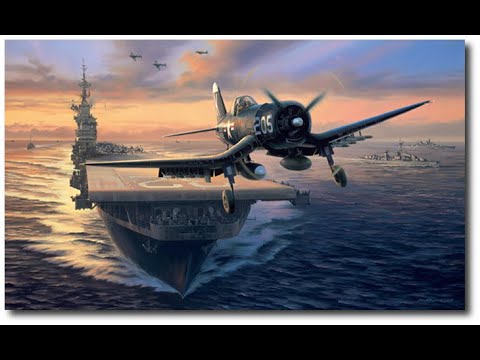
Video from the channel illusive 0ne about Vought F4U Corsair, linked on its Above Ten Thousand entry. Duration: 48:05. Language: English. Video type: Documentary.
What it's about
A two-part 1997 programme about the Vought F4U Corsair. In the first part, a pilot carries out the pre-flight inspection, engine start-up and a test flight of the Planes of Fame museum's F4U-1, and comments on its handling. In the second, a former Marine pilot of squadron VMF-225 recounts his experience with the aircraft during the Second World War.
Historical background
The Corsair was born in 1938, when the US Navy called for a carrier fighter matching the performance of land-based fighters. It was designed around the experimental 2,000-hp Pratt & Whitney XR-2800 engine and a Hamilton Standard propeller of about 13 feet. To avoid needing a long, complicated landing gear, the wing was given the inverted gull shape. The museum's aircraft saw combat at Bougainville; the museum bought it in 1970, returned it to flight in 1976, and considers it the only flying F4U-1 in the country.
The veteran describes his training at Mojave with the early birdcage-cockpit F4U-1s: two days to pass the manual exam and another two for a blindfolded cockpit check. On his first flight, his section leader had to parachute over the desert. He then passed through Pearl Harbor and Espiritu Santo, boarded the USS Wasp from Ulithi, and took part in strikes on the Tokyo area. In one of them, a Zero fighter surprised his formation, and a friend, a dive-bomber pilot, was reported missing in action.
Key facts
The long-stroke landing gear was designed so the aircraft would not bounce on the deck, and it rotates 90 degrees as it retracts. A stall strip on the right wing's leading edge makes that wing stall at the same time as the ailerons lose effectiveness. Because of flutter problems, the ailerons became fabric-covered wood, from the F4U-1 through the F4U-7. In flight, the stall occurs around 73-75 knots. At a 200-knot cruise the engine burns 75 to 80 gallons per hour, and at 145 knots about 45. The programme credits Corsair pilots with 2,120 kills against 189 aircraft lost, a ratio of about 11 to 1. It also notes that Charles Lindbergh flew the aircraft in combat as a civilian and that the Japanese called it "whistling death."