The F4U Corsair: The Fighter That Was Too Dangerous for Its Own Carrier
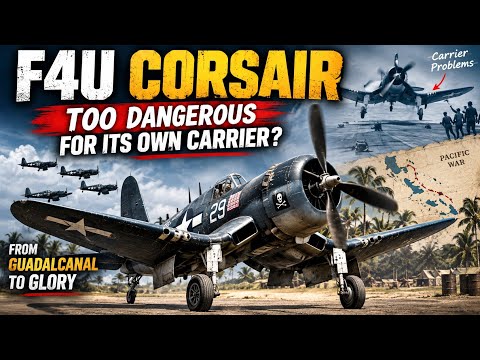
Video from the channel ERAQUORA about Vought F4U Corsair, linked on its Above Ten Thousand entry. Duration: 6:36. Language: English. Video type: Documentary.
What it's about
Documentary about the Vought F4U Corsair that explains why a fighter designed for carriers was initially barred from flight decks and how it eventually returned to them.
Historical background
In 1938 the Navy's Bureau of Aeronautics requested a high-speed fighter. Chance Vought started from the Pratt & Whitney R-2800, an 18-cylinder, 2,000 hp engine, whose large propeller forced the adoption of the inverted gull wing to keep the landing gear short. Since the machine guns took the place of the wing fuel tanks, a 897-litre tank was fitted in the fuselage and the cockpit was moved back nearly 3 ft. Poor visibility on approach, premature stalling of the left wing and gear bounce earned it the nickname "Ensign Eliminator". The Navy then handed it over to the Marines, who gave it its combat debut in February 1943 over the Solomon Islands with VMF-124.
Key facts
According to the video, Gregory Boyington, commanding VMF-214 "Black Sheep", destroyed 28 enemy aircraft. The Corsair racked up 2,140 air victories against 189 losses, flew 44% of Navy and Marine fighter sorties and dropped 70% of the bombs released by US fighters in the Pacific. For its return to carriers, Britain's Fleet Air Arm devised a continuous-turn approach. Vought, for its part, fitted a bubble canopy that allowed the seat to be raised 8 in and increased landing-gear shock-strut pressure to 350 psi. It later served in Korea in close air support, flown among others by Jesse L. Brown, the first African-American naval aviator.