Why Japanese pilots feared the F4U Corsair more than any other Allied fighter
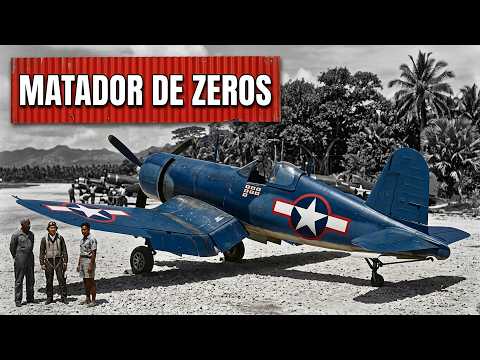
Video from the channel Lendas da Guerra no Céu about Vought F4U Corsair, linked on its Above Ten Thousand entry. Duration: 42:56. Language: Portuguese. Video type: Documentary.
What it's about
Documentary narrated in Portuguese about the Vought F4U Corsair in the Pacific War. It opens with its combat debut, on 14 February 1943, when twelve Corsairs of the Marine squadron VMF-124 took off from Guadalcanal to escort Liberator bombers against Japanese ships near the Shortland Islands and ran into around fifty Zeros out of Kahili. In under twenty minutes the Americans lost eight aircraft, two of them Corsairs, against three Zeros: the so-called "Valentine's Day Massacre." From there, the video explains how the aircraft went from that defeat to becoming a greatly feared fighter.
Historical context
The account compares the Corsair with the Mitsubishi A6M Zero, which Jiro Horikoshi lightened at the cost of removing pilot armor and self-sealing fuel tanks. The XF4U-1 prototype, the work of Rex Beisel, made its maiden flight on 29 May 1940 with Lyman Bullard at the controls. It carried a Pratt & Whitney R-2800 Double Wasp, an 18-cylinder engine with almost 2,000 horsepower. The inverted gull wing allowed the use of a propeller around 4 m across without lengthening the landing gear. Because it failed carrier qualification trials in 1942 due to poor visibility, bouncing and abrupt stalls, the Navy handed it over to the Marines. VMF-124's commander, William E. Gise, died on 13 May 1943. Kenneth Walsh prevailed with the tactic of diving at high speed, firing a single pass, and climbing back up, without engaging in turning fights. The video also follows Gregory Boyington and his VMF-214, the "Black Sheep," and John Thomas Blackburn's VF-17 over Rabaul.
Key facts
According to the documentary, the Zero's decline was due both to the attrition of veteran Japanese pilots and to the aircraft itself: replacement pilots' training hours fell to around 100. Charles Lindbergh, as a civilian consultant for United Aircraft in 1944, taught Corsair pilots to adjust mixture, propeller pitch and throttle to nearly double their range. Boyington, shot down in January 1944, survived as a prisoner at Omori and received the Medal of Honor from Truman in October 1945. The Corsair was built until 1953, with more than 12,500 units made by Vought, Goodyear and Brewster. It fought in Korea and, for the last time, in 1969, in the war between Honduras and El Salvador.