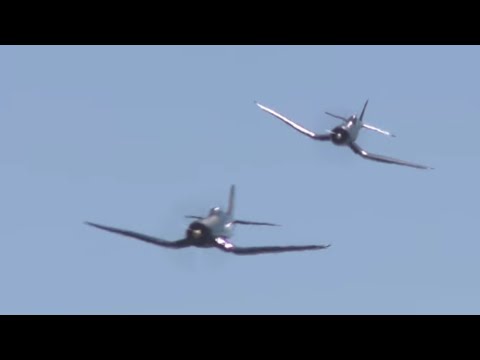
Vought F4U Corsair variant
Vought F4U Corsair F4U-1D
The F4U-1D was the fighter-bomber version of the wartime Corsair: introduced in April 1944 and built alongside the F4U-1C, it combined the water-injected R-2800-8W engine, permanent rocket rails, twin centre-section pylons for bombs or drop tanks and the one-piece blown canopy. Vought delivered 1,685, while Goodyear and Brewster built the equivalent FG-1D and F3A-1D.

- 1,685
- Units built
History
Origins: from fighter to fighter-bomber
By early 1944 the U.S. Navy needed fighter-bombers more than pure fighters, and the powerful, rugged Corsair was the natural candidate. The answer was the F4U-1D, introduced in April 1944, the same month the Navy finally accepted the F4U for shipboard operations once a longer oleo strut had cured its tendency to bounce. It was built in parallel with the F4U-1C (the cannon version, of which only 200 were made, all based on the -1D) and kept the standard armament of six .50-calibre machine guns.
Water-injected engine
The key change was the Pratt & Whitney R-2800-8W Double Wasp with water injection. It had first been tried on one of the late F4U-1As and, after satisfactory results, became the production engine of the -1D. Water injection gave up to 250 hp (190 kW) of extra power, and top speed rose from 671 to 684 km/h.
Rockets, bombs and drop tanks
What defined the -1D was its strike capability. It carried permanent rocket launching rails with twice the rocket load of the -1A, and it was the first model with twin pylons under the inner wing sections able to take two 606-litre drop tanks or two 454 kg bombs, an exceptional load for a fighter. The external stores added drag, but the fuel in the drop tanks still allowed relatively long missions despite the heavy load. On 31 January 1945 F4U-1D Bureau Number (BuNo) 57569 was photographed at the Naval Air Test Center, Patuxent River, carrying eight 5-inch HVAR rockets under its wings and two 11.75-inch "Tiny Tim" rockets.
Bubble canopy
The -1D adopted as standard the one-piece, clear-view "blown" canopy, which was retained on every later production Corsair.
Production
Vought built 1,685 F4U-1Ds in 1944. Navy serial records list, among others, the blocks 50360-50659, 57084-57656 and 57660-57776, with aircraft spread across Navy and Marine squadrons and batches diverted to New Zealand and the United Kingdom. Goodyear and Brewster built the same model under licence as the FG-1D and F3A-1D.
Pacific service
The -1D arrived just as the Corsair moved onto carriers and into the close-support role. The first U.S. Corsair unit effectively based on a carrier was the Marine squadron VMF-124, which joined USS Essex in December 1944; that squadron's F4U-1D 57662 was lost off Hainan on 16 January 1945. The kamikaze threat pushed more Corsair units onto carriers. Loss records show the type's daily war: 50371 of VMO-155 was lost off Kwajalein on 12 January 1945; 50368 of VMF-441 crashed off Okinawa on 9 March 1945; and 57785 of VMF-221, aboard USS Bunker Hill, was lost on 11 May 1945 when the kamikaze strike hit the ship's deck.
Allies
The British Fleet Air Arm received 150 F4U-1Ds, which had no separate designation and were counted among its Corsair Mk IIs. It also took 96 Brewster F3A-1Ds (Corsair Mk III) and 457 Goodyear FG-1Ds (Corsair Mk IV). The Royal New Zealand Air Force used 41 F4U-1Ds during the war alongside its F4U-1s.
The National Air and Space Museum aircraft
F4U-1D 50375 was delivered by Vought to the Navy on 26 April 1944. By October 1944 it was with VF-10, the "Grim Reapers" of USS Enterprise, and shortly afterwards with VF-89, then being equipped at Naval Air Station Atlantic City and later at Oceana and Norfolk. On 30 June 1945 it went to Quantico as surplus; after the war it passed through Memphis and the technical training centre at Pensacola, was stricken on 30 April 1946 and stayed at Norman, Oklahoma, most likely as a mechanics' trainer, until 21 November 1955, when it was shipped to Norfolk for storage pending the museum. Restoration revealed parts from other aircraft (the fin carried BuNo 57101 and the right elevator and stabilizer 50522), most likely the work of trainee mechanics. The restoration took 9,315 hours, and the aircraft was painted as ship number 56 of VMF-113, photographed over Eniwetok on 9 July 1944. In October 1980 veterans of VMF-214, the "Black Sheep", visited it with Gregory "Pappy" Boyington, who signed the inside of the right wheel well. It was moved into the museum on the night of 27-28 January 1981 and now hangs at the Steven F. Udvar-Hazy Center.
Another survivor, Vought-built 82640, was displayed from 1949 to 1985 at the War Museum of West Virginia, where its port wing was cut off for display; in 1985 it went to the Virginia Beach unit of the Commemorative Air Force and in 1998 to Gerald Yagen's Fighter Factory.
Multimedia