Vought F4U Corsair variant
Vought F4U Corsair F2G-1
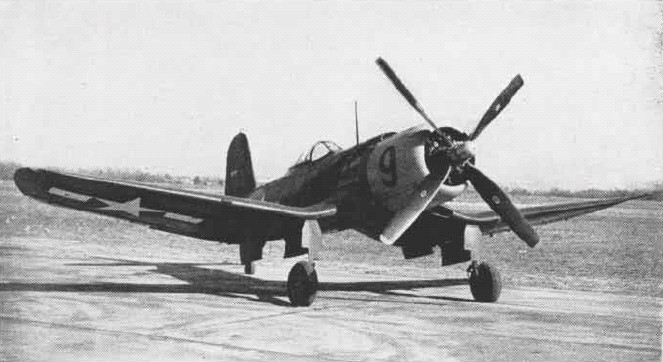
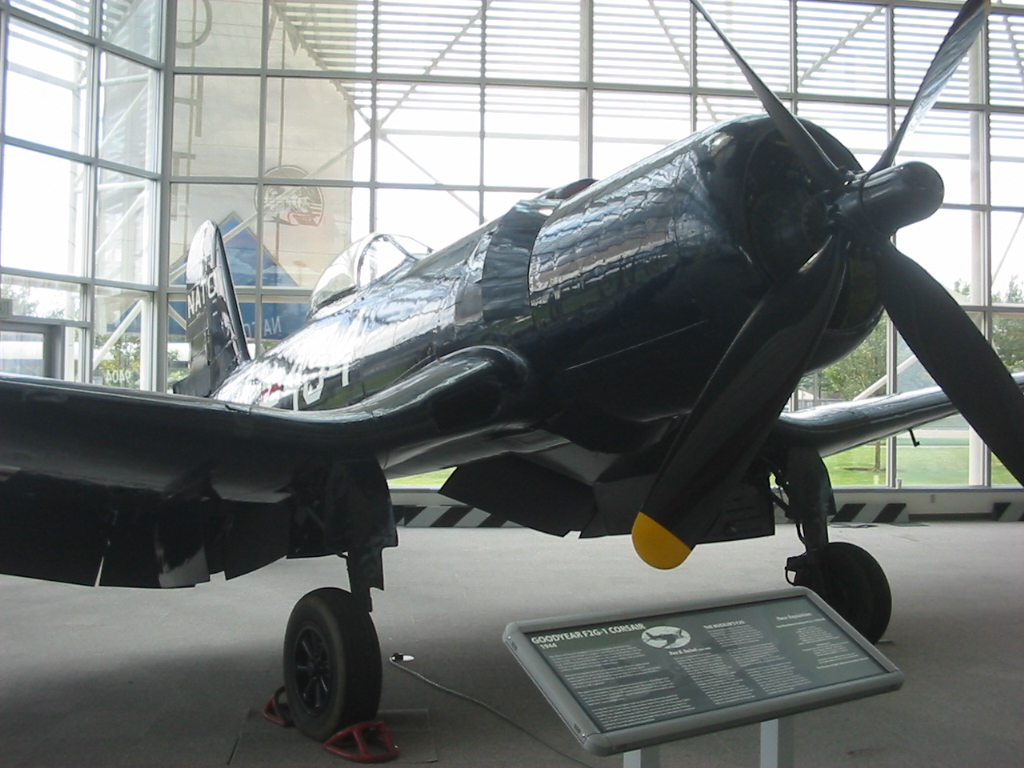
The F2G-1 is the land-based production version of the Goodyear F2G "Super Corsair", the Corsair fitted with the 28-cylinder Pratt & Whitney R-4360 Wasp Major radial. Conceived in 1944 as an anti-kamikaze interceptor, with a bubble canopy and manually folding wings, it was ordered in a batch of 418, but the end of the war stopped production at five aircraft of each version. Never used in combat, the F2G shone in post-war racing with Cook Cleland, who won the Thompson Trophy in 1947 and 1949. Two F2G-1s survive: 88454 at the Museum of Flight in Seattle and the airworthy 88458 "Race 57".

- 5
- Units built
History
Origins: a Corsair for the biggest piston engine
The F2G-1 is the land-based production version of the Goodyear F2G, known as the "Super Corsair" and the most radical branch of the Corsair family. It married the Vought fighter's airframe to the Pratt & Whitney R-4360 Wasp Major, an air-cooled, 28-cylinder, four-row radial of about 3,000 hp (2,200 kW) that the Museum of Flight in Seattle describes as the largest piston engine ever to enter production. This page covers the whole F2G branch: the XF2G-1 prototype and the carrier-going F2G-2 are recorded in the census as sister variants.
The idea of a fighter built around that engine dates back to 1939, when Pratt & Whitney first proposed the R-4360. The practical step came from Vought, which converted one F4U-1 - designated XF4U-1WM or XF4U-1M - to carry and test the Wasp Major; according to the Vought heritage association, it flew successfully on 12 September 1943. That led the Navy to ask Goodyear, already building the Corsair under licence as the FG-1, to develop the new aircraft, and design work began in early 1944.
An interceptor against the kamikazes
The F2G was conceived as a fast, low-altitude interceptor, to be flown from land bases against the growing kamikaze threat in the Pacific. Goodyear modified a number of standard FG-1 airframes as XF2G-1 prototypes to exploit a take-off power increase of around 50 per cent. The visible changes were an all-round vision bubble canopy replacing the original cockpit and turtle deck, a vertical stabilizer 12 inches (about 30 cm) taller and an auxiliary rudder to counter the huge engine's torque. English Wikipedia credits the F2G with a climb rate of 7,000 feet per minute (about 36 m/s), double that of a standard Corsair, although its own specification table gives 4,400 feet per minute (about 22 m/s); the exact figure remains open.
F2G-1 and F2G-2: two different aircraft
In March 1944 Goodyear was awarded a contract for 418 F2G-1 and 10 F2G-2 aircraft. The two versions were significantly different machines. The F2G-1, the land-based variant, had manually folding wings, no tail hook - which saved weight - and a 14 ft (4.3 m) propeller. The F2G-2, meant for carriers, added hydraulic wing folding, an arrester hook and a slightly smaller 13 ft (4.0 m) propeller. Internal fuel capacity was greatly increased over the F4U, and provision was made for two drop tanks.
Planned armament was four or six wing-mounted 12.7 mm machine guns plus eight 127 mm rockets, or alternatively two 1,000 lb (454 kg) Mk.83 general-purpose bombs or AN-Mk.1 armour-piercing bombs of up to 1,600 lb (725 kg). For its F2G-1 the Museum of Flight lists a wingspan of 12.5 m, a length of about 10.4 m, a height of 4.9 m, a wing area of 29 m2, an empty weight of 4,649 kg and a gross weight of 6,995 kg, with a top speed of 694 km/h and a cruising speed of about 306 km/h.
Cancelled without seeing combat
Post-production testing revealed deficiencies in lateral control and insufficient speed, which held development back. Moreover, the Grumman F8F Bearcat, already in production, offered comparable performance with the same engine as the original F4U. When the war ended in August 1945 the order was cancelled: only ten production F2Gs had been completed, five of each version. The F2G-1s carried Bureau of Aeronautics numbers (BuNos) 88454 to 88458, and the F2G-2s 88459 to 88463. None saw combat.
Sources disagree on the number of XF2G-1 prototypes: English Wikipedia's F4U article lists five (BuNos 14691 to 14695), its F2G article and the Museum of Flight speak of seven converted from FG-1s, and the Vought heritage association of eight.
88454, the first production F2G-1
The aircraft preserved in Seattle, BuNo 88454, was built in 1945 at Akron, Ohio, and was the first of the ten production F2Gs. It spent its active life at the Naval Air Test Center at Patuxent River, Maryland, whose markings it still wears, and at Naval Air Station Norfolk between 1945 and 1948; that year it went into containerised storage with only 246 flying hours. In the early 1960s it was found by Captain Walter Ohlrich. In 1966 it moved to the Bradley Air Museum at Windsor Locks, Connecticut, and in 1974 to the Marine Corps museum at Quantico, Virginia; during the 1976 Bicentennial it was displayed aboard USS Intrepid.
The Marine Corps museum traded it, together with a Douglas Skyraider, to Doug Champlin for a Dauntless dive bomber. Champlin kept it at Enid, Oklahoma, until he opened his museum in Mesa, Arizona, in 1981, when former Thompson Trophy racer Ron Puckett flew it to Falcon Field. In 2003 it reached the Museum of Flight with the rest of the Champlin collection, registered NX4324. Because of its rarity it will not fly again, and the "F2G-1D" stencil on its fin is incorrect.
Glory on the race courses
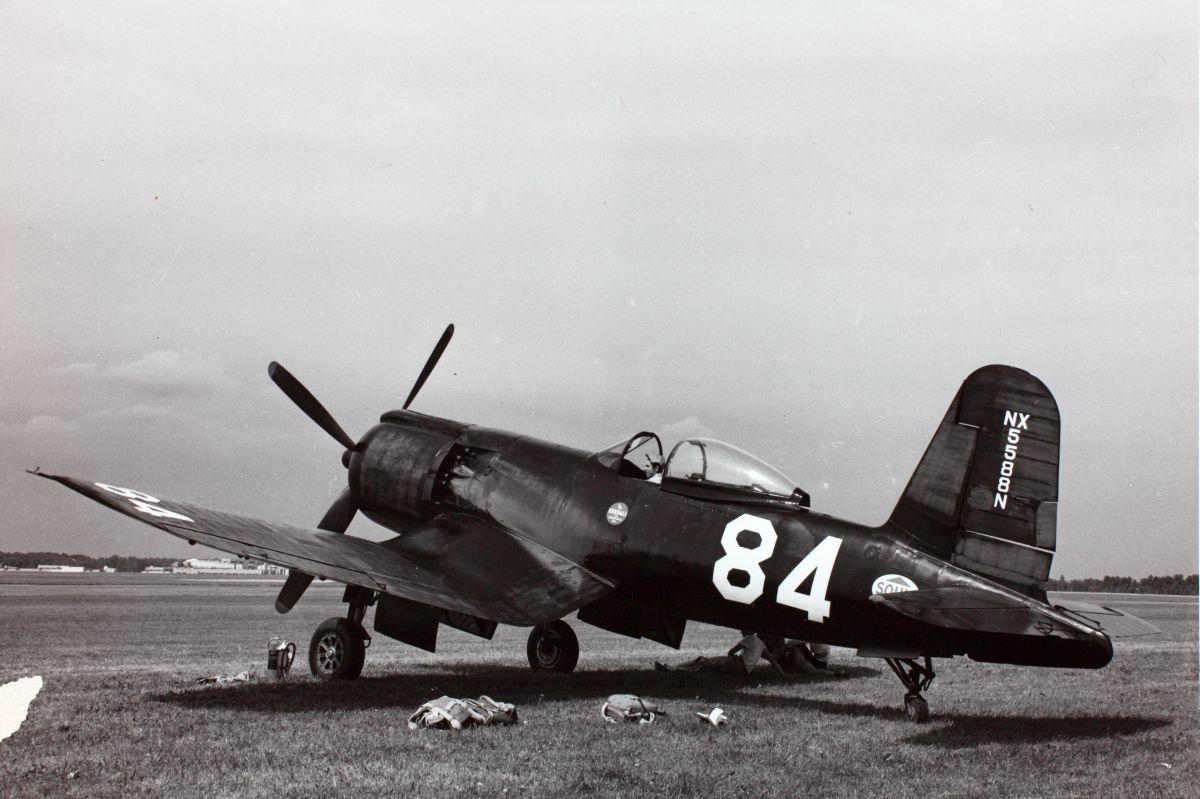
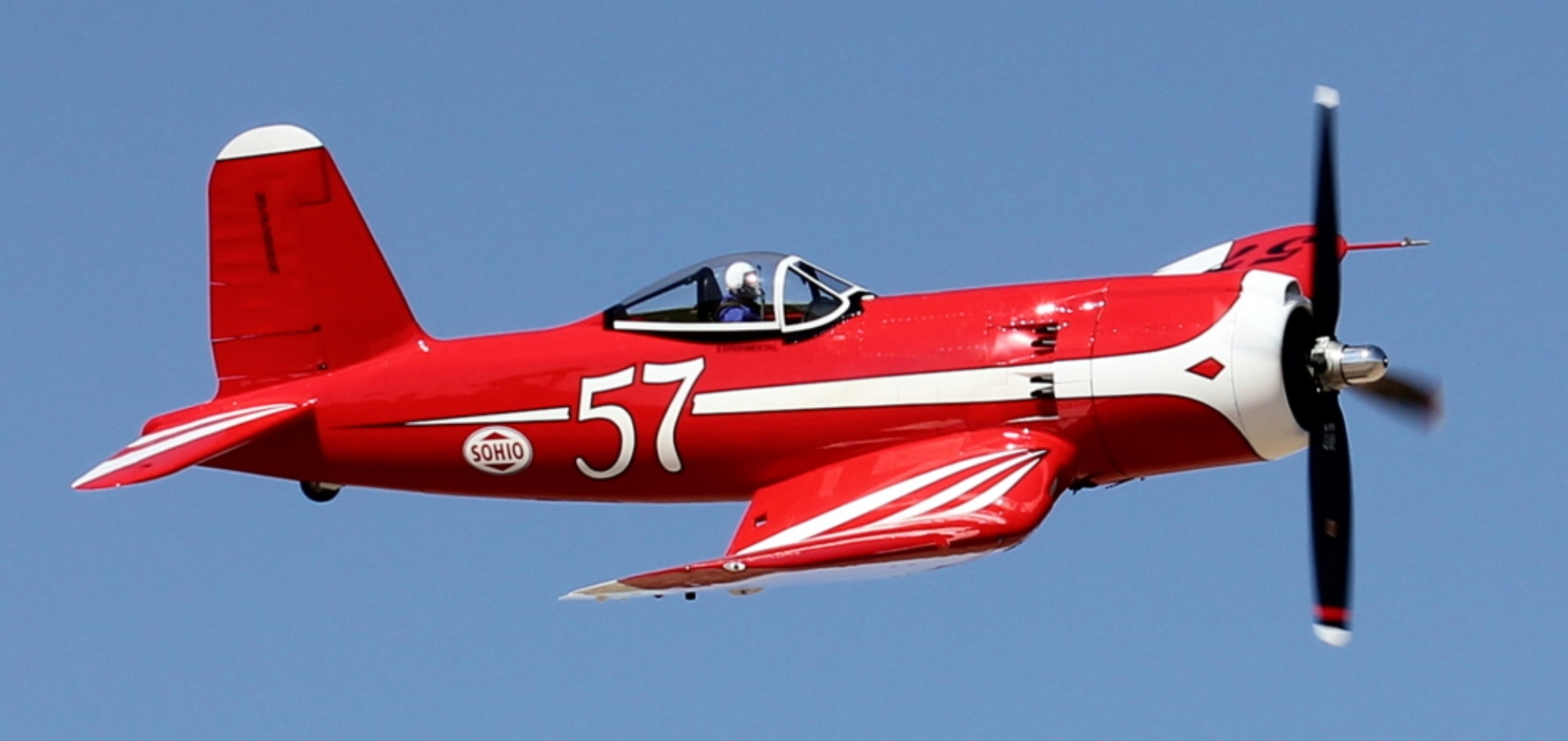
The Super Corsair made its name in post-war air racing. The Navy declared several F2Gs surplus in 1946, and naval aviator Cook Cleland acquired them: four according to the Museum of Flight, three according to the Vought heritage association. He heavily modified one, clipping six feet (1.8 m) off its span, and won the 1947 Thompson Trophy at Cleveland at 396 mph (637 km/h). In 1949, the last year of the piston-engine division, Super Corsairs swept the top three places with Cleland, Ron Puckett and Ben McKillen; Cleland won at 397 mph (639 km/h). In ten starts over three seasons the F2Gs scored two wins, two second places and one third. Several raced under their own numbers: 94 (BuNo 14693), 18 (14694), 84 (88457), 57 (88458) and 74 (88463).
Survivors
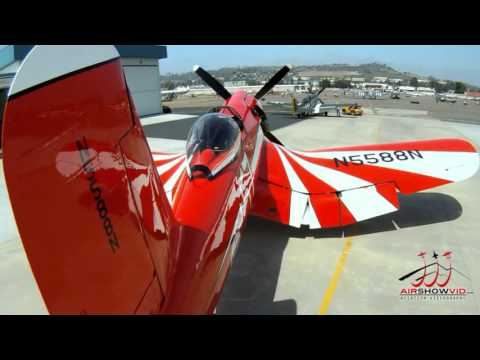
Two Super Corsairs survive, both F2G-1s. Besides 88454 in Seattle, 88458, known as "Race 57" and the fifth production aircraft, was bought by Cook Cleland; English Wikipedia credits it with first place in the 1947 Thompson Trophy and the 1949 Tinnerman Trophy. Registered NX5588N, it passed from owner to owner and slowly deteriorated until Bob Odegaard of North Dakota bought it in 1996 and returned it to flight in 1999. Odegaard raced it in the Unlimited class at Reno from 2006 to 2008, and it featured in the film Thunder Over Reno. In February 2017 it was bought by Steuart Walton and is based at Bentonville, Arkansas.
The only surviving F2G-2, 88463 "Race 74" (N5577N), had completed a full restoration in July 2011 but was destroyed on 7 September 2012 at Valley City, North Dakota, while Odegaard was rehearsing an airshow routine; the pilot was killed.
Multimedia