Vought F4U Corsair variant
Vought F4U Corsair F4U-5N
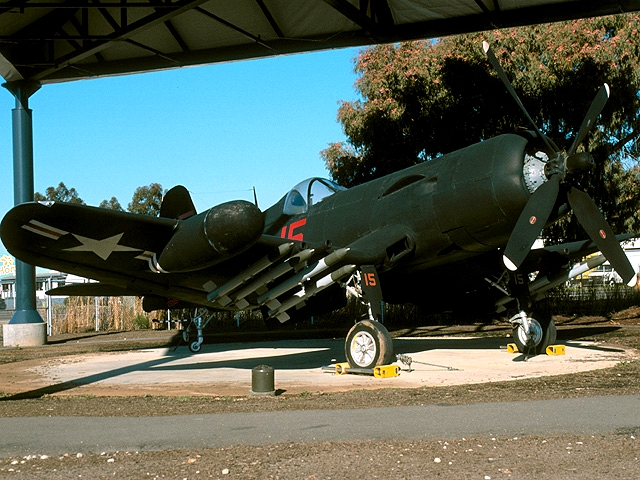
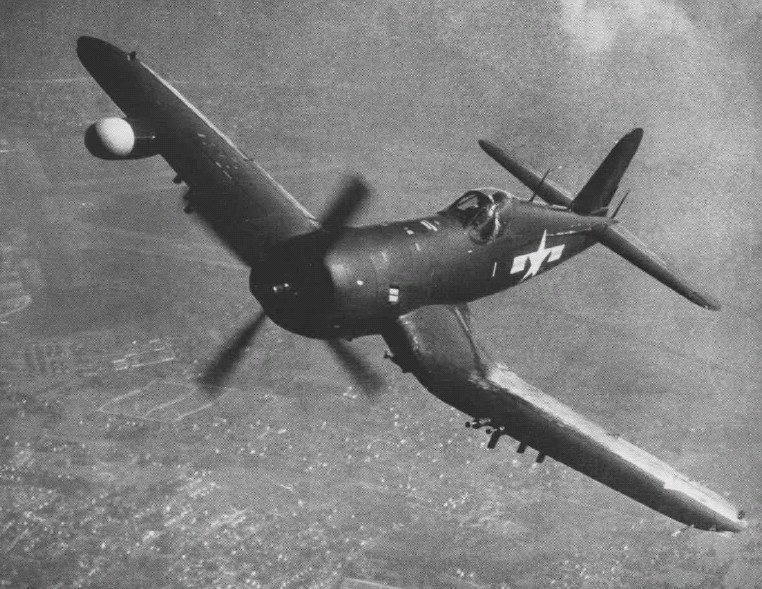
The F4U-5N was the night-fighter version of the F4U-5 Corsair: a post-war fighter-bomber with a Pratt & Whitney R-2800-32W engine, four 20 mm cannon and an AN/APS-19 radar in a radome on the right wing. Vought built 214, and the cold-weather F4U-5NL was developed from it. In Korea, detachments of Composite Squadrons VC-3 and VC-4 flew it at night against truck convoys and trains and against the biplanes that harassed UN troops. In it, Guy Bordelon became the US Navy's only ace of the war. It later served with the navy of Argentina and the air force of Honduras, where Corsairs fought the last battles between propeller aircraft in 1969.

- 214
- Units built
History
Origins: the Corsair night-fighter line
The F4U-5N was the last of a line of night-fighter Corsairs that began during the Second World War. The F4U-2 was an experimental conversion of the F4U-1 for night operations from carriers. It carried an airborne intercept radar in a radome outboard on the starboard wing and lost one of its machine guns. Because Vought was busy with more important projects, the Naval Aircraft Factory converted only 32, and front-line units converted two more. Late in the war came the F4U-4E and F4U-4N, also with a radome projecting from the right wingtip (APS-4 search radar on the first, APS-6 on the second). They were often refitted with four 20 mm cannon. They did not fight in the Second World War, but the night fighters that followed them were used heavily in Korea.
The F4U-5 as a basis
The F4U-5 was a 1945 modification of the F4U-4. It was meant to improve performance and to take in suggestions from Corsair pilots. Sources disagree on its first flight: English Wikipedia gives 21 December 1945, while historian John Rickard (historyofwar.org) gives April 1946. It used a Pratt & Whitney R-2800-32W engine with a two-stage supercharger and automatic blower controls; the quoted power rating also varies by source. Other changes included spring tabs on the elevators and rudder, a fully modernised cockpit, a fully retractable tailwheel, heated cannon bays and pitot head, and windscreen de-icing. The engine was mounted at a slightly lower angle to improve stability and the view ahead. Standard armament became four 20 mm M3 cannon, two in each wing. It kept the eight stubs for 5-inch HVAR rockets and the wing-root pylons for bombs, drop tanks or napalm.
The F4U-5N night fighter
The F4U-5N added an intercept radar to this airframe, in a radome outboard on the starboard wing like earlier Corsair night fighters. The set was the AN/APS-19. According to Rickard, it could work in four modes, from short-range "blind firing" to long-range navigation. Vought built 214 F4U-5Ns. The type led to the F4U-5NL, a winterised version made necessary by the harsh Korean winter. It had rubber de-icing boots on the leading edges of the wings and tail, anti-icing shoes on the propeller and an improved thermal windscreen de-icing system. There were 72 new-build examples and 29 converted from F4U-5Ns, for a total of 101. With 315 aircraft between them, the two night-fighter versions were the most numerous members of the F4U-5 family. Rickard notes that they were used in Korea more than the day-fighter F4U-5.
The Navy's night squadrons
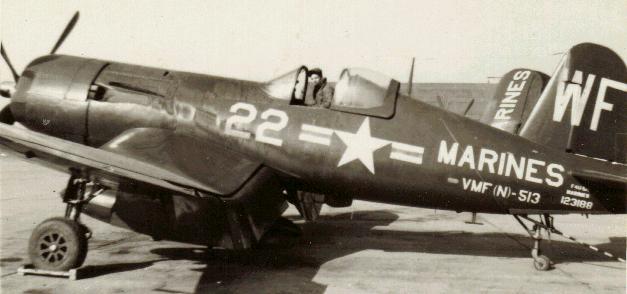
In the US Navy, the F4U-5N was flown mainly by two composite squadrons that sent detachments to aircraft carriers. They had inherited the Navy's wartime experiments with night carrier operations. West Coast-based VC-3 served the Pacific Fleet. VC-4, the "Nightcappers", was established in 1948 at Naval Air Station Atlantic City and did the same on the East Coast. After the Korean War began in 1950, VC-4 sent combat detachments three times: aboard USS Leyte (1950-1951), USS Bon Homme Richard (1952-1953) and USS Lake Champlain (1953). It flew F4U-5Ns, among other aircraft, on all-weather and night fighter and attack missions, and more than forty of its members were killed in action. A period photograph shows VC-3 F4U-5Ns over USS Boxer off Korea on 4 September 1951. The Marine Corps also flew the type: photographs show F4U-5Ns of night-fighter squadron VMF(N)-513 at Wonsan in 1950.
Korea: night interdiction and "Bedcheck Charlie" hunting
At night, F4U-5Ns and F4U-5NLs attacked enemy supply lines, especially truck convoys and trains. They also intercepted night attack aircraft such as the Polikarpov Po-2 "Bedcheck Charlies", which the enemy used to harass UN forces after dark. To light up targets they often worked with C-47 "flare ships" that dropped hundreds of magnesium flares of a million candlepower each. For many operations, Navy F4U-5N detachments moved to shore bases instead of staying aboard ship.
Guy Bordelon, the Navy's only ace
Lieutenant Guy Bordelon, a Second World War veteran nicknamed "Lucky Pierre", led VC-3 Detachment D from USS Princeton while it was based ashore. Between 29 June and 16/17 July 1953 he was credited with three Lavochkin La-9s or La-11s and two Yak-18s; his fifth victory came on 16 July. This made him the US Navy's only ace of the war, the war's only night ace and the only American ace of the conflict flying a piston-engined aircraft. The English Wikipedia article on the Corsair places these victories in 1952, but his biography and the VC-3 history give 1953. In all, Navy and Marine Corsairs were credited with 12 enemy aircraft in Korea. Bordelon received the Navy Cross and two Silver Stars. He later became an instructor, retired as a commander after 27 years of service and died in 2002.
End of US service
After the war, jets took over. In VC-3 the Corsair was replaced by the McDonnell F2H-3 Banshee. In 1956 VC-4 was redesignated All-Weather Fighter Squadron VF(AW)-4 and was already moving to jets. According to Rickard, the F4U-5 left US service in 1956.
Argentina
Argentine Naval Aviation received 26 F4U-5, F4U-5N and F4U-5NL Corsairs. English Wikipedia dates their service from 1956 to 1968, while Spanish Wikipedia has it starting in 1955. They formed the Combat Flotilla at Punta Indio Naval Air Base. Alongside the F4U-5 day squadron, it had a Night Combat Squadron with F4U-5Ns and F4U-5NLs. For more than ten years they flew from the carrier ARA Independencia and from navy bases.
Honduras and the Football War
The Honduran Air Force had 10 F4U-5Ns, F4U-5NLs and F4U-5Ps between 1956 and 1979, as well as nine F4U-4s. In the 1969 war with El Salvador, Captain Fernando Soto Henríquez flew FAH-609, identified as an F4U-5NL (the winterised development of the F4U-5N). On 17 July 1969 he shot down a Salvadoran Cavalier F-51D Mustang in the morning and two Goodyear FG-1D Corsairs in the afternoon. These were the last air battles between propeller aircraft, and they made Soto the only pilot credited with three kills in a war on the American continent. FAH-609 was retired in 1981 and is displayed at the Air Museum in Tegucigalpa.
Survivors
Several aircraft of the family still exist. A former Argentine F4U-5NL (Navy serial 124541) was modified to F4U-7 standard and was shown in France in 2006 in the colours of Aéronavale Flottille 14.F. The Collings Foundation preserves another F4U-5NL, and an F4U-5N in the markings of squadron VMF-312 has been shown at Oshkosh.

Multimedia