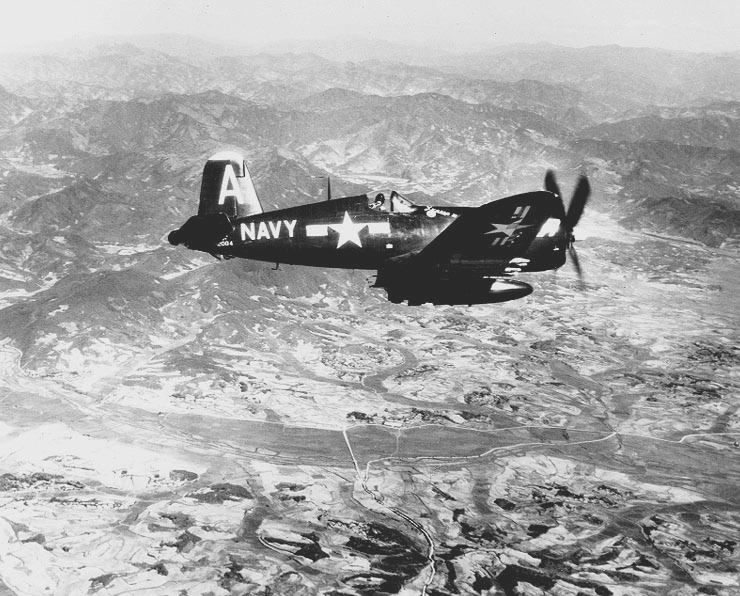
Vought F4U Corsair variant
Vought F4U Corsair F4U-4
The F4U-4 was the last Corsair version to fight in the Second World War and the one that carried Navy and Marine close air support in Korea. With the two-stage, water-injected R-2800-18W engine, a four-bladed propeller and a redesigned cockpit, it reached about 718 km/h and a ceiling above 12,600 m. Vought delivered 2,356 aircraft up to 1947, and Honduras kept the type in service until 1979.

- 2,052
- Units built
- 1,617 km
- Range
History
Origin: an answer to the new Japanese fighters
The U.S. Navy needed a Corsair able to take on the improved Japanese fighters then appearing in the Pacific. Chance Vought's answer was the F4U-4, preceded by the XF4U-4 prototype (new engine and new cowling). Vought also tested two F4U-4Xs, BuNos 49763 and 50301, which served as testbeds for the new R-2800 version: with them it tried fixed wingtip tanks, which did not interest the Navy, and a six-bladed Aeroproducts contra-rotating propeller, which was not accepted for production. According to Vought, the first production F4U-4 flew in September 1944; the Pima Air & Space Museum dates the model's introduction to April that year, and English Wikipedia places Navy deliveries in early 1945.
What changed from the F4U-1
The heart of the F4U-4 was the Pratt & Whitney R-2800-18W, an 18-cylinder twin-row radial with a two-stage supercharger, rated at 2,100 hp (about 1,600 kW). With water-alcohol injection it rose to 2,450 hp (about 1,830 kW) for short periods as war emergency power. It turned a new four-bladed Hamilton Standard propeller 13 ft 2 in (about 4 m) in diameter. The carburettor, now a downdraft type, took its air from an intake under the cowling instead of the wing leading edge, which meant relocating the exhausts.
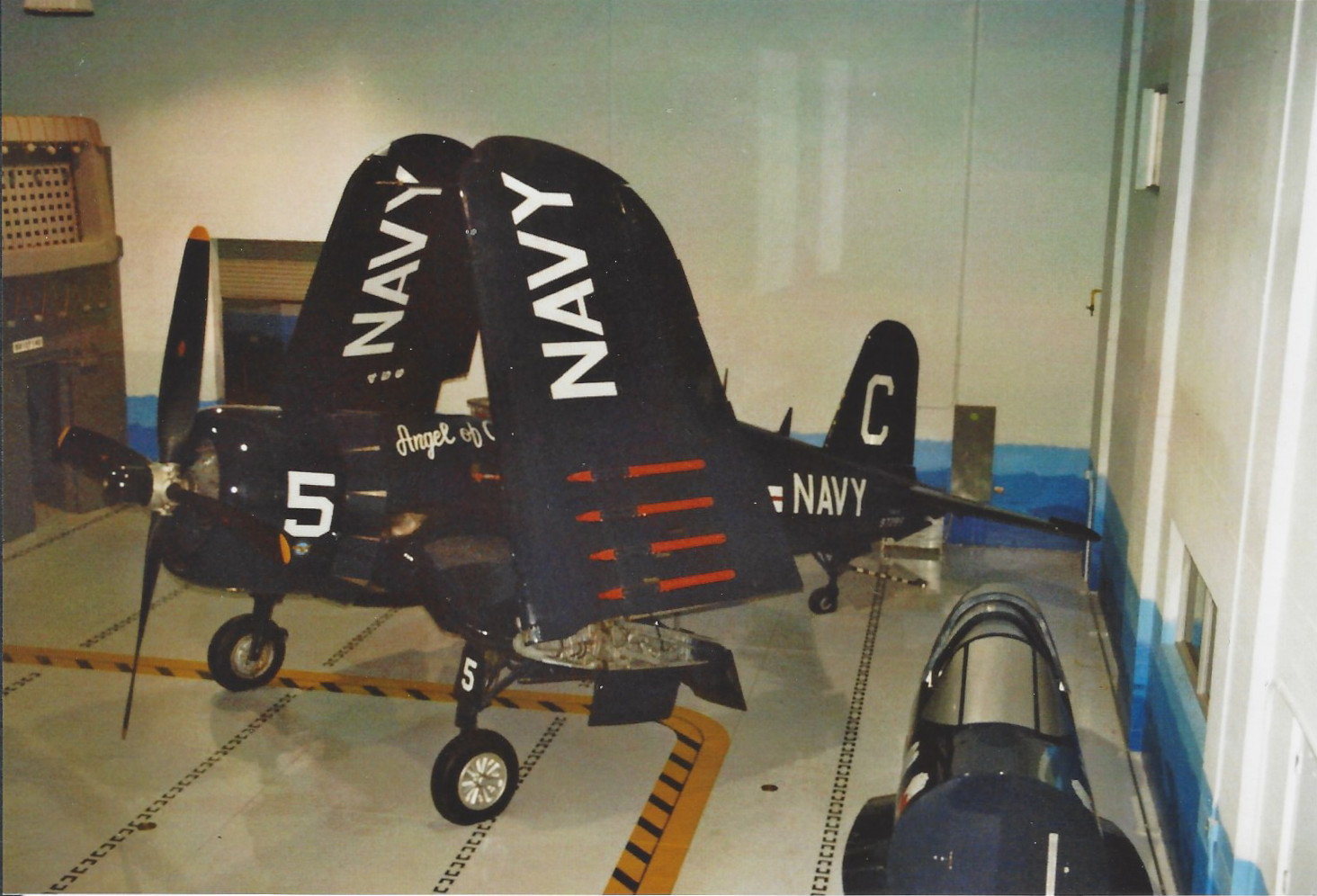
The cockpit was completely redesigned: a new canopy with a better bubble effect, an armour-plated bucket seat that folded to ease access to the radio gear, and regrouped instruments. The unarmoured wing fuel tanks, of 62 US gallons (230 l) each, were removed to gain manoeuvrability at the cost of maximum range. For the fighter-bomber role, rocket stations were added on the outer wing panels; the aircraft could carry eight 5-inch (12.7 cm) rockets or up to 4,000 lb (about 1,820 kg) on the centreline and pylon racks, and it kept all the external-load capabilities of the F4U-1D. Early F4U-4s carried six .50-calibre (12.7 mm) machine guns; the cannon versions had four 20 mm guns. Pilots nicknamed it the "4-Hog".
Performance
Vought's data give the F4U-4 a maximum speed of 446 mph (about 718 km/h), an initial climb rate of 3,870 ft/min (19.7 m/s), a service ceiling of 41,500 ft (12,649 m) and a gross weight of 14,670 lb (about 6,650 kg) against an empty weight of 9,206 lb (about 4,175 kg). Range at cruise speed, with two 150-gallon drop tanks, was about 1,015 miles (about 1,633 km); the Pima museum and MCARA give 1,005 miles (1,618 km). English Wikipedia puts the speed at 448 mph (721 km/h) and the climb at over 4,500 ft/min, against 2,900 for the F4U-1A.
Production
By the end of 1944 Chance Vought was building 300 Corsairs a month, one complete aircraft every 82 minutes. At war's end the company was devoted almost wholly to the F4U-4 and had produced over 1,900 before Japan's surrender. Goodyear won a contract for 2,500 equivalent aircraft, designated FG-4; it completed 12, but the contract was cancelled and none were delivered. The F4U-4 stayed in limited production until the summer of 1947, by which time 2,356 had been delivered (Spanish Wikipedia gives 2,365). The series spawned its own versions: the four-cannon F4U-4B, the F4U-4E and F4U-4N night fighters with a radar on the right wingtip, the F4U-4K experimental radio-controlled target drone, and nine F4U-4Ps with an oblique camera behind the wing that kept their full armament.
Second World War
The F4U-4 reached the front in June 1945, in time for the final push against the Japanese home islands. It was the last Corsair variant to see combat in the Second World War, although its service in that war was limited.
Korea: the close-support workhorse
In Korea, from 1950 to 1953, the Corsair was used mostly for close air support, and the F4U-4 and its cannon-armed F4U-4B were the mainstay of the Marine attack squadrons. On 3 July 1950 the carrier Valley Forge, with squadrons VF-53 and VF-54, launched 16 rocket-armed Corsairs against Pyongyang alongside Skyraiders and Panthers. On 3 August 1950 eight F4U-4Bs of VMF-214 took off from the escort carrier Sicily to strike enemy installations, the first action by a Marine squadron in the war; days later VMF-323 joined them from Badoeng Strait. On 11 August 1950, near Kosong, Captain Vivian M. Moses of VMF-323 became the first Marine aviator killed in Korea. For the Inchon landing, Boxer embarked a scratch-built air group of 64 F4U-4Bs. In June 1951 VMF-323 exchanged its F4U-4Bs for F4U-4s when it went aboard Sicily, and went back to -4Bs on returning ashore in September.
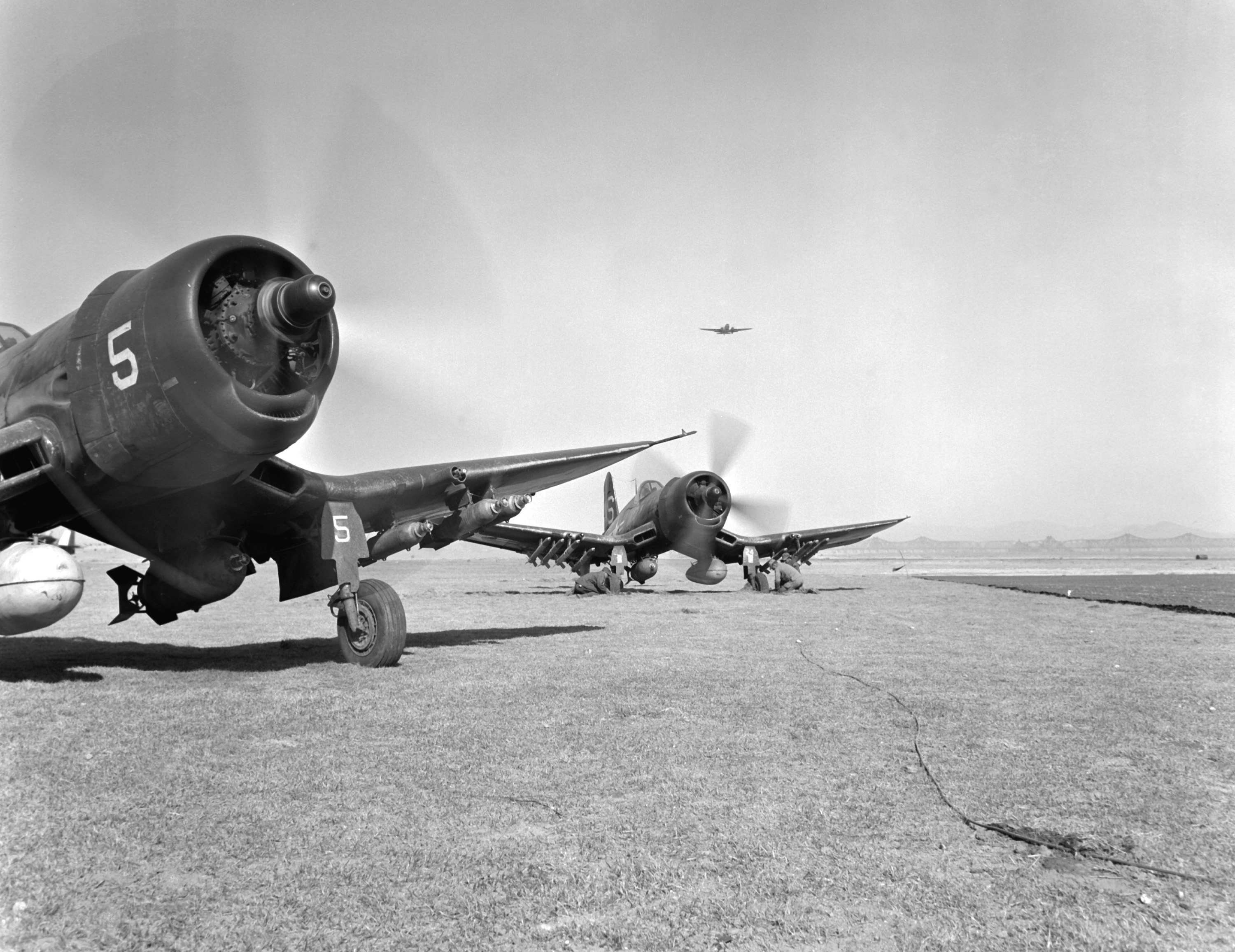
Typical weapons were bombs, napalm and unguided rockets: the 5-inch HVAR, the shaped-charge anti-tank ATAR and, at times, two Tiny Tims under the belly. During the Battle of the Chosin Reservoir, Lieutenant Thomas J. Hudner of VF-32 from the carrier Leyte, flying an F4U-4, deliberately crash-landed beside his squadron mate Ensign Jesse L. Brown, who had been brought down by anti-aircraft fire and was trapped in the wreckage. Brown, one of the Navy's first African American naval aviators, died there; Hudner received the Medal of Honor. Against the MiG-15 the Corsair was outclassed, although an F4U-4B flown by Jesse Folmar did shoot one down.
Honduras
The Honduran Air Force operated nine F4U-4s, alongside ten F4U-5N, -5NL and -5P aircraft, from 1956 to 1979. Its Corsairs formed the core of the Honduran bombing raids in the 1969 war with El Salvador, the last conflict in which piston-engined fighters fought each other.
Multimedia