Fighter · Military · Russia
MiG-29
- October 6, 1977
- First flight
- 1982
- Introduced
- In service
- Status
- 1,600
- Units built


_(6)-1600.webp)

_VGHS-1600.webp)


-1600.webp)
The MiG-29 is the light air-superiority fighter with which the Soviet Union answered America's fourth generation. Christened "Fulcrum" by NATO, its low-speed agility and famous cobra manoeuvre made it the airshow star of the late Cold War. It was born from the 1969 PFI programme, which the Soviets split in two: a heavy long-range fighter —the future Su-27— and a light, cheap, mass-deployable one, the "Product 9-12" that Mikoyan began defining in 1974 and which first flew on 6 October 1977. It entered service in 1982 and became one of the most exported fighters of its era: more than 25 countries have operated it, from India to Cuba, and after German reunification it became the first Soviet fighter thoroughly evaluated by a NATO air force, the Luftwaffe. With around 1,600 aircraft built and versions ranging from the original interceptor to the naval MiG-29K, it remains in service with numerous air forces — a protagonist of both history and current military affairs.
Related events
Category
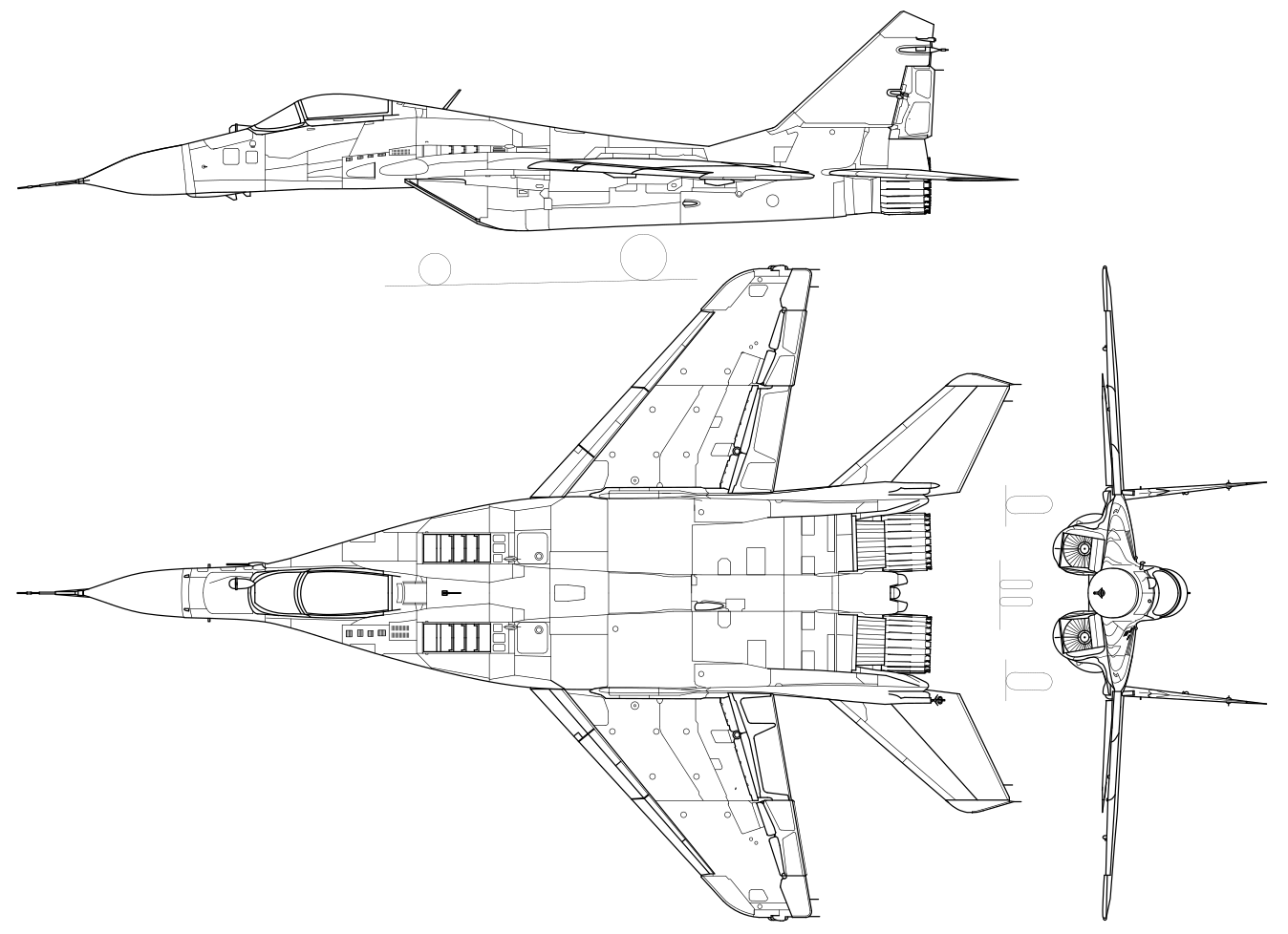
Three-view drawing
History
Designed as the light counterpart in the Soviet answer to American fourth-generation fighters, the MiG-29 first flew on October 6, 1977 and entered service in 1982.
Its agility and rough-field capability made it one of the most widely exported fighters of the late Cold War.
Origin and design
The starting point was the Soviet PFI programme of 1969, the direct answer to the American F-15. It was soon understood that a single aircraft could not be simultaneously large, long-ranged and cheap to mass-produce, and the requirement was split: the heavy fighter would become the Su-27, the light one Mikoyan's "Product 9-12", defined from 1974. The result was a compact twin-engine design with wings blended into the fuselage, intakes that could be shielded to operate from unprepared strips, and outstanding low-speed manoeuvrability.
Soviet service
The first production aircraft reached Soviet frontal aviation regiments in 1982, and by 1983 the deployment was visible to Western observers, who assigned it the NATO name "Fulcrum". Against Western fighters of its generation it brought two tactical trumps: the helmet-mounted sight paired with the R-73 close-combat missile, which allowed firing by "looking" at the adversary, and an airframe capable of flight regimes its rivals could not match in a close fight.
The Fulcrum after the Cold War
German reunification put a complete MiG-29 fleet in the hands of the Luftwaffe, which operated them for years and flew them against Western fighters in training: NATO could finally measure the Fulcrum from the inside, and its conclusions —lethal in close combat, limited in range and avionics— shaped the aircraft's image in the West. Those airframes were eventually transferred to Poland for a symbolic price, where they kept flying. Meanwhile the Soviet collapse pushed Russia to export the fighter to any willing customer, and India became its largest operator outside Russia.
Versions and modernisation
Successive improvements grew from the original interceptor: variants with more fuel and electronic warfare, the modernised MiG-29SMT with digital avionics and extended radius, two-seat conversion trainers and, above all, the naval MiG-29K, which gave the Russian carrier and the Indian navy their embarked fighter. The family culminated in the MiG-35, a deep evolution offered for export. In all, around 1,600 airframes have been built, placing it among the most-produced fourth-generation fighters.
Legacy
Half a century after its first flight the Fulcrum remains in active service with numerous air forces and has fought on both sides of several conflicts. Its story condenses the end of the Cold War: born to contest the sky against NATO, it ended up flying under NATO flags, and its twin-tail silhouette remains one of the most recognisable in military aviation.
Variants
| MiG-29A | MiG-29UB | MiG-29 (9.13) | MiG-29S | MiG-29SMT | |
|---|---|---|---|---|---|
| First flight | October 6, 1977 | April 29, 1981 | — | — | — |
| Aircraft type | Air superiority fighter | Two-seat conversion trainer | Air superiority fighter | Air superiority fighter | Multirole fighter |
| Powerplant | 2 × Klimov RD-33 afterburning turbofans rated at 81.4 kN each (49.4 kN dry) | 2 × Klimov RD-33 afterburning turbofans rated at 81.4 kN each (49.4 kN dry) | 2 × Klimov RD-33 afterburning turbofans rated at 81.4 kN each (49.4 kN dry) | 2 × Klimov RD-33 afterburning turbofans rated at 81.4 kN each (49.4 kN dry) | 2 × Klimov RD-33 series 3 afterburning turbofans rated at 81.4 kN (8,300 kgf) each, with extended service life |
| Powerplant | 2 × Klimov RD-33 | 2 × Klimov RD-33 | 2 × Klimov RD-33 | 2 × Klimov RD-33 | 2 × Klimov RD-33 ser. 3 |
| Thrust per engine | 81.4 kN Best value in this row | 81.4 kN Best value in this row | 81.4 kN Best value in this row | 81.4 kN Best value in this row | 81.4 kN Best value in this row |
| Length | 17.3 m | 17.4 m Best value in this row | — | — | — |
| Wingspan | 11.4 m | — | — | — | — |
| Height | 4.7 m | — | — | — | — |
| Wing area | 38 m² Best value in this row | 38 m² Best value in this row | 38 m² Best value in this row | 38 m² Best value in this row | 38 m² Best value in this row |
| Empty weight | 11,000 kg | — | — | — | — |
| MTOW | 18,000 kg | — | — | 19,700 kg Best value in this row | — |
| Top speed | 2,400 km/h | — | — | — | — |
| Max speed altitude | 11,000 m | — | — | — | — |
| Service ceiling | 18,013 m | — | — | — | — |
| Initial climb rate | 330 m/s | — | — | — | — |
| Range | 1,430 km | — | — | — | 2,100 km Best value in this row |
| Ferry range | 2,100 km | — | — | 2,900 km Best value in this row | — |
| Combat radius | 700 km | — | — | — | — |
| Range conditions | 1,430 km on internal fuel and a 2,100 km ferry range with a drop tank. Combat radius is around 700 km, reaching some 900 km on a high-altitude profile with two R-27s and four R-73s. | Performance matches the single-seater apart from the tandem cockpit, which lengthens the fuselage. | The enlarged dorsal spine houses a bigger No. 1 fuel tank than the 9.12, raising internal fuel reserves. | 2,900 km ferry range with three drop tanks. | Extra tanks in the further enlarged spine raise the range on internal fuel to 2,100 km. |
| Armament | One 30 mm GSh-30-1 cannon with 150 rounds and seven hardpoints (six underwing, one ventral) for up to 3,000 kg of stores: R-27 medium-range and R-73/R-60 short-range air-to-air missiles, free-fall bombs and unguided rockets. | Retains the 30 mm GSh-30-1 cannon and the underwing hardpoints but drops the radar: it relies on the infrared sensor and heat-seeking air-to-air missiles. | Same weapons fit as the 9.12: one 30 mm GSh-30-1 cannon and seven hardpoints for up to 3,000 kg of stores. | One 30 mm GSh-30-1 cannon and seven hardpoints, the inboard pylons in tandem pairs, for up to 4,000 kg of stores; adds the R-77 (RVV-AE) medium-range air-to-air missile. | One 30 mm GSh-30-1 cannon, six underwing and one ventral hardpoint for up to 4,500 kg; the Zhuk-ME radar enables guided air-to-ground weapons. |
| Max weapons load | 3,000 kg | — | 3,000 kg | 4,000 kg | 4,500 kg Best value in this row |
| Payload | 0 kg Best value in this row | 0 kg Best value in this row | 0 kg Best value in this row | 0 kg Best value in this row | 0 kg Best value in this row |
| Cargo capacity | No civil cargo capacity | No civil cargo capacity | No civil cargo capacity | No civil cargo capacity | No civil cargo capacity |
| Crew | 1 Best value in this row | 2 | 1 Best value in this row | 1 Best value in this row | 1 Best value in this row |
| Passengers | 0 | — | — | — | — |
| Units built | 840 | — | — | — | — |
Images