Fighter · Military · United States
General Dynamics F-16 Fighting Falcon
- February 2, 1974
- First flight
- In service
- Status
- 4,604
- Units built





_del_F-16.jpg)











-800.webp)
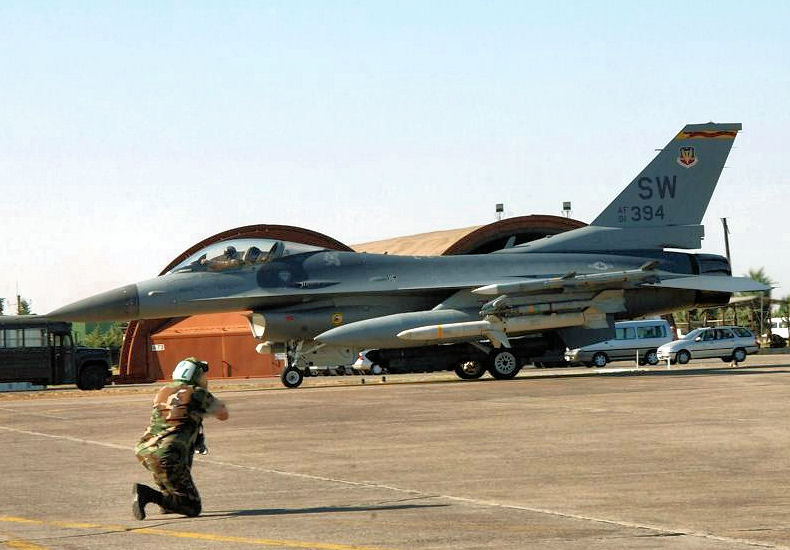
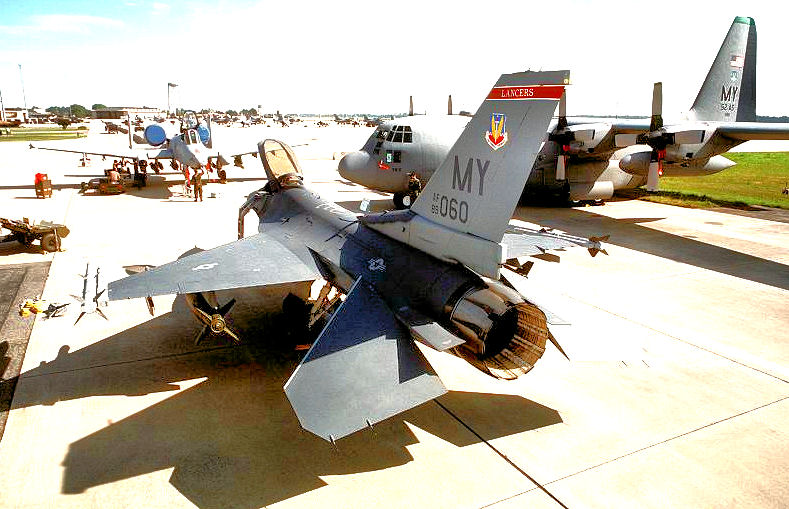
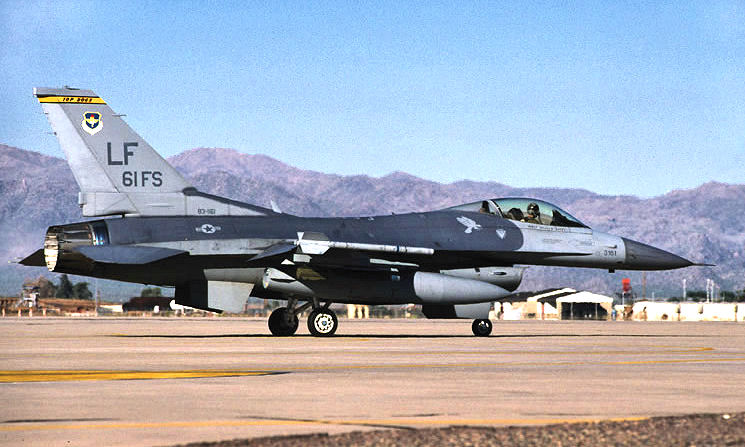
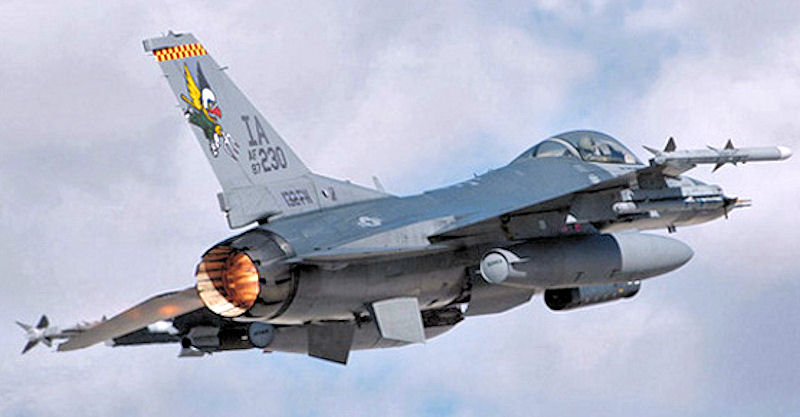
The General Dynamics F-16 Fighting Falcon is a single-engine, fourth-generation multirole fighter designed by General Dynamics and built by Lockheed Martin ever since the former sold its aircraft business in 1993. Its official maiden flight took place on 2 February 1974 at the Air Force Flight Test Center at Edwards, California, although the YF-16 prototype had already left the ground by accident on 20 January during a high-speed taxi test. More than 4,600 airframes have been built since 1976, and as of 2026 the F-16 remained the world's most common fixed-wing aircraft in military service, with 2,102 of the family operational — roughly 15% of all active combat aircraft. That figure, half a century after the first flight, is the aircraft's real story. The F-16 began as a counterweight. A group of officers and analysts around John Boyd argued that the F-15 programme was heading the wrong way: a large, expensive aircraft poorly suited to close-in combat. The Air Force Prototype Study Group was set up in May 1971, and one of its funded proposals became the Lightweight Fighter. The request for proposals of 6 January 1972 called for a 9,100 kg class air-to-air day fighter with good turn rate, acceleration and range. The turn came in April 1974, when Defense Secretary James Schlesinger redirected the competition towards the Air Combat Fighter: no longer a pure fighter but a multirole one, and any order would be additional to the F-15 rather than a replacement for it. That decision defused internal opposition and, in passing, doomed the original requirement. The cheap lightweight fighter became an ever heavier and more capable multirole aircraft — and that was the making of it. What set it apart was a set of choices made around the pilot. The F-16 was the first fighter to use a relaxed static stability / fly-by-wire flight control system, the combination that lets it be deliberately unstable and, for that very reason, agile. The bubble canopy dispenses with the forward bow frame that obstructs forward vision on so many contemporary fighters; the stick sits on the right console rather than between the knees; and the ACES II ejection seat is reclined 30° from vertical, where 13 to 15 degrees was the norm. Everything pointed the same way: it was the first fighter purpose-built to pull 9-g manoeuvres. It has a single turbofan, an internal 20 mm M61 Vulcan cannon in the left wing root and eleven hardpoints, and exceeds Mach 2. Officially it is the Fighting Falcon; to its pilots it is the Viper. The second half of the story is industrial. On 7 June 1975, at the Paris Air Show, the four European partners — Belgium, Denmark, the Netherlands and Norway — signed up for 348 aircraft, split as 116, 58, 102 and 72 respectively. They were not buying aeroplanes so much as a place on the assembly line. Two European production lines were opened, Fokker's at Schiphol-Oost and SABCA's in Belgium; co-production was formally launched on 1 July 1977 at the Fokker factory, and the first deliveries to the Belgian Air Force followed in January 1979. Components crossed the Atlantic both ways: to Fort Worth for fuselage assembly, then back to Europe for final assembly. The programme has outlived its own manufacturer. Lockheed bought General Dynamics' aircraft manufacturing business in 1993 and became part of Lockheed Martin after the 1995 merger; the last Fort Worth F-16 was delivered to the Iraqi Air Force on 14 November 2017, ending forty years of production in Texas, and the line moved to Greenville, South Carolina, where serial production of the F-16V Viper began in 2019. Besides the United States, the air forces of 25 other nations have procured the type. The current standard, the Block 70/72, carries Northrop Grumman's APG-83 AESA radar, a high-resolution centre pedestal display and an extended structural life of 12,000 hours, more than 50% beyond that of earlier production F-16s. And by the end of July 2024 the first aircraft handed over by European operators had reached Ukraine; on 4 August, President Zelenskyy announced that they were in operational service.
Related events
- Accidental liftoff of the YF-16 during a high-speed taxi test
- Official first flight of the YF-16
- YF-16 selected as winner of the Air Combat Fighter competition over the YF-17
- European Participation Air Forces (EPAF) consortium agreement signed for F-16 production
- F-16 enters USAF service
- Operation Opera: Israeli strike on the Osirak reactor
- Bekaa Valley air battle: Israeli F-16s in one of the largest jet-era air battles
- F-16 sees combat in Operation Desert Storm
- First F-16s delivered to Ukraine
Related sheets
Category
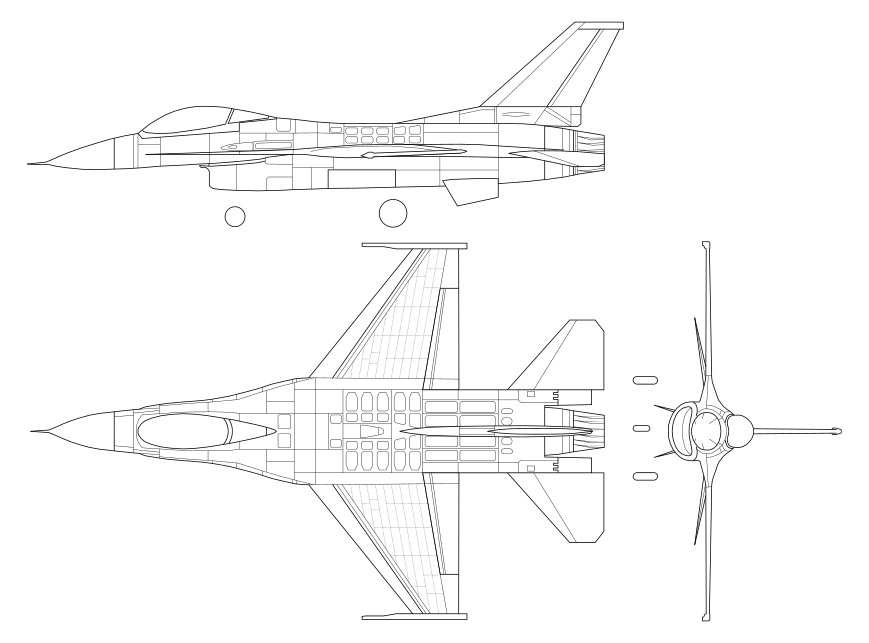
Three-view drawing
History
Origins: energy–manoeuvrability theory and the Fighter Mafia
The F-16 began as an argument, not as an aircraft. American experience in the Vietnam War exposed a double shortfall: the air force needed genuine air-superiority fighters, and it needed far better air-to-air training for its pilots. Drawing on his own combat flying in Korea and on his years as a fighter tactics instructor in the early 1960s, Colonel John Boyd worked with the mathematician Thomas Christie to develop energy–manoeuvrability theory, a way of modelling a fighter's combat performance in terms of the energy it holds and how much of it survives a manoeuvre.
The theory pointed towards an aircraft that much of the establishment did not want: small, light, able to manoeuvre while losing as little energy as possible, and with a high thrust-to-weight ratio. In the late 1960s Boyd gathered a circle of like-minded reformers who became known as the Fighter Mafia, and in 1969 they secured Department of Defense funding for General Dynamics and Northrop to study design concepts based on the theory.
Opposition inside the service was serious. Advocates of the F-X programme saw the lightweight fighter as a threat to the F-15, but Air Force leadership understood that its budget would never stretch to enough F-15s for every mission it had to cover. The Advanced Day Fighter concept, renamed F-XX, found civilian political backing in Deputy Secretary of Defense David Packard, who favoured competitive prototyping. In May 1971 the Air Force Prototype Study Group was established with Boyd as a key member; two of its six proposals would be funded, and one of them was the Lightweight Fighter (LWF).
The request for proposals issued on 6 January 1972 described a 20,000-pound (9,100 kg) class air-to-air day fighter with a good turn rate, good acceleration and good range, optimised for combat between Mach 0.6 and 1.6 at 30,000 to 40,000 feet (9,100–12,000 m) — the region where USAF studies expected most future air combat to happen. The anticipated average flyaway cost of a production aircraft was $3 million. That production plan was hypothetical: the Air Force had no firm intention of buying the winner.
The flyoff: YF-16 against YF-17
Five companies responded. In 1972 the Air Staff picked General Dynamics' Model 401 and Northrop's P-600 for prototype development and testing, with contracts worth $37.9 million and $39.8 million respectively and first flights planned for early 1974. To overcome resistance higher up, the Fighter Mafia and other LWF supporters successfully argued for complementary fighters in a high-cost/low-cost mix; the "high/low mix" would let the USAF afford the force structure it needed, and by the time the prototypes flew off against each other the idea had won broad acceptance, defining the relationship between the LWF and the F-15 from then on.
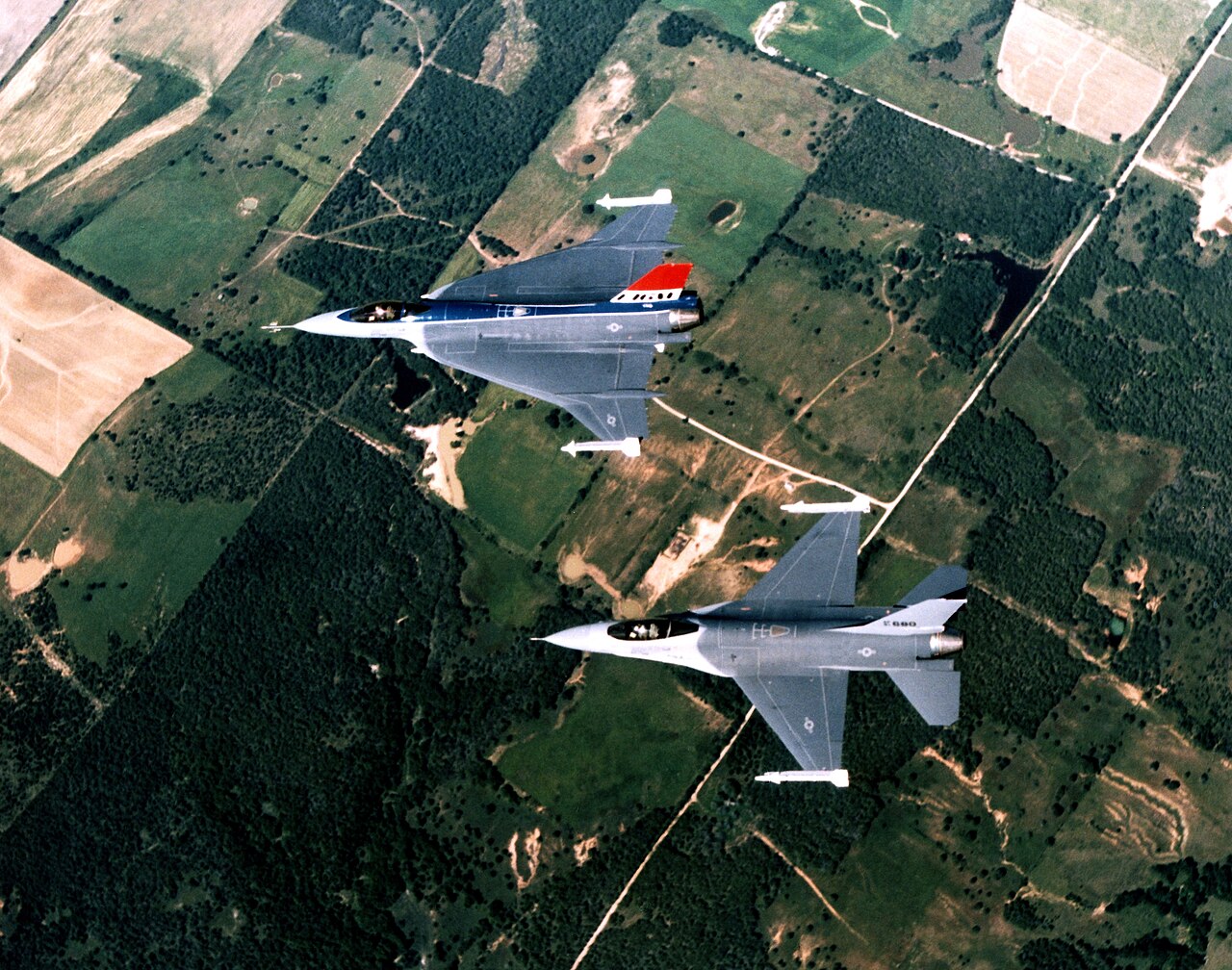
The YF-16 was developed by a General Dynamics team led by Robert H. Widmer. The first aircraft was rolled out on 13 December 1973 and made its 90-minute maiden flight at the Air Force Flight Test Center at Edwards AFB, California, on 2 February 1974. It had already flown, however, by accident. On 20 January 1974, during a high-speed taxi test, a roll-control oscillation caused a fin of the port wingtip missile and then the starboard stabilator to scrape the ground, and the aircraft began to veer off the runway. Test pilot Phil Oestricher chose to lift off rather than risk a crash and landed safely six minutes later. The slight damage was quickly repaired and the official first flight went ahead on schedule.
The YF-16's first supersonic flight followed on 5 February 1974 and the second prototype flew on 9 May; Northrop's two YF-17s flew on 9 June and 21 August of the same year. During the flyoff the YF-16s completed 330 sorties for 417 flight hours against 288 sorties and 345 hours for the YF-17s. The loser was not wasted: the YF-17 was developed into the Navy's YF-18.
From day fighter to multirole: the Air Combat Fighter and the "arms deal of the century"
Growing interest turned the LWF into a real acquisition programme. Four NATO allies — Belgium, Denmark, the Netherlands and Norway — were looking to replace their F-104G Starfighter fighter-bombers, and in early 1974 they agreed with the United States that if the USAF ordered the LWF winner they would consider ordering it too. The Air Force itself needed to replace its F-105 Thunderchiefs and F-4 Phantom IIs. Congress, pressing for commonality between Air Force and Navy procurement, redirected Navy funds in August 1974 into a new Navy Air Combat Fighter programme for a naval fighter-bomber version of the LWF. The four European allies, now the Multinational Fighter Program Group, pushed for an American decision by December 1974, and the USAF accelerated testing accordingly.
In April 1974 Secretary of Defense James R. Schlesinger folded the LWF into a new Air Combat Fighter (ACF) competition. The change of character mattered: the ACF would not be a pure fighter but a multirole aircraft, and Schlesinger made clear that any ACF order would come on top of the F-15, which extinguished the remaining opposition. The ACF also raised the stakes, drawing in competitors after what was already being called "the arms deal of the century": Dassault-Breguet's proposed Mirage F1M-53, the Anglo-French SEPECAT Jaguar and the proposed Saab 37E "Eurofighter", with Northrop also offering the P-530 Cobra, a relative of the YF-17. The Jaguar and the Cobra were dropped early by the European group, leaving two European and two American candidates. On 11 September 1974 the USAF confirmed it would order the winning design to equip five tactical fighter wings. Computer modelling predicted a close contest, but the YF-16 proved significantly quicker at moving from one manoeuvre to the next and was the unanimous choice of the pilots who flew both aircraft.
On 13 January 1975 Secretary of the Air Force John L. McLucas announced the YF-16 as the winner, citing lower operating costs, greater range and manoeuvre performance "significantly better" than the YF-17's, especially at supersonic speeds. There was also an industrial argument: the YF-16 used the Pratt & Whitney F100 turbofan, the same engine as the F-15, and that commonality lowered engine costs for both programmes. McLucas said the USAF planned to order at least 650 aircraft and possibly as many as 1,400. The naval competition went the other way: on 2 May 1975 the Navy chose the YF-17 over the YF-16-derived Vought Model 1600, and from that decision came the McDonnell Douglas F/A-18 Hornet.
From prototype to production aircraft
The production F-16 was not the prototype. The Air Force initially ordered fifteen full-scale development aircraft, eleven single-seat and four two-seat, later cut to eight — six F-16As and two F-16Bs. The YF-16 design was reworked for production: the fuselage was lengthened by 10.6 in (0.269 m), a larger radome was fitted for the AN/APG-66 radar, wing area grew from 280 to 300 sq ft (26 to 28 m²), the tailfin was shortened, the ventral fins were enlarged, two more stores stations were added and a single door replaced the original twin nosewheel doors. Together these changes increased the aircraft's weight by 25 per cent over the YF-16.
The development aircraft were built by General Dynamics at Fort Worth, Texas, in United States Air Force Plant 4 in late 1975. The first F-16A was rolled out on 20 October 1976 and flew on 8 December; the first two-seater flew on 8 August 1977. The first production-standard F-16A flew on 7 August 1978 and was accepted by the USAF on 6 January 1979, and the type entered operational service with the 34th Tactical Fighter Squadron, 388th Tactical Fighter Wing, at Hill AFB, Utah, on 1 October 1980. Reference data give 17 August 1978 as the aircraft's introduction date.
The name "Fighting Falcon" was bestowed on 21 July 1980 and never took root among the people who fly it: crews call the aircraft "Viper", both for a perceived resemblance to the snake and for the fictional Colonial Viper starfighter of *Battlestar Galactica*, which was on television as the F-16 entered service.
One engineering decision proved unusually far-sighted. The LWF programme called for an airframe life of 4,000 flight hours capable of 7.33 g with 80 per cent internal fuel; General Dynamics' engineers designed for 8,000 hours and for 9-g manoeuvres on full internal fuel. That margin paid for itself when the aircraft's mission shifted from pure air combat to multirole work, as new systems added weight and successive structural strengthening programmes became necessary.
Europe: the 1975 consortium and licence production
On 7 June 1975, at the Paris Air Show, the four European partners — by then the European Participation Group — signed for 348 aircraft: 116 for Belgium, 58 for Denmark, 102 for the Netherlands and 72 for Norway. Two European assembly lines were part of the bargain, one at Fokker's Schiphol-Oost plant and the other at SABCA's Gosselies works, producing 184 and 164 aircraft respectively, with Norway's Kongsberg Vaapenfabrikk and Denmark's Terma making parts and subassemblies. European co-production was formally launched at the Fokker factory on 1 July 1977. From November 1977 Fokker-built components travelled to Fort Worth for fuselage assembly and returned to Europe, where final assembly of European aircraft began at the Belgian plant on 15 February 1978. Deliveries to the Belgian Air Force started in January 1979, the first Royal Netherlands Air Force aircraft arrived in June that year, and in 1980 the first Norwegian aircraft were delivered by Fokker and the first Danish ones by SABCA.
The pattern repeated outside Europe. Between the late 1980s and the 1990s Turkish Aerospace Industries built 232 Block 30/40/50 aircraft under licence on an Ankara line for the Turkish Air Force, followed by 46 Block 40s for Egypt in the mid-1990s and 30 Block 50s from 2010. Korean Aerospace Industries opened its own line for the KF-16 programme and delivered 140 Block 52s from the mid-1990s to the mid-2000s. A sixth line was once in prospect: it would have been built in India had the F-16IN won that country's medium multirole combat aircraft competition. Reference data summarise the industrial map as SABCA from 1979 to 1985, Fokker from 1979 to 1982, TUSAŞ from 1987 to 2011 and KAI from 1994 to 2004.
Relaxed stability, fly-by-wire and the deep stall
The F-16 was the first production fighter deliberately designed to be slightly unstable aerodynamically — relaxed static stability. A conventionally stable aircraft returns to straight and level flight if the pilot lets go of the controls, which is comfortable but costs manoeuvrability and adds trim drag. By giving that up, the F-16 gained agility and shed drag; at Mach 1 aerodynamic changes restore positive stability.
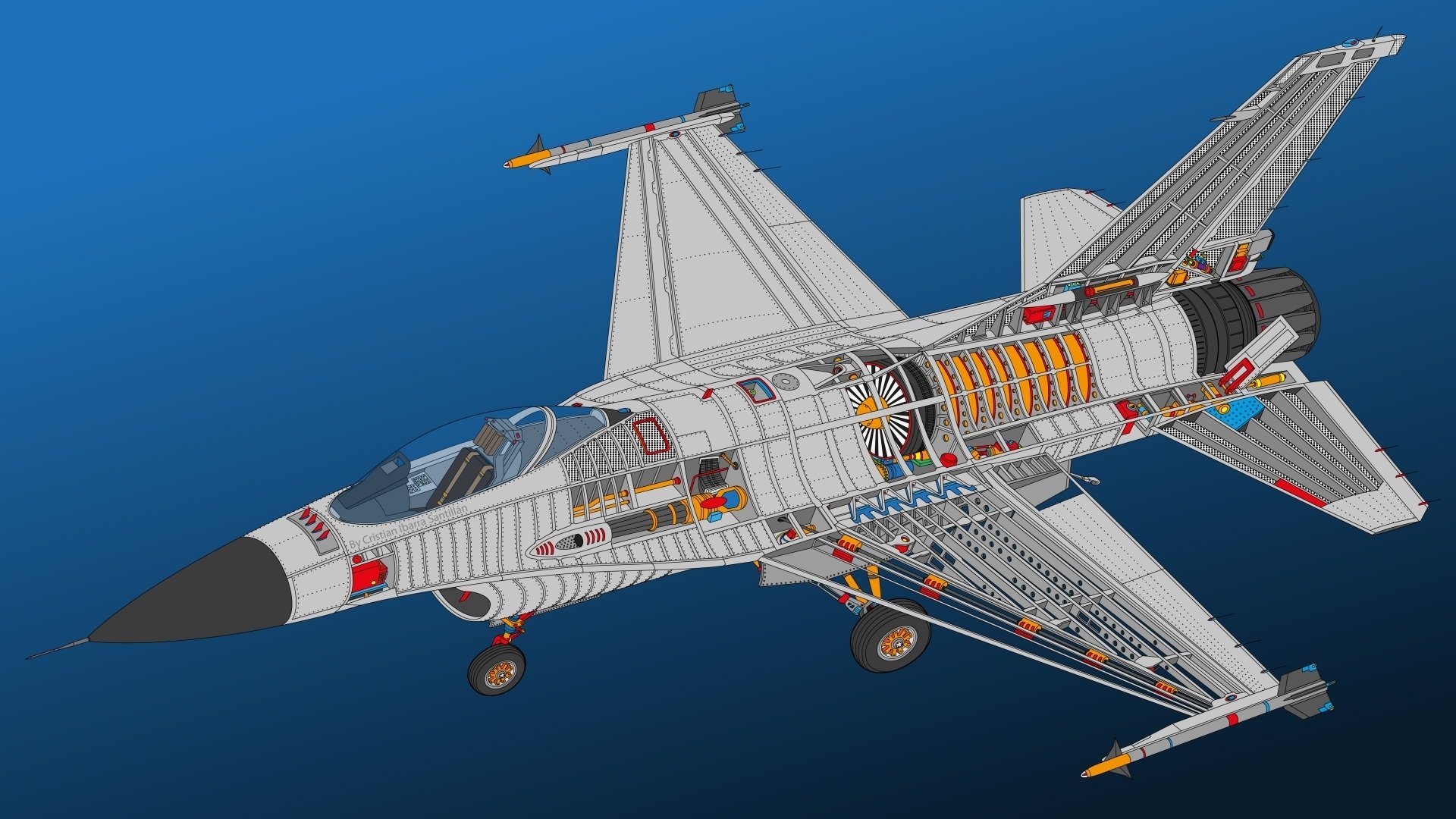
Making such an aircraft flyable required a quadruplex fly-by-wire flight control system. The flight control computer takes stick and rudder inputs and moves the control surfaces to produce the intended result without losing control, running thousands of measurements per second on the aircraft's attitude to correct departures from the pilot's flight path automatically, and applying limiters in all three axes based on attitude, airspeed and angle of attack that prevent slips, skids, stalls and any manoeuvre beyond 9 g.
General Dynamics went a step further than Northrop had with the YF-17: it removed mechanical linkages between the stick and pedals and the control surfaces altogether. The F-16 relies entirely on its electrical systems to relay flight commands, which earned it the early nickname "the electric jet" and pilot aphorisms such as "you don't fly an F-16; it flies you". The quadruplex architecture allows graceful degradation, a lost channel leaving a triplex system. Controls were analogue on the A and B models and became digital from the F-16C/D Block 40 onwards. There was a price: the system proved sensitive to static electricity and lightning, and between 70 and 80 per cent of the C/D models' electronics were vulnerable to electrostatic discharge.
Flight testing also uncovered a dangerous corner of the envelope. "Assaulting" several limiters at once at high angle of attack and low speed could push the aircraft far past its 25-degree limit — "departing", in the jargon — into a deep stall: a near-freefall at 50 to 60 degrees angle of attack, upright or inverted, stable in attitude but with the control surfaces ineffective. The pitch limiter would lock the stabilators at an extreme while trying to recover, so pilots were given the ability to override it and rock the nose out. In parallel, the area of each horizontal stabilizer was increased by 25 per cent on Block 15 aircraft in 1981 and later retrofitted to earlier machines, and a manual override switch was placed prominently on the control console. The risk had surfaced during development and been dismissed: model tests of the YF-16 at Langley Research Center revealed it, no other laboratory could reproduce it, and YF-16 flight testing was not enough to expose it; only the full-scale development aircraft demonstrated the concern was real. The larger tail also improved stability and allowed faster takeoff rotation.
A cockpit that changed the trade
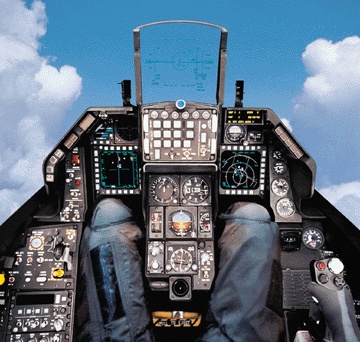
The F-16's cockpit was as influential as its aerodynamics. The single-piece, bird-proof polycarbonate bubble canopy, with no forward bow frame, gives 360-degree visibility, 40 degrees of look-down over the side and 15 degrees over the nose against the 12 to 13 degrees typical of earlier fighters; the pilot's seat is raised to make that possible. The ACES II zero/zero ejection seat is reclined at an unusual 30 degrees, against the 13 to 15 degrees common elsewhere: it accommodates taller pilots and improves g tolerance, though it has been associated with neck complaints, possibly from incorrect headrest use, and later American fighters have settled on more modest angles of around 20 degrees. Because of the seat angle and the canopy's thickness the seat has no canopy-breakers; the whole canopy is jettisoned before the seat fires.
The pilot flies with an armrest-mounted side-stick rather than a centre stick, plus throttle and conventional rudder pedals, and the switches and functions needed most are gathered onto both grips in the arrangement known as HOTAS, so that the aircraft can be handled through high-g manoeuvring without moving the hands. The side-stick was originally non-moving, which pilots found uncomfortable and hard to adapt to — it encouraged over-rotation on takeoff — so a small amount of play was introduced. Since the F-16, HOTAS has become standard on modern fighters.
Information display followed the same logic: a head-up display projecting flight and combat data ahead of the pilot without blocking the view, and multi-function displays either side, the left as primary flight display with radar and moving map, the right as system display for engine, landing gear, slat and flap settings, fuel and weapons. Early aircraft used monochrome cathode-ray tubes, replaced by colour liquid-crystal displays on the Block 50/52. The Mid-Life Update brought night-vision goggle compatibility, and from Block 40 the Joint Helmet Mounted Cueing System allowed targeting by looking, unlocking high-off-boresight missiles such as the AIM-9X; the Scorpion helmet-mounted display later replaced it in US service. As recently as November 2024 the Air Force awarded a $9 million contract to the Danish company Terma for a three-dimensional audio system that separates radio signals spatially, aligns audio with threat direction and adds active noise reduction.
Radars and engines: two races inside one programme
The F-16A/B entered service with the Westinghouse AN/APG-66 fire-control radar, its slotted planar array designed to fit a small nose, with four operating frequencies in X band and four air-to-air and seven air-to-ground modes usable at night and in poor weather. The Block 15 introduced the APG-66(V)2 with more output power and better signal processing, and the Mid-Life Update the faster (V)2A. The AN/APG-68, an evolution of the same design, arrived with the F-16C/D Block 25: twenty-five operating modes including ground mapping, Doppler beam sharpening, ground moving target indication, sea search and track-while-scan on up to ten targets. The Block 40/42's (V)1 added full compatibility with LANTIRN navigation and targeting pods and a high-PRF track mode to guide semi-active missiles such as the AIM-7 Sparrow. Block 50/52 aircraft used the (V)5 and later the (V)9, the latter with 30 per cent greater air-to-air detection range and a synthetic aperture mode for high-resolution mapping; in August 2004 Northrop Grumman was contracted to bring Block 40/42/50/52 radars to the (V)10 standard, with autonomous all-weather detection and targeting for GPS-aided weapons and terrain-following modes. Then came active arrays: the AN/APG-80 on the F-16E/F and the AN/APG-83 Scalable Agile Beam Radar, chosen for US and Taiwanese upgrades. On 28 February 2020 the USAF ordered Northrop Grumman to extend the service life of its F-16s to at least 2048 with the APG-83.
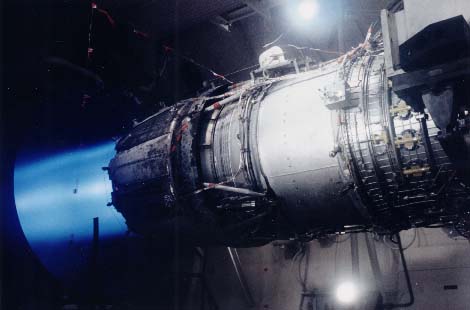
The engine story was rougher. The initial powerplant was the Pratt & Whitney F100-PW-200 afterburning turbofan, a modified F-15 engine rated at 23,830 lbf (106.0 kN). In testing it proved prone to compressor stalls and "rollbacks", in which thrust spontaneously fell to idle; until the problem was solved the Air Force ordered F-16s to operate within dead-stick landing distance of their bases. It remained the standard engine through Block 25, except in Block 15 aircraft built with the Operational Capability Upgrade, which introduced the 23,770 lbf (105.7 kN) F100-PW-220 and its Digital Electronic Engine Control, improving reliability and reducing stalls; from 1988 the "-220" also replaced the F-15's original engine for commonality, and from 1997 many were upgraded to "-220E" standard, cutting unscheduled engine removals by 35 per cent.
The "-220" was a product of the USAF's Alternate Fighter Engine programme, the so-called Great Engine War, which brought General Electric into the F-16 business. Its F110-GE-100 was limited by the original inlet to 25,735 lbf (114.47 kN), but the Modular Common Inlet Duct let it reach 28,984 lbf (128.93 kN). Hence a naming convention that confuses newcomers: from the Block 30 series onwards, blocks ending in zero have General Electric engines and blocks ending in two have Pratt & Whitney engines. The Increased Performance Engine programme produced the 29,588 lbf (131.61 kN) F110-GE-129 for the Block 50 and the 29,160 lbf (129.7 kN) F100-PW-229 for the Block 52, both flying from the early 1990s. Of the 1,446 F-16C/Ds ordered by the USAF, 556 were fitted with F100-series engines and 890 with F110s. The most powerful engine ever developed for the type is the Block 60's F110-GE-132, at 32,500 lbf (145 kN).
The blocks: from A to V
F-16 versions are ordered by rising block numbers covering software, hardware, systems, weapons compatibility and structural changes, applied to both single- and two-seat aircraft and frequently retrofitted to machines already delivered.
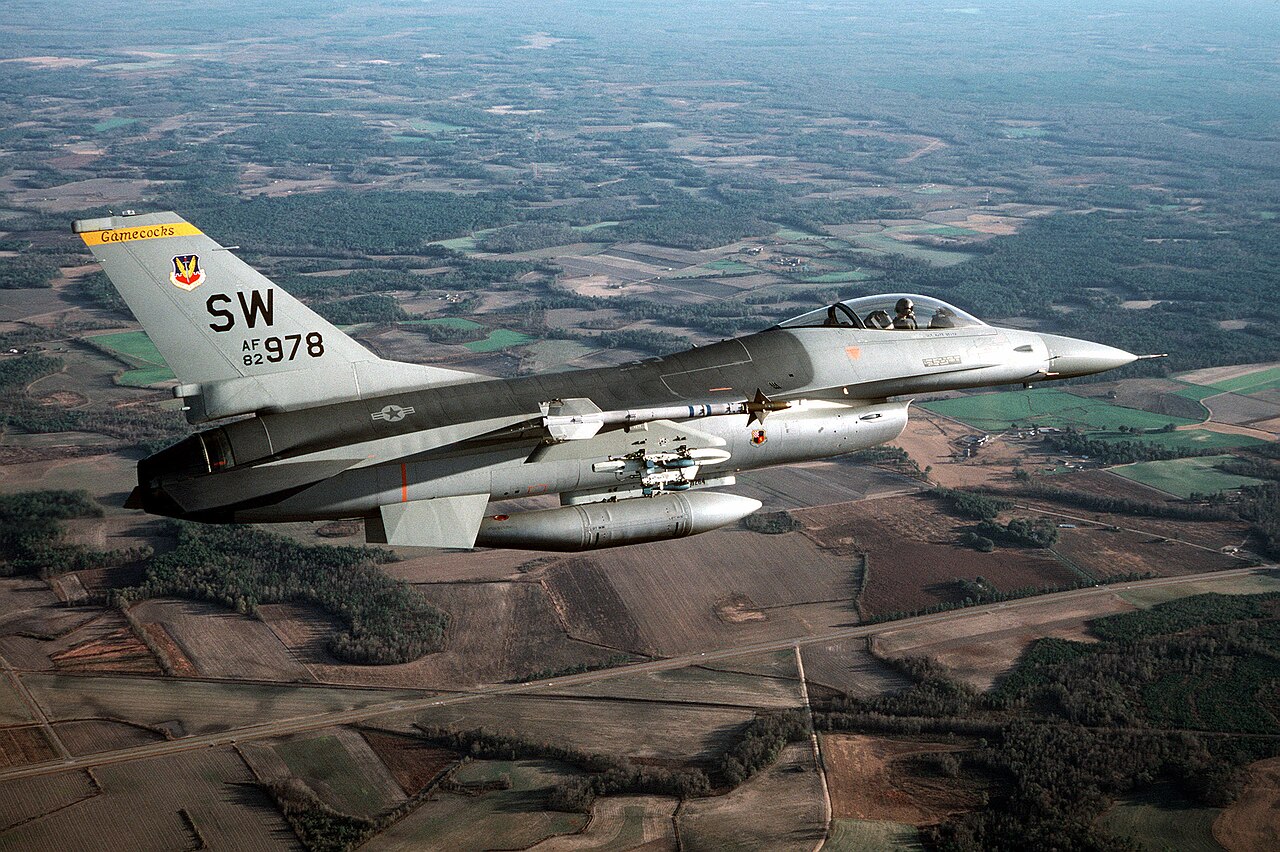
The original F-16A and F-16B span Blocks 1, 5, 10, 15 and 20. Block 15, with its larger horizontal stabilizers, was the first major change and remains the most numerous variant of all, with 983 built. Around 300 earlier USAF F-16A and B aircraft were brought to Block 15 Mid-Life Update standard, giving them capability analogous to the F-16C/D Block 50/52. From 1987, 214 Block 15 aircraft were upgraded to Operational Capability Upgrade standard with engine, structural and electronic improvements, and from 1988 all Block 15s were built to that specification. Between 1989 and 1992, 271 Block 15 OCU airframes — 246 F-16As and 25 F-16Bs — were converted at the Ogden Air Logistics Center into the Air Defense Fighter variant, with improved IFF, radio and radar, the ability to carry beyond-visual-range missiles and a side-mounted 150,000-candlepower searchlight for visually identifying intruders at night. Conceived for Cold War air defence of the continental United States, the ADF lost its rationale with the fall of the Berlin Wall and most were mothballed from 1994; some were later exported to Jordan (twelve A and four B models) and Thailand (fifteen A and one B), while thirty A and four B aircraft were leased to Italy from 2003 to 2012.
The F-16C and D entered production in 1984. The first was the Block 25, with improved cockpit avionics and radar adding all-weather capability with beyond-visual-range AIM-7 and AIM-120 missiles; Blocks 30/32, 40/42 and 50/52 followed. The F-16C/D had a unit cost of US$18.8 million in 1998, and operational cost per flight hour has been estimated at anywhere between $7,000 and $22,470, or $24,000, depending on the method of calculation.
The F-16E and F are the Block 60 versions derived from the C/D Block 50/52, developed with heavy investment from the United Arab Emirates: AN/APG-80 active electronically scanned array radar, infrared search and track, upgraded avionics, conformal fuel tanks and the more powerful F110-GE-132 engine.
The current branch is the F-16V Viper, unveiled at the 2012 Singapore Air Show with an AN/APG-83 AESA radar, new mission computer and electronic warfare suite, automatic ground collision avoidance and various cockpit improvements — a package available on new-build aircraft and retrofittable to most in service. The first flight took place on 21 October 2015 and upgrades to Taiwan's fleet began in January 2017. Bahrain was the first country to confirm the purchase of sixteen new Block 70/72 aircraft; Greece announced in October 2017 that 84 F-16C/Ds would be upgraded to the same standard, and Slovakia ordered fourteen aircraft on 11 July 2018. Taiwan formally requested 66 F-16Vs on 19 March 2019, the sale was approved on 20 August that year, and on 14 August 2020 Lockheed Martin received a US Department of Defense contract that included those 66 aircraft. For the Indian competition the company redesignated its Block 70 offer as the "F-21".
Upgrade programmes ran alongside the blocks. The Multinational Staged Improvement Program of the 1980s evolved the aircraft in three stages and allowed new capabilities to be introduced quickly, at lower cost and with less risk than independent upgrade programmes. In 2012 the USAF allocated $2.8 billion to upgrade 350 F-16s while waiting for the F-35, with automatic ground collision avoidance as the headline improvement. Onboard power and cooling capacity still limit the scope of upgrades, which usually mean adding ever more power-hungry avionics. Sequestration in 2013 cast doubt on the Combat Avionics Programmed Extension Suite, which was left out of the Pentagon's 2015 budget request; Air Combat Command's General Mike Hostage framed the choice bluntly, saying that if he had money only for a service life extension programme or for CAPES, he would fund the former to keep the aircraft flying. In 2014 the USAF issued a request for information to extend the life of 300 F-16C/Ds.
Baptism of fire: Osirak, the Bekaa Valley and the Israeli Air Force
The F-16's first air-to-air success came with the Israeli Air Force over the Bekaa Valley on 28 April 1981, when a Syrian Mi-8 helicopter was shot down with cannon fire. On 7 June that year, eight Israeli F-16s escorted by six F-15s carried out Operation Opera, the type's first significant air-to-ground employment: the raid severely damaged Osirak, an Iraqi nuclear reactor under construction near Baghdad, with the stated aim of preventing Saddam Hussein's regime from using it to build nuclear weapons.
The following year, during the 1982 Lebanon War, Israeli F-16s fought Syrian aircraft in one of the largest jet air battles ever, beginning on 9 June and continuing for two more days. Israeli F-16s were credited with 44 air-to-air kills in that conflict.
Israel's relationship with the type has continued ever since. In January 2000 it completed the purchase of 102 new F-16I aircraft in a deal worth $4.5 billion. Its F-16s fought in the 2006 Lebanon War and the 2008–09 Gaza War, and during and after the former they shot down Iranian-made drones launched by Hezbollah using Python 5 missiles. On 10 February 2018 an F-16I was shot down over northern Israel by a comparatively old Syrian S-200 surface-to-air missile during a strike against Syrian and Iranian targets around Damascus, mounted after an Iranian drone entered Israeli airspace; the crew ejected safely over Israeli territory and an air force investigation concluded on 27 February that the loss was due to crew error, the aircrew having failed to defend themselves adequately. Since the October 7 attacks, F-16Is have played a major role in Operation Swords of Iron, in operations against Hezbollah in Lebanon and in strikes on Iranian-linked assets in Syria and Iraq. On 16 July 2024 the last single-seat F-16C Barak aircraft were retired, while the two-seat F-16D Brakeet and F-16I Sufa remain in service. In October 2024, during Operation Days of Repentance, F-16Is took part in coordinated strikes against Iranian air defence systems and missile production facilities, and in the campaign against Houthi targets in Yemen they have operated at ranges of about 1,700 kilometres, as in the strikes of 26 December 2024 against Sana'a International Airport. On 28 February 2026 they joined Operation Roaring Lion, a large joint US–Israeli operation in which roughly 200 Israeli aircraft struck around 500 targets across at least fourteen Iranian cities. In March 2026 Iran's Revolutionary Guard claimed to have shot down an Israeli F-16, which the Israeli military denied.
Pakistan, the Aegean and South Asia
During the Soviet–Afghan War, Pakistan Air Force F-16As shot down between 20 and 30 Soviet and Afghan aircraft, although the political situation led Pakistan to acknowledge officially only nine, those achieved inside Pakistani airspace. Between May 1986 and January 1989, F-16s of the Tail Choppers and Griffin squadrons — using mostly AIM-9 Sidewinders, though at least one Su-22 fell to cannon fire — downed four Su-22s, two MiG-23s, one Su-25 and one An-26. One F-16 was lost in these engagements, most likely hit accidentally by another F-16.
The type went on to become a routine instrument of Pakistani air power, taking part in international exercises such as "Indus Vipers", flown jointly with Turkey in 2008, and flying more than 5,500 sorties between May 2009 and November 2011 in support of army operations against the Taliban insurgency in the tribal areas of north-western Pakistan, with more than 80 per cent of the munitions dropped being laser-guided. The air clash of 27 February 2019, after Pakistani airstrikes in Jammu and Kashmir, remains wrapped in competing claims: Pakistan said it had downed an Indian MiG-21 and an Su-30MKI, India confirmed only the MiG-21 and in turn claimed to have shot down a Pakistani F-16 — a claim Pakistan denied, neutral sources considered dubious, and which was later undercut by a US physical count of Pakistan's F-16s that found none missing.
Turkey received its first F-16s in 1987 and later built them under licence in four phases of the Peace Onyx programme; in 2015 Turkish Aerospace Industries upgraded them to Block 50/52+ standard with CCIP, and indigenous AESA radars and electronic warfare suites are now being fitted. Incidents in the Aegean punctuate that history: on 18 June 1992 a Greek Mirage F1 crashed during a dogfight with a Turkish F-16; on 8 February 1995 a Turkish F-16 crashed into the sea after being intercepted by Greek Mirage F1s; on 8 October 1996 a Greek Mirage 2000 shot down a Turkish F-16D near Chios with an R.550 Magic II missile, killing the pilot and leaving the co-pilot to be rescued by Greek forces — a loss Turkey's defence minister confirmed in August 2012 and Greece denies; and on 23 May 2006 a Turkish and a Greek F-16 collided in mid-air during an interception off Karpathos, killing the Greek pilot. Turkish F-16s have served in Bosnia-Herzegovina and Kosovo since 1993 in support of United Nations resolutions, and Turkey has used them heavily against Kurdish insurgents at home and in northern Iraq: the first cross-border raid, on 16 December 2007, involved fifty fighters and was the Turkish Air Force's first large-scale night bombing operation. During the Syrian civil war they scored a series of shootdowns: a Mi-17 on 16 September 2013, a MiG-23 on 23 March 2014, a Mohajer 4 drone on 16 May 2015, a Russian Su-24 on 24 November 2015, two Syrian Su-24s on 1 March 2020 and an L-39 trainer on 3 March 2020. In January 2024 the United States approved the sale of forty new Block 70/72 aircraft to Turkey, though as of 1 June 2026 no firm production contract with Lockheed Martin had been publicly announced; meanwhile Turkey pursues its indigenous Özgür modernisation, replacing foreign mission computers and avionics with domestic systems and integrating Turkish weapons.
Desert Storm, the Balkans and the wars of the new century
Although conceived for air combat, in USAF service the F-16 was flown mainly by squadrons focused on ground attack, inheriting the role from units that had operated the F-105 Thunderchief and the A-7 Corsair II, and it took on the suppression of enemy air defences, replacing the F-4G Wild Weasel in that mission by 1996. In those roles it fought in Operation Desert Storm in 1991 and over the Balkans during the Yugoslav Wars. During the NATO bombing of Yugoslavia, on 2 May 1999, an F-16 flown by David L. Goldfein — later Chief of Staff of the United States Air Force — was shot down over western Serbia by the 250th Air Defence Missile Brigade. F-16s then patrolled the Iraqi no-fly zones in Operations Northern Watch and Southern Watch and served in Afghanistan from 2001 and Iraq from 2003; in 2011 they took part in the intervention in Libya.
On 11 September 2001 two unarmed F-16s were launched to ram and bring down United Airlines Flight 93 before it reached Washington; passengers stormed the cockpit and the aircraft came down first, so the fighters were retasked to patrol local airspace and later escorted Air Force One back to the capital.
European operators wrote their own chapter. A Dutch F-16AM shot down a Yugoslav MiG-29 during the Kosovo War in 1999, and Belgian and Danish aircraft flew joint operations over Kosovo. Dutch, Belgian, Danish and Norwegian F-16s deployed for the 2011 Libya intervention, where Norwegian aircraft dropped almost 550 bombs on 596 missions, some 17 per cent of all strike sorties, including the bombing of Muammar Gaddafi's headquarters. Since 1982 the F-16 has also carried NATO's Dual Capable Aircraft nuclear mission, with wings at Kleine Brogel for the Belgian Air Component, Volkel for the Netherlands and Aviano for the USAF, and potentially Incirlik for Turkey in an emergency; the F-35A is to take over that role. Most European F-16s carry drag chutes specifically so they can operate from motorways.
Beyond NATO, the record is long. Egyptian F-16s struck Islamic State weapons caches and training camps in Libya on 16 February 2015 in retaliation for the murder of twenty-one Egyptian Coptic workers. Venezuela was the first Latin American operator, cleared in the early 1980s to buy 24 Block 15 A and B models — it had sought 72 — equipping Escuadrón 161 "Caribes" and Escuadrón 162 "Gavilanes" of Grupo Aéreo de Caza No. 16 "Dragones"; during the November 1992 coup attempt two government-loyal F-16As shot down two OV-10 Broncos and an AT-27 Tucano flown by the rebels and secured air superiority. Two Indonesian F-16Bs intercepted and engaged US Navy F/A-18s over the Java Sea in the 2003 Bawean incident. Morocco and Bahrain each lost an F-16C to Houthi anti-aircraft fire during the Saudi-led intervention in Yemen, on 11 May and 30 December 2015 respectively. Royal Thai Air Force F-16s struck Cambodian military targets during the 2025 conflict between the two countries.
The second-hand market has rejuvenated entire fleets. Argentina obtained US approval in October 2023 for the transfer of 38 Danish F-16s and in April 2024 confirmed the purchase of 24 aircraft plus one more for maintenance training, an F-16B MLU Block 10 that arrived disassembled aboard an Argentine C-130 in late December 2024; the first aircraft was unveiled in Buenos Aires on 24 February 2025. Romania bought 32 Norwegian aircraft and has used them to shoot down unmanned aircraft: on 19 May 2026, flying NATO's Baltic Air Policing mission, a Romanian F-16 downed a Ukrainian drone jammed by Russian electronic warfare over Estonian territory, and between 24 and 26 July that year three Shahed-type attack drones.
There are civilian F-16s as well. In January 2021 the Canadian defence contractor Top Aces took delivery in Mesa, Arizona, of the first civilian-owned examples: a batch of 29 F-16A/B "Netz" aircraft bought from the Israeli Air Force, several of which had flown in Operation Opera. A year later the first had completed a mission-system upgrade with AESA radar, helmet-mounted cueing, electronic countermeasures and tactical datalink, and from late 2022 they have flown regularly as contracted aggressors for USAF F-22 and F-35 squadrons at Luke and Eglin.
Ukraine
In May 2023 an international coalition of the United Kingdom, the Netherlands, Belgium and Denmark announced its intention to train Ukrainian Air Force pilots on the F-16 ahead of possible deliveries, and the United States confirmed it would approve re-export. At the Vilnius summit that year the coalition widened to include Canada, Luxembourg, Norway, Poland, Portugal, Romania, Sweden and Ukraine itself. On 17 August 2023 Washington approved the transfer of Dutch and Danish aircraft once training was complete, and the two countries announced the donation of up to 61 F-16AM/BM Block 15 MLU fighters. The European F-16 Training Centre, organised by Romania, the Netherlands and Lockheed Martin, opened on 13 November 2023 at the Romanian Air Force's 86th Air Base, where Ukrainian pilots began training in September 2024.
The first aircraft arrived by the end of July 2024 and on 4 August President Volodymyr Zelenskyy announced publicly that the type was in operational service. On 26 August 2024 F-16s were reportedly used to intercept Russian cruise missiles for the first time, and on the same day the first aircraft was lost: pilot Oleksii Mes was killed while intercepting aerial targets during the attack. On 13 December 2024 the Ukrainian Air Force reported that a single F-16 had shot down six Russian cruise missiles — two with medium-range missiles, two with short-range missiles and two claimed with the 20 mm cannon. On 12 April 2025 an F-16AM Block 20 was shot down over Sumy oblast, most likely by an S-400 system, killing pilot Pavlo Ivanov; on 16 May another was lost to an unspecified onboard emergency, the pilot ejecting after steering clear of populated areas; and on 29 June Lieutenant Colonel Maksym Ustymenko was killed after downing seven aerial targets, the seventh of which damaged his fighter. By October 2025 four aircraft had been lost and three pilots killed; after a further crash on 29 July 2026, from which the pilot ejected safely, Ukraine confirmed five aircraft lost and three pilots killed. In July 2026 a Ukrainian F-16 shot down a Russian Su-35, the first time the type had downed a Russian fighter. In April 2026 it emerged that Ukrainian pilots training with the Royal Air Force were being taught to operate in GPS-denied conditions — low-altitude visual navigation and terrain-based orientation — because of the intensity of Russian jamming.
The European contribution emptied hangars. The Netherlands, which had originally bought 213 aircraft, donated its remaining 24 operational machines to Ukraine in 2024–25, having previously sold six to Jordan and 36 to Chile. Denmark sent 19 and sold 24 to Argentina. Norway, which retired its F-16 fleet on 6 January 2022 on completing the switch to the F-35, sold 32 to Romania and donated the rest.
Flying laboratories: F-16XL, AFTI, thrust vectoring, VISTA and QF-16
Few fighters have served as testbeds so often. The cranked-arrow F-16XL was once intended to receive the F-16E and F-16F designations for its single- and two-seat versions, but they were never used: the USAF selected the F-15E Strike Eagle as winner of the Enhanced Tactical Fighter programme in 1984 and the XL was cancelled. Its second life was with NASA. The F-16XL Supersonic Laminar Flow Control experiment grew out of in-house and NASA-supported industry studies into whether laminar flow control was feasible for a High Speed Civil Transport; its primary objective was to achieve extensive laminar flow — 50 to 60 per cent of chord — on a highly swept supersonic wing, with the flight data used to validate existing Euler and Navier-Stokes codes and boundary-layer stability codes for transition prediction. The rationale was economic as much as aerodynamic: successful application of laminar flow control to such a transport promised significant reductions in take-off gross weight, mission fuel burn, cruise drag, structural temperatures, engine size, emissions and sonic boom, and of all the aerodynamic technologies under consideration it offered the single greatest potential improvement in lift-to-drag ratio. The programme overview, by Michael C. Fischer of NASA Langley Research Center, was published in April 1992.
The Advanced Fighter Technology Integration F-16 devoted its Automated Maneuvering Attack System phase to developing automated guidance and control for air-to-air and air-to-ground weapons delivery, combining a digital flight control system, dual avionics multiplex buses, an advanced forward-looking infrared sensor with laser ranger, integrated flight and fire-control software, advanced cockpit displays and controls, and modified core Multinational Staged Improvement Program avionics. Developmental and demonstration flight testing totalled 347.3 flying hours over 237 sorties, and the final results were published in June 1987 in a paper by Donald J. Dowden of the USAF Flight Test Center at Edwards and Denis E. Bessette of the NASA Flight Research Center.
Another F-16 served the Multi-Axis Thrust Vectoring programme, fitted with an axisymmetric vectoring exhaust nozzle. The envelope expansion phase tested an initial control law configuration and then a revised one, and added work with nose chines, parameter identification manoeuvres and extended-range angle-of-attack cones. The results were presented in July 1994 by Paul D. Anna and David S. Kidman of Lockheed at Fort Worth, at NASA's Fourth High Alpha Conference. The same experimental family includes the 1990s NF-16D VISTA, ancestor of the X-62 VISTA still listed as an F-16 variant in reference data.
The aircraft's last role comes after the pilot leaves: older F-16s are converted into QF-16 aerial targets. In September 2013 Boeing and the US Air Force flew one of these unmanned aircraft from Tyndall AFB over the Gulf of Mexico, controlled from the ground by two Air Force pilots.
Production, the move to Greenville and the balance sheet
The programme changed owners twice without changing factories: in 1993 General Dynamics sold its aircraft manufacturing business to Lockheed, which merged with Martin Marietta in 1995 to form Lockheed Martin. The move came later, and for a practical reason — to free space at Fort Worth for F-35 assembly. The last Texas-built F-16 was delivered to the Iraqi Air Force on 14 November 2017, ending forty years of production there. A gap in orders made it possible to halt the line during the move to Greenville, South Carolina; serial production of the F-16V began there in 2019, though engineering and modernisation work remains at Fort Worth. While the move was under way the company was negotiating a sale to Bahrain, signed in June 2018, whose first aircraft rolled off the Greenville line in 2023.
The manufacturer presents today's Block 70/72 as the most advanced fourth-generation fighter ever built: an APG-83 AESA radar sharing hardware and software commonality with the F-22 and F-35 radars, a new high-resolution centre pedestal display, integration of the Sniper targeting pod and the Legion-ES infrared search and track system, a Martin-Baker US18E seat bringing fifth-generation escape performance, conformal fuel tanks and a structural life extended to 12,000 hours — more than 50 per cent beyond earlier production F-16s, equivalent to at least forty years of service for most air forces. The Automatic Ground Collision Avoidance System, developed by Lockheed Martin and in USAF service since late 2014, has already saved several pilots and aircraft: by the Air Force's own figures, controlled flight into terrain accounts for 26 per cent of aircraft losses and 75 per cent of all F-16 pilot fatalities. The company counts more than 3,300 certified carriage and release configurations for over 180 weapon and store types across 36 years of weapons integration, and more than 500 suppliers across 41 US states, with 28 international suppliers in 12 more countries.
Production figures do not agree between sources, and that is worth stating plainly: the reference data of both the English and Spanish encyclopaedia articles give 4,604 aircraft — the Spanish one as of June 2018 — while the English text speaks of more than 4,600 built since 1976 and the Spanish text of more than 4,570 from that same year. Part of the discrepancy is simply that production has not ended. Either way, the F-16 is the West's largest jet fighter programme, has been bought by the air forces of 25 countries besides the United States, and in 2026 remained the world's most common fixed-wing aircraft in military service, with 2,102 operational, some 15 per cent of all active combat aircraft. It has also paid the price of so long a career: more than 670 hull-loss accidents had been recorded by January 2025.
Two of those accidents left a mark on the programme. On 8 May 1975, while practising a 9-g display manoeuvre at Fort Worth with the second YF-16 before it was to be sent to the Paris Air Show, test pilot Neil Anderson found one main landing gear jammed; he chose a gear-up landing on the grass to limit damage and avoid injuring onlookers, and the aircraft was only slightly damaged, but the mishap meant the first prototype went to Paris instead. On 15 November 1982 Captain Ted Harduvel died when he crashed inverted into a mountain ridge near Kunsan Air Base in South Korea; his widow sued General Dynamics claiming an electrical malfunction rather than pilot error and a jury awarded damages in 1985, but in 1989 the US Court of Appeals ruled the contractor immune from such suits and overturned the judgment. The case inspired the 1992 film *Afterburn*.
The type's future has been rewritten more than once. The USAF had planned to retire the F-16 by 2025 with the F-35A as its replacement, but delays to the F-35 forced service life extension across the American fleet, and in 2022 it was announced that the Air Force would keep flying the F-16 for another two decades; contracted radar upgrades point to 2048, and the manufacturer maintains that structural and capability improvements will let the international fleet operate to 2060 and beyond.
Variants
| YF-16 | F-16A/B (Block 1/5/10/15/15OCU/20) | F-16XL | F-16C/D (Block 25/30/32/40/42/50/52/52+) | NF-16D VISTA | F-16E/F Block 60 Desert Falcon | QF-16 | F-16V (Block 70/72) | |
|---|---|---|---|---|---|---|---|---|
| First flight | February 2, 1974 | December 8, 1976 | March 15, 1982 | June 19, 1984 | April 9, 1992 | December 13, 2003 | September 19, 2010 | — |
| Aircraft type | lightweight fighter prototype | first-generation multirole lightweight fighter | cranked-arrow delta wing technology demonstrator | second-generation multirole fighter, the most-produced of the family | variable-stability in-flight simulator | export multirole fighter with factory conformal fuel tanks | full-scale unmanned aerial target | latest-production fourth-generation multirole fighter |
| Powerplant | 1 × Pratt & Whitney YF100-PW-100 afterburning turbofan, 106 kN | 1 × Pratt & Whitney F100-PW-200/-220 afterburning turbofan, ~111 kN | 1 × Pratt & Whitney F100-PW-200 afterburning turbofan, 106 kN | 1 × Pratt & Whitney F100-PW-229 or General Electric F110-GE-129, 129 kN | 1 × General Electric F110-GE-100 afterburning turbofan | 1 × General Electric F110-GE-132, 144 kN | 1 × Pratt & Whitney F100 or General Electric F110-GE-100 (depending on donor airframe) | 1 × General Electric F110-GE-129 or Pratt & Whitney F100-PW-229, 129 kN |
| Powerplant | 1 × Pratt & Whitney YF100-PW-100 (JTF22A-33, designación de prototipo) | 1 × Pratt & Whitney F100-PW-200 (Block 15OCU: F100-PW-220) | 1 × Pratt & Whitney F100-PW-200 | 1 × Pratt & Whitney F100-PW-229 o General Electric F110-GE-129 (según planta motriz elegida por el operador; bloques tempranos: F100-PW-220/F110-GE-100) | 1 × General Electric F110-GE-100 (célula base Bloque 30) | 1 × General Electric F110-GE-132 | 1 × Pratt & Whitney F100-PW-200/-220 o General Electric F110-GE-100 (según célula donante de Bloque 15/25/30) | 1 × General Electric F110-GE-129 (Block 70) o Pratt & Whitney F100-PW-229 (Block 72) |
| Thrust per engine | 106 kN | 111 kN | 106 kN | 129 kN | — | 145 kN Best value in this row | — | 129 kN |
| Length | 15 m | 15 m | 16.5 m Best value in this row | 15 m | 15 m | 15 m | 15 m | 15 m |
| Wingspan | 10 m | 10 m | 10.5 m Best value in this row | 10 m | 10 m | 10 m | 10 m | 10 m |
| Height | 5.1 m | 5.1 m | 5.4 m Best value in this row | 5.1 m | 5.1 m | 5.1 m | 5.1 m | 5.1 m |
| Wing area | — | — | 58.8 m² Best value in this row | 27.9 m² | — | — | — | — |
| Empty weight | — | 7,386 kg Best value in this row | — | 8,573 kg | — | — | — | 9,208 kg |
| MTOW | 12,247 kg | 17,010 kg | — | 21,772 kg | — | 23,600 kg Best value in this row | 17,010 kg | 21,772 kg |
| Top speed | 2,178 km/h | 2,178 km/h | 2,253 km/h Best value in this row | 2,178 km/h | — | — | — | 2,178 km/h |
| Max speed altitude | 12,192 m | 12,192 m | — | 12,190 m | — | — | — | 12,192 m |
| Cruise speed | — | — | — | 933 km/h | — | — | — | — |
| Service ceiling | — | 16,764 m Best value in this row | — | 15,240 m | — | — | 15,240 m | — |
| Initial climb rate | — | — | — | 254 m/s | — | — | — | — |
| Range | — | — | — | 4,220 km | — | — | — | — |
| Ferry range | — | 3,862 km | — | 4,215 km Best value in this row | — | — | 3,219 km | — |
| Combat radius | — | — | — | 1,255 km | — | 4,220 km Best value in this row | — | — |
| Range conditions | — | — | — | With two 370-gallon underwing tanks and one 300-gallon centreline tank, combat radius is 1,255 km on a strike mission with two Mark 84 bombs and two air-to-air missiles, and 1,605 km in the air-to-air configuration with two AIM-9 and two AIM-120. On a hi-lo-hi mission with four 1,000 lb bombs the radius drops to about 546 km. Operational range is 4,220 km and ferry range, with two 600-gallon tanks and one 300-gallon tank, 4,215 km. | — | — | — | — |
| Armament | — | — | — | One 20 mm M61A1 Vulcan rotary cannon with 500 rounds in the port wing root. Nine stores stations —six under the wings and three under the fuselage, two of them reserved for sensors— plus two wingtip rails, carrying up to 17,000 lb of external stores. Air-to-air: AIM-9 Sidewinder, AIM-120 AMRAAM, IRIS-T, Python-4 and Python-5. Air-to-surface: AGM-65 Maverick, AGM-88 HARM and AGM-158 JASSM. Anti-ship: AGM-84 Harpoon and AGM-119 Penguin. Unguided Mark 82, Mark 83 and Mark 84 bombs; GBU-10, GBU-12, GBU-24 and GBU-27 Paveway guided bombs, JDAM, GBU-39 SDB and AGM-154 JSOW; CBU-87, CBU-89 and CBU-97 dispensers; Hydra 70, CRV7 and Zuni rockets. It retains tactical nuclear capability for the B61 and B83 bombs. | — | — | None (aerial target, no operational weapons capability) | — |
| Max weapons load | — | — | — | 7,711 kg Best value in this row | — | — | 0 kg | — |
| Payload | — | — | — | 0 kg | — | — | — | — |
| Cargo capacity | — | — | — | None. The F-16C is a single-seat fighter —the F-16D being its two-seat operational conversion trainer— with no cargo hold and no passenger cabin: its cargo and passenger capacity is nil, and the whole useful load is carried on external hardpoints and counted as ordnance. | — | — | — | — |
| Crew | 1 | 1 | 1 | 1 | 2 | 1 | 0 Best value in this row | 1 |
| Passengers | — | — | — | 0 | — | — | — | — |
Images
Elsewhere
- Smithsonian National Air and Space MuseumCabina del General Dynamics F-16 Fighting Falcon ↗
- Smithsonian National Air and Space MuseumF-16 Fighting Falcon fotografiado por el National Air and Space Museum ↗
- Smithsonian National Air and Space MuseumF-16 Fighting Falcon en exhibición estática (NASM) ↗
- Smithsonian National Air and Space MuseumLockheed Martin F-16 Fighting Falcon en el NASM ↗
- Smithsonian National Air and Space MuseumMaqueta del F-16A con la librea de los Thunderbirds (colección NASM) ↗
- Lockheed MartinPágina oficial del F-16 Fighting Falcon de Lockheed Martin ↗
- Ministerie van DefensieLos Países Bajos retiran el F-16 del inventario militar ↗
- ForsvaretFicha oficial del F-16 Fighting Falcon del Ejército danés ↗
- ForsvaretInstrucción de personal ucraniano de F-16 en Skrydstrup ↗
- ForsvaretDespedida oficial de los cazas F-16 daneses ↗
- U.S. Air ForceLos Thunderbirds de la USAF, la unidad de demostración del F-16 ↗
- Republic of Singapore Air ForceEl F-16 en el inventario de aeronaves de la Fuerza Aérea de Singapur ↗
Show the 8 more
- Ministry of Defence SingaporeFicha del F-16 modernizado de la RSAF con radar AESA ↗
- Wojsko PolskieEl F-16 Jastrząb de las Fuerzas Aéreas polacas ↗
- Pima Air & Space MuseumF-16 conservado en el Pima Air & Space Museum ↗
- Pima Air & Space MuseumF-16 biplaza conservado en el Pima Air & Space Museum ↗
- The Museum of FlightF-16 Fighting Falcon del Museum of Flight de Seattle ↗
- Turkish Aerospace (TUSAS)Producción del F-16 en Turquía: programa Peace Onyx II ↗
- Turkish Aerospace (TUSAS)Modernización F-16 Öncel de la industria turca ↗
- Lockheed MartinEl X-62A VISTA, el F-16 de ensayos de autonomía de Lockheed Martin ↗