General Dynamics F-16 Fighting Falcon variant
General Dynamics F-16 Fighting Falcon F-16XL
Cranked-arrow delta wing technology demonstrator, with more than double the wing area of a standard F-16.
General Dynamics F-16 Fighting Falcon sheet

- March 15, 1982
- First flight
History
Origins: the SCAMP project
Shortly after winning the lightweight fighter programme, General Dynamics Fort Worth began looking at F-16 derivatives that would improve both air-to-air and air-to-ground capability while keeping parts commonality with the F-16A. Under Harry Hillaker, designer of the original F-16, the Supersonic Cruise and Maneuver Prototype (SCAMP) project was launched. Several wings were studied, including a forward-swept one, but the large cranked-arrow delta, related to that of the Saab 35 Draken, was chosen for its higher lift-to-drag ratio at supersonic speed. The company worked closely with NASA's Langley Research Center and spent significant research funds on wind-tunnel testing; the design was refined over several years and frozen by late 1980.
The Enhanced Tactical Fighter competition
In 1980 the USAF joined as a partner and supplied the fuselages of the third and fifth production F-16s for conversion; those two airframes became the only F-16XLs ever built. The first flew on 3 July 1982. In March 1981 the Air Force announced the Enhanced Tactical Fighter (ETF) programme to replace the F-111 Aardvark with an aircraft able to fly deep interdiction missions without fighter escort or jamming support. General Dynamics entered the F-16XL and McDonnell Douglas a variant of the F-15 Eagle. The approaches differed sharply: the F-15E needed very few changes from the F-15B/D, whereas the F-16XL had major structural and aerodynamic differences from the baseline F-16 and would have required far more effort, time and money to put into production; the twin-engined F-15E also offered a much higher maximum take-off weight and redundancy in case of engine failure. In February 1984 the USAF awarded the ETF contract to McDonnell Douglas. The two F-16XLs were returned to the Air Force and stored at Edwards Air Force Base. Had General Dynamics won, the aircraft would have entered production as the F-16E (single-seat) and F-16F (two-seat).
Design
The wing and horizontal tail of the F-16A were replaced by a cranked-arrow delta wing 115% larger than the original. Extensive use of graphite-bismaleimide composites saved 595 lb (270 kg), yet the XL-1 and XL-2 came out 4,100 lb (1,900 kg) and 5,600 lb (2,500 kg) heavier than the F-16A. The fuselage was stretched by 56 in (140 cm) with two plugs at the joints of the main sub-assemblies; the tail had to be canted up 3.16° and the ventral fins removed so they would not strike the runway on take-off and landing. The XL-2 also received a larger inlet that later found its way into subsequent F-16 variants.
These changes yielded a 25% improvement in supersonic lift-to-drag ratio while remaining comparable subsonically, and an aircraft that reportedly handled smoothly at high speed and low altitude. Internal fuel grew by 4,350 lb (1,970 kg), about 65%. The F-16XL could carry twice the ordnance of the F-16A and deliver it 50% farther, thanks to a strengthened wing with seventeen stations: sixteen 1,000 lb wing hardpoints, five 2,000 lb hardpoints, four semi-recessed AIM-120 AMRAAM stations under the fuselage, two wingtip stations, a centreline station, two heavy/wet stations and two chin LANTIRN stations. The AIM-120s on the demonstrators were dummies, since the missile had not yet been integrated on the standard F-16.
NASA research
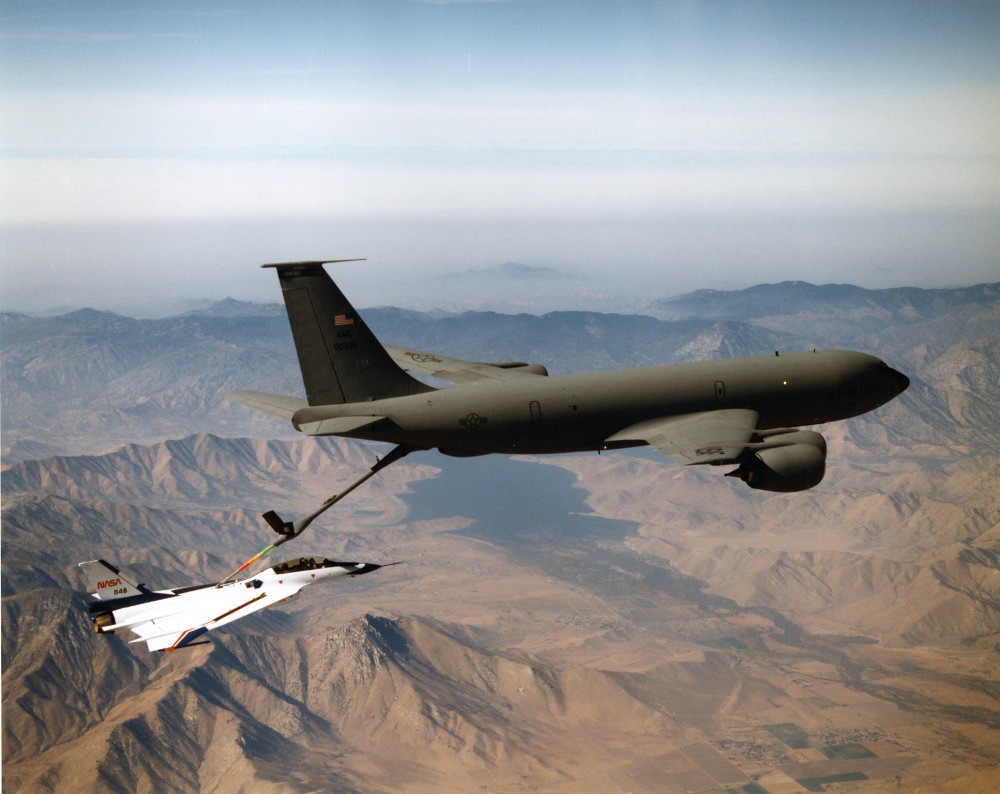
In 1988 both aircraft were handed to NASA's Ames-Dryden Flight Research Facility for supersonic laminar-flow research under the High Speed Civil Transport (HSCT) programme. Their wing and high-speed, high-altitude performance made them ideal: the aim was to achieve laminar flow over the wing, validate computational fluid dynamics design methods and test active suction systems, using passive or active aerodynamic gloves. Langley developed and coordinated the experiments.
F-16XL-1 was fitted with an active suction glove on the left wing, built by North American Aviation, with laser-cut holes nominally 0.0025 in across at 2,500 per square inch; suction came from a Convair 880 air-conditioning turbocompressor mounted where the 20 mm cannon ammunition had been. It flew 31 test sorties between May 1990 and September 1992 and was later used for take-off performance, engine noise and sonic boom studies.
_during_the_Digital_Flight_Control_System_functional_flight%2C_16_Dec_1997_(EC97-44354-2).jpg)
F-16XL-2 had its engine replaced by the more powerful General Electric F110-129, with which it achieved limited supercruise, Mach 1.1 at 20,000 ft (6,100 m) in military power, a design goal never reached during ETF testing. It carried an instrumented passive glove on the right wing and an active one on the left, built by Boeing in titanium with over 12 million laser-cut holes, with suction from a Boeing 707 cabin-pressurisation turbocompressor. It flew 45 test sorties. Although "significant progress" was made, neither aircraft attained the required laminar flow at the intended speeds and altitudes; NASA nevertheless judged the programme a success. Continuing the research with a Tupolev Tu-144, closer to a supersonic civil transport, was briefly considered but dropped for budget reasons.
Retirement
When the test programmes ended in 1999 both aircraft were stored at Dryden. In 2007 Boeing and NASA studied returning XL-1 to flight with F-16 Block 40 improvements to pursue sonic boom mitigation research; it was taxi-tested and given systems checks, but in 2009 both F-16XLs were retired for good at Edwards. 75-0747 is displayed at the Air Force Flight Test Center Museum air park and 75-0749 remains in storage there.
Multimedia

_during_the_Digital_Flight_Control_System_functional_flight%2C_16_Dec_1997_(EC97-44354-2)-1600.webp)
-1600.webp)
_for_sonic_boom_research%2C_1995_(EC95-43024-7)-1600.webp)
_for_sonic_boom_research%2C_1995_(EC95-43024-3)-1600.webp)
_for_sonic_boom_research%2C_1995_(EC95-43024-2)-1600.webp)
-800.webp)

-800.webp)
_takes_off_for_the_first_flight_of_the_Digital_Flight_Control_System_(DFCS)_on_December_16%2C_1997_(EC97-44354-1)-1600.webp)
-1600.webp)

-1600.webp)

_in_flight_060905-F-1234S-051.jpg)
_in_flight_060905-F-1234S-049-1600.webp)
_banking_in_flight_060905-F-1234S-050.jpg)


