General Dynamics F-16 Fighting Falcon variant
General Dynamics F-16 Fighting Falcon F-16C/D (Block 25/30/32/40/42/50/52/52+)
Second generation of the F-16, single-seat (C) and two-seat (D): it began with Block 25 and the AN/APG-68 radar in 1984 and evolved block by block up to the export Block 52+, with two engine families (F100 and F110), LANTIRN night-attack capability and the SEAD mission with the HARM missile.
General Dynamics F-16 Fighting Falcon sheet

- June 19, 1984
- First flight
- 4,220 km
- Range
History
The single-seat F-16C and two-seat F-16D form the second and most numerous generation of the Fighting Falcon. They grew out of the Multinational Staged Improvement Program (MSIP), the staged upgrade effort that the USAF and its partners applied to the F-16 during the 1980s in three stages, introducing new capabilities at lower cost and risk than independent upgrade programs. F-16C/D production started with Block 25, also known as MSIP Stage II. The first F-16C, serial 83-1118, flew on 19 June 1984 and was handed over to the USAF a month later; the version entered the production line in December of that year. Early flight testing exposed problems that were mostly related to software: development lead times, once paced by hardware, were now paced by software bugs, and people who understood both computers and aeroplanes were in short supply.
Block 25 brought a substantial change to the cockpit avionics: the Westinghouse AN/APG-68 radar (an evolution of the APG-66 with greater range and resolution and 25 operating modes, including track-while-scan for up to ten targets and continuous-wave illumination for the AIM-7 Sparrow), improved fire-control and stores-management computers, an Up-Front Controls panel, multifunction displays, a radar altimeter, data-transfer equipment and a MIL-STD-1760 weapons bus that allowed the AGM-65D Maverick and the AIM-120 AMRAAM to be carried. Externally the F-16C is almost identical to the F-16A: the visible difference is an enlarged triangular base at the root of the fin, originally meant to house the AN/ALQ-165 ASPJ jammer; the USAF withdrew from that programme in January 1990 and the jammer was never fitted to its F-16s. Block 25s left the factory with the Pratt & Whitney F100-PW-200 turbofan and were later brought up to the -220E standard. 209 F-16Cs and 35 F-16Ds of this block were delivered, all to the USAF; the 312th TFTS at Luke AFB was the first continental unit to receive them, in April 1986, and was fully operational by October 1988. One Block 25 F-16C nicknamed "Lethal Lady" had passed 7,000 flying hours by April 2008.
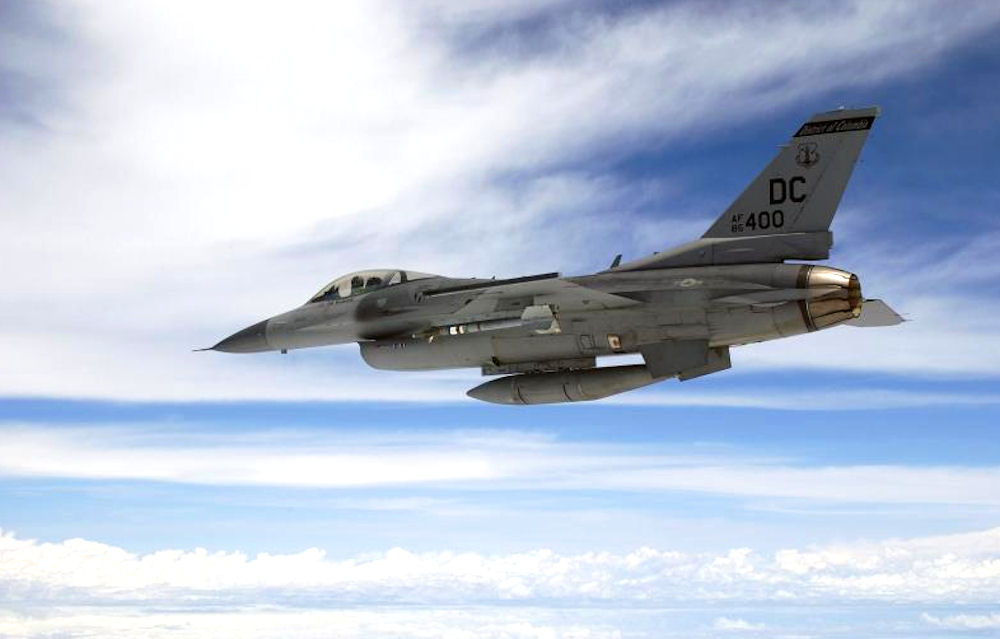
Block 30/32 was the first to feel the effect of the Alternate Fighter Engine programme, the so-called "Great Engine War": for the first time the customer could choose between the Pratt & Whitney F100 and the General Electric F110-GE-100. From then on, blocks ending in "0" are powered by GE and blocks ending in "2" by Pratt & Whitney. The original inlet limited the F110 to 114.47 kN, so from Block 30D the enlarged Modular Common Inlet Duct was introduced, allowing the engine to reach its full 128.93 kN; Block 32 kept the smaller inlet. The first Block 30 entered service in 1987 and the block added the AGM-45 Shrike, the AGM-88 HARM and the AIM-120, the latter operational from September 1991. 200 F-16C and 200 F-16D Block 30s and 100 F-16C and 133 F-16D Block 32s were built; only early Block 30s were exported, to six countries. The Block 32H/J jets of the Thunderbirds, built in 1986 and 1987, are among the oldest operational F-16s in the force. The Air National Guard upgraded its Block 32s with a ring-laser-gyro inertial unit and later an Embedded GPS/INS, the AN/ALQ-213 electronic-warfare suite and the LITENING targeting pod, enabling JDAM and other GPS-aided munitions; the package is informally known as the F-16C++. The Block 30 airframe also gave rise to the 22 F-16N and TF-16N adversary aircraft that the US Navy acquired in 1987–1988 for dissimilar air combat training, retired from 1994 after their wings began to crack.
Block 40/42, in service from 1988, is the all-weather, night-attack strike version equipped with LANTIRN pods, hence the "Night Falcons" nickname and the unofficial F-16CG/DG designation. It received a strengthened undercarriage for the pods, the APG-68(V)1 radar with full LANTIRN compatibility, a GPS receiver and cockpit lighting compatible with night-vision goggles, whose installation order was completed in 2004. From 2002 its arsenal grew with JDAM, the AGM-154 JSOW, the WCMD dispenser and the EGBU-27 bunker-buster. 200 F-16C and 200 F-16D Block 40s and 115 F-16C and 100 F-16D Block 42s were built, all for the USAF, although many were later exported once replaced.
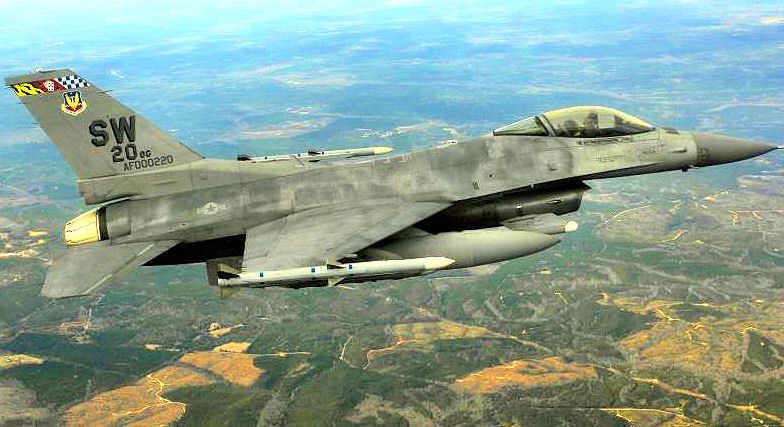
Block 50/52 introduced the engines of the Increased Performance Engine programme: the 131.61 kN F110-GE-129 on Block 50 and the 129.7 kN F100-PW-229 on Block 52, with which F-16s began flying in the early 1990s. The first Block 50 was delivered in late 1991, with improved GPS/INS, the APG-68(V)5 radar and the ability to carry HARM, JDAM, JSOW and WCMD on its nine hardpoints. Aircraft modified for suppression of enemy air defences (SEAD), which replaced the F-4G Wild Weasel, are unofficially known as F-16CJ/DJ: the first, 91-0360, was delivered on 7 May 1993, and the first Block 52 in the whole force reached the 157th FS of the South Carolina Air National Guard in February 1994. They carry the AN/ASQ-213 HARM Targeting System on the port intake hardpoint, in place of the LANTIRN navigation pod, together with the AN/AAS-35V Pave Penny laser spot tracker; the 157th's F-16CJs took the HTS and the Litening II into combat for the first time during Operation Iraqi Freedom. Of the 1,446 F-16C/Ds ordered by the USAF, 556 were fitted with F100-series engines and 890 with F110s. Iraq received 36 Block 50/52 jets (24 single-seat and 12 two-seat), designated F-16IQ.
Block 50/52 Plus (52+) was an export-only model that never served with the USAF. It adds support for conformal fuel tanks mounted above the wing on both sides of the fuselage and easily removable, which provide 1,665 litres of additional fuel and free hardpoints; an enlarged dorsal avionics spine on all two-seaters, adding 850 litres of volume from the cockpit to the tail; the APG-68(V)9 radar, an On-Board Oxygen Generation System and the JHMCS helmet. In 2005 Greece ordered 30 more F-16C/Ds known as Block 52+ Advanced, called Block 52M in the Hellenic Air Force because of their more powerful mission computer, with Link 16, an extra multifunction display with moving map and the ability to carry a reconnaissance pod; the first were delivered in May 2009 to 335 Squadron at Araxos. Beyond Fort Worth, Turkish Aerospace Industries built 232 Block 30/40/50 F-16s under licence in Ankara for the Turkish Air Force in the late 1980s and 1990s, plus 46 Block 40s for Egypt and 30 Block 50s from 2010, and Korean Aerospace Industries produced 140 Block 52s for the KF-16 programme.
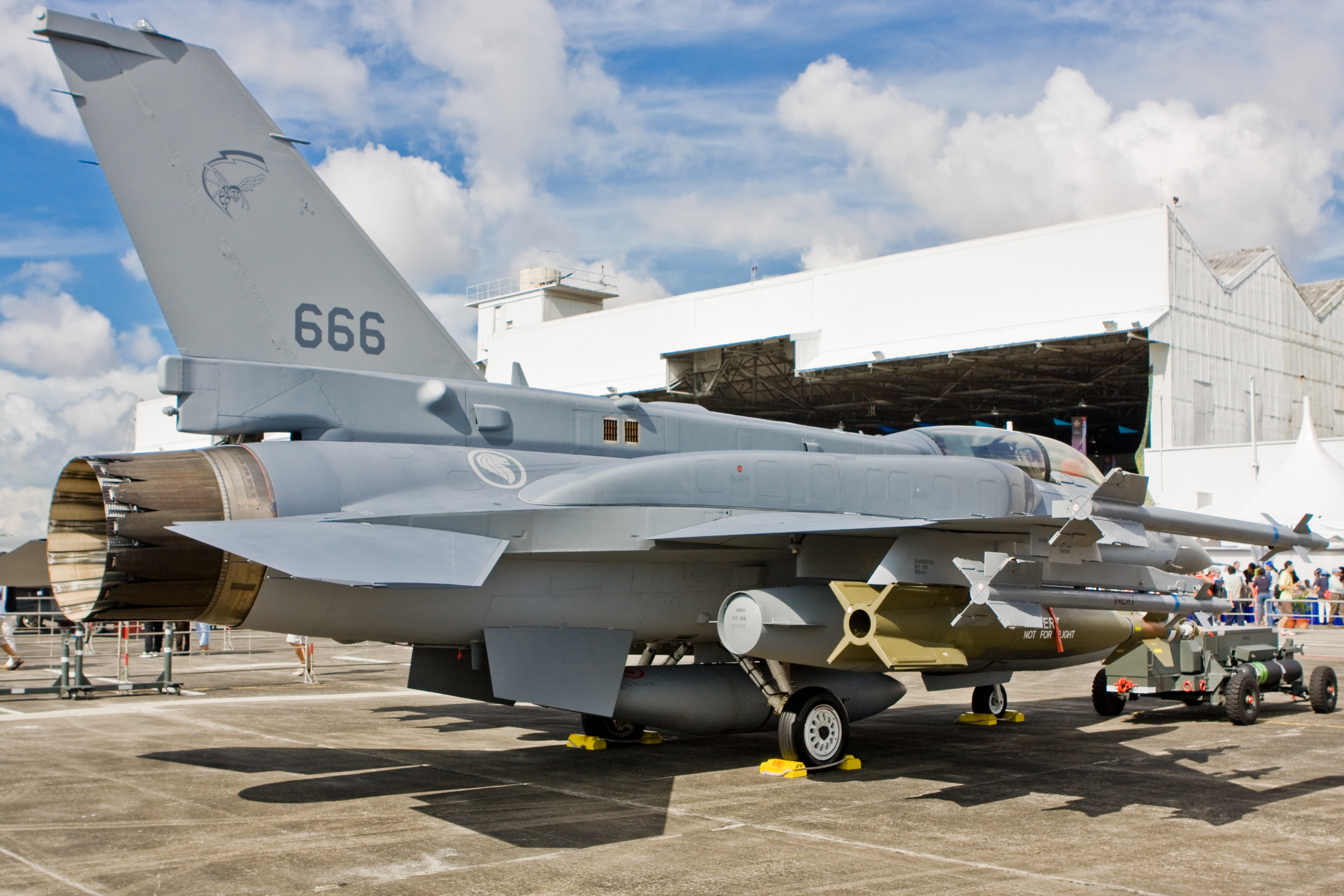
The US Block 40/42 and 50/52 fleet was unified through the Common Configuration Implementation Program (CCIP), a $2 billion modernisation effort that standardised its avionics on a common Block 50/52-based configuration to simplify training and maintenance. Lockheed Martin received the first-phase contract in June 1998, kit production began in 2000 and deliveries in July 2001; in 2007 Korean Air won a contract to apply CCIP, the Falcon STAR structural upgrade and maintenance to 100 USAF F-16s through 2013, extending airframe life from 6,000 to 8,000 hours. With the arrival of the F-22 and mass production of the F-35, the C/Ds are being retired rapidly: in 2024 the USAF and Air National Guard fleet retained 123 F-16C Block 25s, 200 Block 30s, 100 Block 32s, 200 Block 40s and 115 Block 42s, plus 37 F-16D Block 40s and 100 Block 42s. The Block 50/52 later served as the basis for the UAE's F-16E/F Block 60 and, as an upgrade option, for the F-16V.
Multimedia


_F-16D_Block_52-1600.webp)
_F-16C_Block_52_(6_ELT)-800.webp)
Elsewhere
- Turkish Aerospace (TUSAS)Programa Peace Onyx II: F-16 producidos en Turquía ↗
- Turkish Aerospace (TUSAS)Programa Peace Onyx IV de modernización del F-16 turco ↗
- Wojsko PolskieEl F-16 Jastrząb en el inventario de las Fuerzas Aéreas polacas ↗
- U.S. Air ForceLos Thunderbirds de la USAF y sus F-16C de demostración ↗
- Republic of Singapore Air ForceLos F-16C/D en el inventario de la Fuerza Aérea de Singapur ↗
- Ministry of Defence SingaporeFicha del F-16 modernizado de la RSAF con radar AESA ↗
- Korea Aerospace IndustriesPrograma KF-16 de Korea Aerospace Industries ↗