Vought F4U Corsair variant
Vought F4U Corsair F4U-1
The first production version of the Vought F4U Corsair, with the framed "birdcage" canopy, six .50 in wing guns, a fuselage tank that pushed the cockpit aft and the 2,000 hp R-2800-8 engine. Vought built 2,814; the US Navy accepted them from July 1942. Initially kept off carriers because of poor visibility and bouncing on landing, it entered combat on Guadalcanal with VMF-124 in February 1943, equipped VF-17 and VMF-214 and reached the Royal Navy as the Corsair Mk I (95 aircraft).
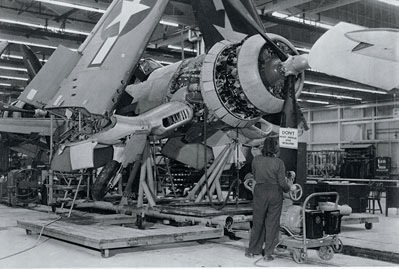
- 2,814
- Units built
- 1,633 km
- Range
History
From prototype to production fighter
The F4U-1 was the first production version of the Corsair, the model that carried the inverted gull-wing fighter from trials into combat. The XF4U-1 prototype had flown on 29 May 1940, but reports from the war in Europe convinced the Navy that its armament, two cowl-mounted .30 in machine guns and two .50 in guns in the wings, was too light. Formal acceptance trials began in February 1941; the Navy signed a letter of intent on 3 March, received Vought's production proposal on 2 April and on 30 June 1941 awarded a contract for 584 F4U-1 fighters, which inherited the name "Corsair" from the firm's late-1920s O2U scout biplane.
Production started slowly because the series aircraft differed greatly from the prototype. Six .50 in (12.7 mm) M2 Browning machine guns, three in each outer wing panel, with 400 rounds for the inner pair and 375 for the outer ones, displaced the wing fuel tanks. The only place near the centre of gravity was the forward fuselage, so a 237 US gal (897 litre) self-sealing tank took the place of the old fuselage guns, the cockpit moved back 32 in (810 mm) and the fuselage was lengthened. The changes added 68 kg of armour plate and a 38 mm internal bullet-resistant windscreen, curved side panels behind the headrest, a window in the lower fuselage to help with deck landings, NACA slotted flaps instead of deflector flaps, longer-span ailerons for a better roll rate, IFF equipment and, in each wing leading edge, a 62 US gal (230 litre) non-self-sealing auxiliary cell. The engine became the Pratt & Whitney R-2800-8 Double Wasp rated at 2,000 hp (1,500 kW) for take-off. Together these changes added several hundred pounds.
The birdcage canopy and running changes
The first production F4U-1 flew on 24 June 1942 according to English Wikipedia; Vought's own production summary gives 25 June. The Navy accepted the first two in July 1942 and nine more in August. Its trademark was the framed "birdcage" canopy, with the pilot seated low and far aft: deck taxiing was hard because the long nose and nose-up attitude blocked the view ahead, and the huge engine torque punished inexperienced pilots, hence nicknames such as "Hog" and "Hose Nose". In November 1942 the fifth production aircraft was modified with a raised seat, the origin of the clear canopy of later batches; Vought counted seven major changes in a year and a half, including an improved landing gear oleo, a new tail hook that stopped skipping on deck and a small spoiler on the starboard wing to give stall warning. According to Vought, the company built 2,814 F4U-1s.

Vought's specification sheet for the F4U-1 lists a 40.90 ft span (about 12.5 m), a 33.30 ft length (about 10.1 m), an empty weight of 8,982 lb (just over four tonnes) and a gross weight of 14,009 lb (about 6.4 tonnes). It gave 425 mph (about 684 km/h), an initial climb of 3,100 ft/min (about 15.7 m/s), a 37,000 ft service ceiling (about 11.3 km) and, at a 186 mph (about 299 km/h) cruise, a range of 1,015 miles, roughly sixteen hundred kilometres. Internal fuel could be topped up with two 150-gallon drop tanks. The F4U-1 was considerably faster than the Hellcat and only 13 mph (21 km/h) slower than the P-47, reaching its top speed at 19,900 ft (6,100 m) with a mechanically supercharged engine.
Turned away from carriers, handed to the Marines
Trials in 1942 aboard the training carrier USS Wolverine and the escort carriers USS Core and USS Charger concluded that, despite visibility and control sensitivity, it was a good carrier type. VF-12 got it in October 1942 and VF-17 in April 1943, but the Pacific air command preferred to give the Corsairs to the Marines and keep Hellcats on deck. VF-12 handed over its aircraft, and VF-17, formed on 1 January 1943 at Norfolk under Tommy Blackburn, was taken off Bunker Hill and fought from land in the Solomons; its experience helped shape the F4U-1A changes. On 8 November 1943 a flight led by Roger Hedrick intercepted 39 Japanese fighters over Empress Augusta Bay, Bougainville, and on 11 November its pilots refitted tail hooks to refuel aboard Bunker Hill and Essex during the Rabaul strike. In its Corsair tours VF-17 shot down 152 aircraft and produced 11 aces.
Guadalcanal and VMF-124
VMF-124, commissioned on 2 September 1942 at Camp Kearney, was the first Marine squadron to fly the Corsair; it was declared operational on 28 December with an average of only 25 hours per pilot in the aircraft. Twelve F4U-1s under Major William Gise reached Henderson Field, Guadalcanal, on 12 February 1943 and that same morning escorted a PBY Catalina to Vella Lavella. On 14 February, escorting B-24s against Kahili, the Americans lost four P-38s, two P-40s, two Corsairs and two Liberators: the "Saint Valentine's Day Massacre". By May the Corsairs had the upper hand, and VMF-124's Kenneth A. Walsh became the first Corsair ace; on 30 August 1943 he downed four Zeros and earned the Medal of Honor. Early F4U-1s also equipped Gregory "Pappy" Boyington's VMF-214 "Black Sheep".
Corsair Mk I and survivors
In mid-1943 the Royal Navy received its first 95 F4U-1s, all birdcage aircraft, as the Corsair Mk I; 1830 Naval Air Squadron, the first Fleet Air Arm Corsair unit, formed on 1 June 1943. The British found the landings dangerous and suffered fatal crashes, but the Mk I never went into combat. Vought also built a single two-seat trainer, in which the Navy showed no interest.

According to the National Naval Aviation Museum only four birdcage Corsairs survive. Its example, production number 312, crashed into Lake Michigan on 12 June 1943 during carrier qualification aboard USS Wolverine; it was recovered in 2010 and its restoration was completed in 2024. Off Midway Atoll, in more than 110 ft of water, lies another F4U-1 that NOAA documented in 2007 without being able to identify it.
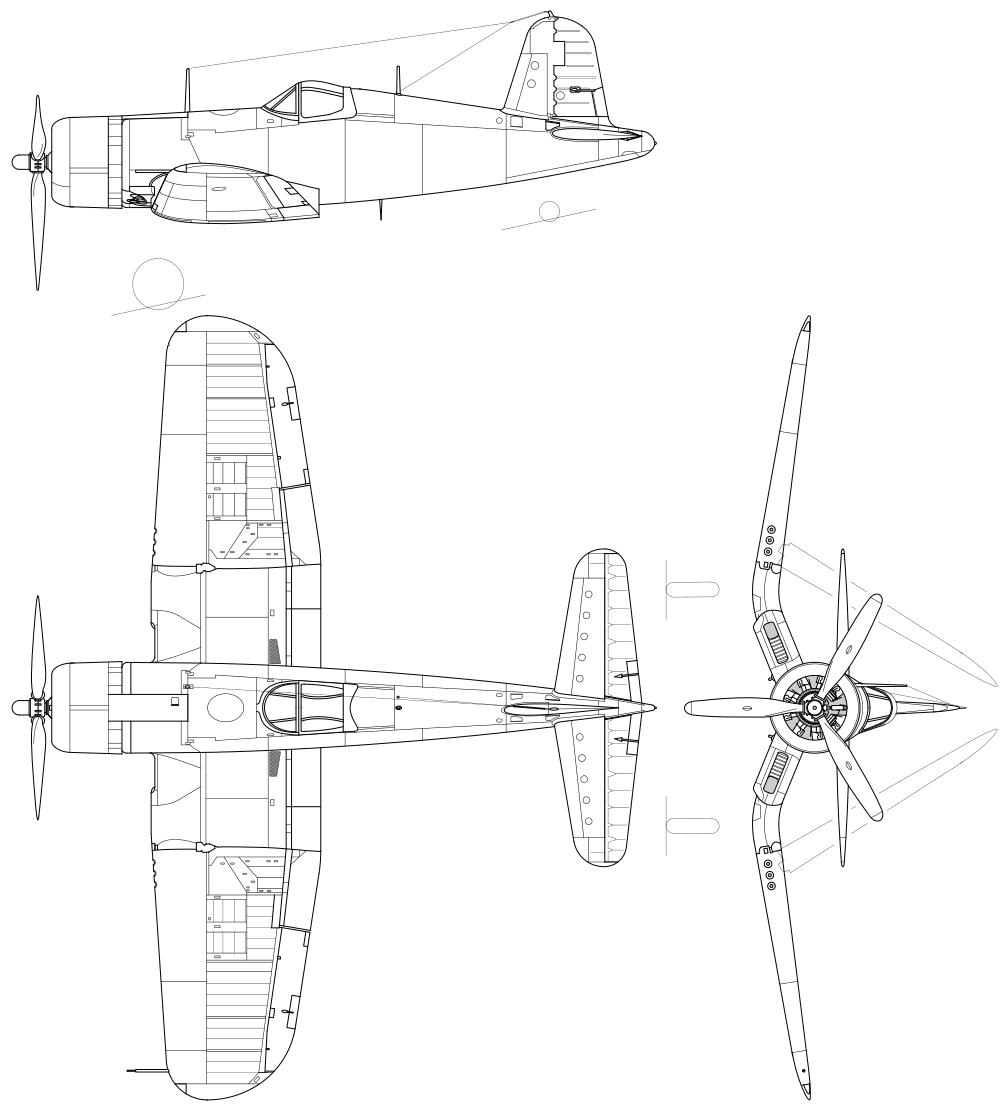
Three-view drawing
Multimedia


