Vought F4U Corsair variant
Vought F4U Corsair AU-1 (F4U-6)
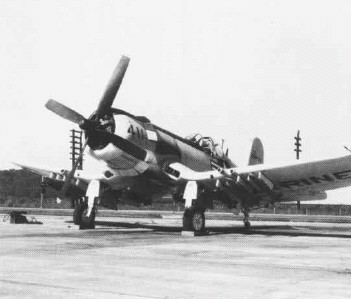
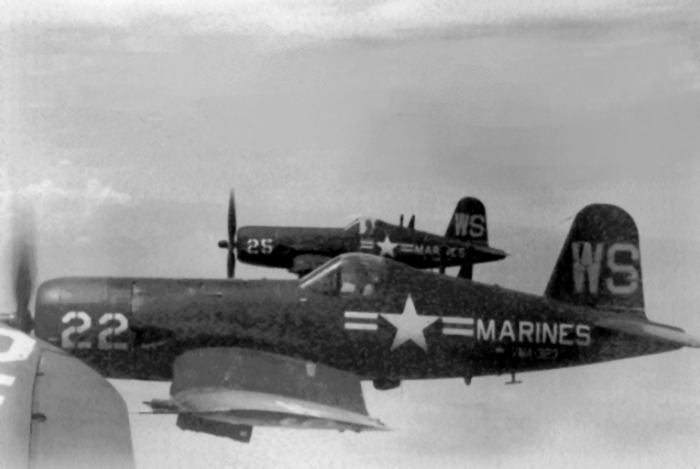
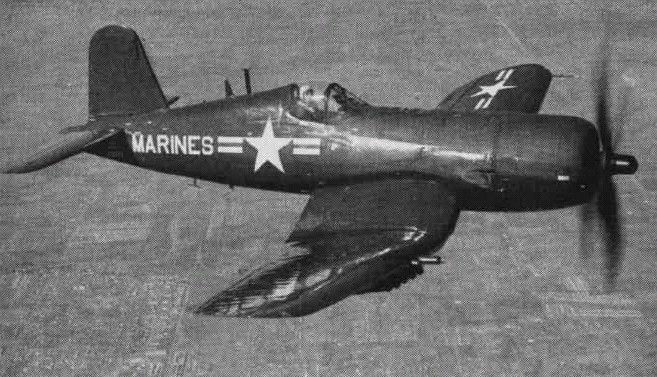
The AU-1, originally designated F4U-6, was the ground-attack version of the Corsair that Vought built in Dallas for the U.S. Marine Corps during the Korean War. Derived from the F4U-5, it added armour, relocated oil coolers and an R-2800-83W engine with a simplified supercharger for low-level work. 111 were built in 1952; after Korea, 25 war-weary examples served with the French Aéronavale in Indochina in 1954, and others later reappeared in Algeria. Its airframe was the basis of the F4U-7, the last Corsair.

- 111
- Units built
History
Origins: a Corsair built for close support
In Korea the Corsair stopped being primarily a carrier fighter and was used mostly for close air support of ground troops; French Wikipedia puts its share of ground-support missions in that war at 80 per cent. For this job Vought began studying a specialised version in 1950 and won a contract for the F4U-6 in January 1951. By the time the first aircraft flew, in January 1952, it had been redesignated AU-1: the A for attack signalled that it was meant strictly for hitting ground targets, not for contesting air superiority. According to Tom Cleaver's historical review, the last F4U-5N had left the Dallas line in October 1951 and the F4U-6 followed it in the same plant, where Vought, by then independent of United Aircraft, had moved in 1949.
Changes from the F4U-5
The AU-1 used the F4U-5 airframe but was tailored for low-altitude flight. Its Pratt & Whitney R-2800-83W (R-2800-83WA in Spanish Wikipedia) dropped the F4U-5's automatic two-stage supercharger for a manually controlled single-stage unit that delivered plenty of power close to the ground; the French Wikipedia variant table credits it with about 2300 hp. The auxiliary air intakes around the cowling disappeared. The oil coolers, a weak spot against ground fire when mounted in the wing, were relocated inboard towards the fuselage, and the pilot and fuel tank received extra armour; people who restored an F4U-7, a direct descendant of this airframe, describe three large plates under the fuselage, ahead of, below and behind the cockpit. Extra racks were fitted: ten under the wings, each able to carry a 5-inch HVAR rocket or a 250 lb (113 kg) bomb. The inverted gull wing also proved an asset in this role: a low straight wing would have blocked the view of the ground, whereas the Corsair's cranked wing gave the pilot better ground references.
Load and performance
Fully loaded for combat, the AU-1 weighed 20 per cent more than a similarly loaded F4U-4 and could carry up to 8,200 lb (about 3,700 kg) of bombs. Spanish Wikipedia gives weights of 5,851 kg normal and 6,032 kg maximum, with an overload take-off weight of up to 8,799 kg, and describes a typical load of two 454 kg bombs on the inner racks and six 227 kg bombs on the others. With 4,600 lb (about 2,100 kg) of bombs and one 150 US gallon (570 l) drop tank, top speed was 238 mph (383 km/h) at 9,500 ft (2,900 m); with ten HVARs and two 150-gallon tanks it rose to 298 mph (480 km/h) at 19,700 ft (6,000 m), and with no external stores it reached 389 mph (626 km/h) at 14,000 ft (4,300 m).
Marine Corps service in Korea
Vought delivered the last of 111 AU-1s in October 1952; Spanish Wikipedia gives 110 elsewhere and Cleaver speaks of 110 in production, but the production tables of English and French Wikipedia agree on 111, plus one converted XAU-1 prototype. In Korea, between 1950 and 1953, the AU-1 flew alongside the F4U-4B, F4U-4P, F4U-5N and F4U-5NL. One of its units was VMF-212, redesignated VMA-212 (attack) on 9 June 1952, which that year replaced its earlier Corsairs with AU-1s. According to its history, no other Marine Corps squadron dropped more ordnance during the war. The AU-1 had a centreline rack for a 2,000 lb (910 kg) bomb, plus two 1,000 lb bombs on the wing-root racks and 100 or 260 lb bombs on the wing racks; the rough Marston matting laid over the old strip at K-6 eventually broke that centre rack off. Loaded, the aircraft struggled towards enemy lines at about 140 knots (260 km/h); once rid of its bombs it again behaved as a nimble fighter. After the Korean ceasefire VMA-212 traded its AU-1s for Douglas AD-2 and AD-3 Skyraiders. The type was retired from U.S. service in 1957.
Indochina: the Aéronavale's AU-1s
In spring 1954, with the Dien Bien Phu garrison surrounded, Flotille 14F, then at Karouba in Tunisia, was moved without its aircraft to Da Nang, arriving on 17 April. The next day the carrier USS Saipan delivered 25 ex-Marine AU-1s to Tourane air base: worn-out Korean veterans that English Wikipedia says had been flown by VMA-212 at the end of that war and that Cleaver says came from Marine Air Group 12 in Japan. According to Spanish Wikipedia, French mechanics managed to make 16 of them airworthy. In about three months 14F's Corsairs flew 959 combat sorties and 1,335 hours, dropping some 700 tons of bombs and firing more than 300 rockets and around 70,000 rounds of 20 mm ammunition, in support of Dien Bien Phu and against Viet Minh railways, bridges and other targets. Dien Bien Phu fell on 7 May and operations continued until the ceasefire of 21 July 1954; the French lost six aircraft and two pilots. The surviving AU-1s were taken to the Philippines and returned to the U.S. Navy.
Algeria and legacy
AU-1s later returned to France: Cleaver notes they were refurbished and sold to the Aéronavale for the Algerian War, while Spanish Wikipedia says they were bought as surplus to make good losses. Between 1955 and 1962 they flew there alongside the F4U-7s of Flotillas 12F, 14F, 15F and 17F. English Wikipedia puts the number of AU-1s used by the Aéronavale at 69, against 25 in French Wikipedia, which counts only those in Indochina. Their main legacy was the F4U-7, ordered by France to combine the AU-1's attack capability with the F4U-4's performance: essentially an AU-1 airframe with the F4U-4's 2,100 hp R-2800 engine.

Three-view drawing

Multimedia