Fighter · Military · United States
Northrop F-5
- July 30, 1959
- First flight
- In service
- Status
Northrop F-5 in the news
September 18, 2026
_204_Conduct_Flight_Operations.jpg)
The Chilean Air Force (FACh) marked this week 50 years since the arrival of the Northrop F-5 in the country. The ceremony was held at El Bosque Air Base in Santiago and brought together members…
September 17, 2026
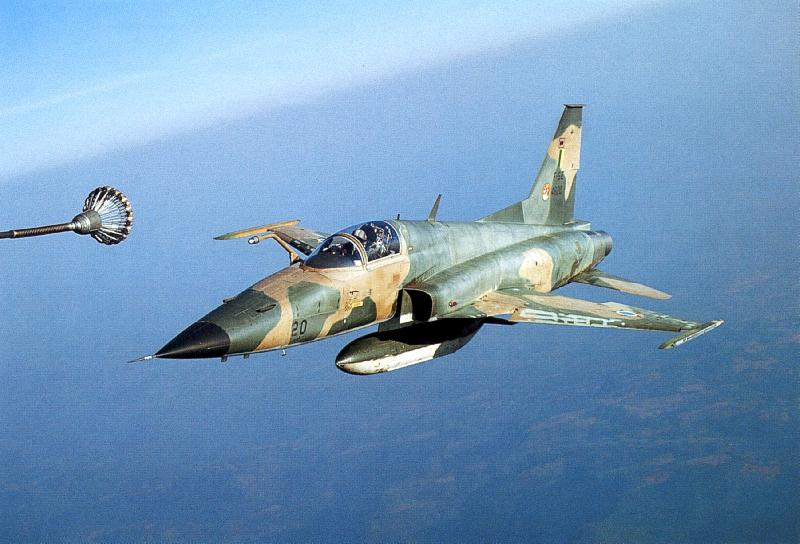
On Tuesday 15 September, the Chilean Air Force (FACh) held the commemorative ceremony for 50 years of operations of the F-5E/F weapons system. The event took place at Air Base El…
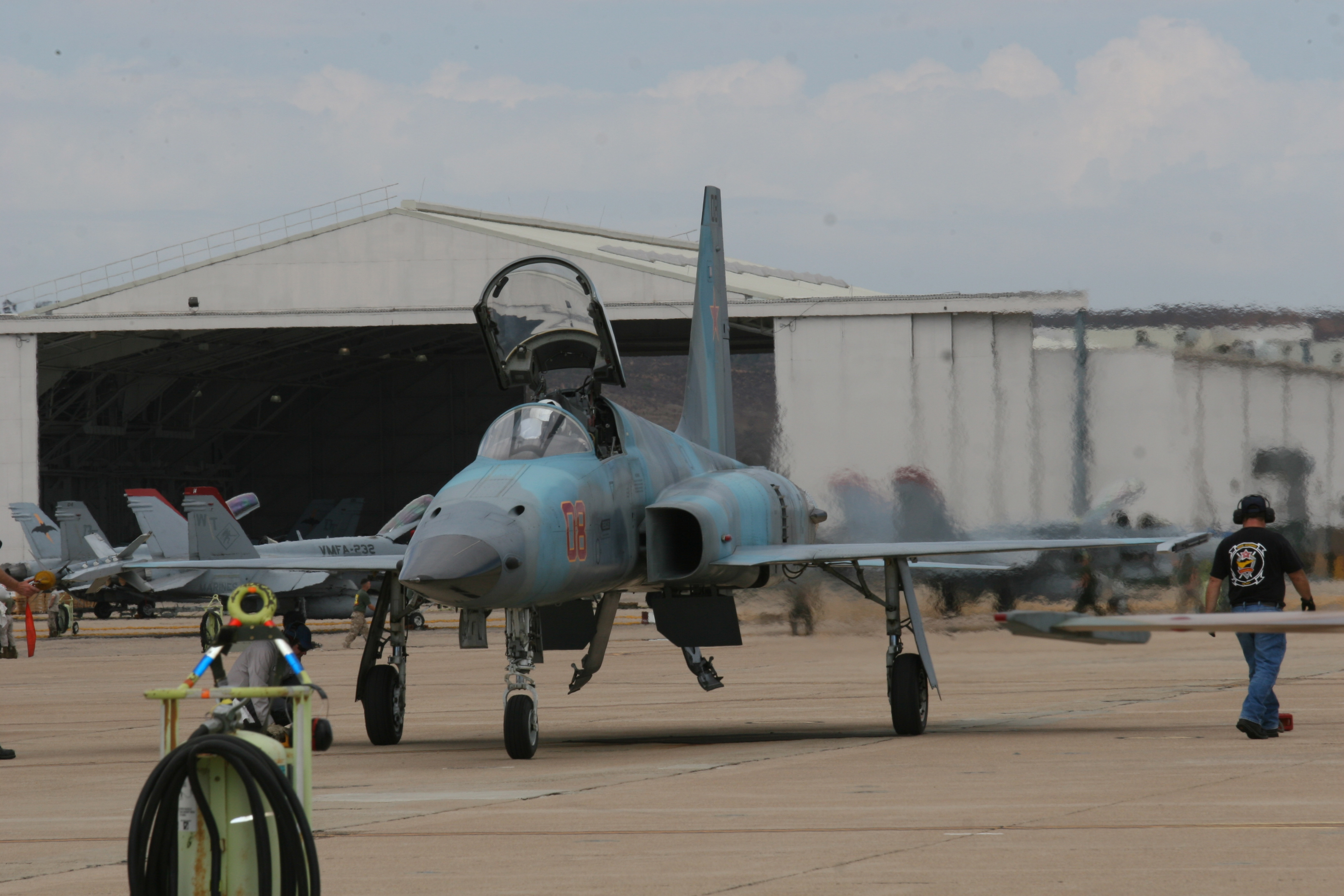
The Chilean Air Force (FACH) marked, on Tuesday the 15th, 50 years of operating the Northrop F-5 fighters, in a ceremony held at El Bosque Air Base, near Santiago. The event brought together…
September 16, 2026
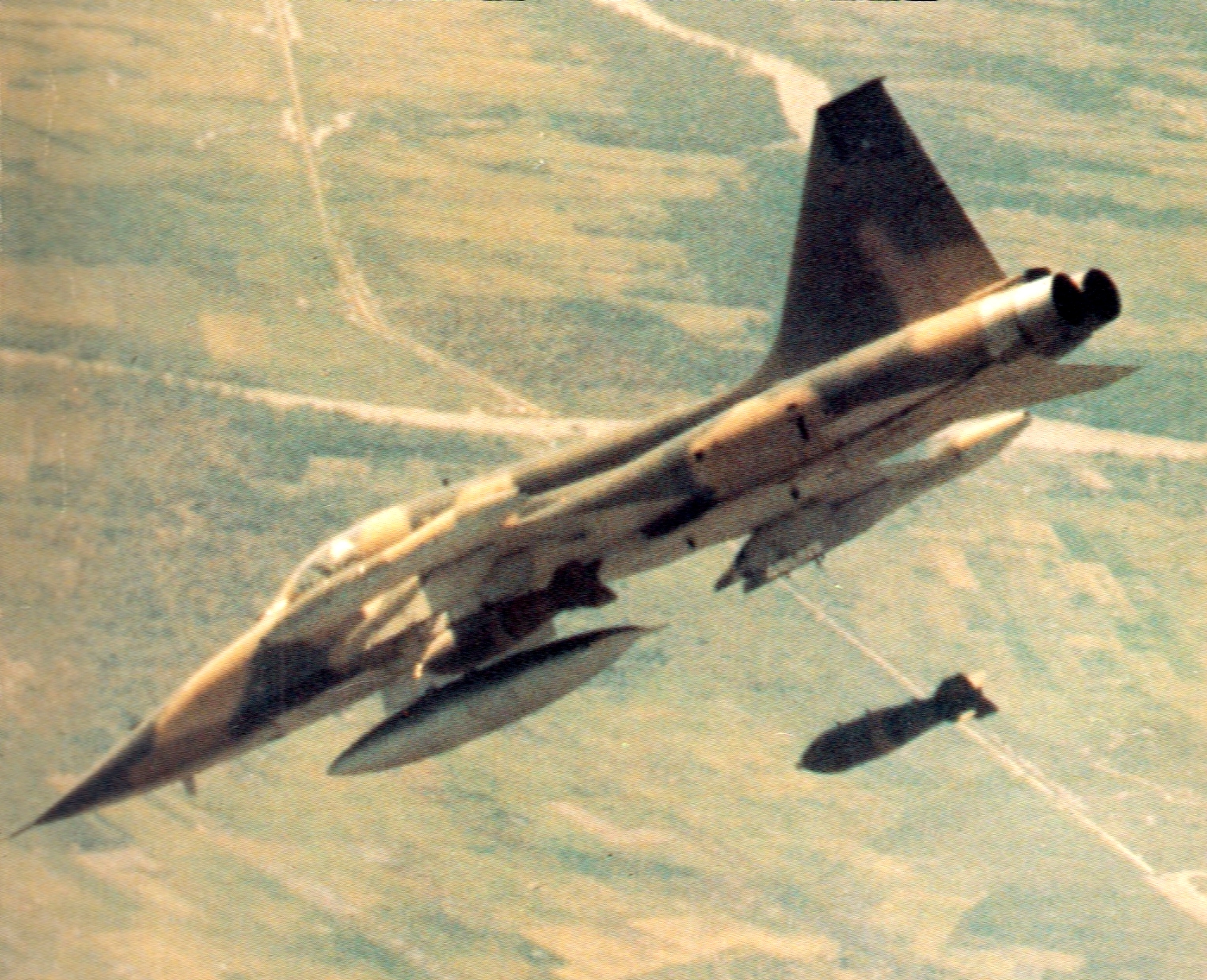
Marking the 50th anniversary of the platform in the service, the Chilean Air Force (FACh) displayed for the first time an F-5E Tiger III fighter armed with one of the Israeli missiles…
September 13, 2026
_061006-F-1234S-068.jpg)
The story of the Northrop F-5F Tiger II began in the mid-1970s, when Northrop developed a two-seat version of the F-5E intended mainly for pilot training, but which…

-1600.webp)
_204_Conduct_Flight_Operations-1600.webp)

_204_Conduct_Flight_Operations-1600.webp)
_Key_West%2C_Fla-1600.webp)

_061006-F-1234S-069-1600.webp)
%2C_1_March_1990_(6456170)-1600.webp)
-800.webp)

_060905-F-1234S-007-1600.webp)
_061006-F-1234S-073-1600.webp)
-1600.webp)
_061006-F-1234S-070-1600.webp)

-1600.webp)
_061006-F-1234S-077-800.webp)
_061006-F-1234S-078-800.webp)
_061006-F-1234S-076-800.webp)
%2C_in_1988_(6456313)-1600.webp)


_204_Conduct_Flight_Operations-1600.webp)
_061006-F-1234S-071-1600.webp)
-1600.webp)
_060905-F-1234S-006-1600.webp)
_061006-F-1234S-067-1600.webp)
_061006-F-1234S-068-1600.webp)




_060905-F-1234S-005-1600.webp)

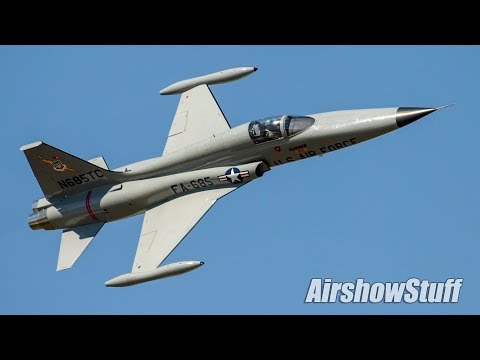
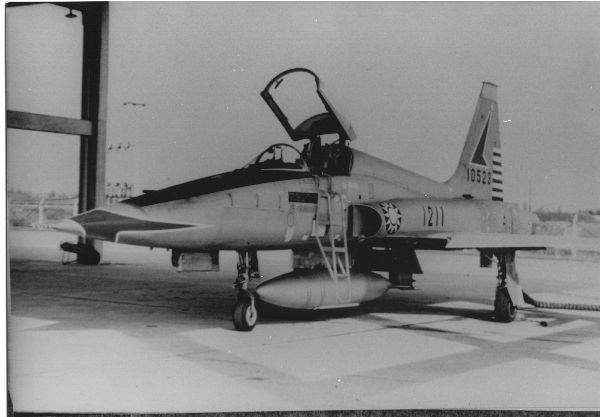
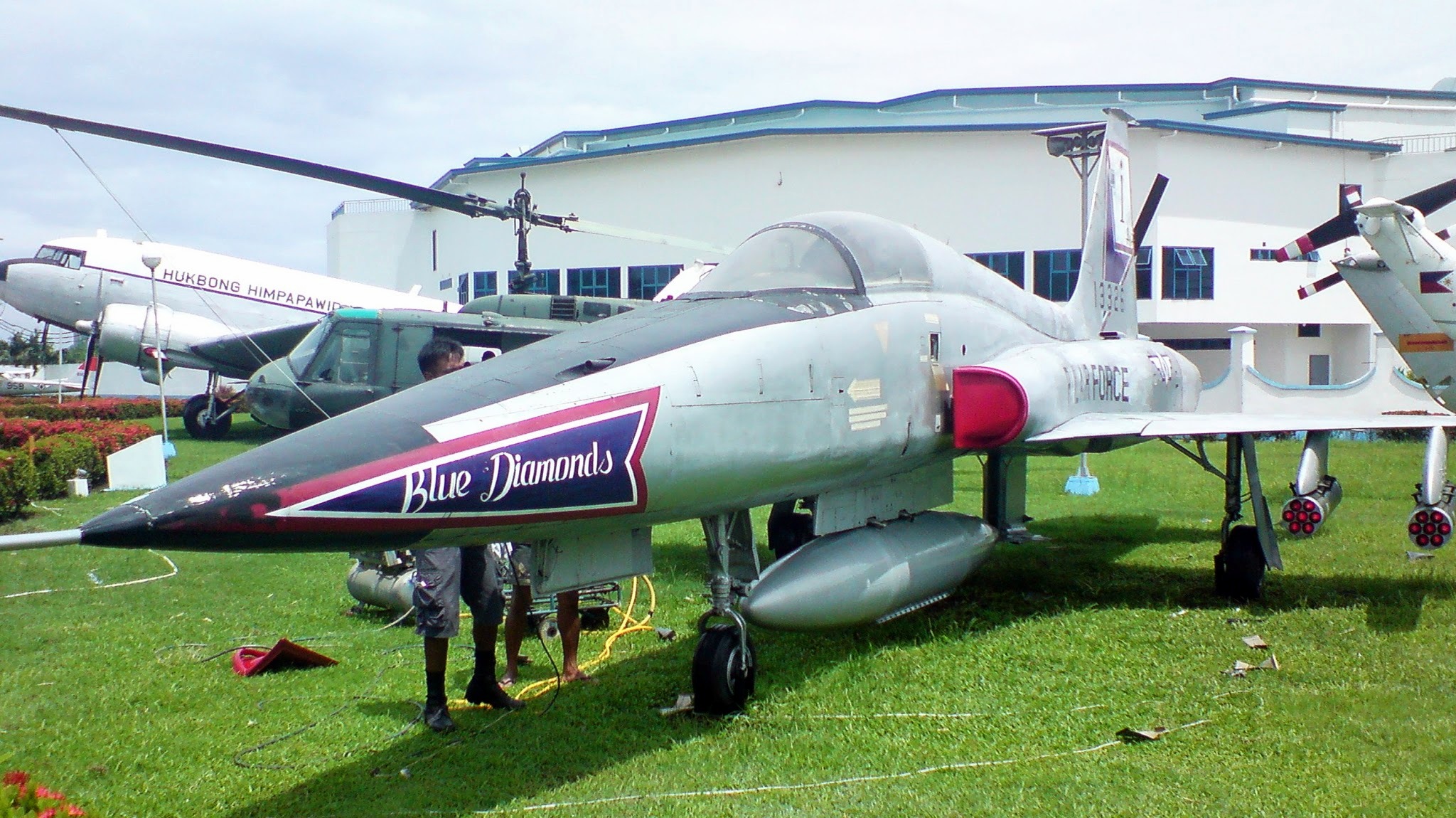
The Northrop F-5 is a family of supersonic light fighters conceived in the late 1950s as a privately funded Northrop Corporation venture. Two generations share the designation: the original F-5A and F-5B Freedom Fighter and the deeply revised F-5E and F-5F Tiger II. In both, the design team wrapped the smallest, cleanest possible airframe around a pair of compact General Electric J85 turbojets, putting performance and cheap maintenance ahead of sophistication. The philosophy came from engineering vice president Edgar Schmued, previously chief designer of the P-51 Mustang and F-86 Sabre at North American, and from chief engineer Welko Gasich, who brought the notion of life cycle cost into fighter design. Against contemporaries such as the McDonnell Douglas F-4 Phantom II, the F-5 was smaller, simpler and far cheaper to buy and operate, which made it the Cold War export fighter par excellence. Although intended for the day air superiority role, it proved an effective ground-attack platform as well. The N-156F prototype flew at Edwards on 30 July 1959 and went supersonic on that first flight, yet the programme languished until the Kennedy administration revived the requirement for a low-cost fighter for military assistance customers: the type won the F-X competition on 23 April 1962, became the F-5A and was ordered into production that October. Northrop built 624 F-5As, 200 F-5Bs and 86 RF-5As, joined by 240 first-generation aircraft licence-built by Canadair and 70 by CASA in Spain. Norway placed the first international order on 28 February 1964. Winning the International Fighter Aircraft competition in 1970 produced the F-5E Tiger II, with more powerful J85-21 engines, a lengthened fuselage, greater wing area, enlarged leading-edge extensions and, at last, radar. The F-5E flew on 11 August 1972 and the two-seat F-5F on 25 September 1974; by the end of production in 1987 a total of 1,400 Tiger IIs had been completed, and between the F-5 and the closely related T-38 Talon more than 3,800 aircraft left Hawthorne, California. As an export fighter it saw combat in Southeast Asia, in the Ogaden War and in the Iran-Iraq War, while in the United States it found a lasting niche as an aggressor aircraft for dissimilar air combat training, a role it still fills with the Navy and Marine Corps on modernised F-5N and F-5F airframes; more than 400 were still in service as of 2021. The same airframe spawned the RF-5E Tigereye reconnaissance version, the Northrop YF-17 that led to the F/A-18, the stillborn F-20 Tigershark and the NASA F-5E rebuilt for the Shaped Sonic Boom Demonstration.
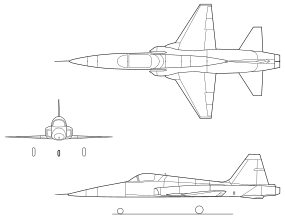
Three-view drawing
History
A light fighter against the grain
By the mid-1950s fighter design was drifting towards ever larger, heavier and costlier aircraft. Northrop chose to row the other way. The effort was led by Edgar Schmued, the company's vice president of engineering, who arrived from North American Aviation with two legendary designs behind him, the P-51 Mustang and the F-86 Sabre, and who assembled a first-rate engineering team at Northrop.
NATO set the context: in December 1953 it issued requirement NBMR-1, calling for a lightweight tactical fighter able to carry conventional and nuclear weapons and to operate from rough airfields. In late 1954 a Northrop team toured Europe and Asia to study that requirement and, along the way, the needs of SEATO members. From the tour Schmued drew the goal that shaped the programme: reverse the trend towards size and weight and deliver an aeroplane that was fast, agile and reliable yet cheaper than its contemporaries. Knowing that no air force could replace a jet fleet every few years, he also demanded engineered growth potential built in from the start, good for a service life of more than ten years.
The enabling piece arrived in 1955 with the General Electric J85 turbojet, originally developed for the ADM-20 Quail decoy carried by the Boeing B-52 Stratofortress. Depending on the version the J85 offered a thrust-to-weight ratio between 6.25 and 7.5, well clear of the 4.7 of the J79 that powered the F-4 Phantom. Two such compact engines made a genuinely small fighter thinkable without giving up performance.
From the N-156TX to the PD-2879D
With a pair of J85s as the baseline, the team worked through a long series of layouts. One of the earliest, the N-156TX of March 1955, hung the engines in pods under each wing, with a far slimmer fuselage than the final design and a crew of two under a narrow canopy. That same year the US Navy showed interest in a fighter able to fly from its escort carriers, too small for the embarked jets of the day, and Northrop answered with a radical redesign, the PD-2706, which tucked the engines against the fuselage in short ducts exhausting ahead of the tail and adopted a T-tail. When the Navy withdrew the escort carriers that branch died, but work continued in two directions: a two-seat advanced trainer, the N-156T, and a single-seat fighter, the N-156F.
It was chief engineer Welko Gasich who convinced Schmued that the engines had to sit inside the fuselage for maximum performance. That produced the PD-2812 of January 1956, already close to the finished article though with a wide low-set tailplane of marked anhedral; March 1956 brought the PD-2832, with a conventional tailplane and a strongly swept fin. After a year of nose variations and successive fuselage stretches, the design settled in December 1956 as the PD-2879D. Gasich also contributed the idea that explains the type's longevity: life cycle cost as a design criterion. A Northrop design study summed it up as applying advanced technology to obtain maximum force effectiveness at minimum cost, and that philosophy produced both the T-38 and the F-5.
The Talon first, the fighter after
The trainer, paradoxically, flew first. The United States Air Force picked the N-156T in July 1956 to replace the T-33, and on 10 April 1959 the first prototype, designated YT-38 Talon, made its maiden flight; by the time production ended in January 1972, 1,189 Talons had been delivered. The fighter advanced more slowly and at Northrop's own expense: on 25 February 1958 three prototypes were ordered of a low-cost aircraft meant for supply to less-developed nations through the Military Assistance Program. The first N-156F flew at Edwards Air Force Base on 30 July 1959 and exceeded the speed of sound on that very first flight.
Testing went well, the aircraft showing unusual reliability and proving superior to the North American F-100 Super Sabre in the ground-attack role, but official interest cooled and by 1960 the programme looked dead. It revived in 1961 when the US Army evaluated it alongside the Douglas A-4 Skyhawk and the Fiat G.91 for reconnaissance and close support. All three did well, yet operating fixed-wing combat aircraft was legally the Air Force's business and it refused to concede the ground, in a dispute identical to the one surrounding the C-7 Caribou.
F-5A Freedom Fighter: the military assistance fighter
The turn came in 1962, when the Kennedy administration revived the requirement for a cheap export fighter. The N-156F won the F-X competition on 23 April 1962, was designated F-5A under that year's new Tri-Service aircraft designation system, which reset the fighter number series, and was ordered into production in October. Northrop delivered 624 F-5As, including three YF-5A prototypes, before production ended in 1972; to these were added 200 two-seat F-5Bs, which gave up the nose cannon but remained combat-capable, and 86 RF-5As with a four-camera reconnaissance nose. Licence production widened the total: Canadair built 240 first-generation aircraft and CASA another 70 in Spain. The first international order came from the Royal Norwegian Air Force on 28 February 1964.
Tiger II: the second generation
In 1970 Northrop won the International Fighter Aircraft competition, held to replace the F-5A with an aircraft better able to face Soviet fighters such as the MiG-21. The result, first known as the F-5A-21, became the F-5E. It carried two J85-21 engines of 3,600 lbf (16 kN) dry and 5,000 lbf (22 kN) in afterburner, and a longer, bulkier fuselage holding more fuel. The wings gained enlarged leading-edge extensions that increased wing area and manoeuvrability, and the avionics took a decisive step with radar, initially the Emerson Electric AN/APQ-153, which the F-5A and F-5B had entirely lacked. The armament of two M39 cannon, one on each side of the nose, was retained, and customers could specify inertial navigation, TACAN or electronic countermeasures fits. From the Canadian CF-5 came the two-position nose landing gear that shortened the take-off run.
The first F-5E flew on 11 August 1972. The combat-capable two-seat F-5F followed on 25 September 1974 at Edwards, with a nose three feet longer which, unlike the F-5B, still made room for a single M39 cannon, albeit with reduced ammunition; its Emerson AN/APQ-157 radar derived from the AN/APQ-153 with dual controls and displays and much the same range, around 10 nautical miles. On 6 April 1973 the 425th TFS at Williams Air Force Base, Arizona, received the first F-5E, the type that would be officially named Tiger II.
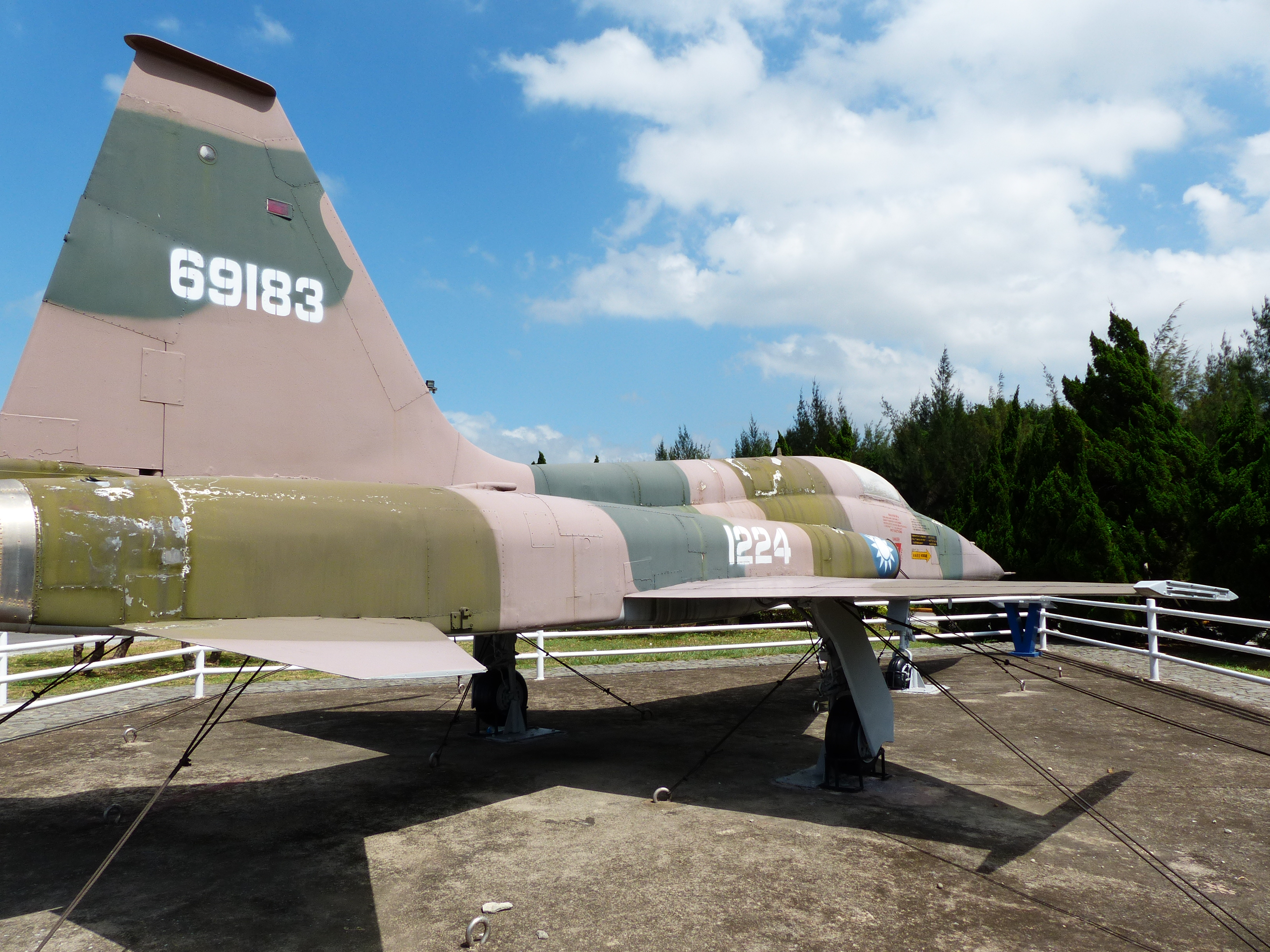
Northrop built 792 F-5Es, 146 F-5Fs and 12 RF-5Es, and licence production added 91 F-5Es and F-5Fs in Switzerland, 68 by Korean Air in South Korea and 308 in Taiwan. The Tiger II was a commercial success among American allies but never fought with the US Air Force, although the modified F-5A, redesignated F-5C, had done so in Vietnam. Its single-engine evolution, the F-5G rebranded F-20 Tigershark, lost the export contest to the F-16 Fighting Falcon in the 1980s.
The United States: Skoshi Tiger and the aggressor trade
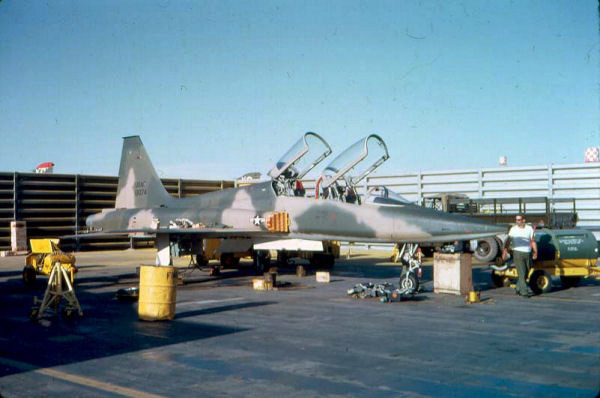
The F-5 entered USAF service on 30 April 1964 with the 4441st Combat Crew Training Squadron at Williams Air Force Base, whose job was training pilots and ground crews for customer nations, Norway among them; significant use by the USAF itself was not then intended. That changed with the 1965 evaluations: first the preliminary combat assessment of the F-5A at the Air Proving Ground Center at Eglin, Florida, code-named Sparrow Hawk, during which one airframe was lost to pilot error on 24 June, and then Skoshi Tiger, the five-month evaluation begun in October 1965. Twelve aircraft went to the 4503rd Tactical Fighter Squadron and, after receiving probe-and-drogue refuelling equipment, armour and improved instruments, were redesignated F-5C. They flew more than 2,600 combat sorties in the Vietnam War from Bien Hoa over South Vietnam and from Da Nang for missions over Laos; one aircraft was lost in combat together with its pilot, Major Joe Baggett.
The evaluation was declared a success: as a ground-attack aircraft the F-5 was rated as capable as the F-100, though shorter-legged. Even so, the exercise was more a political gesture to help export sales than a serious bid for US service; shortly afterwards, in 1965, the Philippine Air Force bought 23 F-5As and F-5Bs. From April 1966 operations continued under the 10th Fighter Squadron, Commando, which raised the strength to 17 aircraft and added another 7,300 sorties; between the two units nine aircraft were lost in Vietnam, seven to ground fire and two to operational causes. In June 1967 the survivors passed to the Republic of Vietnam Air Force.
Its small size and performance similarity to the MiG-21 gave it a second trade: aggressor aircraft for dissimilar air combat training. In the ACEVAL/AIMVAL trials at Nellis in 1977 the F-14 reportedly scored slightly better than two kills for every loss against the F-5, and the F-15 slightly less, although other accounts describe opening weeks in which the heavy fighters were thoroughly outclassed and only recovered after adapting to an F-5 armed with the all-aspect AIM-9L and after rule changes that favoured long-range radar-guided missiles. The F-5E served with the USAF from 1975 to 1990 with the 64th and 65th Aggressor Squadrons at Nellis, the 527th at RAF Alconbury and the 26th at Clark. The Marines bought used Air Force F-5s in 1989 for VMFT-401 at Yuma, and the Navy used them intensively at the TOPGUN school at Miramar before concentrating them in VFC-13. The naval fleet was renewed with 36 low-hour F-5E/Fs bought from Switzerland in 2006 and rebuilt as F-5N/Fs; VFC-111 now flies 18 of them, including a two-seater nicknamed FrankenTiger, made by grafting the front half of an F-5F onto the rear half of a younger Swiss F-5E.
Ogaden and Iran: the F-5 at war
Ethiopia received ten F-5As and two F-5Bs from 1966, supplemented in 1970 by at least three aircraft transferred by Iran and, in 1975, by eight of the fourteen F-5Es agreed with the United States, the rest being embargoed after the country's political turn. With that equipment Ethiopian fighters fought the Ogaden War against Somalia in 1977 and 1978: the F-5Es were held for air superiority because they could carry the AIM-9B missile, the F-5As for interdiction and strike. On 17 July 1977 two F-5s on combat air patrol near Harer met four Somali MiG-21MFs: two were shot down and the other two collided while evading a Sidewinder. Records of the 9th Fighter Squadron claim thirteen MiG-17s and twelve MiG-21s destroyed between 20 July and 1 September 1977, all by AIM-9s, while at least three F-5s fell to Somali air defences. Pilot Legesse Tefera, credited with six or seven kills, is the type's leading ace. Ethiopian pilots who flew both aircraft rated the F-5E the better fighter for its handling at low and medium speeds and for how easy it was to fly, leaving the pilot free to concentrate on the fight.
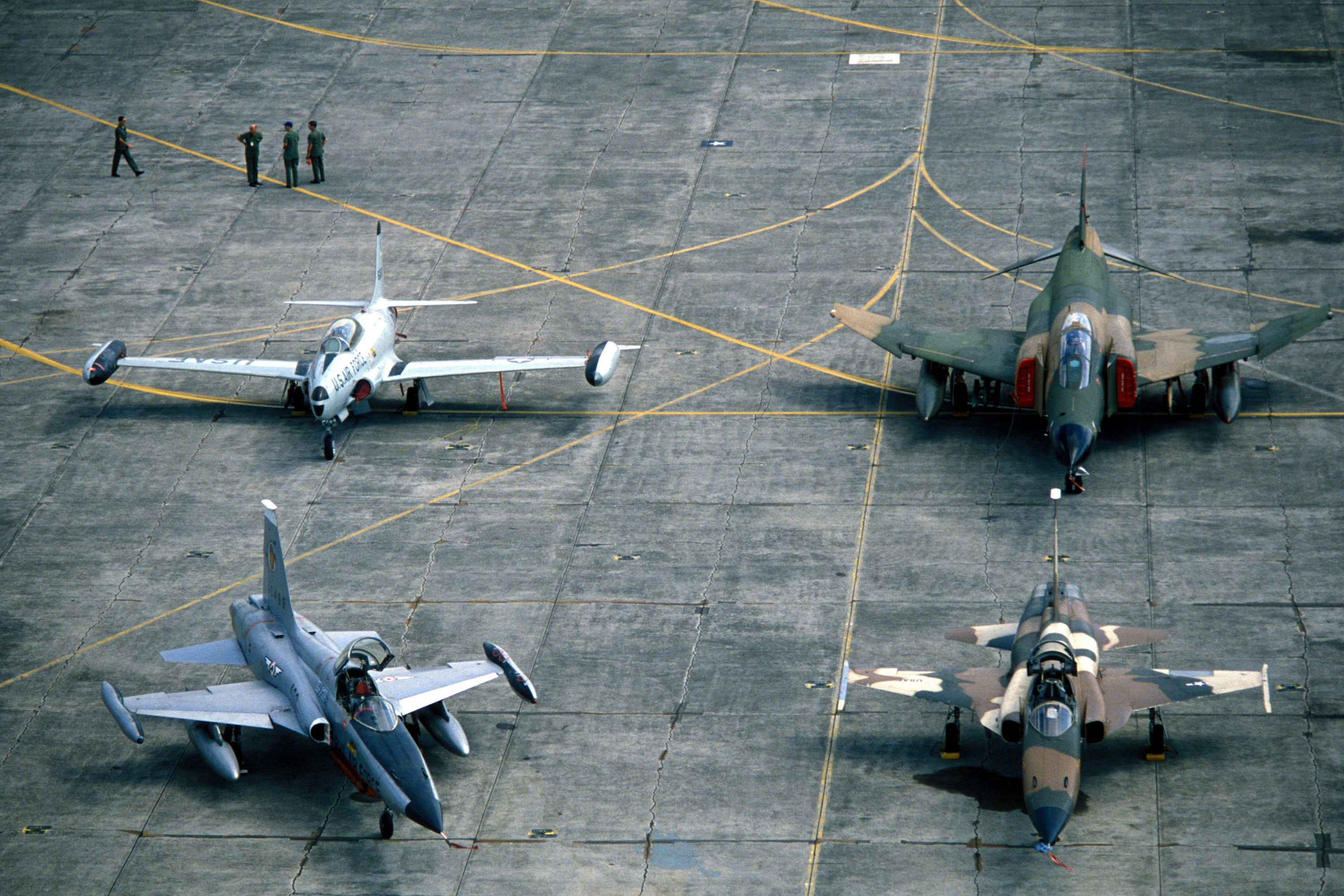
Iran was the other great combat user. The Imperial Iranian Air Force took its first eleven F-5As and two F-5Bs in February 1965 and declared them operational that June; by 1972 it had 104 F-5As and 23 F-5Bs, and from January 1974 it took a total of 166 F-5E/Fs plus fifteen RF-5As, deliveries ending in 1976. F-5s also equipped the Golden Crown display team, and as the Tiger II arrived the first-generation aircraft were sold on to Ethiopia, Turkey, Greece and South Vietnam. After the 1979 revolution the Islamic Republic managed to keep much of that fleet flying through the war with Iraq, thanks to parts bought abroad and a fledgling domestic industry; the F-5s flew air-to-air and air-to-ground sorties against MiG-21s, MiG-23s, MiG-25s, Su-20s and Su-22s, Mirage F1s and Super Étendards. The true tally is disputed: Major Yadollah Javadpour has been credited with downing a MiG-25 on 6 August 1983, while Russian sources place the first confirmed MiG-25 loss in 1985. The Iranian Azarakhsh, Saeqeh and Kowsar aircraft all derive from the F-5 airframe.
Upgrades: an airframe that will not retire
The F-5E has been modernised without pause. The most significant change was the Emerson AN/APQ-159 planar-array radar, with twenty nautical miles of range, replacing the AN/APQ-153; the AN/APG-69 followed, adding mapping, though most users declined it on cost grounds and it saw little service beyond USAF aggressor squadrons and the Swiss air force. Singapore, which took its first Tigers in 1979, brought some 49 aircraft to F-5S single-seat and F-5T two-seat standard, with Galileo Avionica Grifo-F radar, multi-function display cockpits and compatibility with AIM-120 AMRAAM and Python missiles, retiring them in the early 2010s. Thailand turned its own into the F-5T Tigris, with Python III and IV missiles and the Dash helmet-mounted cueing system. Chile, helped by Elbit, produced the F-5 Tiger III Plus with an Elta EL/M-2032 radar.
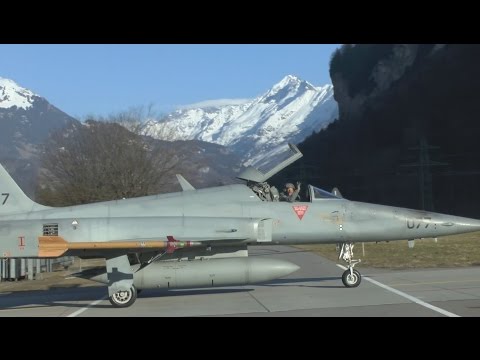
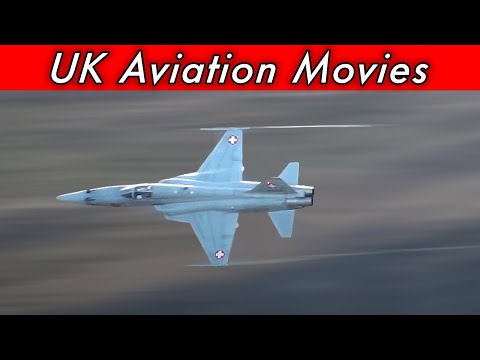
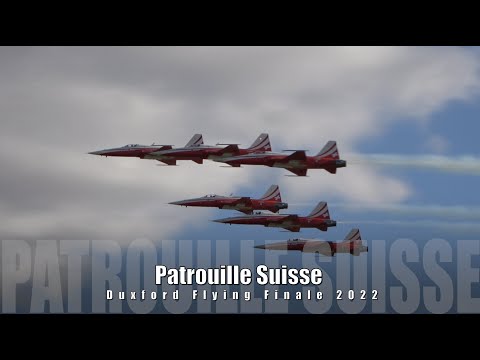
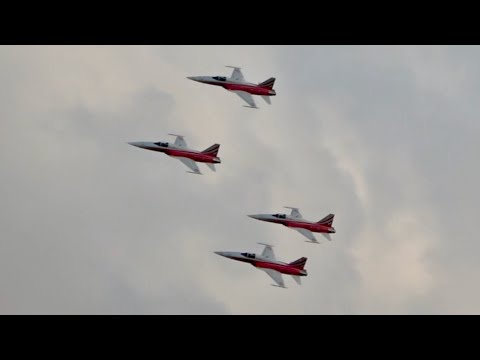
The most ambitious programme is Brazil's. The Brazilian Air Force had ordered thirty-six F-5Es and six F-5Bs in October 1974 for $72 million, delivered from March 1975, and in 1988 bought 22 F-5Es and four F-5Fs second-hand from US aggressor units. In 2001 Elbit Systems and Embraer began a $230 million upgrade of 46 aircraft, redesignated F-5EM and F-5FM: new Grifo F radar, electronic warfare suite, air-to-air refuelling, INS/GPS navigation, HOTAS, liquid-crystal displays, helmet-mounted displays, radar warning receiver, encrypted communications and night-vision-goggle compatibility, plus a secure link with the R-99 airborne early warning aircraft. The first F-5EM was handed over on 21 September 2005; in 2009 Brazil bought eight single-seat aircraft and three two-seat F-5Fs from Jordan for the same standard, and in 2020 began fielding the Brazilian forces' own Link-BR2 data link. In Europe, Greece was the first air force on the continent to receive the Freedom Fighter, in 1965, and operated around 120 of them until the type was withdrawn in 2002. Switzerland still flies the Tiger F-5E with militia squadrons such as Fliegerstaffel 6 at Payerne and Fliegerstaffel 19, and above all with the national display team, the Patrouille Suisse.
Offspring and legacy
The F-5 founded a whole family. The RF-5E Tigereye traded the radar and one cannon for a sensor pack in the nose. The F-5G, rebranded F-20 Tigershark, tried for a generational leap on a single engine and was cancelled when no export customers appeared. Far more consequential was the line of design studies that led to the Northrop YF-17 and, through it, to the F/A-18 naval fighter. One NASA F-5E was given a reshaped fuselage for DARPA's Shaped Sonic Boom Demonstration programme, meant to prove that the acoustic signature of a supersonic aircraft can be shaped; that aircraft is preserved today at the Valiant Air Command Warbird Museum in Titusville, Florida. Others, such as the F-5B and F-5E of the Pima Air & Space Museum in Tucson, tell the story in museum halls. More than sixty years after the N-156F first flew, and with over 400 aircraft still in service as of 2021, the fighter Northrop designed so that modest air forces could afford one is still flying as an adversary, as a low-cost interceptor and as a test platform.
.jpg)
Variants
| N-156F | F-5E Tiger II | F-5F Tiger II | F-5E Tiger 2000 | Azarakhsh | CF-5A | CF-5A(R) | CF-5D | Chung Cheng | F-5/2000 | F-5A Freedom Fighter | F-5A (G) | F-5B | F-5B (G) | F-5BM | F-5C Skoshi Tiger | F-5D | F-5EM | F-5E SSBD | F-5E Tiger III | F-5FM | F-5G | F-5N | F-5S | F-5T | F-5TH Super Tigris | F-5TIII | KF-5E | KF-5F | Kowsar | NF-5A | NF-5B | RF-5A | RF-5A (G) | RF-5E Tigereye | RF-5E Tigergazer | RF-5S | Sa'eqeh | SF-5A | SF-5B | SRF-5A | VF-5A | VF-5D | XF-5A | YF-5A | YF-5B | |
|---|---|---|---|---|---|---|---|---|---|---|---|---|---|---|---|---|---|---|---|---|---|---|---|---|---|---|---|---|---|---|---|---|---|---|---|---|---|---|---|---|---|---|---|---|---|---|
| First flight | July 30, 1959 | August 11, 1972 | September 25, 1974 | July 24, 2002 | — | — | — | — | — | — | — | — | — | — | — | — | — | — | — | — | — | — | — | — | — | — | — | — | — | — | — | — | — | — | — | — | — | — | — | — | — | — | — | — | — | — |
| Aircraft type | Lightweight fighter prototype | Single-seat light tactical fighter | Two-seat combat trainer | Upgrade prototype (Taiwan) | Iranian derivative | Single-seat tactical fighter (Canada) | Single-seat reconnaissance (Canada) | Two-seat trainer (Canada) | Licence production (Taiwan) | Turkish first-generation upgrade | Single-seat light tactical fighter | Single-seat fighter for Norway | Two-seat combat trainer | Two-seat trainer for Norway | Upgraded two-seat trainer (Spain) | Single-seat combat evaluation fighter | Unbuilt trainer | Upgraded single-seat fighter (Brazil) | Experimental testbed | Upgraded single-seat fighter (Chile) | Upgraded two-seat trainer (Brazil) | Single-engined derivative (reference) | Single-seat aggressor fighter (US Navy) | Upgraded single-seat fighter (Singapore) | Upgraded two-seat trainer (Singapore) | Upgraded single-seat fighter (Thailand) | Upgraded single-seat fighter (Morocco) | Licence-built single-seat fighter (South Korea) | Licence-built two-seat trainer (South Korea) | Iranian derivative | Single-seat fighter (Netherlands) | Two-seat trainer (Netherlands) | Single-seat tactical reconnaissance aircraft | Single-seat reconnaissance for Norway | Single-seat tactical reconnaissance aircraft | Single-seat reconnaissance (Taiwan) | Single-seat reconnaissance (Singapore) | Twin-tailed Iranian derivative | CASA-built single-seat fighter | CASA-built two-seat trainer | CASA-built single-seat reconnaissance | Single-seat fighter (Venezuela) | Two-seat trainer (Venezuela) | Static test airframe | Evaluation prototype | Two-seat second-generation prototype |
| Powerplant | — | Two General Electric J85-GE-21 afterburning turbojets of 22 kN each | — | — | — | Two Orenda-built General Electric J85-15 turbojets, 19 kN with afterburner | — | — | — | — | Two General Electric J85 afterburning turbojets | — | Two General Electric J85-GE-13 turbojets | — | — | — | — | — | — | — | — | — | — | — | — | — | — | — | — | — | — | — | — | — | — | — | — | — | — | — | — | — | — | — | — | — |
| Powerplant | 2 × turbojet | 2 × General Electric J85-GE-21 | 2 × General Electric J85-GE-21 | 2 × turbojet | 2 × turbojet | 2 × General Electric J85-15 (Orenda) | 2 × turbojet | 2 × General Electric J85-15 (Orenda) | 2 × turbojet | 2 × turbojet | 2 × turbojet | 2 × turbojet | 2 × General Electric J85-GE-13 | 2 × turbojet | 2 × turbojet | 2 × turbojet | — | 2 × turbojet | 2 × turbojet | 2 × turbojet | 2 × turbojet | 1 × turbofan | 2 × turbojet | 2 × turbojet | 2 × turbojet | 2 × turbojet | 2 × turbojet | 2 × turbojet | 2 × turbojet | 2 × turbojet | 2 × General Electric J85-15 (Orenda) | 2 × turbojet | 2 × turbojet | 2 × turbojet | 2 × General Electric J85-GE-21 | 2 × turbojet | 2 × turbojet | 2 × turbojet | 2 × turbojet | 2 × turbojet | 2 × turbojet | 2 × turbojet | 2 × turbojet | 2 × turbojet | 2 × turbojet | 2 × General Electric J85-GE-21 |
| Thrust per engine | — | 22 kN Best value in this row | — | — | — | 19 kN | — | — | — | — | — | — | — | — | — | — | — | — | — | — | — | — | — | — | — | — | — | — | — | — | — | — | — | — | — | — | — | — | — | — | — | — | — | — | — | — |
| Length | — | 14.7 m Best value in this row | — | — | — | 14.4 m | — | — | — | — | — | — | — | — | — | — | — | — | — | — | — | — | — | — | — | — | — | — | — | — | — | — | — | — | — | — | — | — | — | — | — | — | — | — | — | — |
| Wingspan | — | 8.1 m Best value in this row | — | — | — | 7.9 m | — | — | — | — | — | — | — | — | — | — | — | — | — | — | — | — | — | — | — | — | — | — | — | — | — | — | — | — | — | — | — | — | — | — | — | — | — | — | — | — |
| Height | — | 4.1 m Best value in this row | — | — | — | 4 m | — | — | — | — | — | — | — | — | — | — | — | — | — | — | — | — | — | — | — | — | — | — | — | — | — | — | — | — | — | — | — | — | — | — | — | — | — | — | — | — |
| Wing area | — | 17.3 m² Best value in this row | — | — | — | 17.3 m² | — | — | — | — | — | — | — | — | — | — | — | — | — | — | — | — | — | — | — | — | — | — | — | — | — | — | — | — | — | — | — | — | — | — | — | — | — | — | — | — |
| Empty weight | — | 4,347 kg | — | — | — | 3,938 kg Best value in this row | — | — | — | — | — | — | — | — | — | — | — | — | — | 4,349 kg | — | — | — | — | — | — | — | — | — | — | — | — | — | — | — | — | — | — | — | — | — | — | — | — | — | — |
| MTOW | — | 11,192 kg | — | — | — | 9,249 kg | — | — | — | — | — | — | — | — | — | — | — | — | — | 11,214 kg Best value in this row | — | — | — | — | — | — | — | — | — | — | — | — | — | — | — | — | — | — | — | — | — | — | — | — | — | — |
| Top speed | — | 1,739 km/h | — | — | — | 1,575 km/h | — | — | — | — | — | — | — | — | — | — | — | — | — | 1,875 km/h Best value in this row | — | — | — | — | — | — | — | — | — | — | — | — | — | — | — | — | — | — | — | — | — | — | — | — | — | — |
| Max speed altitude | — | 11,000 m | — | — | — | — | — | — | — | — | — | — | — | — | — | — | — | — | — | — | — | — | — | — | — | — | — | — | — | — | — | — | — | — | — | — | — | — | — | — | — | — | — | — | — | — |
| Cruise speed | — | 1,050 km/h | — | — | — | — | — | — | — | — | — | — | — | — | — | — | — | — | — | — | — | — | — | — | — | — | — | — | — | — | — | — | — | — | — | — | — | — | — | — | — | — | — | — | — | — |
| Service ceiling | — | 15,800 m Best value in this row | — | — | — | 12,000 m | — | — | — | — | — | — | — | — | — | — | — | — | — | 15,800 m Best value in this row | — | — | — | — | — | — | — | — | — | — | — | — | — | — | — | — | — | — | — | — | — | — | — | — | — | — |
| Initial climb rate | — | 175 m/s | — | — | — | 175 m/s | — | — | — | — | — | — | — | — | — | — | — | — | — | 184 m/s Best value in this row | — | — | — | — | — | — | — | — | — | — | — | — | — | — | — | — | — | — | — | — | — | — | — | — | — | — |
| Range | — | 891 km | — | — | — | 1,400 km | — | — | — | — | — | — | — | — | — | — | — | — | — | 1,405 km Best value in this row | — | — | — | — | — | — | — | — | — | — | — | — | — | — | — | — | — | — | — | — | — | — | — | — | — | — |
| Ferry range | — | 3,720 km | — | — | — | — | — | — | — | — | — | — | — | — | — | — | — | — | — | — | — | — | — | — | — | — | — | — | — | — | — | — | — | — | — | — | — | — | — | — | — | — | — | — | — | — |
| Combat radius | — | 220 km | — | — | — | — | — | — | — | — | — | — | — | — | — | — | — | — | — | — | — | — | — | — | — | — | — | — | — | — | — | — | — | — | — | — | — | — | — | — | — | — | — | — | — | — |
| Range conditions | — | The range figures are those of a short-legged day fighter: 891 km range and a 220 km combat radius with weapons. With drop tanks and no offensive load, ferry range reaches 3,720 km. That limited radius was always the type's weak point, and explains why several later upgrades — the Chilean Tigre III Plus among them — added an air-refuelling probe. | — | — | — | — | — | — | — | — | — | — | — | — | — | — | — | — | — | — | — | — | — | — | — | — | — | — | — | — | — | — | — | — | — | — | — | — | — | — | — | — | — | — | — | — |
| Armament | — | Two 20 mm Pontiac M39A2 cannon with 280 rounds per gun; up to 3,200 kg of external stores | One 20 mm M39 cannon; external stores stations retained | — | — | Two 20 mm Pontiac M39A2 cannon with 280 rounds per gun; five hardpoints for 3,200 kg | — | — | — | — | Two 20 mm M39A2 cannon in the nose plus external stores on underwing and centreline pylons | — | No nose cannon; external stores stations retained | — | — | — | — | — | — | — | — | — | — | — | — | — | — | — | — | — | — | — | — | — | One 20 mm M39 cannon | — | — | — | — | — | — | — | — | — | — | — |
| Max weapons load | — | 3,200 kg Best value in this row | — | — | — | 3,200 kg Best value in this row | — | — | — | — | — | — | — | — | — | — | — | — | — | — | — | — | — | — | — | — | — | — | — | — | — | — | — | — | — | — | — | — | — | — | — | — | — | — | — | — |
| Payload | — | 0 kg Best value in this row | — | — | — | 0 kg Best value in this row | — | — | — | — | 0 kg Best value in this row | — | — | — | — | — | — | — | — | — | — | — | — | — | — | — | — | — | — | — | — | — | — | — | — | — | — | — | — | — | — | — | — | — | — | — |
| Cargo capacity | — | No cargo hold and no transport capability: the F-5E is a single-seat tactical fighter and its entire payload rides on external hardpoints — wingtips, underwing stations and the centreline — up to 3,200 kg split between weapons and drop tanks. The centreline station, which normally carries fuel, is the one that has to be given up to hang a heavy missile, as happened in Taiwan's Tiger 2000 project with the TC-2. | — | — | — | — | — | — | — | — | — | — | — | — | — | — | — | — | — | — | — | — | — | — | — | — | — | — | — | — | — | — | — | — | — | — | — | — | — | — | — | — | — | — | — | — |
| Crew | 1 Best value in this row | 1 Best value in this row | 2 | 1 Best value in this row | 1 Best value in this row | 1 Best value in this row | 1 Best value in this row | 2 | 1 Best value in this row | 1 Best value in this row | 1 Best value in this row | 1 Best value in this row | 2 | 2 | 2 | 1 Best value in this row | 2 | 1 Best value in this row | 1 Best value in this row | 1 Best value in this row | 2 | 1 Best value in this row | 1 Best value in this row | 1 Best value in this row | 2 | 1 Best value in this row | 1 Best value in this row | 1 Best value in this row | 2 | 1 Best value in this row | 1 Best value in this row | 2 | 1 Best value in this row | 1 Best value in this row | 1 Best value in this row | 1 Best value in this row | 1 Best value in this row | 1 Best value in this row | 1 Best value in this row | 2 | 1 Best value in this row | 1 Best value in this row | 2 | 1 Best value in this row | 1 Best value in this row | 2 |
| Passengers | — | 0 | — | — | — | — | — | — | — | — | — | — | — | — | — | — | — | — | — | — | — | — | — | — | — | — | — | — | — | — | — | — | — | — | — | — | — | — | — | — | — | — | — | — | — | — |
| Units built | 3 | 792 Best value in this row | 146 | 1 | — | 89 | — | 46 | — | — | 624 | — | 200 | — | — | 12 | — | — | 1 | — | — | — | — | — | — | — | — | 48 | 20 | — | 75 | 30 | 86 | — | 12 | 7 | 8 | — | — | — | — | — | — | 1 | 3 | 1 |
Images
Elsewhere
- airliners.netNorthrop F-5A Freedom Fighter — Royal Norwegian Air Force ↗
- airliners.netNorthrop F-5F Franken-Tiger — US Navy ↗
- airliners.netNorthrop F-5F Tiger II — Iranian Air Force ↗
- jetphotos.comNorthrop F-5E Tiger II — Republic of China (Taiwan) Air Force, AIDC AIDC AIRSHI ↗
- jetphotos.comNorthrop F-5E Tiger II — United States Navy (adversary training) ↗
- FlickrNorthrop F-5A Freedom Fighter at the Spanish Air Force Museum, Madrid ↗
- FlickrNorthrop F-5B Freedom Fighter, Pima Air & Space Museum ↗
- FlickrNorthrop NF-5A Freedom Fighter, Nationaal Militair Museum, Soest ↗
- DVIDSF-22 Raptor and F-5 Tiger II fly together in Heritage Flight, Aviation Nation 2025 ↗
- nationalmuseum.af.milNorthrop YF-5A Freedom Fighter — National Museum of the United States Air Force ↗
- northropgrumman.comF-5 Tiger — official Northrop Grumman aircraft page ↗
- Smithsonian AffiliationsSupersonic Challenges: The Installation of the F-5 Fighter Jet ↗







![Beautiful Takeoff by Swiss F-5 Tigers of the Patrouille Suisse at Emmen Air Base [4K]](https://i.ytimg.com/vi/oPBVA2IvX2M/hqdefault.jpg)



![Best of - Patrouille Suisse F-5E Tiger II Jet Team Airshow Highlights [Pori 2022]](https://i.ytimg.com/vi/VwR80FEaqo8/hqdefault.jpg)


![Swiss Top Guns - F-5 Tiger and F-18 Hornet action in beautiful Meiringen, Switzerland [HD]](https://i.ytimg.com/vi/ohGpGzCIS08/hqdefault.jpg)


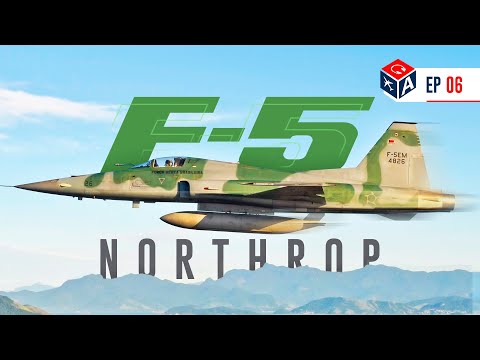


![Northrop F-5 Tiger / Tiger II - A Short History of the Cold War Jet [NEW VERSION]](https://i.ytimg.com/vi/5jCyTrLY9rc/hqdefault.jpg)