Northrop F-5 variant
Northrop F-5 F-5E Tiger II
The family's second generation and its most numerous version: 792 aircraft built by Northrop. It won the International Fighter Aircraft competition in 1970 with a heavily reworked F-5A — more powerful J85-GE-21 engines, leading-edge root extensions, greater wing area and the two-position nose gear taken from the Canadian CF-5 — and, unlike the F-5A, carried radar as standard: first the AN/APQ-153, later the AN/APQ-159. It first flew on 11 August 1972 and reached its first unit, the 425th Tactical Fighter Squadron, on 6 April 1973. It never fought in American markings: the USAF, the US Navy and the Marine Corps used it as an aggressor in dissimilar air combat training, a role it still performs half a century later.
- August 11, 1972
- First flight
- 792
- Units built
- 891 km
- Range
History
The IFA competition
By the late 1960s the USAF was looking for an improved export fighter for the Military Assistance Program, one able to counter the MiG-21s the Soviet Union was supplying to its allies. Northrop won the 1970 International Fighter Aircraft competition with a heavily revised F-5A. The aircraft kept the Freedom Fighter's philosophy — simple, cheap to operate, easy to maintain — but improved on almost everything: more powerful General Electric J85-GE-21 engines, leading-edge root extensions that increased wing area and improved manoeuvrability, and a two-position nose landing gear taken directly from the Canadian CF-5, which shortened the take-off run.
The most significant change was avionics. Unlike the F-5A, which had none, the F-5E carried radar as standard: the AN/APQ-153 on early airframes and the AN/APQ-159 on later ones, both ranging and search sets sized for a light day fighter. The aircraft was named Tiger II in memory of the Skoshi Tiger evaluation the F-5C had flown in Vietnam.
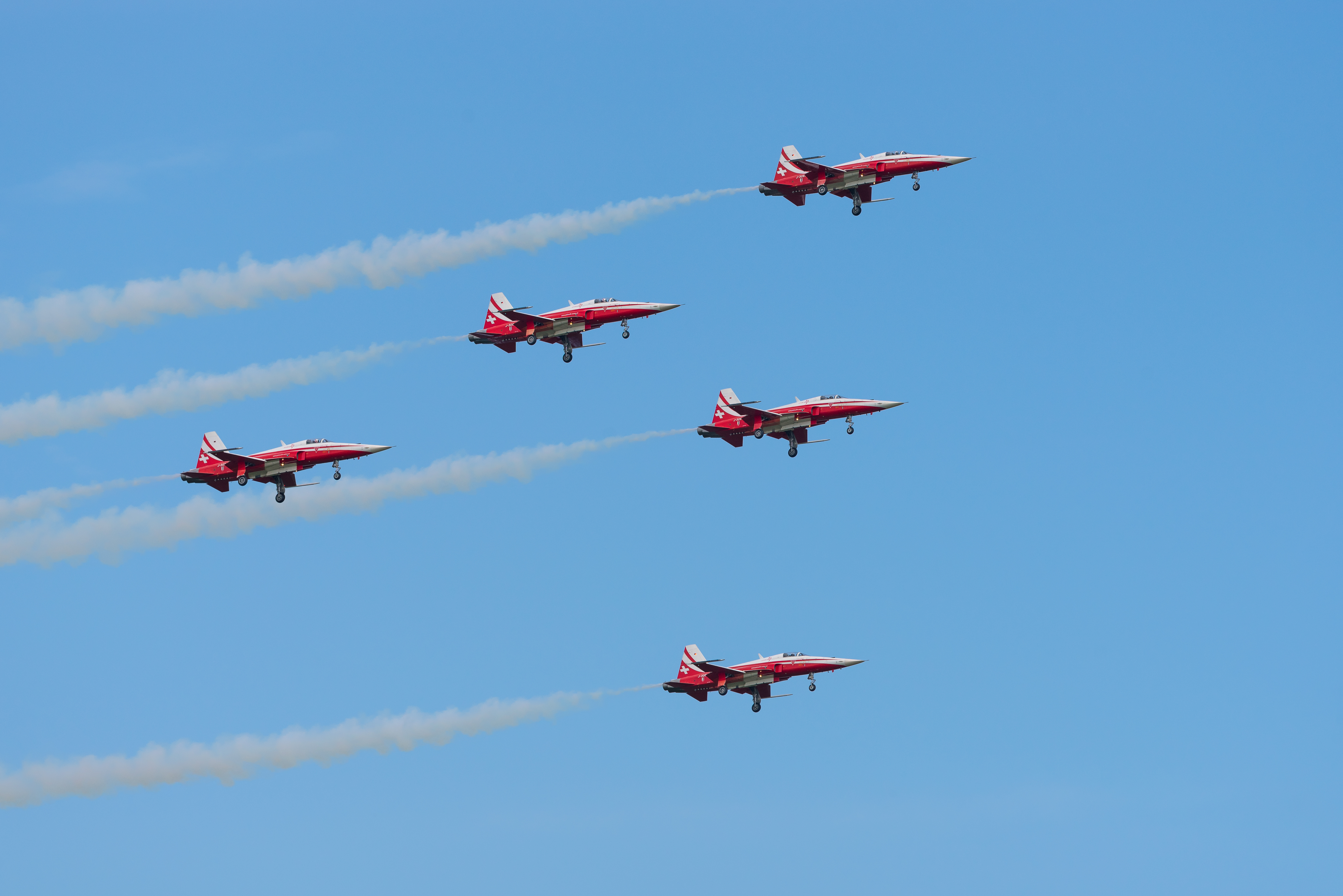
The first F-5E flew on 11 August 1972 and the first aircraft was delivered to the 425th Tactical Fighter Squadron on 6 April 1973, the unit charged with training foreign pilots. Northrop built 792 F-5Es, plus 146 two-seat F-5Fs and 12 RF-5E Tigereye reconnaissance aircraft.
Aggressor, not combatant
The F-5E never entered combat in American markings. Its role in the US inventory was that of an aggressor: similar in size, thrust and handling to the MiG-21, it made an ideal adversary for dissimilar air combat training. The USAF used it with the 57th Fighter Weapons Wing at Nellis, the US Navy at the Top Gun school at NAS Miramar and in Reserve squadrons, and the Marine Corps in its own adversary units. The aircraft wore Soviet-style schemes and their pilots learned Eastern Bloc tactics.
That function has proved the family's most enduring. Half a century after its first flight the US Navy still operates F-5Ns — low-hour ex-Swiss airframes, refurbished and fitted with the AN/APG-69 radar — with squadrons such as VFC-13 at NAS Fallon and VFC-111 at NAS Key West.
Exports
The Tiger II became the standard fighter of dozens of air forces. Taiwan built 242 F-5Es and 66 F-5Fs under licence, production starting on 30 October 1974 under the name Chung Cheng, and at its peak held 336 aircraft in inventory, the largest fleet of the type; its last F-5Es were retired in November 2023 and the F-5Fs and RF-5E Tigergazers in July 2025. South Korea built 48 KF-5Es and 20 KF-5Fs from September 1982. Switzerland ordered a large fleet that peaked in 1981 at 98 F-5Es and 12 F-5Fs, of which 22 F-5Es and 4 F-5Fs remained by the early 2020s; in 2020 it sold 22 aircraft to the United States, with deliveries from March 2024.
Brazil, Chile, Singapore, Thailand, Malaysia, Saudi Arabia, Jordan, Iran, Morocco and Turkey complete a list that explains why the Tiger II still flies: its airframes are rugged, its systems accept deep upgrades and its cost per flight hour is unrivalled among supersonic types. The engineered growth potential Edgar Schmued had demanded of the original design made possible the Brazilian F-5EM, the Chilean Tiger III, the Singaporean F-5S, the Thai F-5TH and the Turkish F-5/2000, all of them with modern radars and beyond-visual-range missiles.
A flying laboratory
One F-5E also served as the testbed for the Shaped Sonic Boom Demonstration run by DARPA, NASA and Northrop Grumman: fitted with a fibreglass and foam fairing that altered the profile of the nose and forward fuselage, it demonstrated in 2003 that the shape of a shock wave can be modified by design, a result that opened the way to quiet civil supersonic flight projects.
Multimedia
