United States · 1939–
Northrop
Northrop Corporation was an American aircraft manufacturer that existed as an independent company from 1939 until 1994, when its purchase of Grumman created Northrop Grumman. Its founder, John Knudsen "Jack" Northrop, had already spent two decades in the industry when he set the firm up in Hawthorne, California, and it was the third company to carry his name: before it came the Avion Corporation of 1928 and the El Segundo Northrop Corporation, backed by Donald Douglas and dissolved by him in 1937. The Hawthorne house was therefore the end point of a long personal trajectory rather than a beginning. What sets Northrop apart from its competitors is a single technical obsession sustained for half a century: the flying wing, the conviction that an aircraft with neither fuselage nor tail, reduced to pure lifting surface, offered the best possible ratio of drag to lift. That conviction produced the small N-1M of 1940, the scale N-9M models, the experimental XB-35 and YB-49 bombers and, decades later, the B-2 Spirit stealth bomber, which flew in 1989 and was built in twenty-one examples. The company did not live on flying wings, however. Its real output lay in long-running conventional aircraft: the P-61 Black Widow night fighter of the Second World War, the F-89 Scorpion interceptor, the SM-62 Snark intercontinental cruise missile and, above all, the F-5 Freedom Fighter lightweight fighter family and its derivative, the T-38 Talon advanced trainer. The F-5 was the firm's greatest commercial success and shaped its industrial strategy through the 1970s and 1980s. That strategy amounted to repeating the cheap, exportable lightweight fighter formula. It yielded the N-300 and P-530 studies, the YF-17 Cobra prototype that lost to the General Dynamics F-16, the F-18L that Northrop never managed to sell and the F-20 Tigershark, which drew almost no market interest. The indirect payoff came through the F/A-18 Hornet, developed from the YF-17 with McDonnell Douglas, of which Northrop went on building much of the fuselage. Losing the Advanced Tactical Fighter contract to Lockheed and having its proposal removed from the Joint Strike Fighter competition brought the independent era to a close: in 1994 Northrop bought Grumman, the name became Northrop Grumman, and that successor remains the manufacturer associated with the B-2 today.
Northrop in the news
September 22, 2026
_204_Conduct_Flight_Operations.jpg)
Northrop Grumman announced a strategic collaboration with Camgian to explore harnessing its advanced Reactor AI platform to enhance command and fire control capabilities for U.S. and allied forces…

Operating from RAAF Bases Tindal and Edinburgh and supported by Northrop Grumman Australia, the MQ-4C Triton fleet is now contributing to Australia’s long-range surveillance capability.
_204_Conduct_Flight_Operations-1600.webp)

September 21, 2026
The Defense Innovation Unit and U.S. Space Force’s Space Systems Command (SSC) have awarded True Anomaly and Northrop Grumman Geosynchronous High-Resolution Optical Space-Based Tactical…
.jpg)
Northrop Grumman GHOST-R. The post Northrop Grumman and True Anomaly selected by the Space Force for the GHOST-R satellite program first appeared on Fly News.
Northrop Grumman has been selected to supply a commercial prototype for the Geosynchronous High-resolution Optical Space Tactical Reconnaissance (GHOST-R) mission of the…
-800.webp)
History
Three companies with the same name
Northrop Corporation only makes sense once the two firms that came before it are told, because the same man founded all three. John Knudsen Northrop, born in Newark, New Jersey, on 10 November 1895 and raised in Santa Barbara, California, entered aviation in 1916 as a draftsman for the Loughead Aircraft Manufacturing Company, itself founded in 1912. After a short spell in the U.S. Army Signal Corps during the First World War — six months, until Loughead successfully petitioned for his return to private industry — he joined the Douglas Aircraft Company in 1923, worked on the Douglas World Cruiser and rose to project engineer.
In 1927 he rejoined the Loughead brothers, whose Lockheed Aircraft Company had been founded in 1926, and served as chief engineer on the Lockheed Vega, the cantilever-wing civil monoplane whose unusual performance for the period made it the aircraft of pilots such as Wiley Post, Amelia Earhart and Hubert Wilkins. In 1929 he produced an all-metal monoplane with the engine buried in the wing structure which, although it still carried tail booms, was the first genuine step toward the flying wing.
That same year he struck out on his own with the Avion Corporation, which in 1930 he was forced to sell to the United Aircraft and Transport Corporation, where it continued as a subsidiary named Northrop Aircraft Corporation and eventually became part of Boeing. When the parent moved its operations to Kansas in 1931, Northrop set up a second Northrop Corporation in El Segundo, California, together with Donald Douglas. It produced the Northrop Gamma and Northrop Delta monoplanes, the A-17 attack aircraft, the BT dive bomber and prototypes such as the XFT naval fighter and the YA-13. Labour difficulties led Douglas to dissolve the corporation in 1937, and the plant became the El Segundo Division of Douglas Aircraft.
Hawthorne, 1939
Northrop still wanted a company genuinely his own, and in 1939 he established the third Northrop Corporation in Hawthorne, California, on a site located by co-founder Moye Stephens. The firm ranked 100th among United States corporations by the value of its Second World War military production contracts. Jack Northrop himself served as president from 1940 to 1953, followed by Oliver Patton Echols to 1955, Whitley C. Collins to 1959, Thomas Victor Jones to 1976, Thomas Otten Paine to 1982 and Frank W. Lynch thereafter; the chairmanship passed through LaMotte T. Cohu, Richard William Millar, Echols, William C. McDuffie and Jones again. The company also ran its own subsidiary, the Radioplane Company.
The war: Black Widow and the first flying wing trials
The first major programme was the P-61 Black Widow, the first American aircraft designed from the outset as a night fighter, which flew in 1942 and was built in 706 examples. From it came the F-15 Reporter reconnaissance aircraft, 36 of which were delivered from 1945. In parallel the company produced the N-3PB patrol floatplane, 24 built from 1940, and explored radical configurations with the XP-56 Black Bullet, a welded-magnesium tailless fighter completed as two prototypes in 1943.
Flying wing research ran alongside. The N-1M, a single aircraft tested in 1940, was the reduced-scale demonstrator of the concept; the four N-9M machines of 1942 served as flying scale models of the future bomber; and the XP-79 of 1945 carried the idea into a tailless jet fighter that never went beyond the prototype.
XB-35, YB-49 and the end of the flying wing
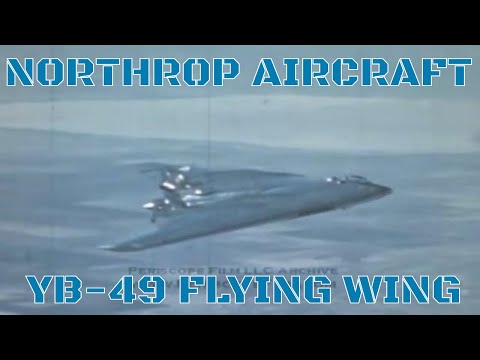
The point of that chain of experiments was a flying wing strategic bomber. The YB-35 flew in 1946 as two test aircraft, and its jet-powered derivative, the eight-engined YB-49, followed in 1947 with three built. The programme was not selected as the post-war bomber platform, the prototypes and the unfinished YB-49s were dismantled, and the decision was a severe blow to its creator.
Jack Northrop retired at 57, in 1952, and virtually ended his association with the company for the next thirty years. In 1979 he broke a decades-long silence in a television interview, accusing the Air Force of killing the project to punish him for refusing to merge his company with Consolidated Vultee, and claiming that Air Force Secretary Stuart Symington had threatened him. Symington called the charge preposterous and absurd, argued that there was tremendous overcapacity in the industry after the Second World War and said he may well have suggested a merger with Convair. Aviation expert Bud Baker, who studied declassified documents and interviewed Symington, Air Force generals and Northrop's chairman, concluded that the cancellation was a sound decision based on budgetary, technical and strategic realities. The two accounts remain in conflict and both are recorded here.
Post-war: interceptors, missiles and transports
Post-war production was conventional and substantial. The F-89 Scorpion all-weather interceptor, first flown in 1948, was the company's largest programme by numbers up to that point at 1,052 aircraft. The SM-62 Snark intercontinental cruise missile rounded out its contribution to strategic deterrence, alongside automatic celestial navigation systems. There were lesser-known ventures too: the YC-125 Raider trimotor transport, 23 built from 1949, and the X-4 Bantam, two aircraft of 1948 devoted to exploring tailless transonic flight. Its target drones and unmanned aircraft included the AQM-35, the AQM-38 and the BQM-74 Chukar, and its missiles, besides the Snark, the GAM-67 Crossbow and the JB-1 Bat.
The F-5 and the T-38
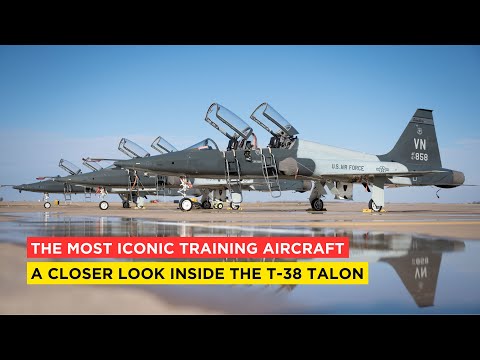
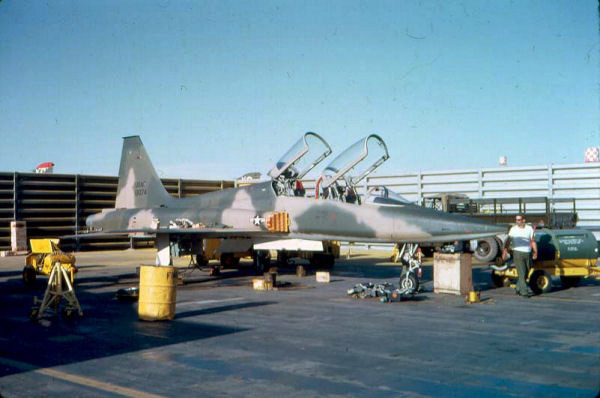
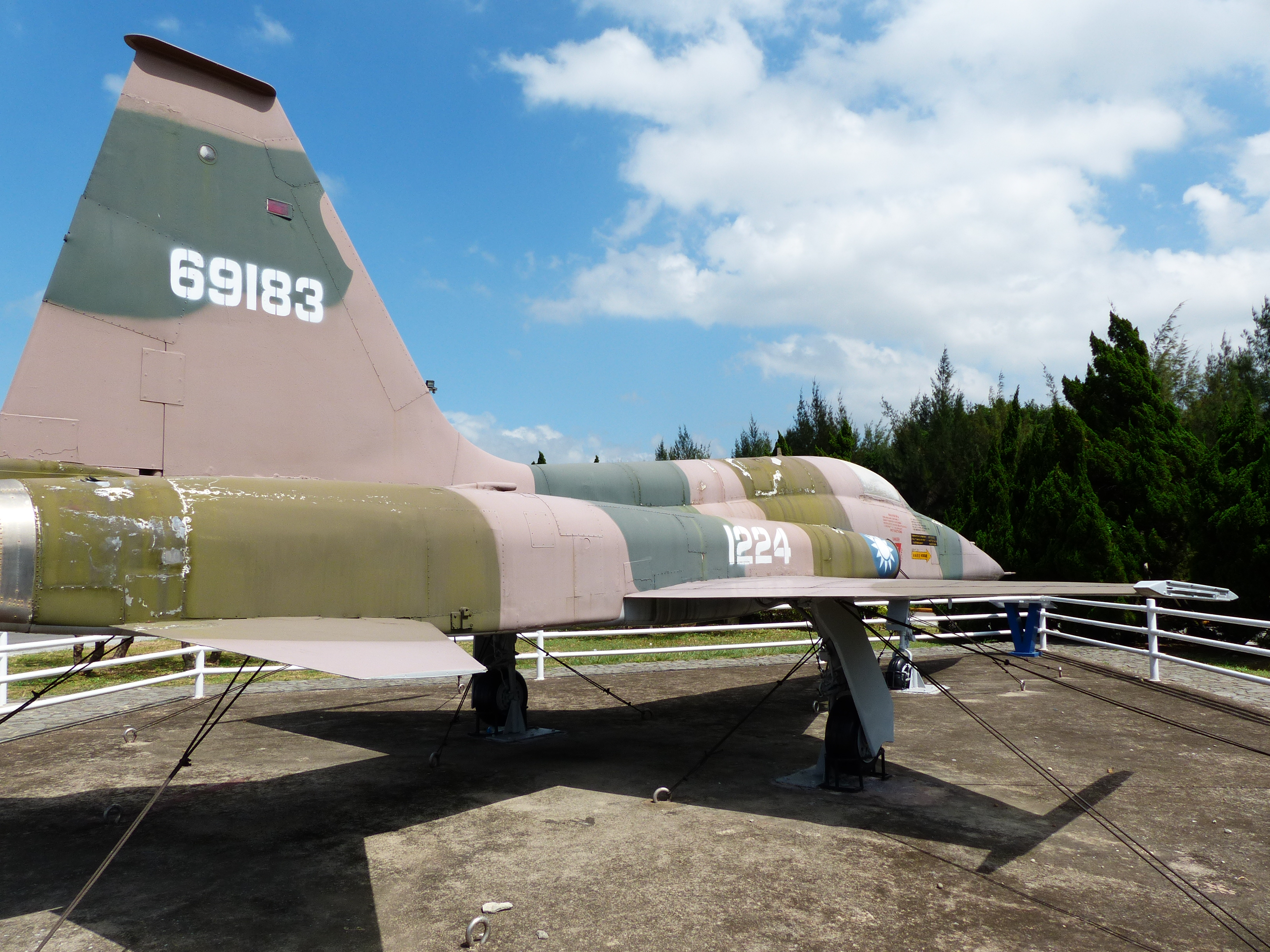
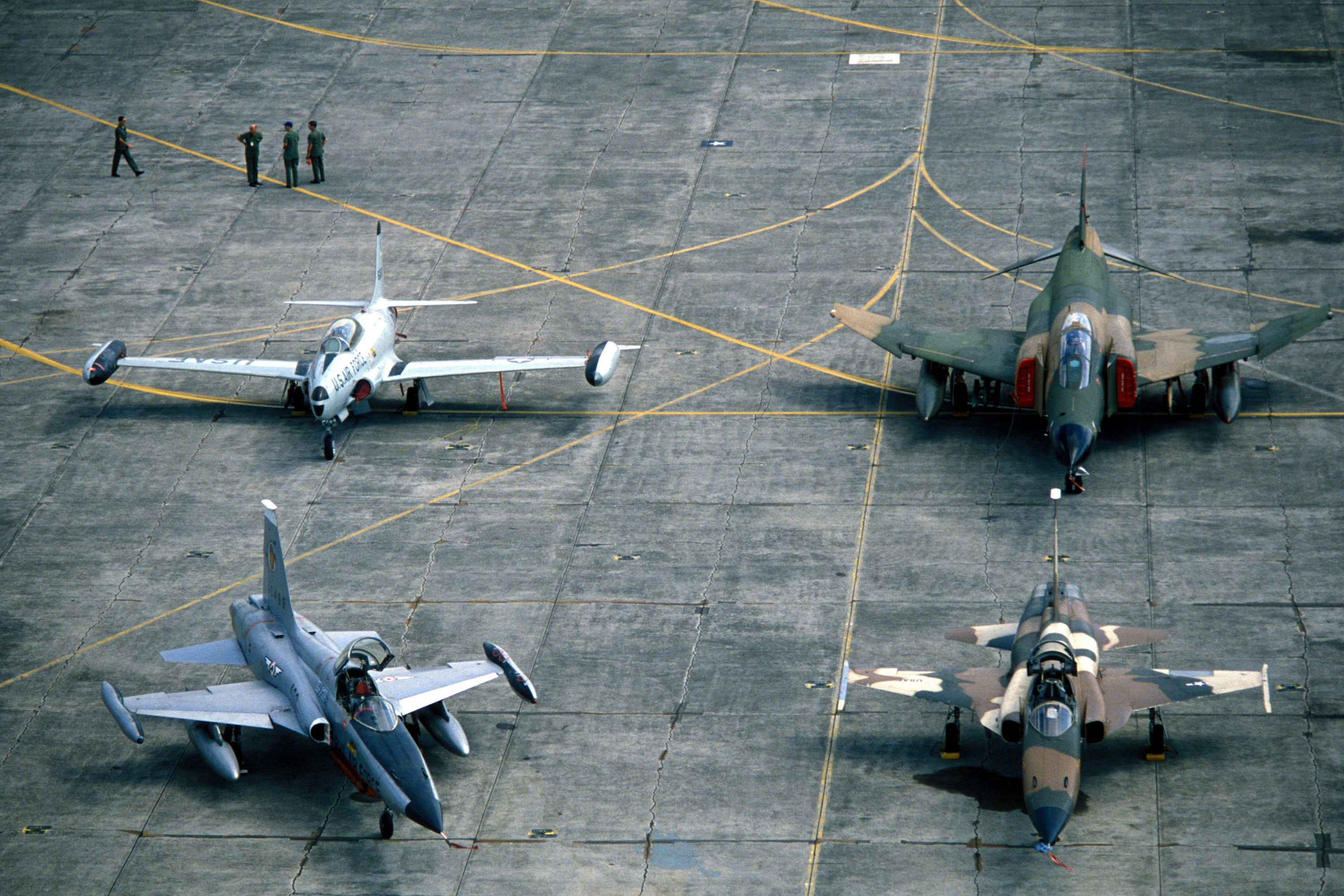
The programme that defined Northrop in the export market was the F-5 Freedom Fighter lightweight fighter, first flown in 1959 and built in 2,246 examples, together with its T-38 Talon advanced trainer derivative of the same year, of which 1,146 were built. They were economical aircraft, simple to maintain and easy to export, and that approach — a cheap light fighter set against the heavy interceptors of the day — became the company's industrial signature.
Trying to repeat the success: N-300, P-530, YF-17 and F-20
The F-5 was so successful that Northrop spent much of the 1970s and 1980s trying to reproduce it. The first attempt was the N-300, with far more powerful engines and the wing raised to allow the extra ordnance that power permitted. The N-300 grew into the P-530, with larger engines still, a small amount of bypass to improve cooling and lighten the engine bay, much more wing area and the radar and systems by then considered essential. When the Light Weight Fighter programme was announced, the P-530 was stripped of much of that equipment to become the P-600 and finally the YF-17 Cobra prototype, two of which were built in 1974 and which lost the competition to the General Dynamics F-16 Fighting Falcon.
The defeat was not final. The YF-17 was modified with help from McDonnell Douglas into the F/A-18 Hornet for a comparable US Navy lightweight competition. Northrop intended to sell a de-navalised version as the F-18L, but the basic F-18A kept outselling it, and the disagreement turned into a long and fruitless lawsuit between the two companies. Northrop nevertheless went on building much of the F-18 fuselage and other systems. In parallel it returned to the original F-5 design with yet another new engine to produce the F-20 Tigershark as a low-cost fighter: it flew in 1982, three were built, and so little market interest followed that the project was dropped.
Lifting bodies and experimental programmes
Away from the production lines, Northrop was a constant presence in American aeronautical research. It built the X-21 in 1963, two experimental boundary-layer control aircraft, and the rocket-powered lifting bodies M2-F2 and HL-10, both of 1966, and the M2-F3 of 1970, machines central to the study of re-entry shapes. It also offered the YA-9 in 1972, two attack aircraft prototypes, and accumulated a long list of projects that never flew: the N-102 Fang, the N-60 anti-submarine design that lost to the Grumman S-2 Tracker, the tailsitting vertical take-off N-63, the N-285 naval trainer that lost to the T-45 Goshawk and the N-34, a nuclear-powered flying wing bomber that stayed on paper.
Tacit Blue and the B-2 Spirit
The flying wing returned with stealth technology. Tacit Blue, a single experimental stealth demonstrator, flew in 1982, and on the basis of its accumulated flying wing experience the company developed the B-2 Spirit strategic stealth bomber, which flew in 1989 and was built in 21 examples. Jack Northrop's flying wing ideas had run decades ahead of the computing and electronic advances behind fly-by-wire stability systems, which are what allow an inherently unstable aircraft such as the B-2 to be flown like a conventional one.
The founder lived to glimpse it. He had lost much of his personal fortune in real estate and, in 1976, with his health failing, wrote to NASA to defend the low-drag, high-lift concept of the flying wing; NASA replied that the idea had technological merit. By the late 1970s a succession of illnesses had left him unable to walk or speak. Shortly before his death he was given clearance to see the designs and hold a scale model of the B-2, which shared features with his XB-35 and YB-49 — the B-2 has the same 172-foot wingspan as the YB-49 — and, by the surviving account, wrote on a sheet of paper that he now knew why God had kept him alive for twenty-five years. He died ten months later, on 18 February 1981.
1994: the merger with Grumman
Northrop bought the domain northrop.com in 1985, the sixth .com domain created. The independent era ended in 1994: losing the Advanced Tactical Fighter contract to Lockheed Corporation — Northrop had flown two YF-23 stealth fighter prototypes in 1990 — and having its proposal removed from consideration for the Joint Strike Fighter competition left the company without the next-generation combat programme it needed, and that same year it bought Grumman to form Northrop Grumman.
Legacy
Jack Northrop received the Spirit of St. Louis Medal from the American Society of Mechanical Engineers in 1947 for meritorious service in the advancement of aeronautics, entered the International Aerospace Hall of Fame in 1972 and the National Aviation Hall of Fame in 1974, and was posthumously inducted into the National Inventors Hall of Fame in 2003. His passion for tailless flight was honoured in the name of the giant pterosaur Quetzalcoatlus northropi, and Hawthorne Municipal Airport is also known as Jack Northrop Field.
In the Above Ten Thousand catalogue, aircraft designed and built by this company up to 1994 are credited to Northrop; later programmes, and B-2 production during its service career, belong to Northrop Grumman, which has its own entry.
Catalog — Aircraft
- 1959
Northrop F-5
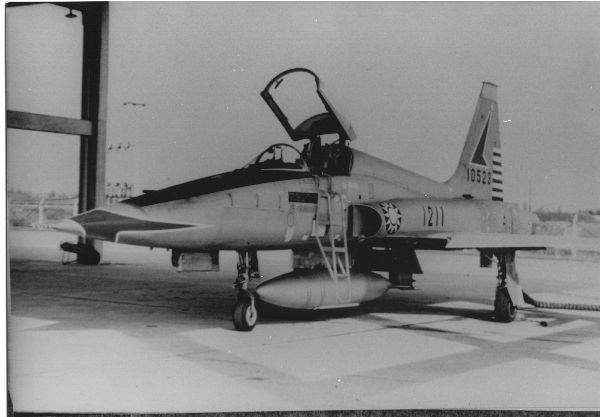
The Northrop F-5 is a family of supersonic light fighters conceived in the late 1950s as a privately funded Northrop Corporation venture. Two generations share the designation: the original F-5A and F-5B Freedom Fighter and the deeply revised F-5E and F-5F Tiger II. In both, the design team wrapped the smallest, cleanest possible airframe around a pair of compact General Electric J85 turbojets, putting performance and cheap maintenance ahead of sophistication. The philosophy came from engineering vice president Edgar Schmued, previously chief designer of the P-51 Mustang and F-86 Sabre at North American, and from chief engineer Welko Gasich, who brought the notion of life cycle cost into fighter design. Against contemporaries such as the McDonnell Douglas F-4 Phantom II, the F-5 was smaller, simpler and far cheaper to buy and operate, which made it the Cold War export fighter par excellence. Although intended for the day air superiority role, it proved an effective ground-attack platform as well. The N-156F prototype flew at Edwards on 30 July 1959 and went supersonic on that first flight, yet the programme languished until the Kennedy administration revived the requirement for a low-cost fighter for military assistance customers: the type won the F-X competition on 23 April 1962, became the F-5A and was ordered into production that October. Northrop built 624 F-5As, 200 F-5Bs and 86 RF-5As, joined by 240 first-generation aircraft licence-built by Canadair and 70 by CASA in Spain. Norway placed the first international order on 28 February 1964. Winning the International Fighter Aircraft competition in 1970 produced the F-5E Tiger II, with more powerful J85-21 engines, a lengthened fuselage, greater wing area, enlarged leading-edge extensions and, at last, radar. The F-5E flew on 11 August 1972 and the two-seat F-5F on 25 September 1974; by the end of production in 1987 a total of 1,400 Tiger IIs had been completed, and between the F-5 and the closely related T-38 Talon more than 3,800 aircraft left Hawthorne, California. As an export fighter it saw combat in Southeast Asia, in the Ogaden War and in the Iran-Iraq War, while in the United States it found a lasting niche as an aggressor aircraft for dissimilar air combat training, a role it still fills with the Navy and Marine Corps on modernised F-5N and F-5F airframes; more than 400 were still in service as of 2021. The same airframe spawned the RF-5E Tigereye reconnaissance version, the Northrop YF-17 that led to the F/A-18, the stillborn F-20 Tigershark and the NASA F-5E rebuilt for the Shaped Sonic Boom Demonstration.