Northrop F-5 variant
Northrop F-5F Tiger II
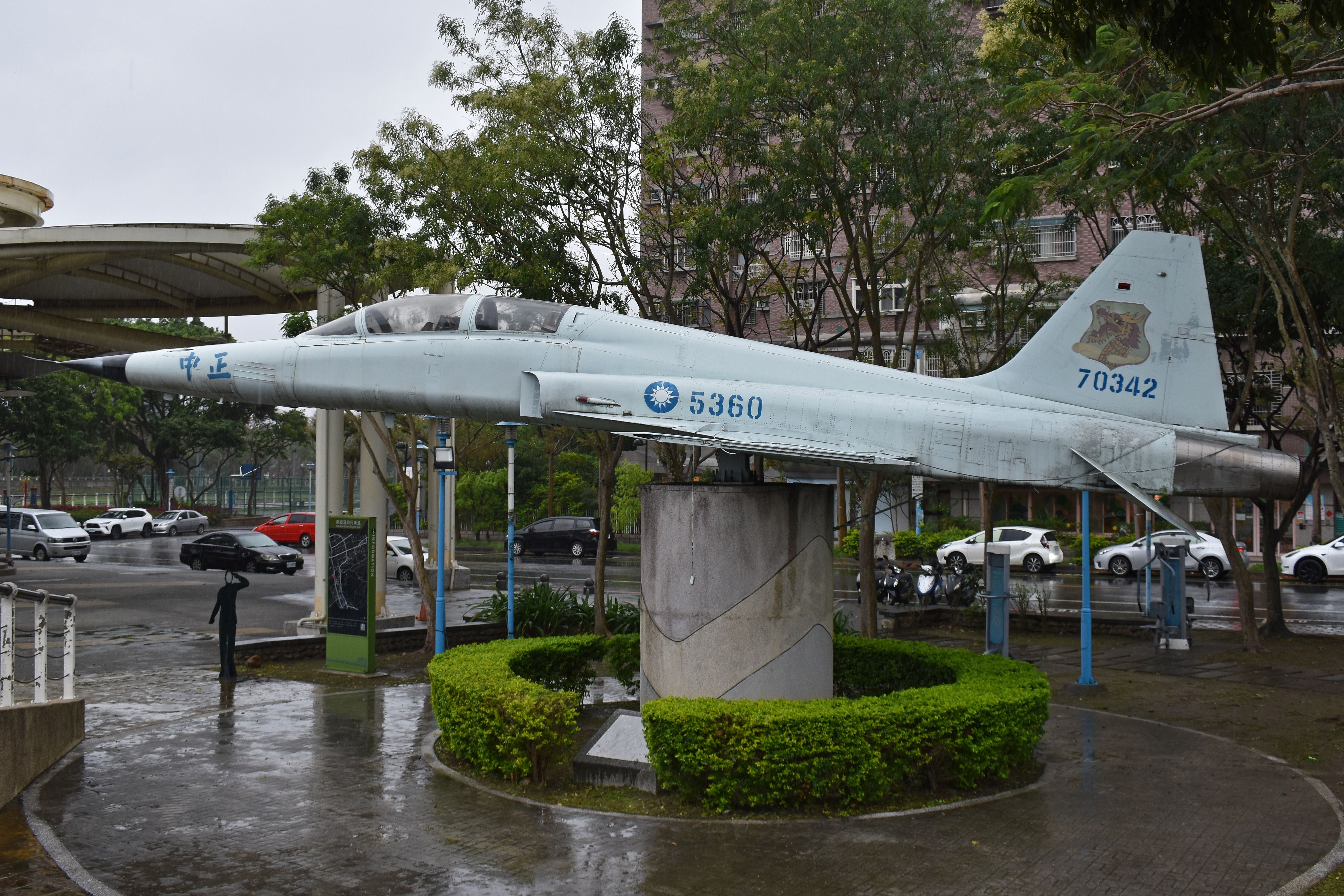
The F-5F is the combat-capable two-seat trainer of the Tiger II family. It first flew on 25 September 1974 at Edwards Air Force Base, with a nose stretched by about 0.9 m that let it keep one of the F-5E's two M39 cannon, something its predecessor, the F-5B, had given up entirely. Northrop built 146, with further licence production in Taiwan, South Korea and Switzerland. It followed the single-seater into almost every export sale and served with US adversary squadrons well into the twenty-first century.

- September 25, 1974
- First flight
- 146
- Units built
History
A two-seater that kept its gun
When Northrop won the International Fighter Aircraft competition in 1970 with what became the F-5E Tiger II, the programme also offered a combat-capable two-seat trainer: the F-5F. The first example flew on 25 September 1974 at Edwards Air Force Base, two years after the single-seater's maiden flight on 11 August 1972.
The key to the design was the nose. In the first generation, the F-5B two-seater had given up its nose cannon altogether to make room for the second cockpit. For the F-5F, Northrop lengthened the nose by three feet (about 0.9 m) over the single-seater, and that extra space allowed it to retain one of the two 20 mm M39 cannon, albeit with reduced ammunition. The result was a dual-control aircraft that remained a fighter: it could convert pilots to the type and still fight, or fly as an aggressor, with an instructor on board.
Dual-control radar
The F-5F was fitted with the Emerson AN/APQ-157 radar, a derivative of the AN/APQ-153 carried by early F-5Es, with duplicated control and display systems for both cockpits. Its range matched the AN/APQ-153 at around 10 nautical miles (about 18 km). When the single-seater adopted the AN/APQ-159 planar-array radar, with a range of some 20 nautical miles (about 37 km), an equivalent upgrade was proposed for the two-seater, the AN/APQ-167 derived from the APQ-159; it was cancelled, and production F-5Fs kept the APQ-157.
Production
Northrop built 146 F-5Fs, against 792 F-5Es and 12 RF-5Es. Licence production came on top of that: in Taiwan, AIDC had turned out 66 F-5Fs (alongside 242 F-5Es) when its line closed at the end of 1986, and the last Taiwanese batches already carried the F-20's shark nose. In South Korea, Korean Air built 20 KF-5F two-seaters, which began entering service in September 1982. Switzerland assembled 91 F-5Es and F-5Fs combined, with no per-variant breakdown in the source.
Operators
The two-seater accompanied the F-5E in almost every sale. Switzerland had 12 F-5Fs at its 1981 peak; in 2006 it sold 36 low-hour F-5E/Fs to the US Navy, and the sale of 22 retired aircraft to the United States finalised in 2020 included six F-5Fs, with deliveries starting from Emmen in March 2024. Singapore received three F-5Fs with its first batch (completed by late February 1979), three more that its pilots collected at RAF Leuchars in Scotland in September 1983, and a final three delivered in December 1987; between March 1996 and 2001 they were upgraded as F-5Ts and lost their single cannon to make room for avionics.
Malaysia received four F-5Fs in 1982 and later a fifth (M29-23) with the shark nose as an attrition replacement; one was lost in a crash at sea in 1986. Mexico took two in 1982, Morocco four (ordered in 1979 with Saudi financing and delivered between 1981 and 1983) and Bahrain two between 1985 and 1987. Kenya ordered two in June 1976 and in 2008 bought two more from Jordan, already upgraded with Rockwell Collins avionics. Chile acquired three in the 1970s, upgraded to Tiger III standard in 1993. Ethiopia had three in a 1975 agreement, but an embargo meant only eight F-5Es arrived and the rest went to a USAF aggressor squadron.

Brazil bought four second-hand F-5Fs from USAF aggressor squadrons in 1988 and three more two-seaters from Jordan in 2009 as part of a US$21 million deal; all were later brought to the F-5FM standard under the Embraer and Elbit programme. Taiwan, which once held 336 F-5E/Fs, retired its last F-5Fs in July 2025 together with the RF-5E Tigergazers.
US Navy aggressor
In the United States, the 36 ex-Swiss F-5E/Fs were updated as F-5Ns and F-5Fs. The US Navy produced three "FrankenTigers" by grafting the front half of an older F-5F onto the rear half of a low-hour ex-Swiss F-5E. Squadron VFC-111 operates 18 aircraft: 17 single-seat F-5Ns and one of these F-5Fs. The latest upgrade, designated F-5F+, installs Garmin G3000 avionics to extend its service life.
Multimedia


Where to see it today
| Serial | Place | City | Country | Status |
|---|---|---|---|---|
| J-3202 | Flieger-Flab-Museum | Dübendorf | Switzerland | On display |
List reviewed on October 29, 2026 against Wikipedia (EN): Northrop F-5, Wikipedia (EN): Flieger-Flab-Museum.