Northrop F-5 variant
Northrop F-5 F-5B
Two-seat training version of the F-5A, fully combat-capable but without the nose cannon. Northrop built 200 alongside single-seat production. Powered by two General Electric J85-GE-13 turbojets, it was the aircraft on which most customer air forces converted their pilots to the type.
- 200
- Units built
History
A trainer that also fights
The F-5B is the tandem two-seat version of the F-5A, conceived from the outset as a conversion trainer that would keep the single-seater's combat capability. The visible difference is the lengthened two-place cockpit and, above all, the absence of the two nose-mounted M39 cannon, given up to make room for the second station. The external stores stations were retained, so the aircraft could be used on real attack or armed training missions.
Northrop built 200 F-5Bs alongside the 624 F-5As. The Pima Air & Space Museum documents the first-generation powerplant on its example: two General Electric J85-GE-13 turbojets of 4,080 pounds of thrust each, a loaded weight of 20,677 lbs, a maximum speed of 885 MPH, a service ceiling of 52,000 ft and a range of 3,660 miles. That airframe wears the markings of the 58th Tactical Fighter Training Wing at Williams Air Force Base, the very training organisation the Military Assistance Program used to school foreign pilots.
International service
The F-5B was almost always the way into the type. Spain received it before the single-seater: the first delivery to the Ejército del Aire, on 19 June 1969, consisted of two F-5Bs for Escuadrón 202 at Morón de la Frontera, with the single-seat F-5A and RF-5A following later. The Spanish F-5B was assigned to Ala 73 at Talavera la Real Air Base for training, a role it has never left. Taiwan received two F-5Bs with its first 1965 batch and operated eleven by 1971. Malaysia took two alongside its F-5Es in 1975 and transferred them to the Royal Thai Air Force in 1982. Brazil bought six F-5Bs with its initial 1974 order and retired them in 1990, sending them to museums around the country.
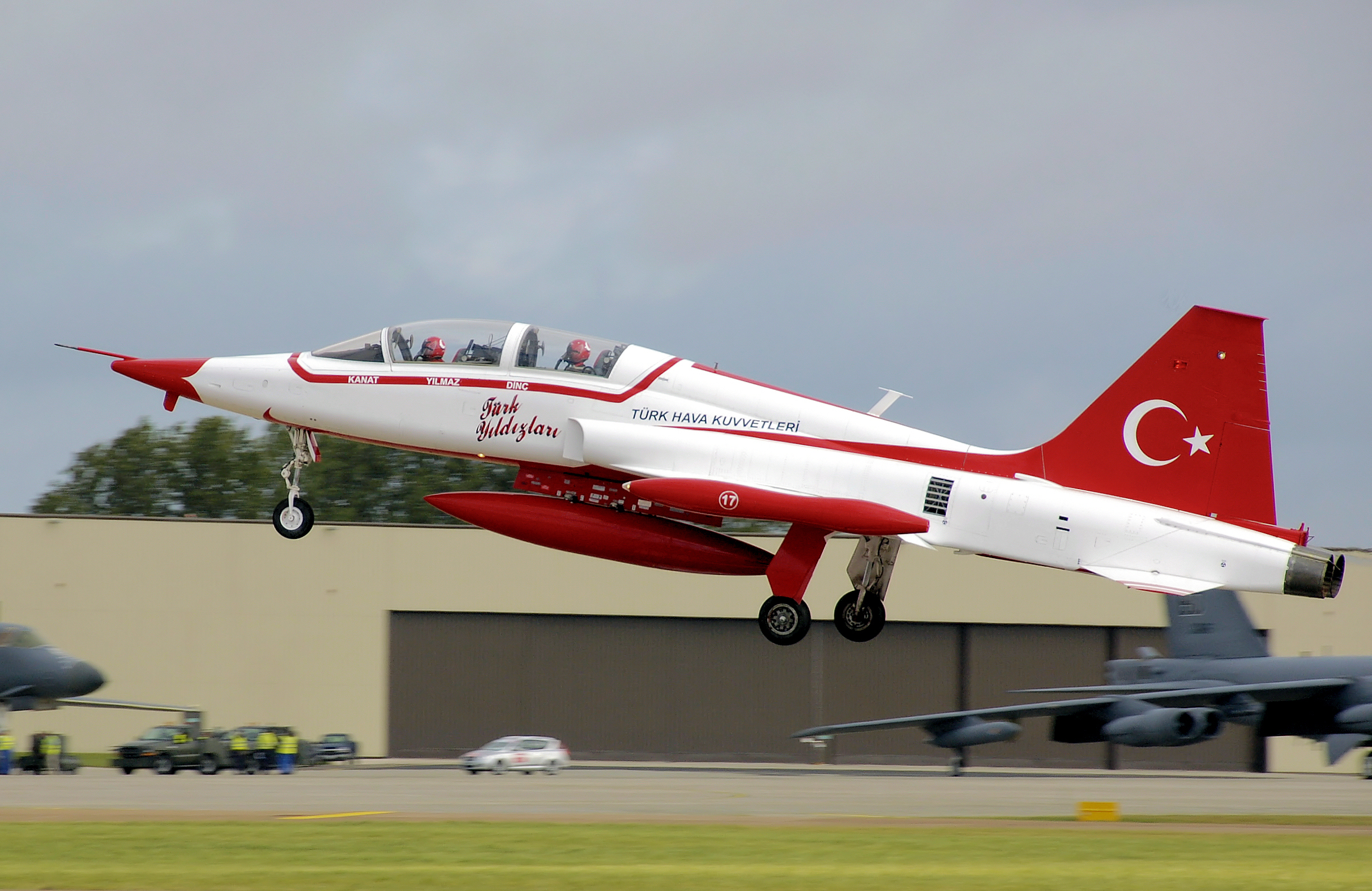
The Spanish two-seater's career was marked by two structural accidents. In 1989 an F-5B crashed due to structural failure of a wing; the entire fleet was grounded while crews searched for signs of material fatigue, and as a result many F-5s were retired. Following the accident all two-seaters were sent to the CASA Getafe factory for maintenance and renovation. A modernisation programme begun in 2008 extended their operational life and added glass cockpits and zero-zero ejection seats; aircraft so treated are designated F-5BM, and the modernised SF-5M carries the Spanish designation AE.9.
A decisive prototype
One F-5B also played a part beyond its trainer role: fitted with a 5,000 lbf General Electric J85-GE-21 engine, it served as the YF-5B prototype for the future F-5E Tiger II. That airframe was the testbed for the powerplant that would define the family's second generation.
Multimedia
