Northrop F-5 variant
Northrop F-5N
Designation of the ex-Swiss F-5Es bought by the US Navy and Marine Corps, disassembled and refurbished by Northrop Grumman for use as adversary aircraft; the programme delivered 41 single-seat F-5Ns and three F-5Fs between 2003 and 2009.

- 41
- Units built
History
Why the Navy went looking for second-hand Tigers
At the turn of the century, the F-5Es with which the US Navy and Marine Corps played the enemy in dissimilar air combat training were badly worn: their airframes averaged about 7,000 flight hours, in an adversary role that is especially severe on the structure. Northrop Grumman had been under Navy contract since 1999 for depot-level maintenance of that F-5E/F fleet, but the real answer lay elsewhere: replacing the veteran aircraft with airframes of the same type and far fewer hours.
Switzerland had exactly what was needed. Its air force had bought 110 Tiger IIs in two tranches, peaking at 98 F-5Es and 12 F-5Fs in 1981, and the arrival of the F/A-18 Hornet pushed much of that fleet into secondary tasks. The Swiss F-5Es averaged only about 2,500 hours per airframe and had also been built with Improved Handling Quality systems, sharper noses, improved wing leading-edge roots and automatic flaps, giving them better performance than the Navy's F-5Es.
A "reverse" military sale
The deal was concluded in 2002 through a unique "reverse" Foreign Military Sales procedure in which the United States was the buyer: 32 well-maintained Swiss F-5Es; the purchase was announced in Switzerland in 2003, and 12 more aircraft were added later. In all there were 44 aircraft, for about 50 million dollars according to the French Wikipedia. The programme called for replacing 24 Navy and 12 Marine Corps F-5s.

Deliveries of the Swiss airframes began in 2003 at a rate of roughly one a month. Each aircraft was disassembled at the RUAG facility in Emmen, the Swiss Air Force's industrial partner, packed in a frame designed and built by Northrop Grumman and flown aboard a Navy Reserve C-130T, two at a time according to the French Wikipedia, to the company's plant at St. Augustine, Florida. The last transport flight took place on 26 October 2007. Thirty-two aircraft had been received by the end of 2007 and the remainder by the end of 2008.
What makes an F-5N
At St. Augustine each airframe was stripped of all paint; the structure, control surfaces and components were inspected by X-ray and other non-destructive testing methods. Fatigue-critical components were replaced, the aft-fuselage areas subject to high fatigue were refurbished and newly designed upper cockpit longerons were installed. The avionics were upgraded as well. The English Wikipedia states that the AN/APG-69 radar replaced the original AN/APQ-159; GlobalSecurity, however, still lists the AN/APQ-159, together with an inertial navigation system, ALR-87 radar warning receivers, ALE-40 chaff and flare dispensers and AIM-9 Sidewinder missiles on wingtip launchers. The pressurised, air-conditioned cockpit has a rocket-powered ejection seat.
The most striking work was the conversion of three single-seat F-5Es into two-seat F-5Fs: the F-5E forward fuselage was replaced with a refurbished F-5F forward fuselage at the basic manufacturing attachment point. These are the "FrankenTigers". On 29 April 2009, at the St. Augustine plant, NAVAIR's PMA 207 office accepted the 44th and final aircraft of the programme, which turned the 44 Swiss aircraft into 41 F-5Ns and three F-5Fs. GlobalSecurity places the completion of this six-year programme in 2008.
With the adversary squadrons
The F-5Ns were assigned to NAS Fallon, Nevada, NAS Key West, Florida, and MCAS Yuma, Arizona. At Fallon they flew with VFC-13 "Fighting Saints", which had moved to the F-5E in April 1996; at Key West with VFC-111 "Sundowners", which operates 18 Tiger IIs: 17 F-5Ns and one F-5F FrankenTiger; at Yuma with the Marines' VMFT-401 "Snipers", which in 2019 had eleven F-5Ns and two F-5Fs. That squadron provides dissimilar air-to-air training to MAWTS-1, VMFAT-101 and Marine Aircraft Groups 11, 13, 14 and 31; in fiscal year 2005 this support accounted for 4,241 of its sorties. The Swiss programme was meant to keep the F-5N flying until at least fiscal year 2015, a horizon long since passed; an improved inertial navigation system was later planned for 24 F-5Ns. As The Aviation Geek Club notes, in its original state the Tiger II only realistically replicates a MiG-21-class threat.
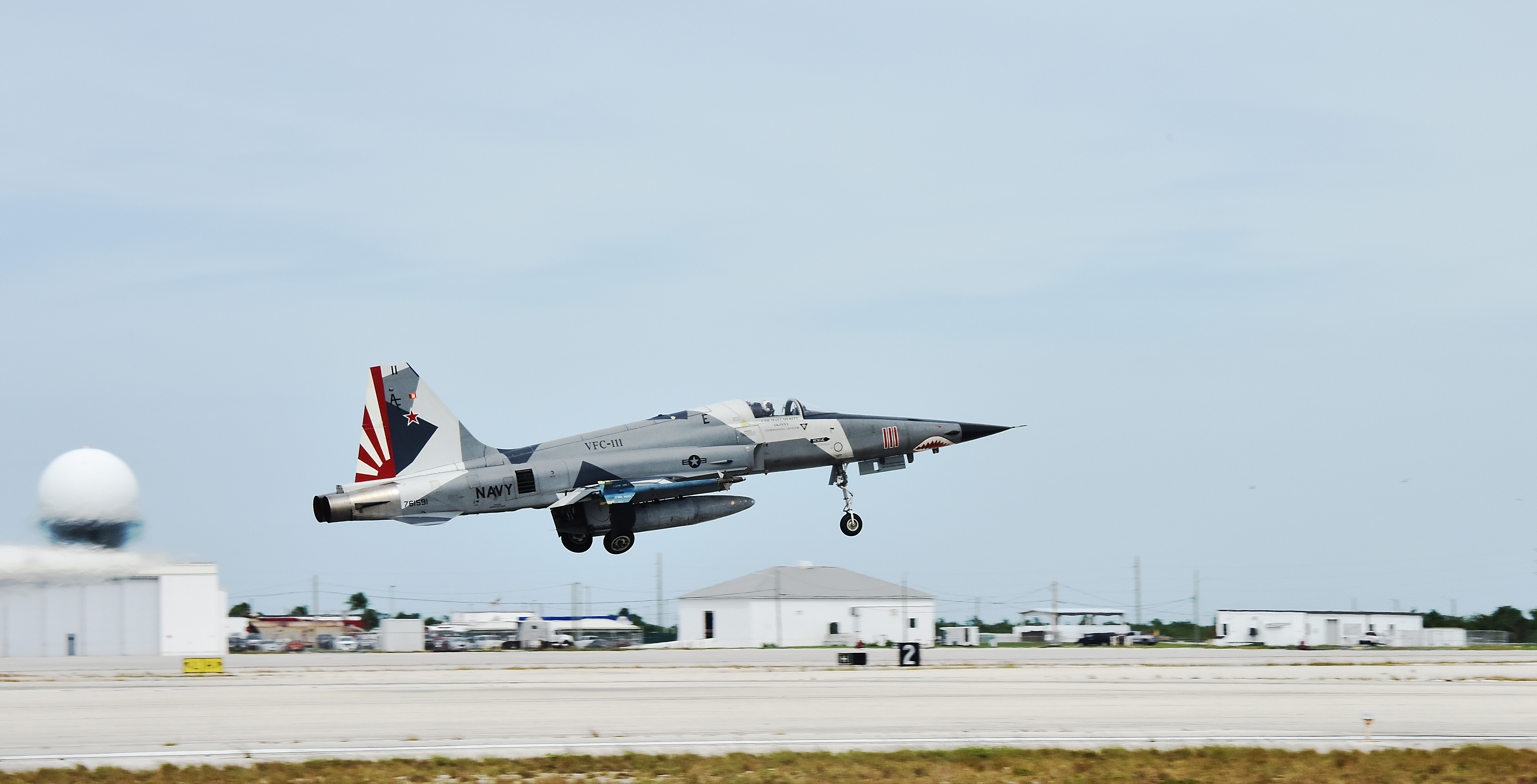
In April 2022 plans became public to replace VFC-13's F-5s with Block 32 F-16s and hand those Tigers to VFA-204 at New Orleans; by December 2022 VFC-13 had transitioned to the F-16C.
The second Swiss purchase
In 2020 the sale of another 22 retired Swiss Tiger IIs was finalised — 16 F-5Es and 6 F-5Fs, with ground equipment, spare parts and logistical support — for an estimated 32.4 million dollars. On 18 March 2024 a Marine Corps KC-130J picked up the first of them at Emmen Air Force Station. These aircraft are to supplement and in some cases replace the 44 in service, and the PMA-226 office will convert them under the ARTEMIS programme, which upgrades the cockpit, avionics and aircraft architecture; aircraft with this upgrade are designated F-5N+ and F-5F+. Its additions include air-to-ground warning, severe-weather protection, fuel-level warnings and new tactical capabilities for air-to-air training; the English Wikipedia mentions Garmin G3000 avionics.
Multimedia


