Fighter · Military · Germany
Eurofighter Typhoon
- In service
- Status


-800.webp)
-1600.webp)
-1600.webp)


-1600.webp)

-1600.webp)


-800.webp)
-1600.webp)
-1600.webp)
-1600.webp)
-1600.webp)
-1600.webp)
-1600.webp)


-1600.webp)
-1600.webp)


The Eurofighter Typhoon is a European twin-engine, supersonic, canard delta multirole fighter, designed originally as an air-superiority fighter and built by a consortium of Airbus, BAE Systems and Leonardo that runs most of the programme through the joint holding company Eurofighter Jagdflugzeug GmbH. On the customer side, the NATO Eurofighter and Tornado Management Agency (NETMA), representing the United Kingdom, Germany, Italy and Spain, manages the project and acts as prime customer. Development began in 1983 with the Future European Fighter Aircraft programme, a multinational effort involving the United Kingdom, Germany, France, Italy and Spain. Germany, Italy and the UK had already developed and fielded the Panavia Tornado together and wanted to repeat the formula with more European partners; disagreements over design authority and operational requirements pushed France out of the consortium to develop the Dassault Rafale on its own. The British Aerospace EAP technology demonstrator first flew on 6 August 1986 and a Eurofighter prototype made its maiden flight on 27 March 1994. The Typhoon name was adopted in September 1998, the same year the first production contracts were signed. The abrupt end of the Cold War cut European demand for fighters and opened a long argument about the aircraft's cost, the division of industrial work among partner nations and the length of its development. The Typhoon entered operational service in 2003 and now serves with the air forces of Austria, Italy, Germany, the United Kingdom, Spain, Saudi Arabia and Oman; Kuwait and Qatar have also ordered it, bringing the procurement total to 680 aircraft as of November 2023. In the air the Typhoon is an exceptionally agile aircraft, built to be an effective dogfighter: deliberately relaxed stability, combined canard and flaperon control surfaces, very low wing loading and a quadruplex digital fly-by-wire system that tames the resulting instability. Later production aircraft have been progressively better equipped for air-to-surface strike and compatible with a growing catalogue of weapons and equipment, including Storm Shadow, Brimstone and Marte ER. Its combat debut came in the 2011 military intervention in Libya, with Britain's Royal Air Force and the Italian Air Force flying reconnaissance and ground-strike missions; since then it has taken primary responsibility for air defence duties in most customer nations.
Related events
- First flight of the Eurofighter Typhoon DA1 prototype
- First Eurofighter production contract signed
- Christening ceremony gives the Eurofighter its Typhoon name at Farnborough
- Italy declares initial operational capability of the F-2000
- RAF forms its first operational Typhoon squadron
- RAF Typhoons take over the Quick Reaction Alert role
- Austria receives its first Eurofighter at Zeltweg
- Saudi Arabia signs contract for 72 Eurofighters
- Spain assigns its Eurofighters to quick reaction alert
- Eurofighter Tranche 3A contract signed
- The 100th production Eurofighter rolls out at Warton
- Kuwait signs contract with Leonardo for 28 Eurofighters
- Qatar agrees to buy 24 Eurofighters
- Belgium selects the F-35A over the Typhoon
- Germany approves order for 38 Tranche 4 Eurofighters
- Eurofighter and NETMA sign the Aerodynamic Modification Kit contract
Category
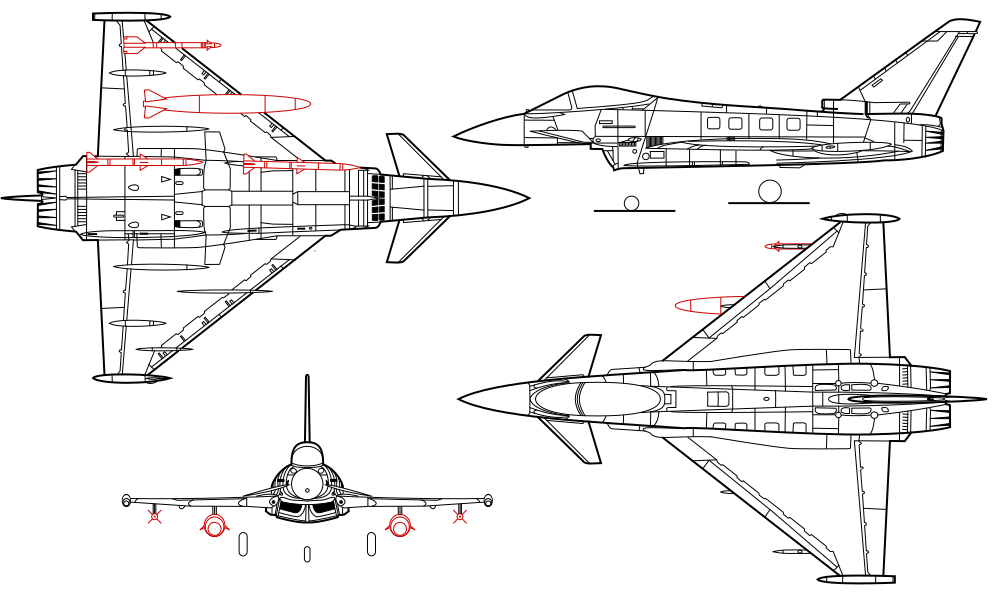
Three-view drawing
.jpg)
History
Origins: three national paths that converge
The Typhoon's genealogy begins long before the consortium existed. In the United Kingdom, work started as early as 1971 on a manoeuvrable tactical aircraft to replace the SEPECAT Jaguar, then about to enter RAF service; the effort soon expanded to include an air-superiority capability. A 1972 specification, Air Staff Target 403, led to the Hawker P.96, an unbuilt design with a relatively conventional planform and a separate tail. In parallel, in West Germany the requirement for a new fighter produced a contest between Dornier, VFW-Fokker and Messerschmitt-Bölkow-Blohm for the future Taktisches Kampfflugzeug 90 (TKF-90). Dornier worked with Northrop on the ND-102, an acclaimed but unsuccessful design; MBB won with a configuration that already contained the future Eurofighter's signature features: a cranked delta wing, close-coupled canards and artificial stability.
In 1979 MBB and British Aerospace put a formal collaboration proposal to their governments, the European Combat Fighter, which the French firm Dassault joined in October of that year. It was at this stage that the Eurofighter name was first attached to the aircraft, though all three partners kept refining separate prototypes: MBB its TKF-90 and Dassault a design known as the ACX. The British P.96, meanwhile, had been cancelled for offering little room for future upgrades and for resembling the McDonnell Douglas F/A-18 Hornet too closely — a rival that would reach the market first and close off its export prospects. BAe answered with two new proposals: the single-engined lightweight P.106B, superficially like the future Saab JAS 39 Gripen, and the twin-engined P.110. The RAF rejected the single-engined concept with a line that stuck: it had "half the effectiveness of the two-engined aircraft at two-thirds of the cost."
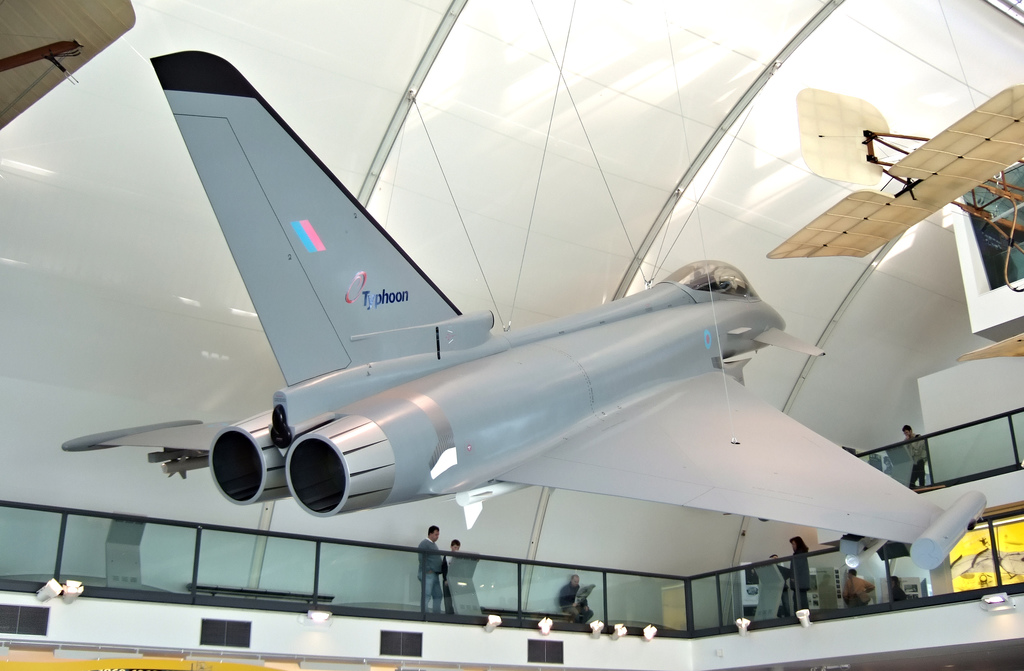
The ECF project collapsed in 1981 over divergent requirements, Dassault's insistence on design leadership and the British preference for a new version of the RB199 against the French preference for the Snecma M88. The Panavia partners — MBB, BAe and Aeritalia — responded in April 1982 by launching the Agile Combat Aircraft programme. The British designers accepted the general TKF-90 configuration but rejected its more ambitious features, such as vectoring nozzles and vented trailing-edge controls; the main external change was replacing the side intakes with a chin intake. When the German and Italian governments withdrew funding, the UK Ministry of Defence agreed to pay half the cost with industry providing the rest, and in May 1983 BAe announced a contract to build a demonstrator: the Experimental Aircraft Programme.
From EFA to contract: workshare and the radar war
In 1983 Italy, Germany, France, the United Kingdom and Spain launched the Future European Fighter Aircraft programme, with short take-off and landing and beyond-visual-range requirements. In 1984 France restated its demand for a carrier-capable version and a leading role; Italy, West Germany and the UK opted out and set up a new EFA programme. In Turin on 2 August 1985 the three confirmed they would go ahead and that France and Spain had chosen not to take part; Spain nonetheless rejoined in early September of that year, while France formally withdrew to pursue the ACX, the future Rafale.
By 1986 the demonstrator programme's cost had reached £180 million, and the British government together with private finance had to provide £100 million to keep it alive when the West German and Italian governments wavered. The EAP was rolled out at Warton in April 1986 and first flew on 6 August; the Eurofighter bears a strong resemblance to it, and design work leaned on EAP flight data for the following five years. Initial requirements were 250 aircraft for the UK, 250 for Germany, 165 for Italy and 100 for Spain, and the production share followed: BAe 33 per cent, DASA 33 per cent, Aeritalia 21 per cent and CASA 13 per cent. In 1986 the Munich-based Eurofighter Jagdflugzeug GmbH was set up to manage development, alongside EuroJet Turbo GmbH — Rolls-Royce, MTU, FiatAvio and ITP — for the EJ200 engine. The aircraft was known as Eurofighter EFA until it was renamed EF 2000 in 1992.
By 1990 the choice of radar had become the programme's main political obstacle: the UK, Italy and Spain backed the Ferranti-led ECR-90, while Germany preferred the APG-65-based MSD2000. Agreement came when UK Defence Secretary Tom King assured his West German counterpart Gerhard Stoltenberg that London would approve the project and allow GEC subsidiary Marconi Electronic Systems to acquire Ferranti Defence Systems from a parent group in financial and legal difficulty; GEC then withdrew its support for the MSD2000.
Delays, reunification and the workshare crisis
The financial burden of reunification led Helmut Kohl to promise in an election campaign that he would cancel the Eurofighter, and in early to mid 1991 Defence Minister Volker Rühe tried to pull Germany out in favour of a cheaper, lighter aircraft using Eurofighter technology. It could not be done: the money already spent, the jobs tied to the project and the binding commitments — under a penalty system the partners had devised themselves — left no exit.
The workshare crisis broke in 1995. The original 33/33/21/13 split between the UK, Germany, Italy and Spain was based on the number of units each nation would buy, and every nation cut its order: the UK from 250 to 232, Germany from 250 to 140, Italy from 165 to 121 and Spain from 100 to 87. On those numbers the split should have become 39/24/22/15, but Germany was unwilling to give up so much work. After negotiation, a compromise was reached in January 1996: Germany would buy another 40 aircraft and the split would settle at 37.42 per cent for the UK, 29.03 for Germany, 19.52 for Italy and 14.03 for Spain. At the 1996 Farnborough Airshow the UK announced funding for the construction phase, and on 22 December 1997 the defence ministers of the four partner nations signed the production contract.
The prototype's maiden flight had taken place in Bavaria on 27 March 1994, flown by DASA chief test pilot Peter Weger. Environmental testing continued for years: in December 2004 IPA4 began three months of cold trials at Vidsel air base in Sweden to verify the aircraft and its systems between −25 and 31 °C, and IPA7, the first fully equipped Tranche 2 aircraft, flew from Manching on 16 January 2008.
Production, tranches and cost
The first production contract was signed on 30 January 1998 between Eurofighter GmbH, Eurojet and NETMA, with totals of 232 aircraft for the UK, 180 for Germany, 121 for Italy and 87 for Spain. On 2 September 1998 a naming ceremony at Farnborough formally adopted the Typhoon name, initially for export aircraft only, continuing the storm theme begun with the Tornado. Germany objected, because the Hawker Typhoon had been an RAF fighter-bomber used against German targets in the Second World War; the name "Spitfire II" had been dropped earlier for the same reason. That same month, contracts were signed for 148 Tranche 1 aircraft and for long-lead items for Tranche 2.
.jpg)
The Typhoon is unique among modern combat aircraft in having four separate assembly lines: each partner company assembles its own national aircraft but builds the same parts for every airframe, exports included. Premium AEROTEC makes the main centre fuselage, EADS CASA the right wing and leading-edge slats, BAE Systems the front fuselage including foreplanes and canopy, the dorsal spine, tail fin, inboard flaperons and a rear fuselage section, and Leonardo the left wing, outboard flaperons and rear fuselage sections. Production was divided into three tranches, a production and funding distinction that does not imply an automatic step in capability: Tranche 3, itself split into 3A and 3B, is based on late Tranche 2 aircraft with improvements added. In July 2009, after almost two years of negotiation, the Tranche 3A contract was signed; the Tranche 3B order never went ahead. On 25 May 2011 the hundredth production aircraft rolled off the Warton line.
Cost has been the programme's permanent political front. In 1985 the estimate for 250 UK aircraft was £7 billion; by 1997 it was £17 billion and by 2003 £20 billion, with the in-service date — defined as delivery of the first aircraft to the RAF — running 54 months late. In 2011 the National Audit Office estimated that the UK's assessment, development, production and upgrade costs would eventually reach £22.9 billion and total programme costs £37 billion. Germany ordered 31 Tranche 3A aircraft on 17 June 2009 for €2.8 billion, a system cost of €90 million per aircraft; Spain put its Typhoon project up to December 2010 at €11.718 billion against an original €9.255 billion, implying a €160 million system cost for each of its 73 aircraft. In July 2016 the ten-year TyTAN support deal between the RAF and industry partners BAE and Leonardo was announced, aiming to cut the type's per-hour operating cost by 30 to 40 per cent.
Design: airframe, aerodynamics and flight controls
The Typhoon is a twin-engined, loosely coupled tailless delta-canard design with 53 degrees of leading-edge sweepback, relaxed stability and digital fly-by-wire controls. Its agility at all speeds, subsonic and supersonic, comes precisely from that intentional instability, from the combined action of canards and flaperons and from a very low wing loading. The quadruplex digital fly-by-wire system manages the instability and allows better manoeuvrability than direct pilot control; it is described as "carefree" because it prevents the permitted manoeuvre envelope from being exceeded. Roll control comes mainly from differential use of the flaperons and pitch control from coupled canard and flaperon operation; the wing leading edges carry automatic movable slats and a single large rudder provides yaw control. The engines are fed by a chin double intake ramp below a splitter plate, and a hydraulically operated air brake behind the cockpit rises to near vertical to maximise drag.
Construction is deliberately light: 82 per cent composites, of which 70 per cent are carbon fibre composites and 12 per cent glass fibre reinforced composites, plus aluminium-lithium and titanium components on leading-edge surfaces. The airframe's estimated life is 6,000 flying hours.
.jpg)
Although not a stealth fighter, the Typhoon received measures to reduce its radar cross section, especially frontally. The intakes conceal the front faces of the engines, a strong radar target; the wing, canard and fin leading edges are highly swept so that radar energy is reflected away from the emitter; some external weapons are mounted semi-recessed; and radar-absorbent materials developed chiefly by EADS/DASA coat the most significant reflectors, from the wing leading edges to the intake interior and the rudder surrounds. The manufacturers measured the DA4 prototype's radar cross section at Warton from the early 1990s to optimise these characteristics. Passive sensors such as the PIRATE IRST further reduce revealing emissions, and the flight control system holds canards and elevons at the angles of smallest reflection.
Cockpit, avionics and sensors
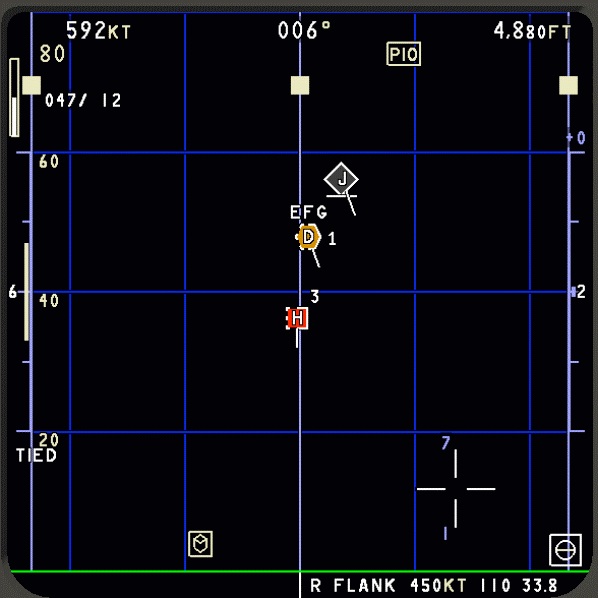
The cockpit is fully glass, with no conventional instruments: three full-colour multifunction head-down displays driven by dedicated controls, softkeys, an XY cursor and voice; a wide-angle head-up display with forward-looking infrared; HOTAS combined with direct voice input; a helmet-mounted symbology system; and LED-lit reversionary instruments beneath a hinged right glareshield. The ejection seat is a Martin-Baker Mk.16A and the canopy is jettisoned by two rocket motors. Standard g protection comes from full-cover anti-g trousers giving sustained protection up to nine g; German and Austrian pilots instead wear the Libelle hydrostatic suit, which also protects the arms. If the pilot becomes disoriented, one button press hands the flight control system full authority over engines and controls, stabilising the aircraft wings-level in a gentle climb at 300 knots; an Automatic Low-Speed Recovery system also prevents departure from controlled flight at very low speeds and high angles of attack.
The Typhoon's Direct Voice Input was the first production DVI system used in a military cockpit. It gives the pilot an additional natural mode of command over roughly 26 non-critical functions to reduce workload, and is deliberately excluded from safety- or weapon-critical tasks such as weapon release or lowering the undercarriage.
Navigation combines GPS and an inertial system, with ILS for poor-weather approaches and a ground proximity warning system based on the Tornado's TERPROM. Link 16 arrives through MIDS. Self-protection is handled by the Praetorian subsystem, formerly Euro-DASS, which monitors and responds automatically to air and surface threats and can handle several at once: radar warning receiver, missile warning system, laser warning receiver on UK aircraft, chaff, flares, an ECM suite and a towed radar decoy, with 16 antenna array assemblies and 10 radomes. Sensor fusion is performed by the Attack and Identification System, which merges on-board sensors with off-board information from AWACS and MIDS and should allow targets to be identified beyond 150 nautical miles — about 280 km — and acquired and auto-prioritised beyond 100 nautical miles.
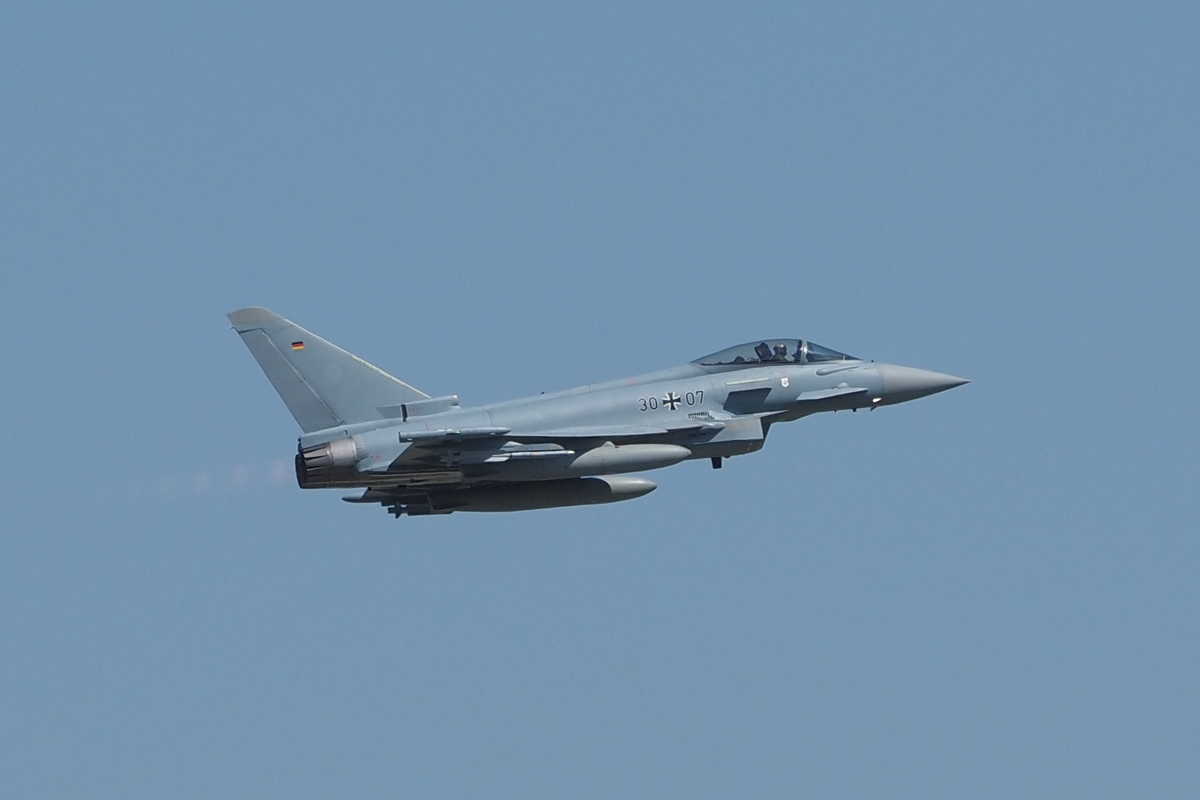
The baseline radar is the Euroradar Captor, a mechanically scanned multimode pulse-Doppler set with three working channels, one of them dedicated to classifying and suppressing jamming. Its active-array evolution is the Captor-E, also known as CAESAR, developed by the Euroradar consortium under Selex ES; the upgrade contract was signed in Edinburgh on 19 November 2014 in a deal worth around €1bn, and Kuwait became the launch customer in April 2016. The AESA effort is now split into three European Common Radar System variants: ECRS Mk0, or Radar One Plus, fitted to Kuwaiti and Qatari aircraft; ECRS Mk1, developed by Hensoldt and Indra for Germany and Spain; and ECRS Mk2, or Radar Two, with electronic warfare capabilities, developed by Leonardo for the RAF and integrated by BAE Systems, with Italy having joined the programme. In January 2024 the first ECRS Mk2 was announced as fitted to an RAF test and evaluation Typhoon at Warton.
The signature passive sensor is PIRATE, an infrared search and track set mounted on the port side ahead of the windscreen, built by the EUROFIRST consortium of Selex ES, Thales Optronics and Tecnobit. Aircraft from Tranche 1 block 5 carry it, and the first Typhoon with PIRATE was delivered to the Italian Aeronautica Militare in August 2007. It detects temperature variations at long range, doubles as a navigation and landing aid, feeds the helmet-mounted display and can track up to 200 targets simultaneously across several modes, including a visual identification mode with resolution superior to Captor's.
Engines, performance and armament
The Typhoon is powered by two Eurojet EJ200 afterburning turbofans, each rated at up to 60 kN (13,500 lbf) dry and more than 90 kN (20,230 lbf) with reheat. On the "war" setting dry thrust rises 15 per cent to 69 kN and reheat thrust 5 per cent to 95 kN per engine, with a few seconds of up to 102 kN available without damaging the engine. The EJ200 combines technologies from the four European partner companies: digital control and health monitoring, wide-chord aerofoils and single-crystal turbine blades, and a convergent/divergent exhaust nozzle. By 2007 the EJ200 fleet had accumulated 50,000 engine flying hours with the four national air forces.
The aircraft can supercruise, sustaining supersonic flight without reheat. Published figures vary with source and configuration: Air Forces Monthly gives a maximum of Mach 1.1 for the RAF's multirole FGR4, a Typhoon supercruised at Mach 1.21 on a hot day with a combat load during a Singaporean evaluation, and Eurofighter states Mach 1.5. As with the F-22, weapons can be launched while supercruising to extend their range through that running start.
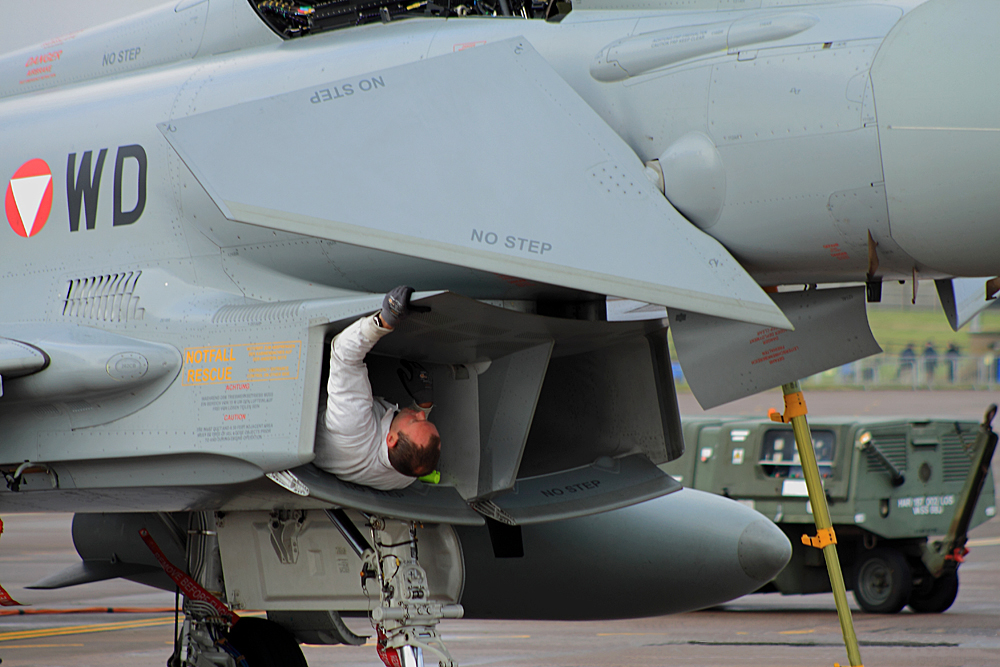
Published general characteristics give a length of 15.96 m, a wingspan of 10.95 m, a height of 5.28 m and a wing area of 51.2 m², with an empty weight of 11,000 kg, a gross weight of 16,000 kg and a maximum take-off weight of 23,500 kg; internal fuel is roughly 4,500 kg, rising to about 7,600 kg including external stores. Maximum speed is quoted as 2,495 km/h at 11 km altitude — Mach 2.35 — and 1,530 km/h at sea level. Range is 2,900 km, with a combat radius of 1,389 km on a hi-lo-hi ground attack profile and 601 km lo-lo-lo, and a ferry range of 3,790 km with three drop tanks. The service ceiling is 16,764 m and maximum flight altitude 20,000 m, with limits of +9/−3 g, a rate of climb of 315 m/s, a wing loading of 312 kg/m² and a thrust-to-weight ratio of 1.15 in the interceptor configuration.
Fixed armament is a specially developed variant of the 27 mm Mauser BK-27 revolver cannon originally designed for the Tornado: single-barrel, electrically fired and gas-operated, with a linkless feed, mounted in the starboard wing root and capable of firing up to 1700 rounds per minute, with 150 rounds carried. A 1999 cost-driven proposal would have limited the gun fit to the first 53 batch-1 UK aircraft and kept it out of operational use; the decision was reversed in 2006. There are thirteen hardpoints — eight under-wing and five under-fuselage — carrying in excess of 9,000 kg of payload. Air-to-air weapons include the AIM-120 AMRAAM and MBDA Meteor beyond-visual-range missiles alongside the short-range ASRAAM, IRIS-T and AIM-9 Sidewinder; air-to-surface options run from the Paveway family of laser-guided bombs and Paveway IV to JDAM, Storm Shadow, Brimstone, AGM-88 HARM and the Taurus KEPD 350, with the Marte ER for the anti-ship role.
Continuous upgrade
Meteor integration, selected by the UK in 2000 with a December 2011 in-service date, slipped because of protracted contract negotiations and a shortage of trials aircraft; in December 2002 France, Germany, Spain and Sweden joined the UK in the missile contract covering Typhoon, Rafale and Gripen. Improvements have been organised in successive packages: P1Ea entered service in the first quarter of 2013, adding Paveway IV, EGBU16 and the cannon against surface targets; P1Eb added GPS-guided bombs and a real-time operating system allowing multiple targets to be attacked in a single pass; P2E introduced Storm Shadow and Meteor, and P3E brought Brimstone, whose first live firing was completed in July 2017.
In Britain, the confirmed retirement of the Tornado GR4 in March 2019 forced the pace: in 2014 the UK began the programme that became the £425 million Project Centurion, so the Typhoon could take over the Tornado's precision strike duties. Phase 1 standard aircraft were used operationally for the first time during Operation Shader over Iraq and Syria in 2018, and on 18 December that year the RAF approved release to service for the full package.
.jpg)
Germany has followed its own path. On 24 April 2018 Airbus offered the Typhoon as a Tornado replacement, with new weapons integration under Project Odin and an enlarged 1,800-litre fuel tank against the current 1,000-litre tanks; on 5 November 2020 the government approved an order for 38 Tranche 4 aircraft with ground attack capability to replace Tranche 1 units, and in March 2022 it ordered the conversion of 15 airframes to the EK electronic warfare standard, armed with AGM-88E AARGM and expected to be NATO-certified by 2030. On 5 June 2024 the German chancellor announced the purchase of another twenty Eurofighters.
Aerodynamically, in 2015 Airbus flight tested the Aerodynamic Modification Kit, a package of reshaped fuselage strakes, extended trailing-edge flaperons and leading-edge root extensions that increases wing lift by 25 per cent, improving turn radius and low-speed nose pointing; on 5 February 2026 Eurofighter and NETMA were announced to have signed the contract for the AMK's development, testing and certification. Conformal fuel tanks of 1,500 litres each, fittable to any Tranche 3 aircraft, thrust vectoring nozzles for the EJ200 and BAE's Striker II helmet have all been studied as well.
Operational service
Germany accepted its first series production Eurofighter on 4 August 2003, beginning the replacement of the MiG-29s inherited from the East German air force; the first wing to receive it was Jagdgeschwader 73 "Steinhoff" on 30 April 2004 at Rostock-Laage, followed by JG 74 on 25 July 2006 at Neuburg, replacing its F-4F Phantom IIs. The Luftwaffe assigned the type to Quick Reaction Alert on 3 June 2008. Its Eurofighters have repeatedly covered NATO Baltic Air Policing from Ämari in Estonia: on 28 October 2014 they scrambled and intercepted seven Russian Air Force aircraft over the Baltic Sea, and they deployed again between August 2020 and April 2021.
Italy declared initial operational capability for the F-2000 on 16 December 2005, based at Grosseto and immediately assigned to QRA; in July 2009 Italian aircraft deployed to protect Albanian airspace, and on 29 March 2011 they began flying combat air patrols in NATO's Operation Unified Protector over Libya. Between January and August 2015 four F-2000A Typhoons of the 36º and 37º Stormo covered Baltic Air Policing from Šiauliai.
.jpg)
Spain flew its first production Eurofighter, CE.16-01, on 17 February 2003 from Getafe, and assigned its Tifón fleet to QRA duties in July 2008. Austria selected the Typhoon in 2002 over the F-16 and the Gripen; the purchase of 18 aircraft was agreed on 1 July 2003 and cut to 15 in June 2007, with the first aircraft delivered to Zeltweg on 12 July 2007. The Austrian Court of Audit calculated that instead of 18 Tranche 2 jets at €109 million each the country ended up paying €114 million per aircraft for 15 partially used Tranche 1 jets; in July 2008 the fleet took on QRA duties and by the end of the year had been scrambled 73 times.
The RAF flew its first development aircraft, DA-2, on 6 April 1994 from Warton, and its first production aircraft on 14 February 2003 in a twenty-one-minute flight. The first operational squadron, No. 3 (Fighter) Squadron, formed on 31 March 2006 at RAF Coningsby and took over QRA from the Tornado F3 on 29 June 2007; on 17 August that year two Typhoons intercepted a Tupolev Tu-95 approaching British airspace. The 2015 Strategic Defence and Security Review decided to retain some Tranche 1 aircraft to grow from five to seven front-line squadrons and to extend the out-of-service date from 2030 to 2040, though the 2021 Defence Command Paper set the retirement of all Tranche 1 aircraft for 2025. The last of the RAF's 160 Typhoons was delivered on 27 September 2019.
Beyond the four partners, Saudi Arabia confirmed the purchase of 72 aircraft in August 2006 and signed a £4.43 billion contract on 17 September 2007; the first 24 were Tranche 2 airframes diverted from RAF orders and the last of the 72 was delivered in June 2017. Oman became the seventh customer on 21 December 2012 with an order for 12 aircraft, formally presented in May 2017. Kuwait signed a contract with Leonardo on 5 April 2016 worth €7.957 billion ($9.062 billion) for 28 aircraft — 22 single-seat and six twin-seat — to Tranche 3 standard with the Captor-E radar, with deliveries starting in 2021. Qatar agreed in December 2017 to buy 24 aircraft, with deliveries beginning in 2022.
Combat debut and later operations
The combat debut came over Libya. On 20 March 2011 ten Typhoons from RAF Coningsby and RAF Leuchars arrived at Gioia del Colle in southern Italy to enforce the no-fly zone alongside Tornado GR4s, and on 21 March they flew their first-ever combat mission. On 12 April 2011 a Typhoon and a Tornado GR4 dropped precision-guided bombs on ground vehicles operated by Gaddafi's forces: each aircraft released one 454 kg GBU-16 Paveway II, with target designation provided by the Tornados and their Litening III pods, because few Typhoon pilots had yet been trained for air-to-ground missions. The RAF described the strike as a significant milestone in the delivery of the multirole Typhoon.
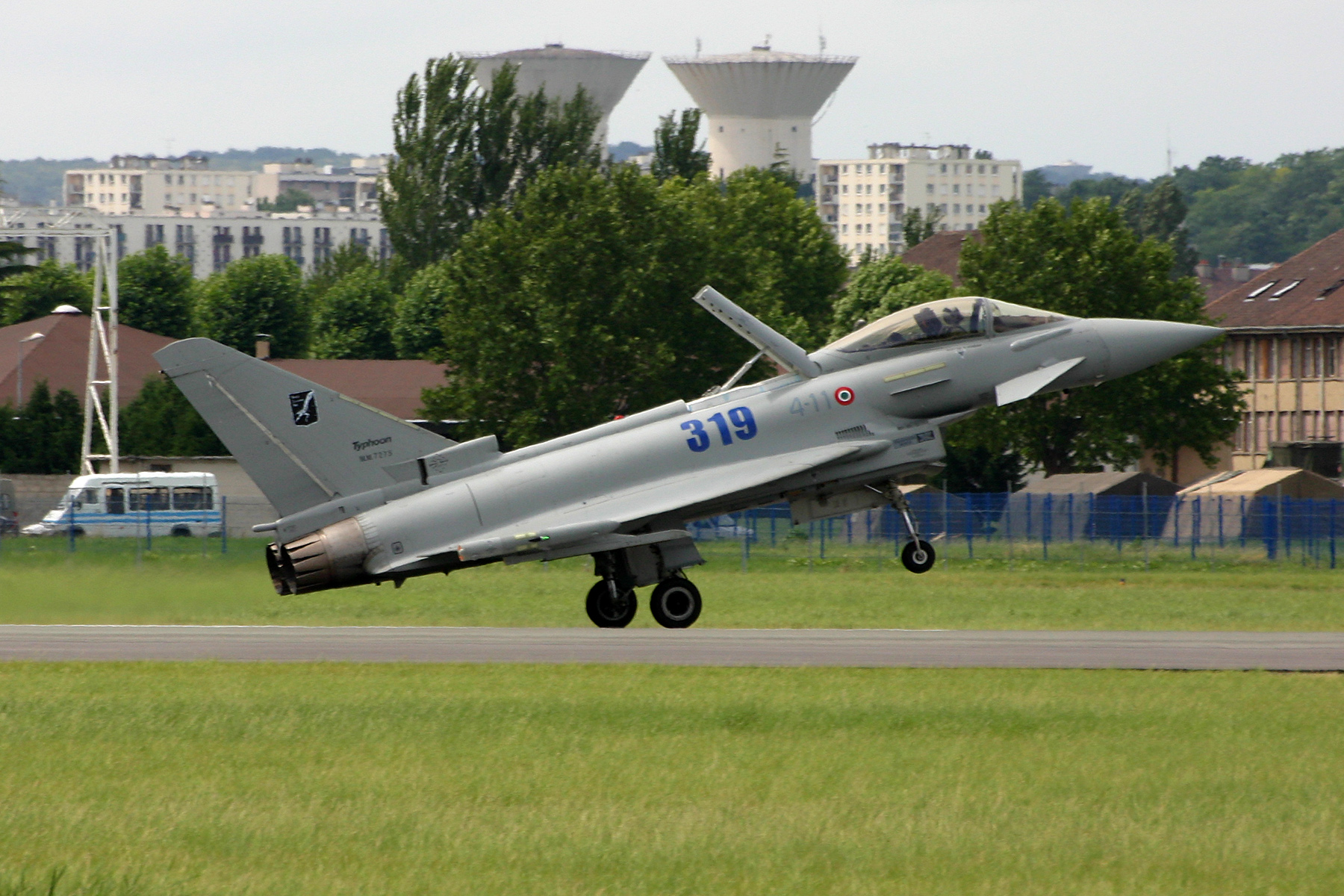
Syria and Iraq followed: on 3 December 2015 six Typhoon FGR4s deployed to RAF Akrotiri for operations against ISIL and struck targets in Syria the following evening. On 14 December 2021 the RAF achieved its first air-to-air kill with the type, shooting down a small hostile drone with an ASRAAM near the Al-Tanf coalition base. On 7 September 2022, during the joint UK/US SinkEx exercise Atlantic Thunder, a 41 Squadron Typhoon hit the hulk of the ex-USS Boone with Paveway IVs, the first RAF Typhoon strike on a naval target with live ordnance. On 12 January 2024 four Typhoons dropped Paveway IV bombs on Houthi facilities in Yemen used to attack shipping in the Red Sea, and on 13 April that year they shot down uncrewed aerial vehicles during the Iranian strikes on Israel. Saudi Typhoons, for their part, have played a central role in the Saudi-led bombing campaign in Yemen and first struck ISIS targets in Syria with Paveway IV bombs in February 2015.
Successor
For the United Kingdom and Italy, together with Japan, the intended successor is the sixth-generation fighter of the Global Combat Air Programme, set within Britain's wider Future Combat Air System. Germany had planned to replace the Eurofighter with the New Generation Fighter co-developed with Spain and France, but in June 2026 the NGF project was cancelled by Germany and France.
Variants
| DA1 | DA2 | DA3 | DA6 | DA7 | DA5 | DA4 | IPA2 | IPA3 | IPA1 | CE.16 Typhoon | IPA4 | ISPA1 | IPA5 | ISPA2 | IPA6 | IPA7 | Tranche 4 | C.16 Typhoon | IPA8 | IPA9 | ISPA3 | ISPA4 | ISPA5 | Tranche 1 | Tranche 2 | Tranche 3 / 3A | Typhoon FGR4 | Typhoon T1 | |
|---|---|---|---|---|---|---|---|---|---|---|---|---|---|---|---|---|---|---|---|---|---|---|---|---|---|---|---|---|---|
| First flight | March 27, 1994 | April 6, 1994 | June 4, 1995 | August 31, 1996 | January 27, 1997 | February 24, 1997 | March 14, 1997 | April 5, 2002 | April 8, 2002 | April 15, 2002 | February 17, 2003 | February 27, 2004 | May 11, 2004 | June 7, 2004 | July 9, 2004 | November 1, 2007 | January 16, 2008 | July 14, 2026 | — | — | — | — | — | — | — | — | — | — | — |
| Aircraft type | Development Aircraft prototype | Development Aircraft prototype | Development Aircraft prototype | Two-seat Development Aircraft prototype | Development Aircraft prototype | Development Aircraft prototype | Two-seat Development Aircraft prototype | Instrumented Production Aircraft | Instrumented Production Aircraft | Instrumented Production Aircraft | National designation (Spain) | Instrumented Production Aircraft | Instrumented Series Production Aircraft | Instrumented Production Aircraft | Instrumented Series Production Aircraft | Instrumented Production Aircraft | Instrumented Production Aircraft | Production batch | National designation (Spain) | Instrumented Production Aircraft | Instrumented Production Aircraft | Instrumented Series Production Aircraft | Instrumented Series Production Aircraft | Instrumented Series Production Aircraft | Production batch | Production batch | Production batch | National designation (United Kingdom) | National designation (United Kingdom) |
| Powerplant | — | — | 2 × EJ200 | — | 2 × EJ200 | — | — | — | — | — | — | — | — | — | — | — | — | — | — | — | — | — | — | — | — | Eurojet EJ200 Mk 101 | — | — | — |
| Crew | 1 Best value in this row | 1 Best value in this row | 1 Best value in this row | 2 | 1 Best value in this row | 1 Best value in this row | 2 | 2 | 2 | 2 | 2 | 1 Best value in this row | 2 | 1 Best value in this row | 1 Best value in this row | — | — | — | 1 Best value in this row | 2 | 1 Best value in this row | — | — | — | — | — | — | 1 Best value in this row | 2 |
| Units built | 1 | 1 | 1 | 1 | 1 | 1 | 1 | 1 | 1 | 1 | — | 1 | 1 | 1 | 1 | 1 | 1 | — | — | 1 | 1 | 1 | 1 | 1 | 148 Best value in this row | — | 112 | — | — |
Images
Elsewhere
- JetPhotos31-48 Eurofighter Typhoon EF2000, Germany - Air Force ↗
- JetPhotosZK349 Eurofighter Typhoon FGR.4, United Kingdom - Royal Air Force ↗
- JetPhotosZK334 Eurofighter Typhoon FGR.4, United Kingdom - Royal Air Force ↗
- Airliners.netEurofighter EF-2000 Typhoon S - Germany - Air Force ↗
- Airliners.netEurofighter EF-2000 Typhoon FGR4 - UK - Air Force ↗
- Airliners.netEurofighter EF-2000 Typhoon S - Italy - Air Force ↗
- Planespotters.netMM7292 Aeronautica Militare (Italian Air Force) Eurofighter EF-2000 Typhoon ↗
- Planespotters.net98+07 Luftwaffe (German Air Force) Eurofighter EF-2000 Typhoon ↗
- Planespotters.net30+68 Luftwaffe (German Air Force) Eurofighter EF-2000 Typhoon ↗
- ABPicEurofighter Typhoon T1, ZJ810 / BT011, Royal Air Force ↗
- ABPicEurofighter EFA Typhoon, ZH588 / DA2, RAF Museum ↗
- ABPicEurofighter Typhoon T3, ZK379 / BT024, Royal Air Force ↗
Show the 7 more
- FlickrZJ920 Eurofighter Typhoon FGR.4 of the Royal Air Force ↗
- FlickrRoyal Air Force Eurofighter Typhoon FGR4 ↗
- FlickrEurofighter Typhoon FGR4 - ZJ914/Blackjack - RAF Typhoon Display ↗
- FlightGlobal ImagesEurofighter Typhoon in flight ↗
- MilitaryImages.netEurofighter Typhoons ↗
- MilitaryImages.netEurofighter Typhoon Cutaway ↗
- FlickrBritish Aerospace Eurofighter 2000 Typhoon Cutaway Drawing ↗