Eurofighter Typhoon variant
Eurofighter Typhoon Tranche 1
First production batch of the Eurofighter Typhoon: 148 aircraft contracted in September 1998 for the United Kingdom, Germany, Italy, Spain and Austria, delivered between 2003 and 2008 in Blocks 1, 2, 2B and 5 and later brought to a common Block 5 standard through the R2 retrofit.
-1600.webp)
- February 13, 2003
- First flight
- 148
- Units built
History
Contracts and allocation
Tranche 1 is the first series-production batch of the Eurofighter Typhoon. Contracts were signed in September 1998 for 148 aircraft, together with long-lead items for Tranche 2. The final split was 53 aircraft for the United Kingdom, 33 for Germany, 28 for Italy, 19 for Spain and 15 for Austria, the programme's first export customer. The Austrian share was made up of nine Block 2 aircraft transferred from the Luftwaffe plus six production slots given up by the partner nations. Some sources quote the original allocation before that transfer (55, 44, 29 and 20 aircraft respectively), which accounts for the differing figures found in the literature.
Within the tranche, production was organised into two funding batches and several capability blocks that did not line up exactly: Batch 1 covered Block 1, while Batch 2 covered Blocks 2, 2B and 5. That overlap is why, for instance, the aircraft the RAF designates FGR4 is a Tranche 1 Block 5 machine.
Start of production
Final assembly of the first production aircraft, IPA1, began at Warton on 4 November 2000, and assembly of the first German Typhoon, PT003, started at Manching in December 2000. The first series aircraft for each nation flew within days of one another in February 2003: German GT001 took off from Manching on 13 February; the following day, little more than an hour apart, Italian IT001 and British BT001 (serial ZJ800, a 21-minute sortie from Warton) made their maiden flights; Spanish ST001 flew from Getafe on 17 February. Type acceptance was signed on 30 June 2003, formalising delivery to the partner nations, and the first handovers to the air forces followed that summer: the Luftwaffe accepted its first series aircraft, 30+03, on 4 August 2003. The Typhoon formally entered service in spring 2004, and Italy became the first nation to operate it in the air-defence role, in 2005.

The first production single-seater, PS001 (IPA4), flew from Getafe on 27 February 2004; weighing before the flight established a basic mass empty of 11 tonnes, within the contracted requirement. The same year saw the first flights of BT005 (11 May, the first Instrumented Series Production Aircraft, ISPA1) and PS002 (IPA5, 7 June).
Capability blocks
Block 1 delivered initial operational capability for air defence, with the mechanically scanned CAPTOR-M radar and AIM-120B and AIM-9L missiles. Block 2 introduced the DASS defensive-aids subsystem limited to chaff and flares, PIRATE in FLIR mode and initial direct voice input; Block 2B brought full DASS integration. With the delivery of IS002 to 4º Stormo at Grosseto in April 2005, all four air forces were operating Batch 2 single-seaters with the PSP2 package: initial DASS, MIDS data link, initial DVI and sensor fusion. Block 5 was the last build standard of Tranche 1 and defined full operational capability (FOC), combining the complete air-to-air suite with an initial laser-guided-bomb air-to-surface capability; it received type acceptance from the NETMA agency and was the standard planned for the Austrian aircraft. From Block 5 onwards the aircraft carry the PIRATE infrared sensor; the first Typhoon fitted with PIRATE was delivered to the Aeronautica Militare in August 2007.
The R2 retrofit
The Retrofit 2 (R2) programme brought every Block 1, 2 and 2B aircraft up to Block 5 standard. Block 2B airframes went first because they needed the least work (BS021 and GS019 were the first), followed by Block 2 aircraft and finally the Block 1 machines, all of them two-seaters. The combination of new Block 5 deliveries and retrofitted aircraft allowed the partner air forces to meet their NATO commitments from the end of 2007, and the programme was planned to complete in early 2012, by which point the Tranche 1 fleet had been brought to a common standard.
Completion of the tranche and weapons
Tranche 1 closed with the delivery of GT015, a German two-seater, on 20 March 2008. By then 144 series aircraft had been delivered, including five to Austria, the fleet had passed 34,000 flying hours and ten units at six air bases were operating the type. An AMRAAM firing from IPA2 at Decimomannu on 27 February 2008 concluded weapon testing under the Main Development Contract, clearing for Tranche 1 the AIM-9L, ASRAAM, AMRAAM and IRIS-T missiles and the Paveway II, Enhanced Paveway II, GBU-10 and GBU-16 bombs. In 2006 the United Kingdom had launched Change Proposal 193 (CP193), worth £73 million, to give its Block 5 aircraft an "austere" air-to-surface capability with GBU-16 and the Litening III designator pod; ISPA1 completed the pod integration work on 3 March 2008.
Service and retirement
The type's combat debut came over Libya in 2011, where British and Italian Typhoons flew reconnaissance and strike missions; the Tranche 1 aircraft used the GBU-12 Paveway II. Austria, which had selected the Typhoon on 2 July 2002 and agreed to buy 18 on 1 July 2003, cut the order to 15 on 26 June 2007; its Court of Audit calculated in 2008 that it was paying €114 million per unit for partially used Tranche 1 jets against the €109 million originally stipulated for Tranche 2 aircraft. The Austrian Typhoons took over QRA duties in July 2008, and by October 2013 the whole fleet was at the latest Tranche 1 standard; in summer 2020 Indonesia expressed interest in acquiring those 15 aircraft.
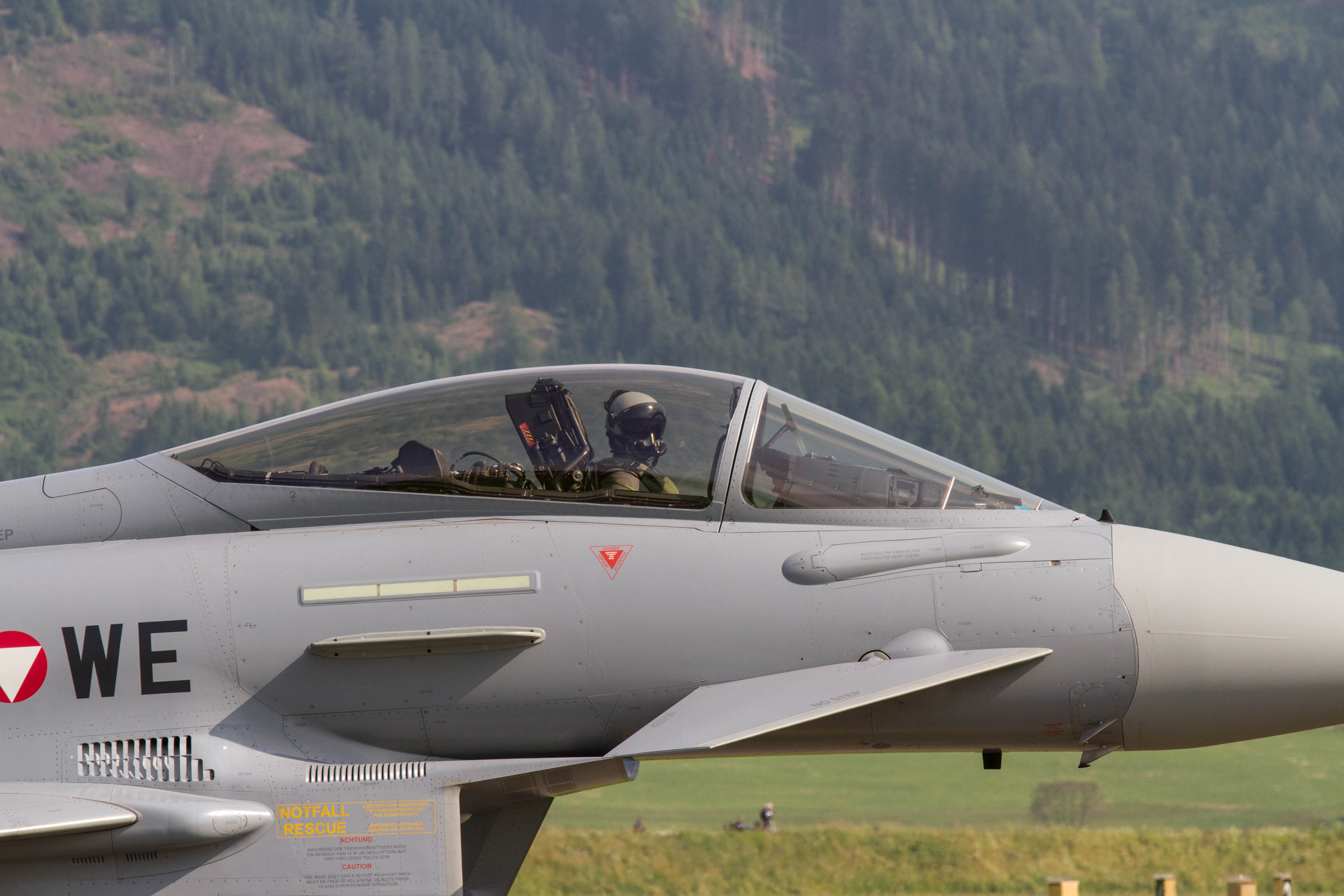
Because Tranche 1 differs structurally and technically from later batches, the United Kingdom planned to phase its aircraft out from 2015-2016, although the 2015 SDSR chose to keep some of them to grow the front-line force from five to seven squadrons. The Defence Command Paper of 22 March 2021 set the retirement of all British Tranche 1 Typhoons for 2025; of the 30 aircraft, 26 had been retired by late 2025 and the last four are due to follow by 2027, to be shredded and recycled rather than re-exported. Germany ordered 38 Tranche 4 Typhoons on 11 November 2020 under the Quadriga agreement to replace its Tranche 1 fleet, with deliveries from 2025, and Italy plans to retire its aircraft of this batch by around 2029.
Multimedia


-1600.webp)
