Eurofighter Typhoon variant
Eurofighter Typhoon IPA5
British single-seat Instrumented Production Aircraft (ZJ700), built by BAE Systems at Warton and first flown on 7 June 2004. It handled air-to-air and air-to-surface weapons integration and, from 2014, became the flying testbed for the Captor-E electronically scanned radar.

- June 7, 2004
- First flight
- 1
- Units built
History
IPA5 (Instrumented Production Aircraft 5) was the fifth instrumented production aircraft of the Eurofighter Typhoon programme and the second contributed by the United Kingdom, after the two-seat IPA1. Unlike the Development Aircraft (DA) of the first phase, the IPAs were Tranche 1 production airframes fitted with test instrumentation, and each partner nation took on a share of the work: IPA5 was allocated air-to-air and air-to-surface weapons integration. Built by BAE Systems at Warton, Lancashire, it received the British military serial ZJ700 and made its first flight from the same factory on 7 June 2004 with test pilot Mark Bowman at the controls. As a single-seater it was, in Royal Air Force nomenclature, the first Typhoon F2, the British designation for the one-seat fighter; the aircraft never entered operational service, however, and remained with BAE Systems as a test aircraft. From its first flight it was also used for avionics testing.
The bulk of its early work was the weapons qualification campaign through which the consortium had to obtain the clearances for the Full Operational Capability (FOC) specified in the Main Development Contract. The AMRAAM and ASRAAM air-to-air missiles, 1,000 lb (about 454 kg) bombs, BL755 cluster munitions and the ALARM anti-radar missile were integrated and tested on IPA5. Within that campaign, while the Spanish IPA4 dealt with electromagnetic compatibility, flutter and separation trials of the GBU-16 laser-guided bomb, IPA5 was set aside for carefree-handling, low-altitude and transonic testing with external stores. The final FOC clearances were obtained in 2007 and became available for Block 5 aircraft.
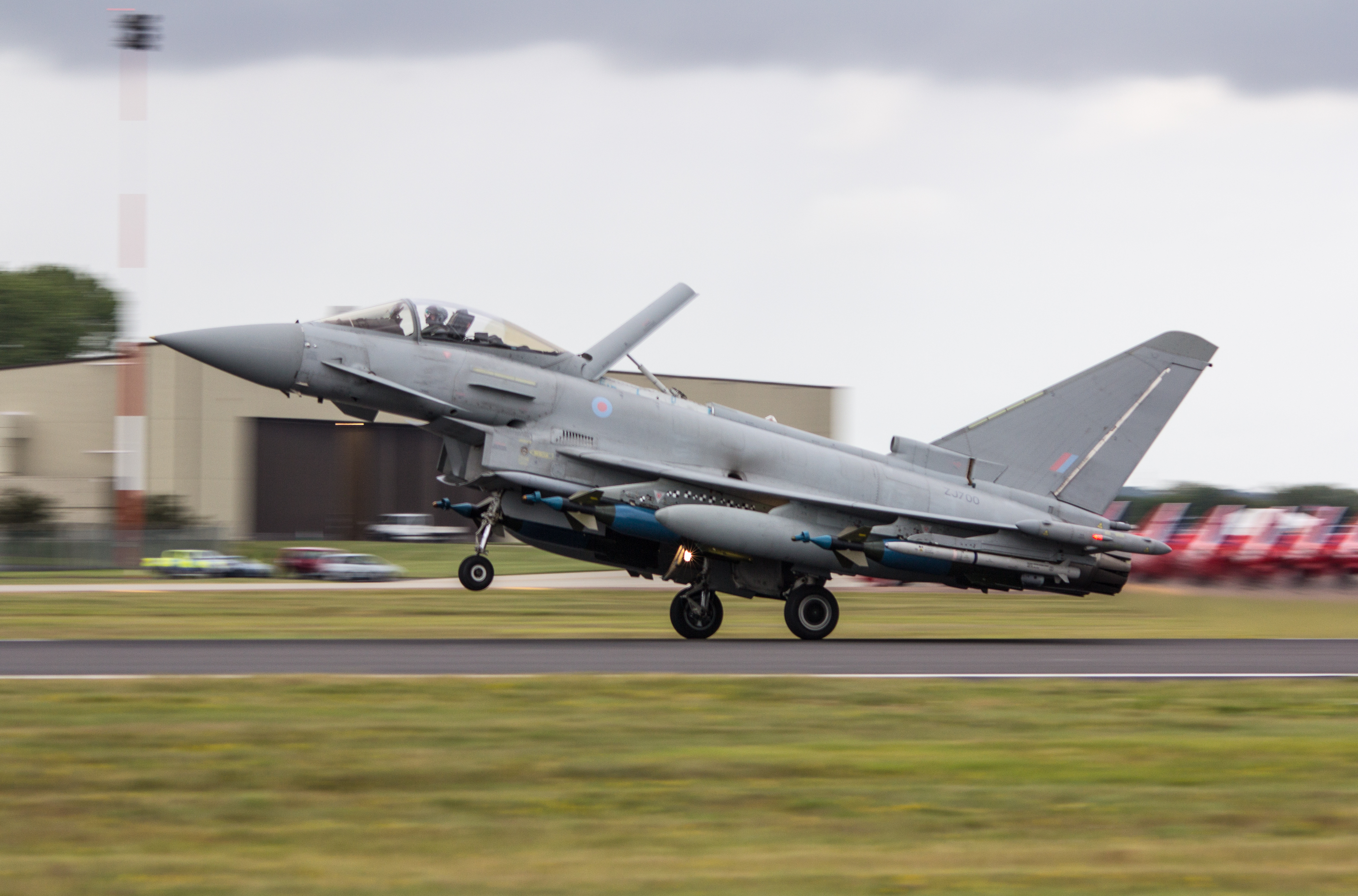
The aircraft was also modified with extended wing leading edges elongated up to the intake, a measure intended to improve the Typhoon's performance at high angles of attack and trialled first on this airframe.
One of its most widely cited episodes was the cooperative firing trial of March 2009. On 12 March IPA5 flew directly from Warton to Morón air base in southern Spain, a two-hour-four-minute flight covering over 1,000 miles (about 1,600 km) with two external fuel tanks and without air-to-air refuelling. On 31 March, over southern Spain, IPA4 fired an AMRAAM at a Mirach target with its own radar in passive mode, that is, invisible to an adversary's electronic support measures: the target data were acquired by IPA5's radar and passed to the shooter over the MIDS (Multifunctional Information Distribution System) datalink, an early demonstration of networked combat with the Typhoon.
After that phase IPA5 moved on to avionics trials and, in the following decade, became the flying testbed for the Captor-E active electronically scanned array radar. In March 2014 BAE Systems used it to perform the first test flight of a Typhoon fitted with a mass model replicating the future E-scan radar, and at the Farnborough air show that same year BAE Systems, Eurofighter and the Euroradar consortium publicly unveiled a production-representative Captor-E fitted to the nose of ZJ700. Choosing a Tranche 1 airframe made programme sense: it also served to demonstrate that the new radar could be installed in the oldest aircraft of the fleet. A further two years passed before the radar actually entered flight trials: on 8 July 2016 IPA5 undertook a flight of around one hour from Warton with the Captor-E on board. The decisive push came from the need to have the radar and weapon system ready for the first deliveries to the Kuwait Air Force, due in late 2020, following that country's order for 28 aircraft placed in April 2016.
In the accounts of the British fleet IPA5 is counted, together with IPA1 and IPA6, among the 53 Tranche 1 Typhoons received by the United Kingdom, although the three development aircraft stayed outside the operational squadrons.
The sources disagree on its first flight: one list of variants gives 6 June 2002, a date incompatible with the IPA schedule (the first three flew in April 2002 and IPA4 in February 2004) and contradicted by the other sources, which agree on 7 June 2004.
Multimedia
