Eurofighter Typhoon variant
Eurofighter Typhoon FGR4
RAF service designation for the single-seat multirole Eurofighter Typhoon, born of the Tranche 1 Block 5 air-to-surface upgrade and consolidated by Project Centurion.

History
The Typhoon FGR4 is the Royal Air Force service designation for its single-seat Eurofighter Typhoon in multirole configuration. It is not a separate production model but the product of a British capability decision. The RAF took its first Typhoons into service as the F2, a pure air-defence fighter inheriting the role until then held by the Tornado F3. That first generation soon showed its limits: Tranche 1 aircraft could drop laser-guided bombs only when a third party designated the target, and the prospect of deploying the type to Afghanistan meant the United Kingdom needed a self-contained bombing capability sooner than its partner nations did. In 2006 the British Ministry of Defence launched Change Proposal 193, a £73m programme to give Tranche 1 Block 5 aircraft an "austere" air-to-surface capability built around the GBU-16 Paveway II bomb and the Rafael/Ultra Electronics Litening III laser designator. Aircraft with that upgrade were designated Typhoon FGR4 by the RAF — fighter, ground attack, reconnaissance — and the label eventually spread across the whole British single-seat multirole fleet, including the later Tranche 2 and Tranche 3 jets that received equivalent capability on the main development pathway through the Phase 1 Enhancement packages.
The FGR4's operational record opens over the Mediterranean. On 20 March 2011 ten Typhoons from RAF Coningsby and RAF Leuchars arrived at Gioia del Colle air base in southern Italy to enforce the no-fly zone over Libya alongside Tornado GR4s; the move had been announced on 19 March and the squadron left its home base within twenty-four hours, flying its first operational mission within eighteen hours of arrival. On 21 March RAF Typhoons flew their first-ever combat mission. In that opening phase they worked in a defensive counter-air role, each armed with six Raytheon AIM-120 AMRAAM and two MBDA ASRAAM missiles alongside the 27 mm Mauser cannon. The deployment surprised many observers, because the three-squadron front-line Typhoon force was only just able to meet its standing commitments of two quick reaction alerts, one in the United Kingdom and one covering the Falkland Islands. Over Libya the Tranche 1 jets used the GBU-12 Paveway II; by July 2014 a dozen RAF Tranche 2 Typhoons had been upgraded to Phase 1 Enhancement standard, enabling the Paveway IV, which can be set to detonate above or beneath a target and to strike at a chosen angle.
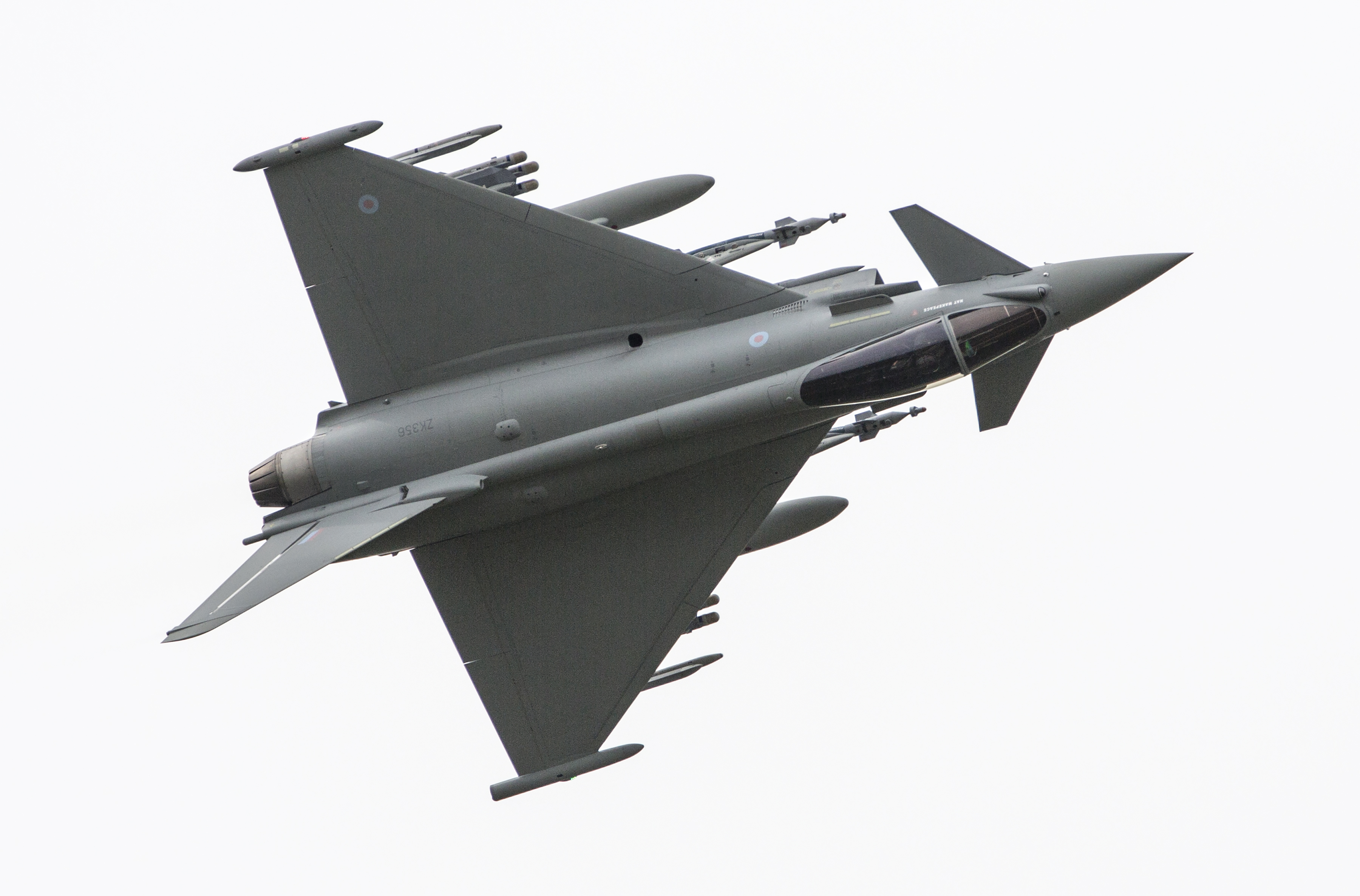
The decisive step was Project Centurion. With the RAF's Tornado GR4 retirement confirmed for March 2019, in 2014 the United Kingdom began a £425 million upgrade programme to ensure the Typhoon could assume the ageing Tornado's precision strike duties. It was delivered in phases: Phase 0 covered initial multirole upgrades; Phase 1/P2EA brought MBDA Meteor integration and an initial Storm Shadow capability; Phase 2/P3EA added full Storm Shadow capability together with Brimstone integration. Phase 1 standard aircraft were used operationally for the first time as part of Operation Shader over Iraq and Syria in 2018, and on 18 December 2018 the RAF approved release to service for the full Centurion package. Much of the trials work fell to IPA6 (ZJ938), a UK-built single-seater initially configured to Tranche 1 Block 5 standard and later upgraded to Block 8, which first flew on 1 November 2007 and had amassed over 1,000 flight hours by June 2022 after pioneering the Brimstone 2, Meteor and Storm Shadow firings under Centurion. With the package delivered, BAE Systems and 41 Squadron moved on to the next Centurion iteration, test flying the Litening 5 targeting pod, a new version of the PIRATE FLIR/IRST sensor, the BAE Striker II helmet-mounted display and Leonardo's BriteCloud expendable active decoy, 33 rounds of which were dispensed against simulated threats in April 2019.
The RAF's own aircraft page describes the FGR4 as an extremely agile fourth-generation multirole fighter, deployable across air policing, peacekeeping and high-intensity conflict. Its air-to-air armament combines the infrared-guided ASRAAM, the 27 mm Mauser gun and the radar-guided AMRAAM and Meteor for longer ranges; for air-to-surface work it carries GPS and laser-guided Paveway IV bombs, Brimstone 2 missiles and the long-range Storm Shadow cruise missile. In armed reconnaissance and close air support the typical fit is a Litening V targeting pod, four Paveway IV bombs, six Brimstone 2 missiles and the cannon. Sensors comprise the Captor ECR 90 radar, the PIRATE infrared search and track system and the Litening V pod, while the defensive suite includes electronic counter and surveillance measures, a missile approach warner, expendables and a towed radar decoy. The pilot flies the aircraft through a hands-on-throttle-and-stick system and the Helmet Equipment Assembly. Air Forces Monthly credits the multirole FGR4 with a maximum supercruise speed of Mach 1.1, although in a Singaporean evaluation a Typhoon supercruised at Mach 1.21 on a hot day with a combat load.
The squadron structure flying the type built up from the mid-2000s. No. 29 (R) Squadron formed as the Typhoon Operational Conversion Unit, and No. 3 (Fighter) Squadron became the first operational Typhoon squadron on 31 March 2006 at RAF Coningsby; its Typhoon F2s took over quick reaction alert duties from the Tornado F3 on 29 June 2007. No. XI (F) Squadron stood up on 29 March 2007 and received its first multirole aircraft that August; No. 6 Squadron formed at RAF Leuchars on 6 September 2010, and No. 41 (R) Test and Evaluation Squadron began operating the Typhoon from Coningsby on 22 April 2013. No. II (AC) Squadron became the fifth Typhoon squadron on 12 January 2015 at RAF Lossiemouth, and No. IX (B) Squadron converted from the Tornado GR4 to the Typhoon FGR4 on 1 April 2019 as an aggressor and air defence unit. No. 12 (B) Squadron, announced in December 2017 as a joint RAF/Qatari unit, was assigned its first Typhoon FGR4 in July 2019 and began operating as a joint RAF-QEAF unit at Coningsby in July 2020. The 2015 Strategic Defence and Security Review decided to retain some Tranche 1 aircraft in order to grow the front-line force from five to seven squadrons and to push the out-of-service date from 2030 to 2040.
The operational tempo has not eased. On 3 December 2015 six Typhoon FGR4s deployed to RAF Akrotiri to support operations against ISIL, striking targets in Syria the following evening alongside Tornados. In October 2016 four FGR4s of No. II (AC) Squadron, supported by a Voyager KC3 tanker and a C-17 Globemaster III, deployed to Misawa Air Base in Japan for the JASDF's first bilateral exercises with non-US forces. In 2019 No. XI (F) Squadron sent four aircraft to Ämari in Estonia for a four-month NATO Baltic air policing mission under Operation Azotize, and between November and December No. 1 (F) Squadron flew from Keflavik in Iceland, conducting more than 180 practice intercepts and 59 training sorties in a single month. On 14 December 2021 a Typhoon achieved the RAF's first operational air-to-air engagement with the type, downing a small hostile drone with an ASRAAM near the Al-Tanf coalition base in Syria. On 7 September 2022, during the joint UK/US SinkEx 'Atlantic Thunder', a 41 Squadron Typhoon struck the ex-USS Boone with Paveway IVs, the first RAF Typhoon to hit a naval target with live ordnance. In September 2023 the same squadron landed and took off from a highway at Tervo during the Finnish-led Exercise 'Baana 23', a first for any Eurofighter operator. On 12 January 2024 four Typhoons dropped Paveway IV bombs on two Houthi military facilities used to launch drone and missile strikes on Red Sea shipping, and on 13 April that year Typhoons based in Cyprus and Romania shot down uncrewed aerial vehicles during the Iranian strikes on Israel while operating under Operation Shader. On 1 March 2026 a 12 Squadron Typhoon flying from Qatar downed an Iranian UAV approaching Qatari airspace, and in May 2026 the fleet was fielded in the Middle East with the US-developed Advanced Precision Kill Weapon System to destroy drones more cheaply.

The 160th and last Typhoon ordered by the RAF, ZK437, was delivered on 27 September 2019. The Defence Command Paper published on 22 March 2021 announced the retirement of all Tranche 1 Typhoons by 2025 and the upgrading of the remaining fleet; that same year the United Kingdom launched the P3Ec package, due for delivery in 2024, which among other improvements replaces the multifunction displays with a Large Area Display. As of April 2025 the RAF's total Typhoon inventory stood at 137 aircraft, predominantly Tranche 2 and Tranche 3, and by September 2025 26 of the original 30 Tranche 1 airframes had been scrapped, leaving roughly 107 operational platforms expected to serve until at least 2040. The FGR4 flies today from RAF Coningsby and RAF Lossiemouth and sustains quick reaction alert duties in the United Kingdom and the Falkland Islands, alongside the Ellamy, Shader, Azotize and Biloxi operations that punctuate its record.
Multimedia


