Eurofighter Typhoon variant
Eurofighter Typhoon T1
Two-seat conversion and training version of the Eurofighter Typhoon, corresponding to the first batch of Tranche 1. Sharing the airframe and powerplant of the single-seater, it converted crews from the Tornado and Jaguar and became the baseline from which the RAF Typhoon T3 was built or upgraded.

- April 15, 2002
- First flight
History
The Typhoon T1 is the two-seat version of the Eurofighter Typhoon's first production batch: in programme terminology, a Tranche 1, batch 1 two-seat trainer conceived for crew conversion and advanced training rather than as a downgraded combat aircraft. From the outset the consortium built the two-seater around the same airframe, engines and core avionics as the single-seater, giving up part of the internal fuel to accommodate the second cockpit in tandem, so that crews trained on an aircraft that flew like the one they would later take up alone.
The line begins with the development aircraft. The twin-seat DA4, the second BAE Systems development airframe, first flew in March 1997 and was used extensively to mature the avionics suite before being decommissioned on 13 December 2006, after which it served to train Royal Air Force ground specialists. In Spain, DA6 (coded XCE.16-01), rolled out of the CASA plant in Seville, was likewise a two-seater and made its first flight on 24 February 1997, though it was eventually lost when both engines failed while operating out of Getafe. The first Typhoon T1 as such was one of the Instrumented Production Aircraft, IPA1, which made its maiden flight on 15 April 2002 and remained part of the BAE Systems test fleet.

Two-seaters also opened series production in three of the four partner nations. On 13 February 2003 GT001, the first German series aircraft and a Production Standard Twin Seat, flew from Manching as the first of the 180 aircraft planned for the German air force. Just over an hour separated the maiden flights, on 14 February 2003, of Italy's IT001 from Caselle and Britain's BT001 (serial ZJ800) from Warton, the first of the 232 aircraft then planned for the RAF; both were likewise production-standard two-seaters. Spain followed on 17 February 2003 with ST001, designated CE.16-01, flying from Getafe air base. In national nomenclature the Italian two-seater was designated TF-2000A against the single-seat F-2000A, and the Spanish one CE.16 against the C.16.
The internal split of the orders shows how much the training version mattered. On 21 September 1998 Germany signed the contract for the first production tranche covering 44 Eurofighters, of which 28 were single-seaters and 16 two-seat trainers; in the second batch of 68 aircraft the number of two-seaters fell to 10, and in the third to 7, a clear sign that converting the fleets demanded far more dual-control aircraft than sustaining them afterwards. Tranche 1 totalled 148 aircraft, with 55 for the United Kingdom, 44 for Germany, 29 for Italy and 20 for Spain.
In British service the T1 was the tool with which the RAF built its transition from the Tornado F3 and the Jaguar. The official in-service date for the first RAF Typhoon T1, serial ZJ803, was 30 June 2003, with formal delivery on 18 December, at which point No. 17 Squadron began a full flying programme; ZJ800 of No. XVII (R) Squadron, photographed at RAF Waddington in June 2004, was the first full production RAF aircraft to fly. In 2005 No. 17 Squadron, the operational evaluation unit, and No. 29 Squadron, the operational conversion unit, moved to RAF Coningsby to establish initial operating capability. Two-seaters also took part in trials far from home: British-built ZJ804 (ISPA1) left Warton on 3 February 2005 for Lajes and on to China Lake as part of Exercise High Rider, crewed by a BAE Systems test pilot and a Typhoon OEU pilot.
The second Tranche 1 batch earned a designation of its own, Typhoon T1A. A change of batch would not normally warrant a different name, but these aircraft carried a fuel system modification that fixed a fuel gauge problem identified on the development fleet. With the arrival of the Block 5 standard, two-seaters built or upgraded from the T1 became known as Typhoon T3s, just as the single-seat F2 became the FGR4; British nomenclature thus paired T.1 and F.2 for Blocks 1 and 2 with T.3 and FGR.4 from Block 5 onwards. The RAF received its hundredth aircraft on 28 January 2013.
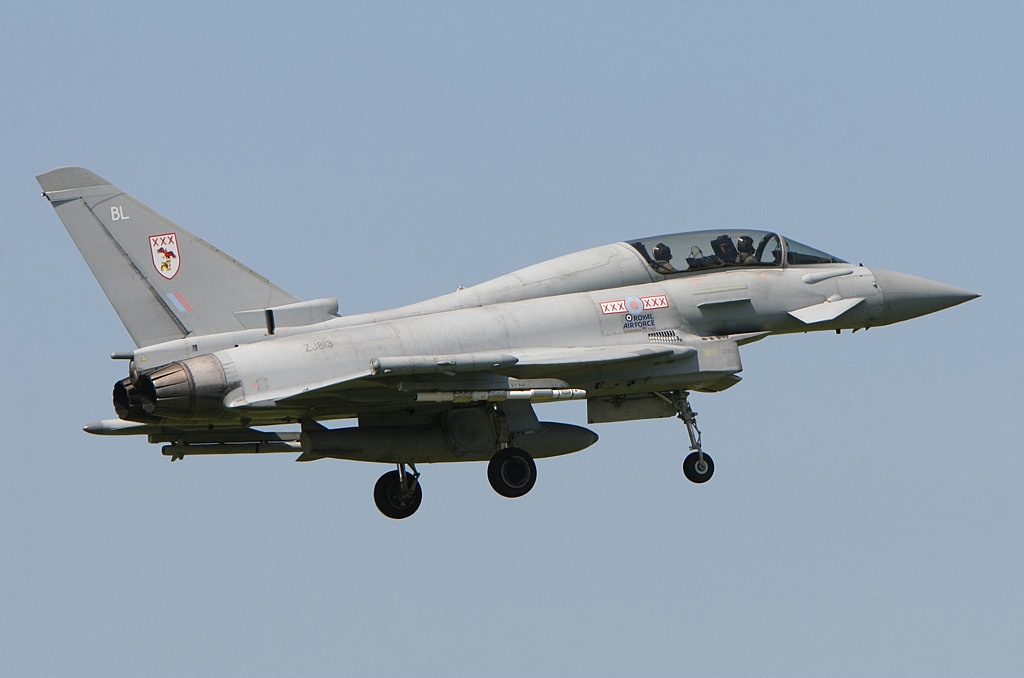
The cost of keeping the earliest jets current ultimately decided their fate. Tranche 1 aircraft, two-seaters included, remained constrained against later standards and their upgrade proved expensive and incompatible with more modern avionics baselines. In March 2021 the United Kingdom announced plans to retire its Tranche 1 fleet by 2025; according to answers in Parliament, 26 of the 30 aircraft of that batch had been retired and scrapped by September 2025, with the remaining four expected to follow by 2027, leaving around 107 Tranche 2 and 3 platforms expected to serve until at least 2040. Italy plans to retire its roughly 26 first-batch aircraft by 2029. Several withdrawn airframes were used for spares recovery, engines included, feeding other development and RAF aircraft.
Multimedia


