Eurofighter Typhoon variant
Eurofighter Typhoon IPA7
IPA7 (Instrumented Production Aircraft 7) is the German instrumented production aircraft of the Eurofighter Typhoon programme: a single-seater with series serial GS029, assembled by EADS at Manching and the first airframe built to the full Tranche 2 standard. It first flew on 16 January 2008 and has since been used for Block 8 type acceptance, for the integration of the Paveway IV bomb and the Taurus KEPD 350 cruise missile, and for aerodynamic and avionics trials.

- January 16, 2008
- First flight
- 1
- Units built
History
IPA7 is the seventh of the Eurofighter Typhoon programme's Instrumented Production Aircraft (IPA) and the only one built, from the outset, to the complete Tranche 2 standard. Unlike the Development Aircraft (DA), the IPAs are series airframes diverted from the production line and fitted with telemetry instrumentation; legally they belong to NETMA (the NATO EF 2000 and Tornado Development, Production and Logistics Management Agency) and are operated by industry as flight-test platforms. IPA7 is the German airframe GS029 (some sources cite it as GS0029), a single-seater assigned to EADS Military Air Systems at Manching in Bavaria, later operated under the Airbus name after the industrial reorganisation.
Its origins are tied to the Tranche 2 contract, signed on 14 December 2004, which laid down the delivery of 251 aircraft: 93 for the United Kingdom, 75 for Germany, 48 for Italy and 35 for Spain, in addition to the export aircraft for Austria. Production of the first aircraft updated to that standard began in November 2005 and, at the end of October 2006, the first Tranche 2 Typhoons were gearing up for final assembly in Germany and the United Kingdom. IPA7 was to be the first of them all: it was the 29th single-seater assembled in Germany and was scheduled to move to the final assembly rigs at Manching at the end of 2006. The first flight was initially announced for before the end of 2007, but slipped by a few weeks.
The Tranche 2 standard differs from Tranche 1 chiefly in its new mission computers, which provide the higher processing and memory capacity required to integrate future weapons such as the Meteor air-to-air missile and the Storm Shadow and Taurus cruise missiles. The remaining build differences relate to changes in production technology and to component obsolescence. To test that standard the consortium had two aircraft: IPA6, a British Tranche 1 Typhoon converted with the full Tranche 2 mission computer suite and avionics features, and IPA7, which represented the full build standard. While IPA6 validated the avionics on an older airframe, IPA7 was the first "real" Tranche 2 Typhoon.
The maiden flight took place on 16 January 2008 from the EADS airfield at Manching, with test pilot Chris Worning at the controls. With it, the first Tranche 2 Eurofighter was in the air. Its first prominent task was to achieve, in April 2008 and together with the BAE Systems-operated IPA6 based at Warton, Type Acceptance for Block 8, the first capability standard of Tranche 2. The first series Tranche 2 aircraft was delivered to the Royal Air Force on 10 October 2008, with Tranche 1 already closed after the delivery of its final aircraft to the German Air Force in March of that year.
IPA7 then took on a major share of the weapons trials. Around June 2008 tests began with the 500 lb guided bomb (Paveway IV) and, in that same month, the aircraft flew with a load of six Paveway IVs, four medium-range and two short-range air-to-air missiles, a configuration that demonstrated how the Flight Control System behaved with a full weapons load. That year it also completed five Missile Approach Warner (MAW) test flights over the North Sea, supported by a Luftwaffe F-4 Phantom and a Panavia Tornado, a series that continued into 2009.
On 26 May 2009 IPA7 took off from Manching to perform the first flight of a Phase 1 Enhancement (P1E) capability package product on a Tranche 2 aircraft: it confirmed the functionality of the MAW ahead of a dedicated trials campaign planned over the North Sea in early September. The first P1E flights, focused on the aeromechanical aspects of the new stores, had been flown by IPA1, IPA2 and IPA4, all of Tranche 1 build standard; IPA7 was used to complete the P1E air vehicle trials, with Flight Control handling-qualities flights carrying the new class of 500 lb precision-guided bombs.
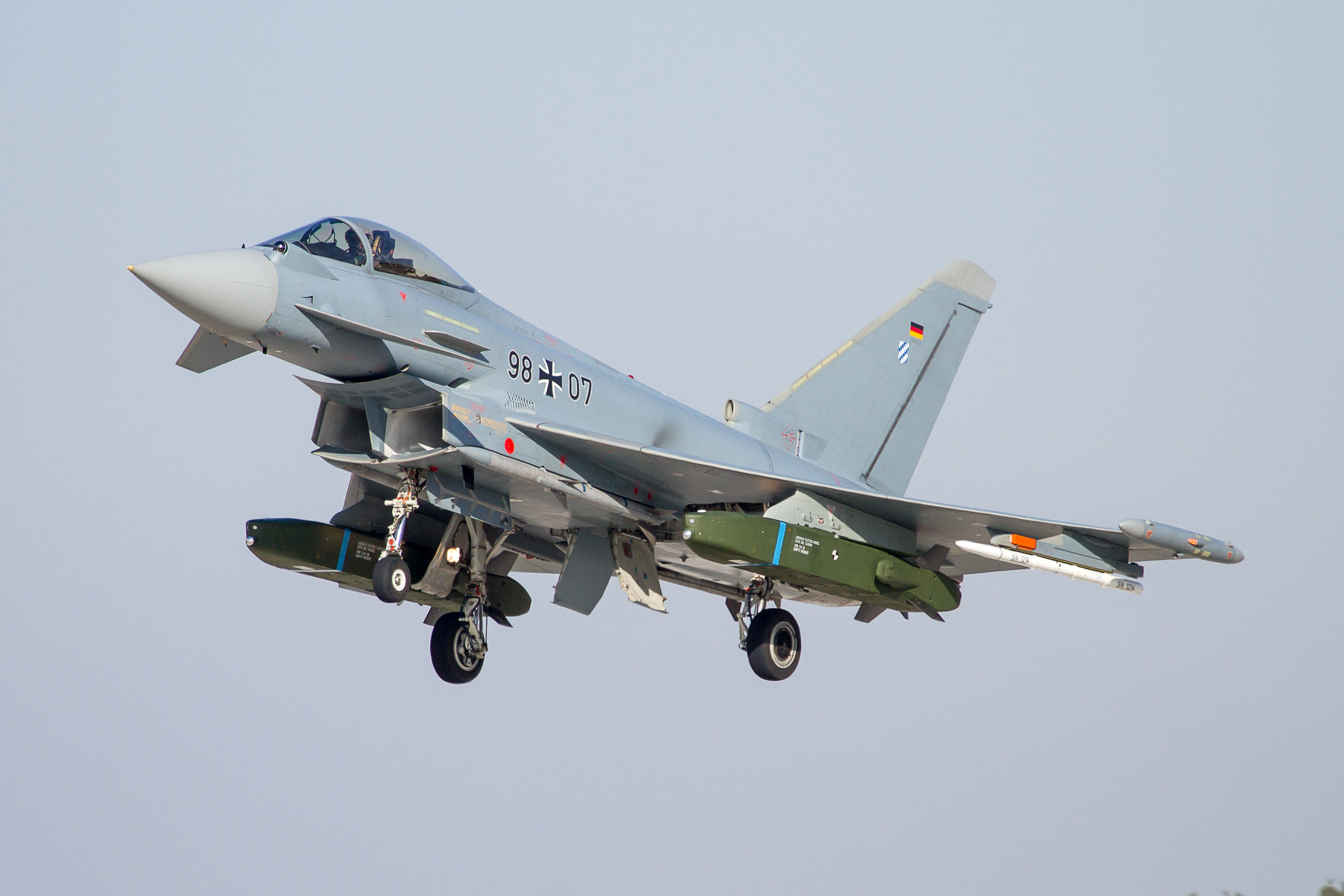
From late 2012 the aircraft was devoted to software testing and, from late 2013, to trials with the Taurus KEPD 350 cruise missile. On 15 January 2014 it made the first test flight with two KEPD 350 under the wings, and a photograph from that year shows it on final approach carrying both missiles. In mid-2014 it was fitted with additional strakes above the canards and larger rudders, intended to give better control of the pitch-up moment that appears when flying with conformal fuel tanks, and also to allow the aircraft to be pulled through the stall and to improve roll rates in that regime. Together with IPA6, IPA7 has also been used for the flight tests of the new avionics required for the system's international certification.
Multimedia
